
M&A or private equity due diligence
Covers: strategy, finance, legal, tax, operations, technology, people and ESG, with the management team as one workstream.
Ends: with the investment decision on the whole deal.
Last reviewed: October 2026
No Credit Card Required
Printed from checkflow.io/templates/due-diligence/management-due-diligence-checklist
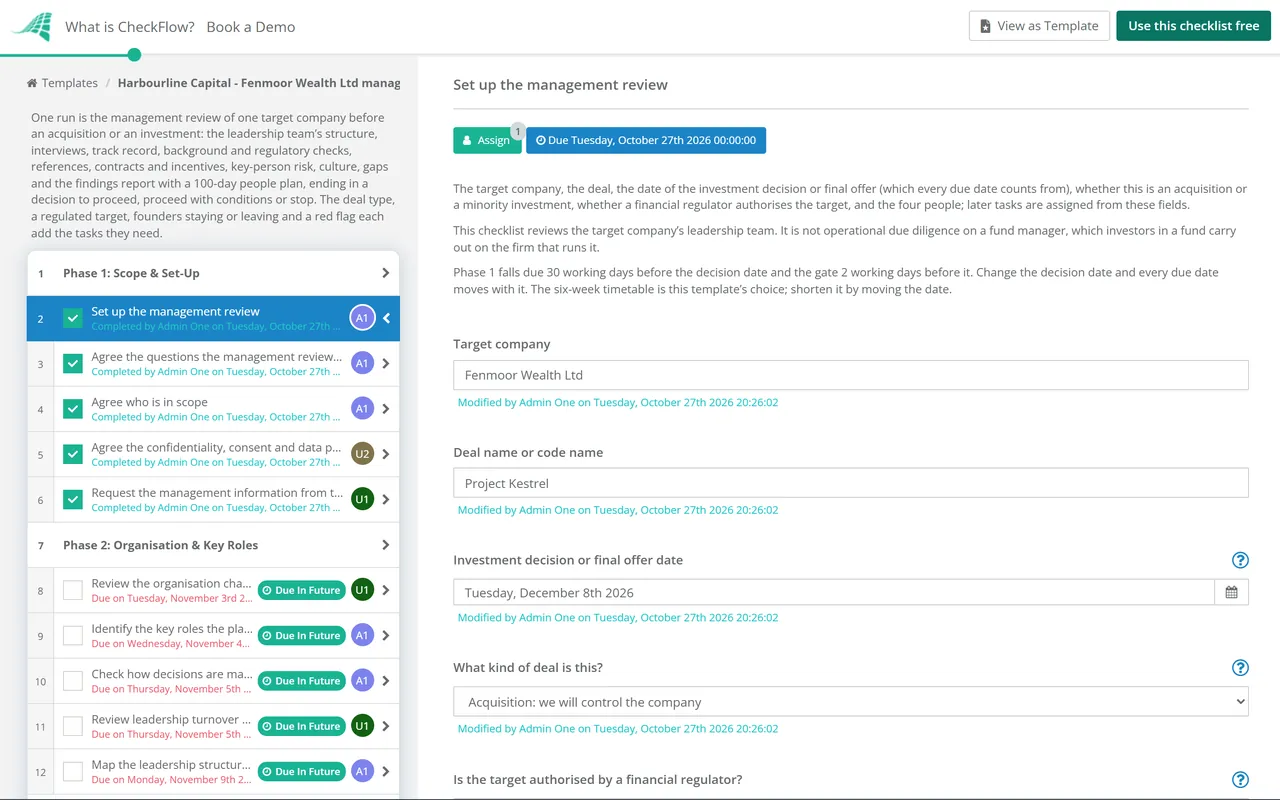
This free management due diligence checklist is for deal teams, private equity and corporate development investors, and the HR and legal advisers who assess a target company’s leadership team before an acquisition or an investment. One run covers one target, with every due date counted back from the date of the investment decision or final offer. It sets the scope and the people in it, reviews the organisation chart and key roles, interviews each leader, tests their track record against past plans and budgets, runs background and regulatory checks within each country’s rules, takes references, and reviews service agreements, restrictive covenants, equity and retention. It then rates key-person risk, looks at culture and how the team works, finds the gaps, and ends with a findings report and a 100-day people plan that the deal lead or investment committee accepts before the final offer. The first task’s answers add tasks for an acquisition or a minority investment and for a target authorised by the FCA or another regulator; founders staying or leaving and a red flag add their own.
The M&A Due Diligence Checklist and the Private Equity Due Diligence Checklist both name the management team as one workstream among many, with a handful of tasks each. This checklist is that workstream run in full: one target company’s leadership team, from scope to a decision that the deal lead or investment committee accepts before the final offer or investment decision. Run it beside the main due diligence and feed its findings into the same decision.
It is about the people who run a company you are buying or investing in. It is not due diligence on a fund manager, which investors in a fund carry out on the firm that runs it, and it is not a hiring check on one candidate. For the founders of an early-stage company, the Venture Capital Due Diligence Checklist has its own team phase.
Covers: strategy, finance, legal, tax, operations, technology, people and ESG, with the management team as one workstream.
Ends: with the investment decision on the whole deal.
Covers: the leadership team’s structure, interviews, track record, background and regulatory checks, references, contracts, incentives, key-person risk, culture and gaps.
Ends: with the findings accepted, conditions for the deal documents and a 100-day people plan.
Covers: the integration office, Day 1 and the first 100 days across every workstream. The Post-Merger Integration Checklist runs it.
Ends: with the 100-day review signed off. The people plan from this checklist is one of its inputs.
Nine phases take one target’s leadership team from scope, six weeks before the decision, to a findings report and a 100-day people plan. The checklist halts at the decision in Phase 9. The answers on the first tasks add tasks for the deal type, a regulated target and the founders, and a red flag adds two more.
Start about six weeks before the investment decision or final offer. The first task names the four people and asks two questions: an acquisition or a minority investment, and whether a financial regulator authorises the target. Every due date counts from the decision date, in working days.
Know the structure before you meet the people. The deal type adds a task to plan the structure after completion when the buyer will control the company.
Use the same core questions for every leader so the answers can be compared, and write the notes up the same day.
Test what the leaders say against what the business delivered under them.
Run only the checks the law allows in each country, with the person’s agreement where it is needed. Take legal advice. A target authorised by a financial regulator adds the regulatory checks. If a check turns up a red flag, answer the red flag question in Phase 6 straight away.
Ask every referee the same questions, and test the claims from Phase 4. The last task asks whether a red flag has been found; Yes adds the escalation tasks.
What keeps each leader in the business after the deal, and what the deal itself changes. The founders answer and the deal type add tasks here.
Bring the interviews, track record, references and contracts together: who matters most, how likely they are to go, how the team works, and what it lacks.
The decision maker accepts the findings with a decision before the final offer or investment decision. Nothing after that task can be completed until it is done. The decision and the deal type add the tasks that follow.
A check on a target’s leaders needs a legal basis in the country where it is run. The table sets out the rules this checklist cites for the UK and the US, read on the official sites in October 2026. It is a summary, not legal advice. Everywhere else, take local advice before any check.
| Check | Where | What the source says | Source |
|---|---|---|---|
| Criminal record check | England and Wales | A basic DBS check shows unspent convictions and conditional cautions, and a person can apply for one to get a copy of their own record. Standard and enhanced checks are for certain roles, for example in healthcare or childcare. DBS checks do not cover time someone lived outside the UK. Scotland and Northern Ireland have different rules. | GOV.UK: Check someone’s criminal record; Request a basic DBS check |
| Criminal offence data | United Kingdom | Can include information about the absence of convictions. Without official authority, processing needs a condition in Schedule 1 of the Data Protection Act 2018 as well as an Article 6 lawful basis. The condition must be decided before processing starts and should be documented. The ICO says this guidance is under review after the Data (Use and Access) Act. | ICO: Criminal offence data |
| Directorships, disqualifications and insolvency | United Kingdom | Companies House gives free details of a company’s current and resigned officers and insolvency information. The disqualified directors register includes disqualifications given by the courts, the Insolvency Service, the CMA, the FCDO and HM Treasury through OFSI. The Individual Insolvency Register covers England and Wales. | GOV.UK: Get information about a company; Search for disqualified company directors; Search the bankruptcy and insolvency register |
| Approved persons and fit and proper | A target the FCA authorises | Senior Management Functions need FCA or PRA approval before the person starts. Firms must ensure Senior Managers and Certification Staff are fit and proper on an ongoing basis, including an annual assessment, and take regulatory references going back 6 years for a Senior Manager applicant. The Financial Services Register shows current roles and any disciplinary or regulatory action. The FCA says the regime is being reformed. | FCA: Senior Managers Regime; Fitness and Propriety; Financial Services Register; SM&CR |
| Consumer reports for employment purposes | United States | Before obtaining one: a clear and conspicuous written disclosure, in a document that consists solely of the disclosure, and the person’s written authorisation. Before adverse action based on one: a copy of the report and a written description of the person’s rights. Employment purposes include evaluating someone for retention as an employee. | Fair Credit Reporting Act, 15 U.S.C. 1681a(h) and 1681b(b)(2) and (3) |
| Every other check | Other countries and US states | Not covered by this template. Rules on criminal records, credit checks, consent and moving personal data differ by country, and US state and local rules can add to the FCRA. | Take local legal advice |
The buyer’s own approval is separate. When the FCA authorises the target, the FCA says anyone who wants to acquire or increase control in a firm it regulates must first notify it and get its approval, and that not doing so is a criminal offence. That belongs to the deal’s regulatory workstream; this checklist covers the target’s leaders and any new Senior Manager the deal brings in.
Consent and a fair hearing are this template’s practice. It asks you to tell each leader what you will check, to agree references with them before you take them, and to put any concern to the person before it goes into the findings. In the US, the FCRA makes part of that a rule when a consumer report is used for employment purposes.
Hiring rather than buying? Checks on one candidate for a job are in the Pre-Employment Background Check Checklist, which sets out the role-based checks, consent, adverse action and DBS levels in more depth.
The decision maker named on the first task is the only person who can complete the acceptance, and the checklist halts there: nothing after it can be completed until they record proceed, proceed with conditions or stop. Conditions add a task to write them into the deal documents, and a stop adds a task to close the review. See how approvals that halt a checklist work.
An acquisition adds the structure after completion and the hand-over to integration; a minority investment adds the governance rights and a plan agreed with the board. A target the FCA authorises adds the Register, fit and proper and approval tasks. Founders staying or leaving and a red flag add their own tasks. Conditional logic keeps the rest out of the way.
Enter the decision date and every task falls due a set number of working days before or after it. Tasks go to the deal lead, the people lead and the legal adviser named on the first task, and each sees their work in the Tasks Grid. Every review sits in the Reports Grid with its progress.
CheckFlow runs the review: who does what and by when, the evidence, the findings and the decision. It does not run background checks or assess people itself. Your advisers and screening providers do that, and the checklist records what they found.
The M&A Due Diligence Checklist and the Private Equity Due Diligence Checklist run the whole deal; this checklist is their management workstream in full. For an early-stage company, the Venture Capital Due Diligence Checklist covers the founders, and sellers preparing for any of these can use the Investor Data Room Checklist. After completion, the Post-Merger Integration Checklist runs the 100-day plan, the Executive Onboarding Checklist brings in any new leader the gaps call for, and the Succession Planning Checklist keeps cover in place for each key role. In a firm the FCA regulates, the SM&CR Annual Fitness & Propriety Certification Checklist runs the yearly cycle.
Describe the process in a sentence and the AI checklist generator drafts the phases and tasks for you.
It is the part of due diligence that assesses the people who run the target company before an acquisition or an investment: whether the leadership team can deliver the plan the deal is priced on, who is critical, whether they will stay, what the team lacks, and whether anything in their backgrounds or contracts is a risk. This template covers structure, interviews, track record, checks, references, contracts and incentives, and ends with findings and a people plan.
This template has nine stages: the scope and the people in it, the organisation and key roles, structured leadership interviews, the track record against past plans and budgets, background and regulatory checks, references, contracts, incentives and retention, key-person risk, culture and gaps, and the findings report with a 100-day people plan. A decision to proceed, proceed with conditions or stop is recorded before the final offer or investment decision.
No. Investors in a private equity, venture or hedge fund assess the firm that manages the fund: its people, operations and controls. That is a different exercise with a different subject. This checklist is about a company’s own leadership team, the executives of a business you are buying or investing in directly. A private equity firm would run it on each company it backs, not on itself.
Gather evidence from several sources and compare them. This template uses structured interviews with the same core questions for every leader, the team’s presentation of the plan, past plans and budgets against results, references from people each leader named and people they did not, and background checks. Where the sources disagree, follow it up. The result is a view of each leader, key-person risk and the gaps.
Only within each country’s rules, and this template asks for the person’s agreement first. In England and Wales, a person can apply for a basic DBS check on their own record and share it. In the UK, the ICO says criminal offence data needs a condition in Schedule 1 of the Data Protection Act 2018. In the US, the FCRA requires a written disclosure and written authorisation before a consumer report is obtained for employment purposes. Public registers are simpler. Take legal advice.
The risk that the plan fails because one person leaves or cannot do the job. This template rates each key leader on the impact if they left and how likely they are to leave in the first year, using the interviews, references, contracts and what they receive at completion. A high risk is reduced with retention terms, succession cover, a new hire or a condition in the deal documents.
The plan for the leadership team’s first 100 days after completion: retention agreements signed, roles and reporting lines confirmed, hires started, regulatory approvals applied for, governance changes made, and support for each leader, each with an owner and a date. This template drafts it before the decision, so the decision maker sees what the team will need. After an acquisition, it goes to the integration lead.
In this template, a red flag adds two tasks. The deal lead escalates it to the decision maker, agrees the extra checks and decides whether the timetable moves. The person then gets a fair chance to explain, and the outcome goes into the findings. In the US, the FCRA sets steps before adverse action based on a consumer report. The decision maker can still proceed, proceed with conditions or stop.
14-day free trial, no card required. The Business plan is $10 per user per month after the trial. Full details at checkflow.io/pricing.
14-day free trial, no credit cardFull refund in your first 30 daysUS hosting, EU on request