Construction Project Closeout Checklist Template

The building is finished, but the O&M manuals are half written, the subcontractor holding the warranty has left site, and the end of the defects period passes without an inspection, along with the retention it would have released.

Last reviewed: October 2026

This free construction project closeout checklist is for main contractors, principal contractors, project managers and commercial teams, and for client-side project managers who need to see what is still owed. One run closes one project, from the closeout plan weeks before completion to the end of the defects period. It covers the punch list, testing and commissioning, certificates, O&M manuals, as-built drawings, warranties, spares, training, and keys and access, then the project director’s confirmation that practical or substantial completion has been certified. After completion come demobilisation, the final account, lessons learned, the end of defects inspection and the archive. Choose UK or US rules and the matching steps appear: the health and safety file, the fire safety information and the building control notices, or the certificate of occupancy and lien waivers. Retention release and funder reporting steps appear only when they apply.

Completion Is a Date. Closeout Is Everything Around It.

On a construction project, practical or substantial completion is the moment the contract says the building is finished enough for the client to take it over. Closeout is the work either side of that date: proving the building is finished, giving the client what it needs to run it, then settling the money and the defects. Most of it is paperwork owed by subcontractors who are about to leave site, which is why it slips.

This checklist is narrower than the project closeout checklist, which closes any kind of project, and it takes over where the construction and commissioning phases of the capital project checklist end. It does not replace your punch list: the walk-through and its items get their own list, and this checklist makes sure that list is closed before the completion inspection. At the other end of the job, the construction site induction checklist brings each worker onto site; this one takes the site away.

Before completion

Prove the building is finished

Covers: the punch list, testing and commissioning, certificates, O&M manuals, as-built drawings and warranties.

Owned by: the project manager and site manager, with every subcontractor.

Output: a building the client’s representative can certify.

At handover

Give the client what it needs to run it

Covers: training, spares and attic stock, keys and codes, the fire safety information and health and safety file in the UK, the certificate of occupancy in the US.

Owned by: the project manager, with the client’s facilities team.

Output: certified completion and a building someone can operate.

After completion

Close the money and the defects

Covers: demobilisation, final accounts, retention, lien waivers in the US, lessons learned, the defects period and the archive.

Owned by: the commercial lead and the project director.

Output: an agreed final account, released retention and a closed project.

What the Construction Project Closeout Checklist Covers

Eight phases take one project from the closeout plan to the end of the defects period. Choose UK or US rules on the first task and the matching legal steps appear. The retention, funder and lien waiver tasks appear only when they apply, and nothing after the project director’s confirmation of completion can be completed until it is given.

  1. Phase 1

    Phase 1: Plan the Closeout

    5 tasks

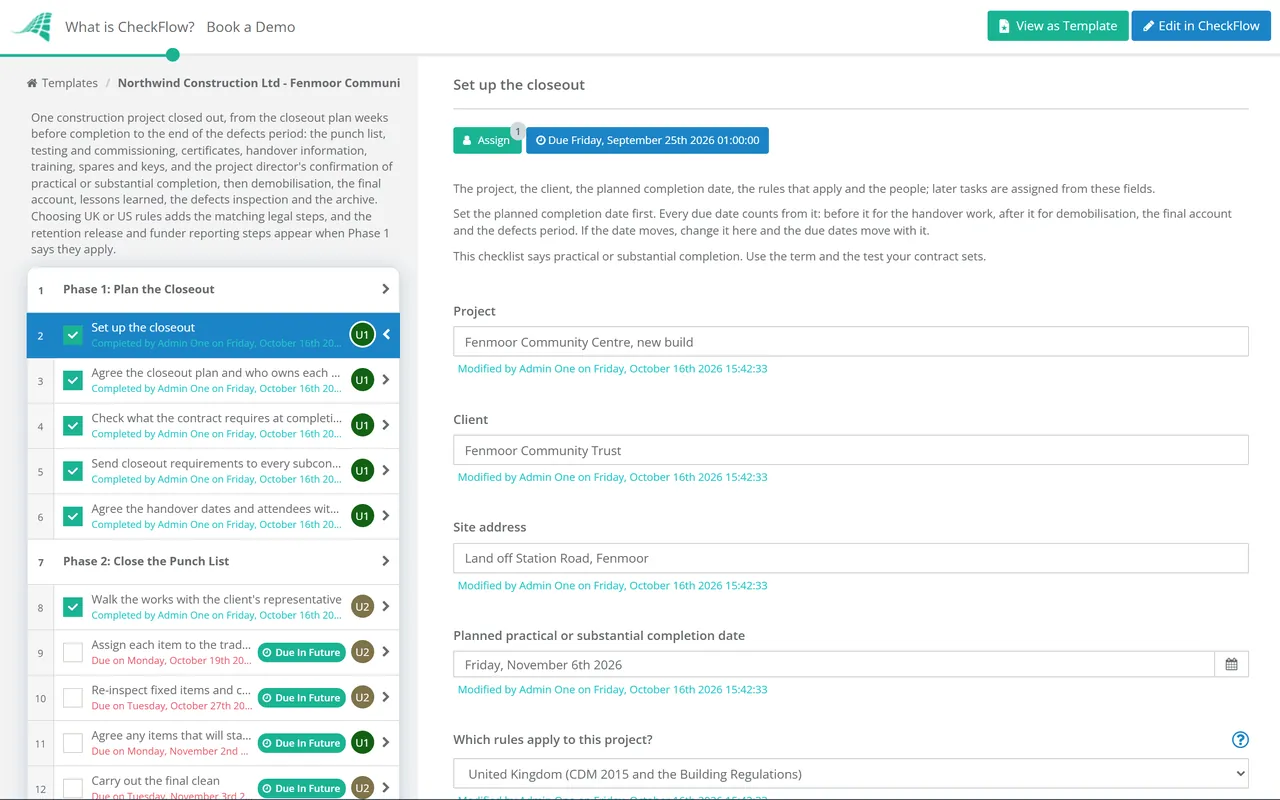
    Start closeout weeks before the planned completion date, while the people who know where everything is are still on site. Set the completion date first, because every due date counts from it, and answer the three questions that decide which steps appear.

    • Set up the closeout — the project, the client, the planned completion date, the rules that apply and the people; later tasks are assigned from these fields
    • Agree the closeout plan and who owns each deliverable — documents, tests, training, certificates and handover items, each with an owner and a date
    • Check what the contract requires at completion — how completion is defined and certified, the handover documents and training, the defects period, retention and how the final account is agreed
    • Send closeout requirements to every subcontractor and supplier — the O&M information, as-built mark-ups, warranties, test certificates and spares each one owes, and the date it is due
    • Agree the handover dates and attendees with the client — the completion inspection, the training sessions and the handover meeting, and who attends for the client and its facilities team
  2. Phase 2

    Phase 2: Close the Punch List

    5 tasks

    The punch list, or snagging list, is the work still to finish or put right. Close it before the completion inspection, so the client’s representative inspects a finished building rather than a list.

    • Walk the works with the client’s representative — area by area and trade by trade, logging every incomplete or defective item well before the completion inspection
    • Assign each item to the trade that will fix it — with a fix date that leaves time to re-inspect before completion
    • Re-inspect fixed items and close them out — each one checked by someone other than the person who fixed it, with a photo of the finished work
    • Agree any items that will stay open at completion — minor items the client’s representative accepts, each listed with a date to finish
    • Carry out the final clean — a builder’s clean, protection removed and waste cleared, so the building is ready to inspect
  3. Phase 3

    Phase 3: Testing, Commissioning & Certificates

    5 tasks

    Commissioning shows each system works as designed before anyone relies on it. The certificate tasks follow the rules chosen in Phase 1: building control notices in the UK, the certificate of occupancy in the US.

    • Test and commission every building system — mechanical, electrical, fire, security, lifts and controls, against the commissioning plan and witnessed where the specification asks
    • Collect the test certificates and commissioning records — electrical, fire alarm, emergency lighting, gas, water and lift certificates, and the balancing and performance test reports
    • Clear the approvals tied to completion — planning conditions, highways and utility agreements, and any other consent the work depended on
    • Send building control the air pressure test and commissioning notices — UK only, where the Building Regulations require them: the pressure test results within seven days of the final test, and confirmation that the fixed building services are commissioned
    • Pass the final inspections and obtain the certificate of occupancy — US only: from the local building department, where the local code requires one, before anyone occupies the building
  4. Phase 4

    Phase 4: Handover Information

    5 tasks

    This is what the client needs to run, maintain and later alter the building. Collect it from subcontractors early: it is much harder to get once they have left site.

    • Compile the operation and maintenance manuals — system descriptions, maintenance schedules, product data and contacts, reviewed by the designers or the client before handover
    • Issue the as-built drawings — updated from site mark-ups and subcontractors’ drawings to show what was built, including hidden and buried services
    • Collect the warranties and guarantees — manufacturers’ and subcontractors’ warranties, with start dates, lengths and the conditions that would void them
    • Send the principal designer the health and safety file information — UK only: as-built information, services, hazardous materials and safe access for maintenance; a principal contractor duty under CDM 2015 regulation 12(7)
    • Give the fire safety information to the responsible person — UK only: no later than completion or first occupation, with their written acknowledgement and a notice to building control within five days
  5. Phase 5

    Phase 5: Train, Hand Over & Confirm Completion

    6 tasks

    The last task is the gate. Nothing after it can be completed until the project director confirms that completion has been certified under the contract.

    • Train the client’s facilities team — on each system, using the O&M manuals, with attendance recorded and any recordings handed over
    • Hand over spare parts and attic stock — the spares, extra tiles, paint and finishes the specification asks for, counted and signed for
    • Hand over keys, fobs and access codes — counted against a key register and signed for, with alarm and access codes reset or passed on securely
    • Hand the health and safety file to the client — UK only: the principal designer passes it at the end of the project, or the principal contractor if the principal designer’s appointment has ended
    • Hold the completion inspection with the client’s representative — against the contract’s test for completion, with any agreed open items listed
    • Project director confirms practical or substantial completion — the certificate or written confirmation under the contract, its date and the start of the defects period
  6. Phase 6

    Phase 6: Demobilise & Clear the Site

    5 tasks

    The building is now the client’s. Leave the site as the contract and any agreements with neighbours require, and keep a dated record of how you left it.

    • Agree the demobilisation sequence with the client — what leaves when, which areas the client takes over first and access for any work still to finish
    • Give building control the completion notice — UK only: within five days of completion, with the signed client and dutyholder statements, and give the owner the energy performance certificate and energy information
    • Remove cabins, plant, hoarding and temporary services — and close the site’s temporary utility supplies and accounts
    • Clear waste and reinstate the ground — materials and compounds removed, and roads, verges and neighbouring land put back as agreed
    • Photograph the site as handed back — inside and out, dated, as the record of its condition when you left
  7. Phase 7

    Phase 7: Final Account & Lessons Learned

    7 tasks

    Agree the money while the records are fresh. The retention, funder and lien waiver tasks appear only when Phase 1 says they apply.

    • Claim any retention the contract releases at completion — with the payment application or notice the contract asks for, then track it to payment
    • Give the client the completion evidence its funder needs — photos, certificates, final cost figures and anything else the funding conditions ask for
    • Agree each subcontractor’s final account — measured work, variations and contra-charges agreed, with any dispute recorded
    • Collect final lien waivers from subcontractors and suppliers — US only: against each final payment, in the form the contract and state law require
    • Submit the final account to the client — variations, provisional sums, claims and deductions, with the records that support each one
    • Project director approves the agreed final account — before it is signed with the client, with the final margin and any sums still in dispute
    • Run the lessons learned review — with the site team, the commercial lead and key subcontractors, written as changes to make on the next project
  8. Phase 8 — Defects period

    Phase 8: Defects Period & Final Close

    7 tasks

    The defects period runs from the certified completion date for as long as the contract says. The due dates here assume twelve months; change the offsets in your copy of the template if your contract sets a different period.

    • Log and fix defects reported during the defects period — each with the date reported, the trade responsible and the date it was made good
    • Hold the end of defects inspection — with the client’s representative before the period ends, listing everything still to make good
    • Make good the defects and get them signed off — with the certificate or written confirmation under the contract that the defects are made good
    • Claim the remaining retention — once the defects are made good, as the contract sets out, with the payment notice it needs
    • Release the retention held on subcontractors — on the terms of each subcontract, once their defects are made good
    • Archive the project records — contract, certificates, O&M manuals, as-built drawings, warranties, correspondence and this checklist, with a retention period and an owner
    • Project director closes the project — accounts settled, retention received, defects made good and the records archived

Completion Paperwork in England and the US

Completion is a contract event in both countries, but much of the paperwork around it is set by law. The table shows what the law asks for at closeout in England and in the US, and which regulation says so. Wales has its own version of several of the Building Regulations, and US requirements differ by state and city, so check the rules for the site before you rely on the table.

At closeout England (UK) United States
Completion itselfDefined and certified under the building contract. Practical completion is the usual UK term.Defined and certified under the contract. Substantial completion is the usual US term.
Building approvalA completion notice to building control within five days of completion, with signed statements from the client, principal contractor and principal designer. The authority has eight weeks to give a completion certificate if it is satisfied (Building Regulations 2010, regs 16(4) and 17).Final inspections and a certificate of occupancy under state and local codes. In New York City, for example, no one may legally occupy a building before a certificate or temporary certificate is issued.
Tests and commissioningAir pressure test results to building control within seven days of the final test, and a notice that the fixed building services are commissioned (regs 43 and 44).Follow the contract, the specification and the inspections the local code official asks for.
Fire safety informationGiven to the responsible person by completion or first occupation, acknowledged, and building control told within five days (reg 38).Follow the contract and the fire code that applies locally.
Health and safety filePrepared by the principal designer with information from the principal contractor, passed to the client at the end of a project with more than one contractor, and kept normally for the lifetime of the building (CDM 2015 reg 12; HSE L153).No OSHA equivalent. The O&M manuals and as-built drawings the contract asks for carry much of the same information.
EnergyThe energy performance certificate to the owner, with notice to the local authority, within five days of completing a new building (EPB Regulations 2012 reg 7A), and information on running the fixed building services efficiently (reg 40).Follow the contract and the energy code that applies locally.
Final paymentA payment notice for every payment the contract provides for, within five days of the due date, so retention releases and the final payment need one too (Construction Act, s.110A).Final payment is usually exchanged for final lien waivers or releases. Lien rights and the wording of waivers are set by state law.

Retention, defects periods and the test for completion are contract terms. The standard forms used in the UK and the US each set them in their own way, and bespoke amendments change them again, so read your own contract rather than relying on what the last job said. Record the defects period and the retention terms in Phase 1, and the due dates for the end of defects inspection and the retention release follow from the completion date.

Records outlive the project. In the UK, the client keeps the health and safety file for as long as it is relevant and passes it on if they dispose of their interest in the building. In the US, OSHA’s recordkeeping rule asks for a separate injury and illness log for a site expected to operate for a year or longer, kept for five years after the end of the calendar year it covers (29 CFR 1904.30 and 1904.33). Set a retention period for the rest of the project file when you archive it.

Why Run Construction Closeouts in CheckFlow?

1

Completion is a gate, not a date in the programme

The project director’s confirmation is assigned to them alone, and the checklist halts there. Demobilisation, the final account and the defects period cannot be completed until completion has been certified and recorded, with the certificate attached. See how approvals that halt a checklist work.

2

Every document has an owner and a due date

Due dates count back from the planned completion date and forward from it, so moving the date moves the whole closeout. Registers for subcontractor documents, commissioning, warranties, training and spares sit on the tasks they belong to, and the Reports Grid shows every project in closeout as tasks are completed.

3

The defects period stays on someone’s list

The end of defects inspection, the making good and the retention release fall due a year after completion and are assigned from the first task, so nobody has to remember them. Choose UK or US rules and the matching notices and certificates appear. Change the offsets to suit your contract in the template designer.

CheckFlow does not certify completion and it is not a document management system. It runs the closeout steps in the same order on every project, with a record of who did what and when, and keeps the certificates and registers on the tasks they belong to.

This template closes one construction project. Close other kinds of project with the Project Closeout Checklist, run an investment from feasibility to handover with the Capital Project Checklist and induct every worker with the Construction Site Induction Checklist. After handover, the facilities team can run the plant from the O&M manuals with the Preventive Maintenance Checklist and use the fire safety information in the Fire Risk Assessment Checklist, and a building that will be let can have its condition recorded with the Move-In / Move-Out Inspection Checklist.

AI generator

Didn’t find what you need? Describe it.

Describe the process in a sentence and the AI checklist generator drafts the phases and tasks for you.

Frequently Asked Questions

What should a construction closeout checklist include?

The closeout plan and who owns each deliverable, the punch list closed, testing and commissioning records, the certificates and approvals the site needs, O&M manuals, as-built drawings, warranties, spare parts and attic stock, training for the client’s facilities team, and keys and access codes. In the UK add the health and safety file and the fire safety information; in the US, the certificate of occupancy and lien waivers. After completion come demobilisation, the final account, retention, lessons learned, the defects period and its end inspection, and archiving the records.

What is the difference between practical completion and substantial completion?

They are the UK and US names for much the same contract event: the point at which the building is finished enough for the client to take it over and use it, even if minor items remain. Each contract sets its own test and says who certifies it, often the architect, contract administrator or owner’s representative. The certified date matters, because it usually starts the defects or correction period and can trigger a retention release, so record it exactly and keep the certificate.

What is a health and safety file in construction?

Under the UK’s CDM 2015, it is the information needed to work safely on the building in future: maintenance, cleaning, refurbishment or demolition. It is needed on a project with more than one contractor. The principal designer prepares and updates it, the principal contractor supplies information for it, and at the end of the project the principal designer, or the principal contractor where there is none, passes it to the client. HSE’s guidance says the client keeps it for as long as it is relevant, normally the lifetime of the building.

What documents are handed over at the end of a construction project?

Operation and maintenance manuals, as-built drawings, test and commissioning certificates, warranties and guarantees, a register of keys and access codes, a list of spares and attic stock, training records and the completion certificate or written confirmation under the contract. In England the responsible person also receives the fire safety information and the owner an energy performance certificate, and the health and safety file goes to the client under CDM 2015. In the US the certificate of occupancy and the final lien waivers are usually part of the set.

When is retention released on a construction project?

When the contract says. Where retention is split, part is released at practical or substantial completion and the rest once the defects or correction period has ended and the defects are made good. The percentages and triggers are contract terms, so read them at the start of closeout and put both dates in the diary. In England, Wales and Scotland, the Construction Act requires a payment notice for every payment a construction contract provides for, so each release needs one.

What is a lien waiver?

In the US, a lien waiver or release is a document in which a contractor, subcontractor or supplier gives up its right to claim a lien on the property for the amount it has been paid. Owners and general contractors usually ask for one with each payment, and a final waiver with the final payment, so the property is clear of lien claims when the project closes. Lien rights and the wording of waivers are set by state law, so use the form the state and the contract require.

When should construction closeout start?

Weeks before the planned completion date, not after it. Subcontractors owe most of the closeout documents, and they are hardest to reach once they have left site. Start the checklist when the end of the programme is in sight: set the planned completion date, send every subcontractor its list of documents, walk the works for the punch list and book the commissioning and training. The tasks after completion, from demobilisation to the end of the defects period, then fall due from the same date.

Is CheckFlow free for this template?

14-day free trial, no card required. The Business plan is $10 per user per month after the trial. Full details at checkflow.io/pricing.

Close Every Project Down to the Last Retention Payment

Free trial — no credit card required.

14-day free trial, no credit cardFull refund in your first 30 daysUS or EU hosting