Capital Project Checklist Template

McKinsey research shows 98% of megaprojects experience cost overruns or delays. The average overrun is 80%. The decisions that determine 80% of a project’s total cost are made in the first 15% of the spend — at feasibility and design, before most of the money is committed.

Capital projects fail in predictable ways. The scope that was not fully defined before the detailed design began produces change orders that grow the budget by 30%. The contractor that was selected on price rather than capability produces construction quality issues that require expensive remediation. The commissioning phase that was compressed to meet an externally set go-live date produces equipment that is technically operational but not performing to specification. The handover that was executed before the operating team was trained produces a facility that nobody knows how to operate. Each of these failures is a process failure, not a technical one — and each is preventable with a structured project management process that enforces the right activities at the right phase, with defined stage gates that require decision-maker sign-off before capital is committed to the next phase. This free checklist gives capital project managers, operations directors, and engineering managers a structured framework for the full capital project lifecycle.

Use This Template Free See Live Example
No Credit Card Required

Stage Gates — Why Every Capital Project Needs Formal Decision Points

A stage gate (or tollgate) is a formal decision point in the project lifecycle where the project must demonstrate it is on track, well-defined, and appropriately governed before the next tranche of capital is released and the next phase begins. Stage gates exist because capital commitment is irreversible at different points in the project: stopping a project at feasibility costs a fraction of stopping it mid-construction; making a scope change at design costs a fraction of making the same change during installation.

The most important stage gates in a capital project are: before detailed design begins (confirming the project justification and high-level scope are sound before major engineering investment), before procurement begins (confirming detailed design is complete and the budget is robustly estimated before contracts are placed), and before construction or installation begins (confirming all contractors are selected, all materials are on order, and the site is ready to receive work). Projects that skip stage gates or treat them as bureaucratic hurdles rather than decision-quality checkpoints spend money on the wrong project.

Gate 1

Feasibility complete; proceed to detailed design? Confirm the project justification and high-level scope are sound before major engineering investment is committed.

Gate 2

Detailed design complete; proceed to procurement? Confirm design is final, all permits are secured, and the budget estimate is at sufficient confidence before contracts are placed.

Gate 3

Procurement complete; proceed to construction? Confirm all contracts are awarded, key materials are on order, and the site is ready to receive work.

Gate 4

Construction / installation complete; proceed to commissioning? Confirm mechanical completion is achieved, pre-commissioning checks are clear, and utilities are connected.

Gate 5

Commissioning complete; ready for handover and operation? Confirm all systems perform to specification, operating team is trained, and O&M documentation is delivered.

What the Capital Project Checklist Covers

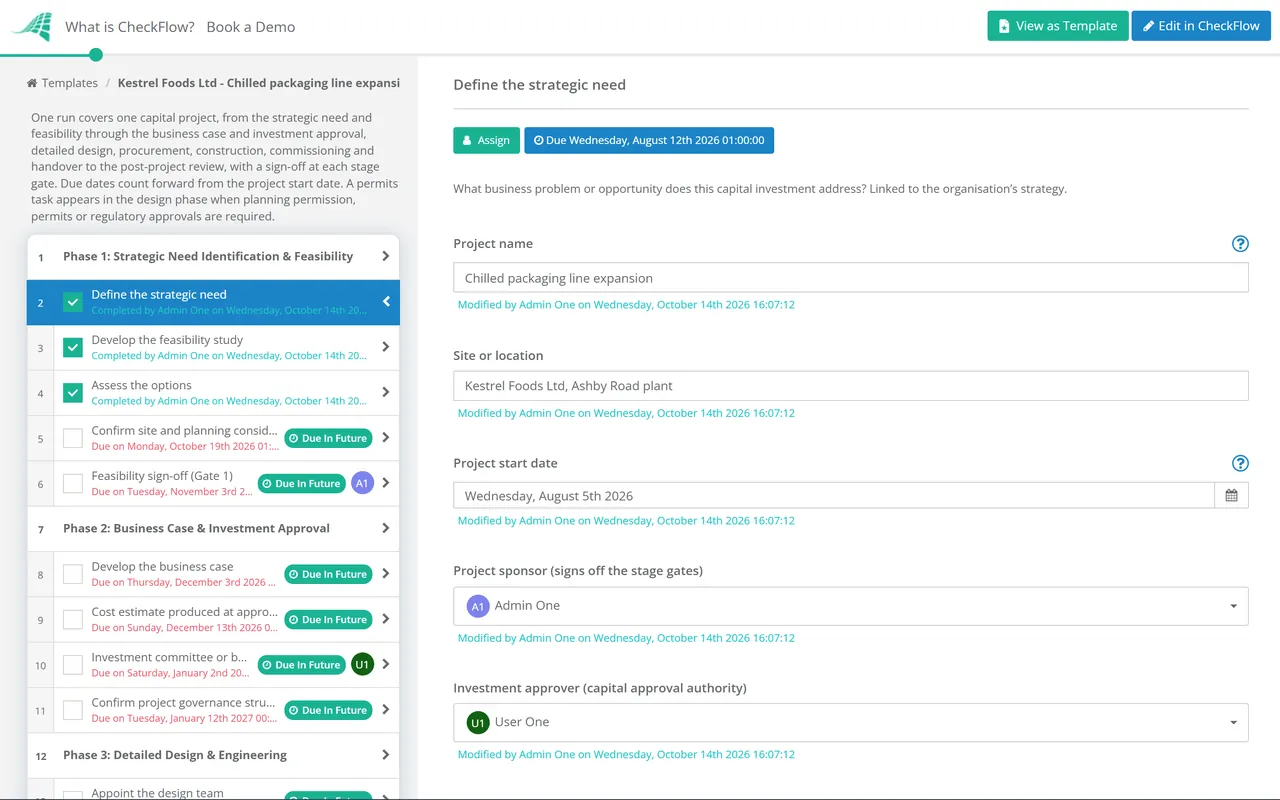
This checklist covers the full capital project lifecycle in seven phases with five stage gates — from strategic need identification through to post-project review.

Phase 1

Phase 1: Strategic Need Identification & Feasibility

  • Define the strategic need — what business problem or opportunity does this capital investment address? Linked to the organisation’s strategy
  • Develop the feasibility study — is the project technically achievable? What are the likely options? Rough order-of-magnitude (ROM) cost and schedule estimates
  • Assess the options — typically 3–4 options including “do nothing”; each assessed against criteria (cost, risk, benefit, schedule, operability)
  • Confirm site and planning considerations — any planning permission, permits, or regulatory approvals required; confirmed feasible before committing to detailed design
  • Feasibility sign-off (Gate 1) — by the project sponsor; project is worthwhile; proceed to detailed design and business case
Phase 2

Phase 2: Business Case & Investment Approval

  • Develop the business case — strategic justification, option comparison, financial analysis (NPV, IRR, payback period), risk assessment, implementation plan
  • Cost estimate produced at appropriate confidence level — Class 3 or Class 4 estimate (AACE International) for business case; contingency aligned with the cost estimate class
  • Investment committee or board approval — for the capital expenditure; per the capital approval authority; signed off in writing with approved budget and scope
  • Confirm project governance structure — project sponsor, steering committee, project manager, and key workstream leads; reporting lines and escalation paths defined
Phase 3

Phase 3: Detailed Design & Engineering

  • Appoint the design team — engineering consultants, architects, and specialists; through a competitive process; with clear scope of service
  • Detailed design developed — construction-ready drawings and specifications; sufficient for accurate contractor pricing
  • Design review and approval — at defined design stages (concept, schematic, detailed); by the technical authority and the project sponsor
  • Confirm all permits and regulatory approvals — planning permission, environmental permits, building control approval; all in hand before procurement begins
  • Class 2 cost estimate produced — based on detailed design; budget reconfirmed or reapproval sought if estimate has moved significantly
  • Design freeze declared (Gate 2) — design is complete and approved; all change requests after Gate 2 go through formal change control
Phase 4

Phase 4: Procurement & Contracting

  • Procurement strategy confirmed — which packages to be tendered? What contract form? What is the risk allocation?
  • Pre-qualify contractors — financial standing, technical capability, relevant experience, health and safety record; before issuing tender
  • Issue tender packages — to pre-qualified contractors; with clear scope of work, specifications, and contract conditions
  • Evaluate tenders — against technical and commercial criteria; not price alone; lowest bid is the most common source of construction quality problems
  • Award contracts — to selected contractors; contract signed before any work commences
  • Long-lead items ordered — equipment with long delivery times ordered well ahead of the construction programme
  • Procurement complete (Gate 3) — all contracts awarded, key materials on order; proceed to construction
Phase 5

Phase 5: Construction & Installation

  • Construction programme baseline confirmed — contractor programme reviewed and accepted; key milestones defined; reporting cadence established
  • Health and safety plan — site-specific H&S plan in place; induction process for all site personnel; permit-to-work system active
  • Progress monitoring weekly — against programme and budget; variations and change requests managed through change control
  • Quality inspections at defined hold points — specific construction activities requiring independent inspection before being covered up or built over
  • Defect management — all defects logged and tracked through to resolution; snag list maintained
Phase 6

Phase 6: Commissioning & Performance Testing

Commissioning is the structured process of verifying that every system performs as designed before handover. Compressed commissioning produces facilities that are technically operational but performing below specification — discovered by the operating team after handover rather than by the project team before it.

  • Commissioning plan produced — all systems and equipment to be commissioned; sequence; responsible parties; acceptance criteria
  • Pre-commissioning checks — mechanical completion verification; utilities connected; safety systems functional; documentation reviewed
  • Systematic commissioning — subsystem by subsystem; each to its design specification; witness testing where specified
  • Performance testing — full-load performance testing demonstrating the system meets the specified performance criteria
  • Commissioning sign-off (Gates 4/5) — all systems commissioned and performing to specification; proceed to handover
Phase 7

Phase 7: Handover & Project Close-Out

  • Operations team trained — on all systems and equipment; training completed before handover; not after
  • Operations and maintenance documentation delivered — as-built drawings, O&M manuals, warranty documents, and spare parts list
  • Formal handover certificate — signed by the project manager and the operations receiving manager; snagging list status confirmed; warranty period begins
  • Final accounts settled — all contractor final accounts agreed and closed; project costs reconciled to approved budget
  • Post-project review — at 3–6 months post-handover; is the facility performing to specification? Are the benefits in the business case being realised? Lessons learned documented

Why Use CheckFlow for Capital Projects?

1

Stage gates enforced before capital is committed

The stage gate that is treated as a rubber stamp does not prevent the overrun it was designed to prevent. CheckFlow’s capital project checklist makes each stage gate a required phase with specific tasks and documented sign-off before the next phase can begin — ensuring the commitment of capital to each phase is a deliberate decision, not an assumption.

2

A complete capital project record from feasibility to handover

Capital projects span months or years; teams change; sponsors change. CheckFlow creates a documented record of every decision, approval, change, and issue across the full project lifecycle — providing the institutional memory that survives personnel changes and the evidence trail that governance and audit requires.

3

Consistent process across a capital programme portfolio

Organisations with multiple concurrent capital projects need the same governance standard applied consistently across all of them — not dependent on the approach of each individual project manager. CheckFlow deploys the same capital project checklist to all projects in the portfolio, with central visibility of stage gate status across all projects.

Every capital project begins with a business case. CheckFlow’s Business Case Checklist covers the structured process for building the investment justification. See the Business Case Checklist →

Commissioned capital assets require an ongoing equipment servicing and facility inspection programme. CheckFlow’s Operations & Facilities Management templates cover the post-handover operational management process. See Operations & Facilities Management templates →

Frequently Asked Questions

What does a capital project checklist include?

+

A capital project checklist covers seven phases with five stage gates: strategic need and feasibility (need definition, options assessment, Gate 1 sign-off), business case and approval (financial analysis, cost estimate, investment approval, governance setup), detailed design and engineering (design team appointment, design reviews, permits, design freeze at Gate 2), procurement (procurement strategy, contractor pre-qualification, tender, evaluation, award, Gate 3), construction and installation (programme baseline, H&S plan, weekly monitoring, quality hold points), commissioning and testing (commissioning plan, pre-commissioning checks, systematic commissioning, performance testing, Gates 4/5), and handover and close-out (operations training, O&M documentation, handover certificate, final accounts, post-project review).

What is front-end loading in capital project management?

+

Front-end loading (FEL) is the practice of investing sufficient time and resource in the early phases of a capital project — particularly feasibility, requirements definition, and design — to produce a well-defined scope, a reliable cost estimate, and an executable project plan before major capital is committed. Research from the Independent Project Analysis group consistently shows that projects with high FEL scores significantly outperform projects with low FEL scores on cost, schedule, and operability. The principle is that decisions made in the first 10–15% of project spend determine 80–90% of total project cost — making investment in this phase the highest-return investment in the project.

What types of projects are considered capital projects?

+

Capital projects are large-scale investments in physical assets that typically require significant upfront capital expenditure and produce long-lived assets on the balance sheet. Examples include: facility construction and expansion, major equipment installation and replacement, infrastructure development (roads, utilities, communications), automation and robotics integration, renewable energy installations, data centre construction, manufacturing line installation, and significant facility refurbishment.

How are capital project cost estimates classified?

+

Capital project cost estimates are typically classified using the AACE International framework from Class 5 (most uncertain) to Class 1 (most certain). Class 5 (±50–100% accuracy) is based on limited scope information at the feasibility stage. Class 3 (±10–20% accuracy) is based on substantial design completion and used for the project approval budget. Class 1 (±3–10% accuracy) is based on near-complete design and used for bid checking and contract negotiation. The appropriate contingency allowance should align with the cost estimate class — a Class 5 estimate presented with 5% contingency is misleading.

Is CheckFlow free for this template?

+

14-day free trial, no card required. The Business plan is $10 per user per month after the trial. Full details at checkflow.io/pricing.

Manage Every Capital Project Phase From Feasibility Through Handover — With Stage Gates That Hold

Free trial — no credit card required.