Return to Office Checklist

Bringing staff back to the office, or setting office days for hybrid teams? Check contracts, consult, answer flexible working requests and adjustments, plan desks and IT, get sign-off and review the change after 90 days.

Last reviewed: November 2026

Printed from checkflow.io/templates/remote-work-hybrid-teams/return-to-office-checklist

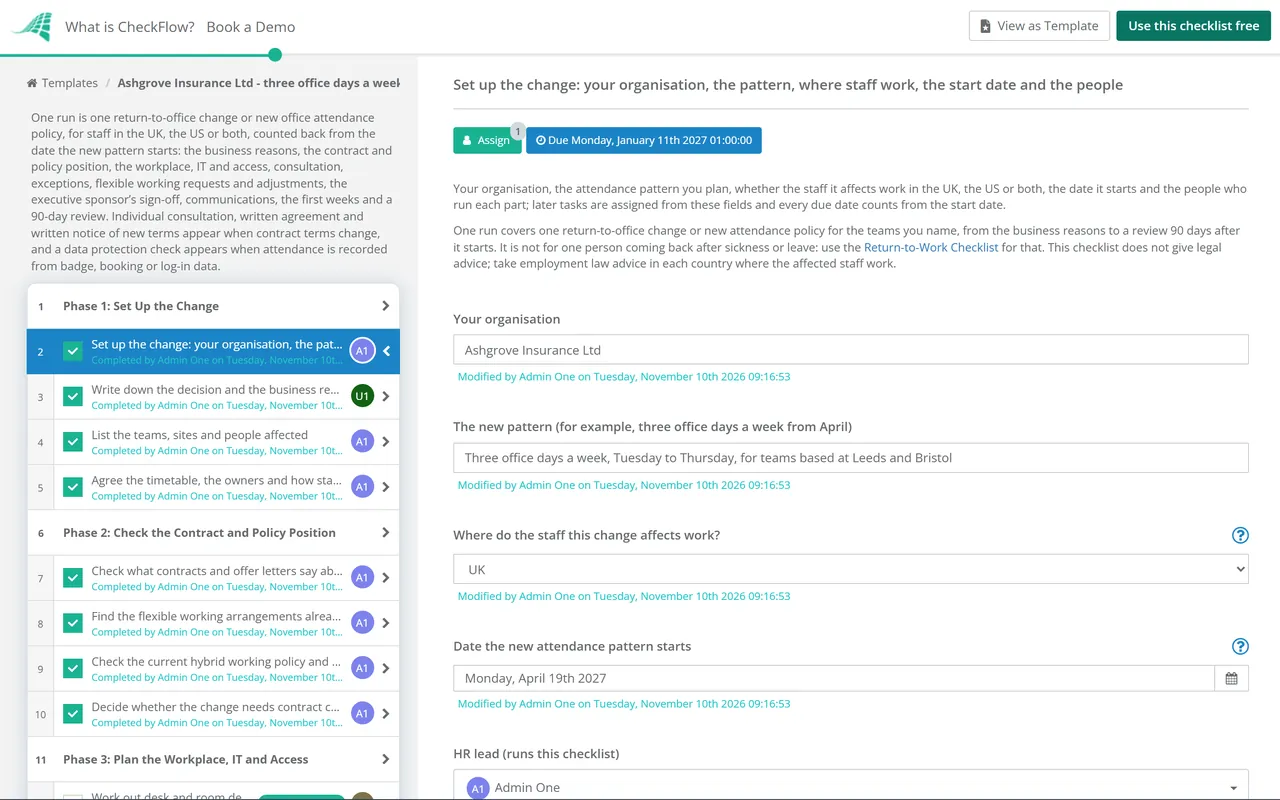
This free return to office checklist is for HR teams and the executives who sponsor a change to where people work: a return to the office, more office days for hybrid staff, or a first written office attendance policy. One run covers one change, for staff in the UK, the US or both, counted back from the date the new pattern starts. It starts with the decision and the business reasons and checks what contracts, offer letters and the current policy already promise, including flexible working requests already granted. It plans desks, rooms, IT and building access for the busiest day, and asks how attendance will be recorded. It runs consultation and, where contract terms change, records each person’s agreement. It handles exceptions, statutory flexible working requests in Great Britain, reasonable adjustments, and ADA and PWFA accommodations in the US. The executive sponsor signs off before anything is announced. Then it briefs managers, tells staff, runs the first weeks and reviews the change after 90 days. It covers England, Scotland and Wales, says where Northern Ireland differs, and leaves US state law to a check for each location.

Return to Office, Return After Absence or an Office Move?

Someone coming back after sickness, injury or parental leave has their own checklist, the Return-to-Work Checklist. Moving to new premises, with the lease, fit-out and move day, is the Office Relocation & Office Move Checklist. Setting up a good workspace at home is the Home Office Setup Checklist. This checklist is the change to where a group of staff work, with the contract, consultation and request steps around it.

This checklist

One return to office change

Covers: the business reasons, contracts and the current policy, desks, IT and access, consultation and agreement, exceptions, flexible working requests and adjustments, the sponsor’s sign-off, communications, the first weeks and a 90-day review.

Planned around: the date the new attendance pattern starts.

One person

Back after sickness or leave

Covers: fit notes or fitness-for-duty certification, occupational health, adjustments, a phased return and follow-up reviews for one employee.

Planned around: the employee’s return date.

New premises

Office relocation

Covers: the budget, the lease exit, fit-out, IT and telecoms, staff updates, move day and address changes.

Planned around: move day.

What the Return to Office Checklist Covers

Nine phases take one change to where people work from the business reasons to a review 90 days after it starts. The first task records the start date, which sets every due date, and where the affected staff work, which adds the UK tasks, the US tasks or both. Individual consultation, a record of each person’s agreement and written notice of new terms appear when contract terms change, a task to decide what happens next appears if anyone has not agreed, and a data protection check appears when attendance is recorded from badge, booking or log-in data. The sign-off in Phase 6 is assigned to the executive sponsor, and nothing after it can be completed until they approve.

  1. Phase 1

    Phase 1: Set Up the Change

    4 tasks

    Owned by the HR lead with the executive sponsor. Enter the date the new attendance pattern starts on the first task: every due date counts back from it in working days, and the 90-day review counts forward. Choose where the affected staff work, and the UK or US tasks appear.

    • Set up the change: your organisation, the pattern, where staff work, the start date and the people — your organisation, the attendance pattern you plan, whether the staff it affects work in the UK, the US or both, the date it starts and the people who run each part; later tasks are assigned from these fields and every due date counts from the start date
    • Write down the decision and the business reasons — what is changing (how many days or what share of time in the office, for which teams), why, the evidence behind it and what the change should achieve, so staff hear real reasons and the 90-day review has something to measure against
    • List the teams, sites and people affected — each team, the site it works from, its current pattern (fully remote, hybrid or office-based) and its headcount, including anyone hired as home-based
    • Agree the timetable, the owners and how staff will be consulted — the dates for each phase counted back from the start date, who owns each part, and how staff take part: a recognised trade union, an employee forum, team sessions or all three
  2. Phase 2

    Phase 2: Check the Contract and Policy Position

    5 tasks

    Check what each group has already been promised before you announce anything. The answer to the last task decides whether individual consultation and written notice of new terms appear later.

    • Check what contracts and offer letters say about the place of work — for each group, the place of work in the contract, offer letter or written statement, any contract that names home as the place of work, and any clause that lets you decide where people work
    • Find the flexible working arrangements already agreed — statutory flexible working requests granted, informal home or hybrid agreements, trials still running and adjustments or accommodations that include working from home, so the new policy does not undo them by accident
    • Check the current hybrid working policy and any collective agreement — whether the current home or hybrid working policy is part of the contract, what it promises and how much notice it says you give of a change, and any agreement with a trade union about working arrangements
    • Decide whether the change needs contract changes — whether the new pattern fits within what contracts and the current policy already allow, or changes the terms of some or all staff; where it does, individual consultation, written agreement and written notice of the new terms appear later
    • List the state and local laws for each US work location (US) — for each US state and city where the affected staff work, the laws that touch the change, so the policy, notices and any monitoring meet them
  3. Phase 3

    Phase 3: Plan the Workplace, IT and Access

    7 tasks

    Owned by the facilities lead, with IT. Plan for the busiest day, not the average one. If attendance will be recorded from badge, booking or log-in data, a data protection task appears.

    • Work out desk and room demand for each day — the number of people expected in each site on each day against the desks, meeting rooms and quiet spaces you have, and the peak day
    • Check the space, fire safety and welfare for the numbers expected — the fire risk assessment and evacuation plan, first aid cover, toilets, kitchens and ventilation for the number of people expected on the busiest day
    • Set up desk booking and team days — how people book a desk, which days each team is in together, team neighbourhoods and what happens on a day with no desk free
    • Ready the IT at desks and in meeting rooms — docks and monitors at every bookable desk, Wi-Fi and network capacity for the busiest day, video equipment in meeting rooms so hybrid meetings work, and printing
    • Restore building access, passes and parking — a working pass for everyone who will attend, including people who joined while working remotely, lockers, parking, cycle storage and the visitor process
    • Decide how attendance will be recorded — whether attendance is recorded at all, and if so how: by managers, by staff themselves, or from badge, desk booking or network log-in data
    • Check the use of attendance data with your data protection lead — the purpose, what data is used and for how long, who sees it, what staff are told, and whether an impact assessment is needed before it starts
  4. Phase 4

    Phase 4: Consult and Listen

    7 tasks

    Owned by the HR lead. Share the proposal and the reasons, listen, and change the plan where the feedback shows you should. When contract terms change, each affected person is consulted and their agreement recorded; if anyone has not agreed, a task appears to decide what happens next.

    • Brief staff representatives and open consultation — the proposal, the reasons, the timetable and how views will be taken, shared first with any recognised trade union or employee forum
    • Tell affected staff about the proposal and how to respond — the proposal, the reasons, how and by when to give views or raise a concern, and where the questions and answers will be kept
    • Hold team sessions and log the concerns raised — a session for each team or site, with every concern and question logged with the answer given
    • Consult each person whose contract terms change (when terms change) — a meeting with each person whose terms change, to explain the reasons, hear their circumstances and any alternative they suggest, before the terms are settled
    • Record each person’s agreement in writing (when terms change) — for each person whose terms change, whether they agreed, on what date and to what terms, kept with their file
    • Decide what happens for anyone who has not agreed — for each person, whether you keep their current terms, offer something different or take advice on other options; dismissal is a last resort that needs legal advice first
    • Change the proposal where consultation shows it should — what changed in the pattern, the exceptions or the timetable because of what people said, and why other suggestions were not taken up
  5. Phase 5

    Phase 5: Exceptions, Requests and Adjustments

    5 tasks

    Owned by the HR lead. Decide who the policy does not apply to and handle every individual request on its own merits, before the policy is signed off. Requests that arrive later go through the same steps.

    • Set the exceptions and how people ask for one — the roles, contracts and circumstances the pattern does not apply to, how someone asks for an exception, who decides and how quickly
    • Answer statutory flexible working requests within two months (UK) — each statutory request logged on the day it arrives, discussed with the employee before any refusal, and decided, with any appeal, within two months unless the employee agrees to longer
    • Make reasonable adjustments for disabled staff (UK) — for each disabled person the pattern puts at a disadvantage, the adjustments considered and agreed, which can include some or all days at home, with occupational health advice where it helps
    • Handle accommodation requests under the ADA and the PWFA (US) — each request handled through the interactive process: the limitation, the essential functions of the job, the options and the accommodation agreed or the reason for refusal, recorded
    • Check the policy’s effect on people with protected characteristics — who the pattern could disadvantage, such as carers, disabled staff, pregnant staff or people with religious observance, what you found and what you changed
  6. Phase 6

    Phase 6: Executive Sponsor Sign-Off

    3 tasks

    The executive sponsor signs off the final policy, the exceptions, the workplace plan and the start date before anything is announced. The checklist halts at the sign-off: nothing after it can be completed until it is done.

    • Prepare the sign-off pack — the final policy, what consultation changed, the exceptions, the outcome of requests and adjustments, the impact check, the workplace and IT plan, and the start date
    • Put right what the sponsor turned down, then ask again — the changes the sponsor asked for, made and sent back; the sponsor then changes the decision to Approved and completes the sign-off. If the start date has to move, change it on the first task and every due date moves with it
    • Sign off the policy, exceptions and start date — the sponsor’s decision that the policy, exceptions and workplace plan are ready and the start date stands, so the policy can be announced
  7. Phase 7

    Phase 7: Brief Managers and Tell Staff

    5 tasks

    Managers hear the final policy first, then everyone. Where contract terms change, each person gets the new terms in writing.

    • Brief managers on the policy and how to apply it — the policy, the reasons, the exceptions, how to handle requests and adjustments, and how to deal with concerns fairly and consistently
    • Publish the policy and the questions and answers — the final policy, the start date, what changed after consultation, how to ask for an exception or make a request, and the questions and answers, sent to everyone affected
    • Give each person whose terms change the new terms in writing (when terms change) — a letter or updated written statement for each person whose terms change, with the new place of work, the date it applies and any other change agreed
    • Update US offer letter templates, remote work agreements and the handbook (US) — the handbook section on where people work, the offer letter template for new hires and any remote work agreement form, with employees’ acknowledgements where your process asks for them
    • Remind staff a week before and share the practical details — how to book a desk, passes, parking, team days, IT at desks and who to ask on the first days
  8. Phase 8

    Phase 8: Ready the Office and Start

    3 tasks

    Owned by the facilities lead. Walk the space before the start date, then deal with problems quickly in the first weeks.

    • Check desks, IT and access are ready — a walk-through of each site: desks and docks, meeting room video, passes, signage and the booking system working
    • Run the first week and log the issues — a welcome on the first days, a named contact on each site and every issue logged with an owner until it is fixed
    • Check in with managers after the first two weeks — how the pattern is working in each team, any problems with space or IT, and any new requests or concerns
  9. Phase 9

    Phase 9: 90-Day Review

    4 tasks

    Review the change against the reasons you gave for it, about 90 days after the start date, and decide what to keep, change or drop.

    • Gather attendance, space use and feedback — attendance and space use in aggregate, a short staff survey or team feedback, and the issues log
    • Review the change against its business reasons — each measure written down at the start, what the evidence shows and what has not worked
    • Check every request, exception and adjustment was handled on time — the flexible working, exception, adjustment and accommodation logs: each answered, on time and recorded, with any appeal
    • Agree changes to the policy and the date of the next review — what stays, what changes and the next review date, agreed by the sponsor; a further change to contract terms starts a new run of this checklist

What the Law Says in the UK and the US

The UK rules this checklist follows

As each source reads on 10 November 2026. The Employment Rights Act 2025 is changing several of these in stages: from 1 January 2027 the qualifying period for unfair dismissal in Great Britain falls from two years to six months (section 25, SI 2026/559), and its change to flexible working refusals (section 9) was not yet in force. Check the dates again before you start a run.

Rule What the source says Where it applies Source
Changing contract termsYou must get an employee’s agreement to change their contract. Consult or negotiate with employees or their representatives, explain the reasons and listen to alternative ideas. You must consult a recognised trade union about changes to terms agreed with it.Great Britain; Northern Ireland has the same need for agreementGOV.UK, Acas, nidirect
Place of work in writingThe written statement gives the place of work, or says the worker works at various places and gives the employer’s address. A change goes in a written statement within one month of the change.Great Britain; Northern Ireland also one monthERA 1996 s1(4)(h) and s4, nidirect
Flexible working requestsEmployees can ask to change where they work from their first day, twice in any 12 months. The employer discusses a request before refusing, decides within two months (or longer if agreed) and refuses only for a listed business reason.Great Britain. Northern Ireland: 26 weeks’ service, one request in 12 monthsGOV.UK, Acas Code, nidirect
Reasonable adjustmentsWhere a provision, criterion or practice puts a disabled person at a substantial disadvantage, the employer takes such steps as it is reasonable to have to take to avoid it.Great Britain; Northern Ireland under the Disability Discrimination Act 1995Equality Act 2010 s20, nidirect
Indirect discriminationA rule that puts people who share a protected characteristic at a particular disadvantage is unlawful unless it is a proportionate means of achieving a legitimate aim.Great BritainEquality Act 2010 s19
Collective consultationProposing to dismiss 20 or more employees at one establishment within 90 days, including dismissals to impose new terms, needs consultation with representatives at least 30 days (45 days for 100 or more) before the first dismissal.Great BritainTULRCA s188 and s195
Dismissal and re-engagementThe 2024 Code of Practice applies now; the government’s consultation says it will be revoked in March 2027 and a revised code will follow in summer 2027. New unfair dismissal rules for dismissals over contract changes are in the Employment Rights Act 2025 but were not in force on 10 November 2026; the government intends them to start in March 2027.Great BritainCode, ERA 2025 s28, consultation
Monitoring attendanceYou must tell workers about monitoring, apart from very exceptional covert cases, and carry out an impact assessment before monitoring likely to cause high risk.UKICO guidance

The US rules this checklist follows

Federal rules as the EEOC states them on 10 November 2026. State and city laws differ, so the checklist asks for each location’s laws to be listed and checked with an adviser.

Rule What the source says Where it applies Source
Reasonable accommodation (ADA)Working at home may be a reasonable accommodation even without a telework programme, decided through an interactive process. The employer may choose any effective accommodation.Employers with 15 or more employeesEEOC
Pregnancy (PWFA)Reasonable accommodation of known limitations related to pregnancy, childbirth or related medical conditions, unless it causes an undue hardship. In effect since 27 June 2023.Employers with 15 or more employeesEEOC
State and local lawVaries by state and city. For example, New York requires prior written notice on hiring when an employer monitors telephone, email or internet use.Each locationN.Y. Civil Rights Law s52-c

CheckFlow does not give legal advice. Take employment law advice for each country and state where the affected staff work.

Why Run a Return to Office in CheckFlow?

1

Only the steps your change needs

Choose the UK, the US or both on the first task, and say in Phase 2 whether contract terms change. The checklist shows flexible working requests and adjustments for the UK, accommodations and state law for the US, and individual consultation and written notice only where terms change.

2

A sign-off before anything is announced

The final policy, exceptions, workplace plan and start date go to the executive sponsor, and the checklist halts there: managers cannot be briefed and the policy cannot be published until they approve. Not approved shows a task to put things right and keeps the sign-off open.

3

Every step has a date and an owner

Name the HR lead, the sponsor and the facilities, IT and communications leads on the first task, and every task is assigned from those fields. Due dates count back from the start date in working days, and the 90-day review counts forward from it.

CheckFlow does not give legal advice or decide your policy: those stay with your HR team, your sponsor and your advisers. CheckFlow makes sure every step is done in order, by the right person, with a record of what was decided. Track every change in the Reports Grid.

Publish the new policy with the Employee Handbook Update & Rollout Checklist, set up hybrid meetings with the Virtual Meeting Best Practices Checklist, and use the Redundancy & Layoff Process Checklist if dismissals are ever proposed.

AI generator

Didn’t find what you need? Describe it.

Describe the process in a sentence and the AI checklist generator drafts the phases and tasks for you.

Frequently Asked Questions

What should a return to office checklist include?

The business reasons, what contracts and the current policy already promise, desk and room capacity, IT and building access, consultation with staff and their representatives, exceptions, flexible working requests and adjustments, a sign-off, manager briefings, written notice where terms change, the first weeks and a review. This template puts those in nine phases counted back from the start date, with UK and US tasks chosen on the first task.

Can an employer require staff to come back to the office in the UK?

It depends on the contract. Acas says you might not need to change a contract that lets you decide where someone works, but might need to if it names a specific address. A statutory flexible working request that was granted is a change to the contract too (GOV.UK). Changing a contract needs the employee’s agreement, so this checklist checks contracts first and adds consultation and written agreement where terms change.

Can an employee make a flexible working request to keep working from home?

Yes. In England, Scotland and Wales employees can make a statutory request to change where they work from their first day, twice in 12 months. The employer must discuss it before refusing, decide within two months unless the employee agrees to longer, and refuse only for a listed business reason. Northern Ireland has different rules. This template logs every request with its own deadline.

Is working from home a reasonable accommodation in the US?

It can be. The EEOC says working at home may be a reasonable accommodation under the ADA, even where an employer has no telework programme, decided through an interactive process. The employer need not remove essential functions and may choose another effective accommodation. The PWFA adds accommodation for pregnancy-related limitations. Both apply to employers with 15 or more employees.

How much notice should staff get before an office attendance policy starts?

No single UK or US rule sets a period for this. Check what contracts and the current policy say, and allow time to consult and to answer requests: a statutory flexible working request in Great Britain can take two months. This template’s timeline starts about 14 weeks before the start date and publishes the final policy about four weeks before it. You can choose a later date.

Can we track office attendance with badge data?

Badge, booking and log-in records are personal data. In the UK the ICO says you must tell workers about monitoring and must carry out an impact assessment before monitoring likely to cause high risk; its guidance is under review after the Data (Use and Access) Act. Some US states have notice rules. This template adds a data protection check when you choose to use that data.

What does the Employment Rights Act 2025 change for a return to office?

In Great Britain, from 1 January 2027 the unfair dismissal qualifying period falls to six months. New rules on dismissals over contract changes and on refusing flexible working requests were not in force on 10 November 2026; the government’s consultation on the revised fire and rehire code says it intends to start the dismissal rules in March 2027, when the 2024 Code is revoked, with a new code in summer 2027. This template’s notes give the sources.

Is CheckFlow free for this template?

14-day free trial, no card required. The Business plan is $10 per user per month after the trial. Full details at checkflow.io/pricing.

Run Every Return to Office Change the Same Way

Free trial — no credit card required.

14-day free trial, no credit cardFull refund in your first 30 daysUS hosting, EU on request