Employee Handbook Update & Rollout Checklist

Most handbook problems are not bad policies. They are three versions in circulation, a sick pay section written before the law changed, and no record of who was told what.

This free employee handbook update checklist runs one revision from the trigger to the archive. It records why the update is happening, checks the handbook against recent law changes in the UK or the US, drafts the changes in a redline, sends them for legal review, and holds the rollout until leadership and legal have signed off. It then briefs managers, sends the new version to every employee, tracks acknowledgements in one table and archives the version it replaces. If your people work in more than one state or country, a supplements phase appears for the local rules.

Use This Template Free See Live Example
No Credit Card Required

Last reviewed: October 2026

Why Handbook Updates Go Wrong

The handbook is the version of your policies employees actually read. It explains how to report sickness, book leave, raise a complaint and behave online. When it falls behind the law, managers follow the old text in good faith, and the employer ends up defending a rule it no longer means. When a new version goes out with no record of delivery, nobody can show later that a particular employee received it.

Updates arrive from three directions. A scheduled annual review, a change in the law, or a change in how the business works, such as a new hybrid working policy or an acquisition. The template asks which one started this revision, because a law change has a date the handbook must meet and an annual review does not.

This page covers the employee-facing handbook. Reviewing the whole policy library, including information security and anti-bribery policies, is the job of the Annual Policy Review Checklist. Use that for the library, and this template whenever the handbook itself changes.

United Kingdom

Contract terms and handbook policies

Day one: the written statement of particulars under section 1 of the Employment Rights Act 1996 is due on or before the first day; a few items, such as disciplinary and grievance procedures, can follow within two months. It may point to a reasonably accessible document, which is often the handbook.

Contractual or not: Acas says handbooks should make clear which sections form part of the contract. Changing a contractual term needs agreement, unless a flexibility clause allows it, and the statement of changes is due within one month.

2026: Employment Rights Act 2025 changes to sick pay, family leave and whistleblowing took effect on 6 April.


United States

At will, federal notices and state rules

Disclaimers: in many states a handbook promise can be read as a contract, so most handbooks say clearly that they are not one and that employment is at will. Montana requires good cause after probation.

Work rules: the NLRB judges handbook rules under its 2023 Stericycle standard, which covers non-union workplaces too. The General Counsel has asked the Board to overturn it; until it does, Stericycle applies.

FMLA: a covered employer with eligible employees must include the FMLA general notice in its handbook, if it has one, or give it to each new hire.

The template sets out the process and points to the authority behind each check; it is not legal advice. Before you change anything that touches pay, notice, sick pay or dismissal, ask an employment lawyer to read the redline for each country or state you employ in.

What the Employee Handbook Update Checklist Covers

Seven phases, from the trigger to the archive. The UK and US gap checks follow the jurisdiction answer, the supplements phase appears only for multi-jurisdiction handbooks, and the agreement step only when a contractual term changes.

Phase 1

Phase 1: Trigger & Scope

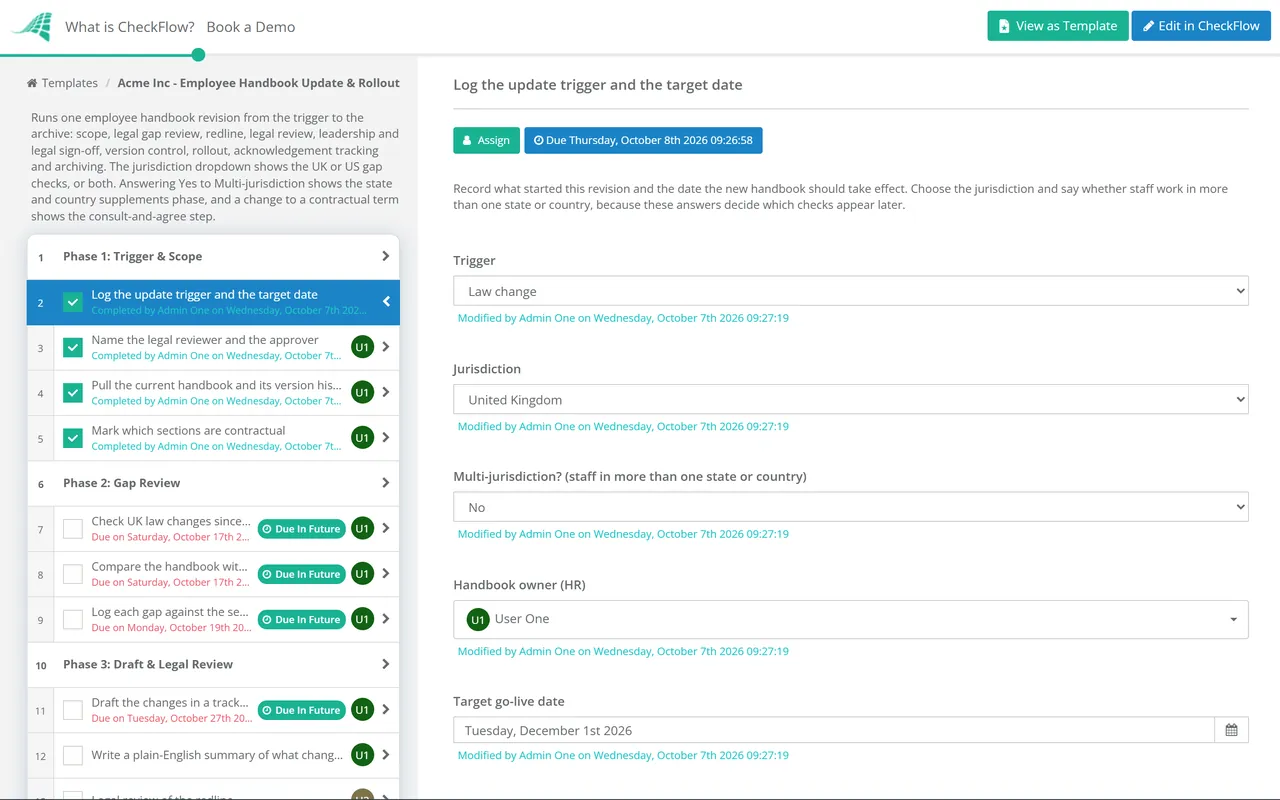
  • Log the update trigger and the target date — annual review, law change or policy change, the jurisdiction and whether staff work in several states or countries
  • Name the legal reviewer and the approver
  • Pull the current handbook and its version history — the live version, its effective date and every supplement
  • Mark which sections are contractual — and record whether this update changes any of them
Phase 2

Phase 2: Gap Review

  • Check UK law changes since the last version — Employment Rights Act 2025 steps in force and due
  • Compare the handbook with the written statement (UK) — no conflicts, and every cross-reference still points somewhere
  • Check federal, state and local law changes (US)
  • Test conduct rules against the NLRB standard (US) — confidentiality, social media, recording and civility rules
  • Check the at-will disclaimer and the FMLA notice (US)
  • Log each gap against the section it affects
Phase 3

Phase 3: Draft & Legal Review

  • Draft the changes in a tracked redline — never overwrite the live text
  • Write a plain-English summary of what changed and why
  • Legal review of the redline — against the gap log and each jurisdiction
  • Resolve review comments and freeze the text
Phase 4 — If Multi-Jurisdiction

Phase 4: State & Country Supplements

Shown when the answer to ‘Multi-jurisdiction?’ is Yes.

  • List every state or country where staff work
  • Check local policy requirements for each location — leave, pay, harassment, notices and language
  • Draft or update each supplement — and point to it from the core handbook
  • Legal review of each supplement
Phase 5

Phase 5: Sign-Off & Version Control

  • Leadership and legal approve the new handbook — the checklist waits for the decision
  • Consult on and agree contractual changes — with employees or their representatives, then a written statement of changes
  • Assign the version number and effective date — on the cover and in every footer
  • Record the change in the version log — sections changed, approver and approval date
Phase 6

Phase 6: Rollout & Acknowledgement

  • Brief managers before staff hear about it — what changed, why, and the answers to likely questions
  • Publish the new version in one place
  • Send the handbook and change summary to every employee — including those on leave
  • Track acknowledgements by employee — who received which version, and when they confirmed
  • Chase missing acknowledgements through managers
  • Update onboarding packs with the new version
Phase 7

Phase 7: Archive & Close

  • Archive the superseded version with its dates — keep it, do not delete it
  • Withdraw old copies wherever they were saved — shared drives, intranet pages and printed binders
  • Update training and templates that quote the handbook
  • Report the rollout to the approver — acknowledgement rate and open questions
  • Set the next review date

Contract, Handbook or Supplement? And the Dates Behind This Year’s Update

Before drafting, decide where each piece of content lives. A term in the contract is hard to change; a policy in the handbook is easier to update but carries less weight; a local rule buried in the core handbook confuses everyone outside that location. Use the table during the scoping task in Phase 1.

Content Usual home Watch for
Pay, hours, holiday and noticeContract or UK written statementChanging these needs agreement in the UK; repeat them in the handbook only by cross-reference
Sick pay and other paid leaveHandbook, referenced from the written statementThe UK statement can point to a reasonably accessible document; check the statutory sick pay wording against the April 2026 rules
Disciplinary and grievance proceduresHandbookSay whether they are contractual; a promised step that is skipped can cause problems in both countries
Conduct, IT, social media and confidentialityHandbook, as non-contractual policiesIn the US, test each rule against the NLRB standard; narrow wording is easier to defend
Family and medical leaveHandbookUS: the FMLA general notice if you are covered and have eligible employees; UK: day-one paternity and unpaid parental leave
Rules that apply in one state or country onlyA supplementGive each supplement only to the people it covers, and track its acknowledgement separately

The dates below drive most UK and US handbook updates this year. Anything marked “due” is planned but still depends on regulations or a Board decision, so check the GOV.UK Employment Rights Act timeline and the NLRB’s decisions again in the week before go-live, and note in the gap log which source you checked and when.

Aug 2023

US: the Stericycle work-rules standard

A rule that could reasonably chill employees from exercising their labour-law rights is presumed unlawful unless the employer shows a legitimate, substantial interest that a narrower rule could not serve. In August 2026 the NLRB General Counsel said she is arguing for it to be overturned. Until the Board rules, it is the standard.

6 Apr 2026

UK: sick pay, family leave and whistleblowing

Statutory sick pay is now payable from the first day of sickness, with no lower earnings limit. Paternity leave and unpaid parental leave became day-one rights. A disclosure about sexual harassment can now count as whistleblowing, so the speak-up policy should say so.

30 Oct 2026

UK: harassment prevention, due

The duty to take “all reasonable steps” to prevent sexual harassment, and protection from harassment by third parties, are due to start on this date. Review the harassment policy and reporting route now rather than after.

Jan 2027

UK: union rights statement and dismissal changes

From 1 January 2027, employers are due to give workers a standard statement of their right to join a trade union; government guidance lists a staff handbook as one way to make it available to existing workers. The unfair dismissal qualifying period falls to six months for dismissals taking effect from that date, so check probation wording too.

Why Run Handbook Updates in CheckFlow?

1

The checks that fit your workforce

The jurisdiction dropdown shows the UK or US gap checks, or both. Answer Yes to ‘Multi-jurisdiction?’ and the supplements phase appears; say a contractual term is changing and the agreement step appears. Due dates run back from the go-live date.

2

No rollout without sign-off

The final text is an approval task assigned to the leadership or legal approver picked at the start. The checklist halts until it is approved, so no unapproved draft reaches employees.

3

Acknowledgements in one table

Each employee, the version sent and the date they confirmed sit in a table on the task. Redlines and the legal sign-off attach to their tasks, and the audit trail shows who did what and when.

The handbook touches every stage of employment. CheckFlow’s HR checklist software runs onboarding, reviews, grievances and departures from templates, with assignments, due dates and approvals shared between HR, legal and line managers.

Put the annual review on a recurring schedule so it starts itself each year. New starters should receive the current version on day one: the Employee Onboarding Checklist covers the handover, and the Grievance Procedure Checklist runs the complaint route the handbook describes.

Frequently Asked Questions

How often should an employee handbook be updated?

+

Review it at least once a year, and straight away when a law, a policy or the way the business works changes. 2026 has been a busy year in the UK, with sick pay, family leave and whistleblowing changes in April and more due in October 2026 and January 2027. In the US, state and local laws change on their own timetables, so check each location you employ in.

Is an employee handbook a contract?

+

Parts of it can be. In the UK, terms written in a handbook can be incorporated into the contract, and Acas says handbooks should make clear which sections are contractual; the rest are policies. In the US, many states treat clear handbook promises as capable of forming a contract, which is why most handbooks include a conspicuous at-will disclaimer. South Carolina sets the form by statute: underlined capitals on the first page, signed by the employee.

Do employees have to sign an acknowledgement of the handbook?

+

There is usually no general legal requirement to collect a signature, but a dated record that each person received a specific version is the best evidence you have if a policy is disputed later. Some rules need more: New York requires employers to give staff the sexual harassment prevention policy in writing at hire and at each annual training. Track acknowledgements per employee and per version, including supplements.

Does the NLRB’s Stericycle standard still apply to handbook rules?

+

Yes, as of October 2026. Under Stericycle, a work rule that could reasonably chill employees from acting together about pay or conditions is presumed unlawful unless it is narrowly tailored to a legitimate and substantial business interest. It applies to private-sector employers whether or not the workforce is unionised. In August 2026 the NLRB General Counsel listed it among the precedents she is asking the Board to overturn, so check for a Board decision before your next review.

How long should we keep old versions of the handbook?

+

Long enough to show what applied to an employee at any past date, which your retention schedule should set. A claim can arrive well after a policy changed, and the question will be which version was live at the time and whether the employee had it. Archive each version with its effective dates, approval record and acknowledgement list rather than overwriting the file.

What should we tell employees when the handbook changes?

+

Send a short summary with the new version: which sections changed, what each change means in practice, the date it takes effect, anything employees need to do, and who to ask. Brief managers first so they can answer questions from their teams. If a change affects a contractual term, it needs agreement first, and in the UK a written statement of the change within one month.

Is CheckFlow free for this template?

+

14-day free trial, no card required. The Business plan is $10 per user per month after the trial. Full details at checkflow.io/pricing.

Roll Out Every Handbook Update With Proof of Who Received It

Free trial — no credit card required.