Return-to-Work Checklist

The first few weeks back decide whether a long absence ends well. An employee who returns to a dead laptop, a full inbox and a manager who doesn’t know what the doctor advised is more likely to go off again, or to leave.

This free return-to-work checklist plans and runs an employee’s return after long-term sickness or injury, after parental leave, or after another extended absence such as a sabbatical or career break. Pick the reason for the absence and the country, and the checklist shows the right tasks: fit notes or fitness-for-duty certification, occupational health, reasonable adjustments, a phased return, a private space to express milk, and follow-up reviews at two, four and eight weeks. Health information is treated as sensitive data throughout. If the employee is returning from parental leave, the Parental Leave Checklist hands over to this one about four weeks before the return date.

Use This Template Free See Live Example
No Credit Card Required

Why Returns Go Wrong

Nobody plans the return. The absence was managed: sick notes filed, pay adjusted, cover found. The return gets less attention because it looks like the end of the problem. In practice it is the point where the employee is most likely to struggle, and where a few hours of planning make the biggest difference.

Medical advice gets lost between people. The doctor suggests altered hours, HR files the note, and the line manager never sees the advice. Or the opposite happens, and the whole team learns a diagnosis that should have stayed private. Health information is among the most sensitive data you hold. Share what managers need to act on, such as hours, duties and adjustments, and keep the medical detail with HR.

The plan has no end date. A phased return that is never reviewed drifts. The employee is unsure whether they are back, the manager is unsure what to expect, and pay for the hours not worked becomes an argument. Fix the review dates on day one and write down what happens at each.

Different absences need different returns. After an operation or a period of mental ill health, the questions are medical: what the employee can do, for how long, and with what support. After parental leave they are practical: hours, childcare, flexible working and a place to express milk. After a sabbatical or career break they are mostly about catching up. One template handles all three, because the steps that matter most, contact before the return, a first-day meeting and dated reviews, are the same.

The law differs between the UK and the US, mainly in what medical evidence you can ask for and how adjustments are decided. Where a return could lead to a capability process, a dismissal or a dispute about adjustments, take advice from an employment lawyer on the specific case.

United Kingdom

Fit notes and reasonable adjustments

Medical evidence: a fit note after seven days’ sickness. Doctors, nurses, occupational therapists, pharmacists and physiotherapists can all issue one.

“May be fit for work”: advice on a phased return, altered hours, amended duties or workplace adaptations. It is advice, not an instruction, but record why if you cannot follow it.

Adjustments: the Equality Act 2010 requires reasonable adjustments for disabled employees.

United States

Fitness for duty and the interactive process

Medical evidence: after FMLA leave for the employee’s own condition, a fitness-for-duty certification, but only under a uniformly applied policy.

Restrictions: a doctor’s release with restrictions counts as a request for accommodation under the ADA.

Adjustments: employers with 15 or more employees must work through an interactive process and accommodate unless it causes undue hardship.

What the Return-to-Work Checklist Covers

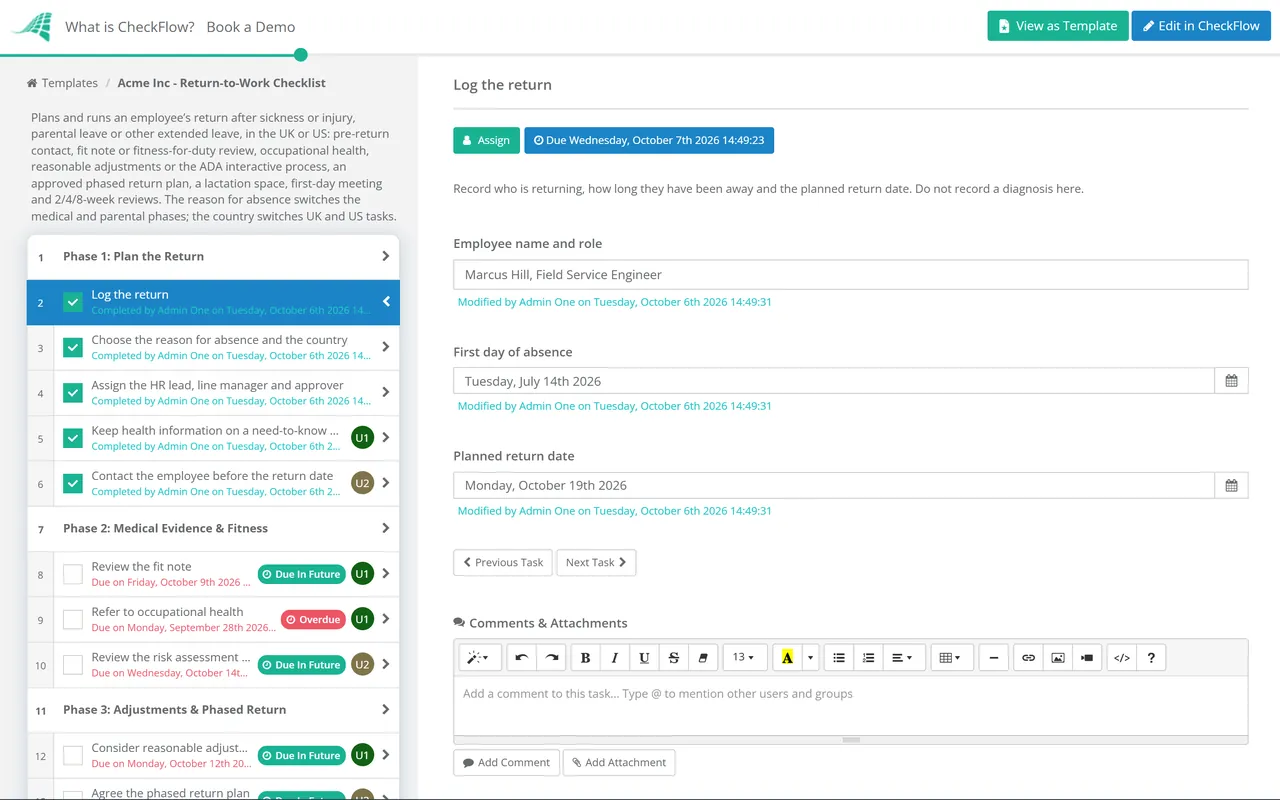
Six phases run from planning to the eight-week review. The reason for the absence decides whether the medical phase or the parental leave phase appears.

Phase 1

Phase 1: Plan the Return

  • Log the return — employee, manager, length of absence and planned return date
  • Choose the reason for absence and the country
  • Assign the HR lead, line manager and approver
  • Keep health information on a need-to-know basis
  • Contact the employee before the return date — how they are and what they need
Phase 2 — Sickness or Injury

Phase 2: Medical Evidence & Fitness

Shown when the absence was for sickness or injury.

  • Review the fit note — UK: what the “may be fit for work” advice says
  • Request a fitness-for-duty certification — US: only if your policy requires it
  • Refer to occupational health — with consent and specific questions
  • Review the risk assessment for the role
Phase 3

Phase 3: Adjustments & Phased Return

Shown for every return. Mark tasks not applicable when no adjustment or phased return is needed.

  • Consider reasonable adjustments — UK, under the Equality Act 2010
  • Start the ADA interactive process — US
  • Agree the phased return plan — hours, duties, pay and an end date
  • Approve the return plan
  • Arrange equipment and workplace changes
Phase 4 — Parental Leave

Phase 4: Returning from Parental Leave

Shown when the employee is returning from parental leave.

  • Confirm hours and any flexible working agreed
  • Arrange a private space to express milk — not a toilet or bathroom
  • Update the risk assessment for a new or breastfeeding mother — UK
  • Reconcile holiday, pay and benefit deductions
  • Plan a lighter first week
Phase 5

Phase 5: First Day Back

  • Re-enable system access and check equipment — before they arrive, not after
  • Hold the return-to-work meeting — using the agenda below
  • Brief them on what changed while they were away
  • Agree priorities for the first month
  • Tell the team only what the employee has agreed to share
Phase 6

Phase 6: Follow-Up Reviews

Due dates are set from the return date recorded in Phase 1.

  • Review at two weeks — hours, duties and adjustments
  • Review at four weeks — change the plan if it isn’t working
  • Review at eight weeks and close the phased return
  • Record lasting adjustments and close the checklist

A Phased Return Plan, Week by Week

The example below is for an office worker on a 37.5-hour week, returning after four months off following surgery, with a fit note suggesting a phased return over six weeks. It is an illustration, not a standard. Acas guidance is that the length of a phased return depends on the person, and should be agreed and then reviewed regularly. Build the real plan from the fit note or occupational health advice and from what the employee says they can manage.

Weeks Hours Duties Check-in
1–23 days a week, 4 hours a day (12 hours)Catch-up, reading, team meetings, one or two familiar tasks. No deadlines and no out-of-hours contactShort daily chat with the manager; formal review at the end of week 2
3–44 days a week, 5 hours a day (20 hours)Own workload back in part. Hand back the tasks cover found easiest to give upTwice-weekly chat; formal review at the end of week 4
5–64 full days (30 hours)Most of the normal role, still excluding travel and on-call workWeekly one-to-one
7–8Full contracted hours (37.5)Full role, with any adjustments that are stayingFinal review at week 8: close the plan, extend it, or ask occupational health for further advice

Agree pay before the plan starts. Acas says employees should receive their usual rate for the hours they work. Pay for the hours they don’t work depends on your policy: full pay, company sick pay or Statutory Sick Pay. SSP can only be paid for whole days not worked, never for part of a day. In the US, if the reduced hours are medically necessary, the time off can count as FMLA leave taken on a reduced schedule.

When the plan isn’t working. At any review, the choices are to slow the plan down, change the duties, extend the end date or ask occupational health for fresh advice. If the employee may be disabled, consider whether a permanent change to hours or duties is a reasonable adjustment, or whether another role would suit them better. Do not move a health-related dip into a performance process. A performance improvement plan is for problems that remain once adjustments are in place and working.

The Return-to-Work Meeting Agenda

Hold the meeting on the first morning, somewhere private, for 30 to 45 minutes. In the UK, Acas notes that a return-to-work meeting is not a legal requirement and is often an informal chat. It is still the single most useful thing on this page. The aim is a welcome and a plan, not a medical interview.

5 minutes

Welcome & wellbeing

  • How are you feeling about being back?
  • Is there anything you’d like us to know?
  • What would make this week easier?
10 minutes

What changed

  • Team changes and new faces
  • Projects, clients and systems
  • Policy, pay or structure changes
15 minutes

The plan

  • Hours and days for the next two weeks
  • Duties to pick up first, and what to avoid
  • Adjustments, equipment and breaks
5 minutes

Support & next steps

  • Who to talk to if it isn’t working
  • What colleagues will be told
  • Date of the two-week review

After a parental leave return, swap the medical questions for practical ones: childcare pick-up times, any agreed change to hours, and where the employee can express milk. In the UK the employer must provide somewhere suitable for a breastfeeding employee to rest, and the HSE says toilets are not suitable for expressing. In the US, the PUMP Act requires break time and a private space other than a bathroom for a year after the birth.

Why Run Returns in CheckFlow?

1

Reviews that actually happen

Enter the return date once. The pre-return call, the first-day tasks and the two, four and eight-week reviews are due relative to it and assigned to the line manager, so the plan is checked rather than forgotten after week one.

2

The right tasks for the reason

Conditional logic reads the reason for absence and the country. A return from surgery shows the fit note and occupational health tasks; a return from maternity leave shows the lactation space and flexible working tasks instead.

3

A record of what was agreed

The phased return plan is approved by a named person before it starts. Reviews are logged in a table, and the audit trail shows who completed each step and when, which matters if the return is ever disputed.

Returns are one part of the employee lifecycle. CheckFlow’s HR checklist software runs onboarding, leave, reviews and departures from templates, with assignments, due dates and approvals between HR and line managers.

Coming back from a new baby? The Parental Leave Checklist covers everything before this point, from the first notice to the return date. For someone returning to a remote or hybrid role, pair this template with the Home Office Setup Checklist.

Frequently Asked Questions

What should a return-to-work checklist include?

+

Contact with the employee before the return date, a check of any medical evidence, occupational health advice where needed, adjustments and a phased return plan with an end date, systems and equipment ready for the first morning, a return-to-work meeting, a briefing on what changed, and follow-up reviews. After parental leave, add hours, flexible working and a private space to express milk.

Is a return-to-work meeting a legal requirement?

+

Not in itself. Acas describes it as often an informal chat between the employee and their manager, and US federal law does not require one either. It is still worth holding for every long absence, because it is where adjustments are agreed and recorded, and the duty to make adjustments for a disabled employee is a legal requirement in both countries.

Can an employee come back before their fit note ends?

+

Yes. Government guidance for employers says an employee can return at any time, even before the fit note expires, and does not need a note saying they are fit. If the note says they may be fit for work with changes, discuss whether you can make them. The advice is not binding. If you cannot agree the changes, the same fit note serves as evidence for sick pay, as if it said not fit for work; the employee does not need a new one.

Can a US employer require a doctor’s note before someone returns?

+

After FMLA leave for the employee’s own serious health condition, yes, if a uniformly applied policy requires it for all similar employees and the designation notice said so. The certification can only address the condition that caused the leave. The employee pays for it, you cannot ask for a second opinion, and you cannot delay the return while you contact the provider. Any other medical inquiry must be job-related and consistent with business necessity under the ADA.

How long should a phased return last?

+

As long as the person needs, based on medical advice and how they are managing. There is no fixed length in law or in Acas guidance. Agree the plan, an end date and the review dates in writing before the return, and extend it at a review rather than letting it drift. If it becomes long-term, consider whether the reduced hours should become a permanent adjustment.

How should health information be handled?

+

As the most sensitive data you hold. In the UK it is special category data under UK GDPR, so you need a lawful basis and an extra condition to process it, and the ICO advises keeping absence records rather than sickness details where you can. In the US, the ADA requires medical information to be kept confidential and stored separately from the personnel file. In both, managers should be told about restrictions and adjustments, not diagnoses.

Is CheckFlow free for this template?

+

14-day free trial, no card required. The Business plan is $10 per user per month after the trial. Full details at checkflow.io/pricing.

Plan the Return Before the First Morning

Free trial — no credit card required.