
Flexible Working Request Checklist Template

A statutory request comes with dates you cannot miss: two months for the decision and any appeal, consultation before any refusal, and a refusal only for a reason the law lists. This checklist puts each step in order with its own due date.

Last reviewed: November 2026

Printed from checkflow.io/templates/human-resources/flexible-working-request-checklist

This free flexible working request checklist runs one statutory request from one employee in England, Scotland or Wales, from the day it arrives to the decision and any appeal. It follows sections 80F to 80I of the Employment Rights Act 1996, the Flexible Working Regulations 2014 and the Acas Code of Practice on requests for flexible working. HR checks the request and the employee’s earlier requests, works out the last day of the two-month decision period and acknowledges it. The manager who will decide prepares, assesses the change against the eight business reasons in the Act and holds the consultation meeting. The decision is the gate: an agreed request shows the letter, the contract change and any trial, and a refusal shows the reasons letter and the appeal instead. Northern Ireland has its own rules, and this checklist is not legal advice.

One Request, From the Day It Arrives to the Decision

In England, Scotland and Wales every employee can make a statutory request to change their hours, the times they work or where they work, from their first day in the job. The employer must handle it in a reasonable manner, consult the employee before any refusal, refuse only for one or more of the eight business reasons in the Act, and decide within two months, including any appeal, unless the employee agrees to longer.

This checklist runs one request for one employee. A request made when a parent comes back from leave can run beside the Parental Leave Checklist or the Return-to-Work Checklist. Two other checklists sit closest to it.

This checklist

One statutory request

Covers: one employee’s request, from the day it arrives to the decision and any appeal: the checks, the decision period, the meeting, the eight business reasons, the letter and the contract change.

Where: England, Scotland and Wales.

Output: a decision on time, with its reasons and a complete record.

A policy change

The Return to Office Checklist

Covers: bringing staff back to the office or setting office days for a whole team: the business reasons, contracts, consultation, desks and IT, and a 90-day review.

Where: the United Kingdom and the United States.

Use it: for the policy; run a request here for each employee who asks to work differently. Return to Office Checklist.

A disability

The Reasonable Accommodation Request Checklist

Covers: a request for a change at work linked to a health condition: the duty to make reasonable adjustments in Great Britain, or reasonable accommodation under the ADA.

Where: the United States and Great Britain.

Use it: when the request relates to a disability. Both can run at once, because the two duties are separate. Reasonable Accommodation Request Checklist.

What the Flexible Working Request Checklist Covers

Eight phases follow one statutory request from the day it arrives to the record. The date it was received sets the first due dates and the decision period; the consultation meeting date sets every due date after the meeting is arranged. Set the meeting at least eight business days after the request arrives, and early enough that the decision (four business days after the meeting) and any appeal (about 16 business days after it) fall inside the decision period, or agree an extension. Two or more earlier requests in 12 months show the not-a-statutory-request task, an earlier request still proceeding shows a note to the same effect, a request linked to a disability shows the reasonable adjustments task, and an extension shows the new last day. The manager’s decision is the gate: an agreed request or a trial shows Phase 6, a refusal shows Phase 7 with the appeal, and a withdrawn request shows the withdrawal letter.

  1. Phase 1

    Phase 1: Receive & Check the Request

    7 tasks

    Start this checklist the day a written request arrives. Enter the date it was received first: the due dates in this phase count in business days from it, and the two-month decision period runs from it.

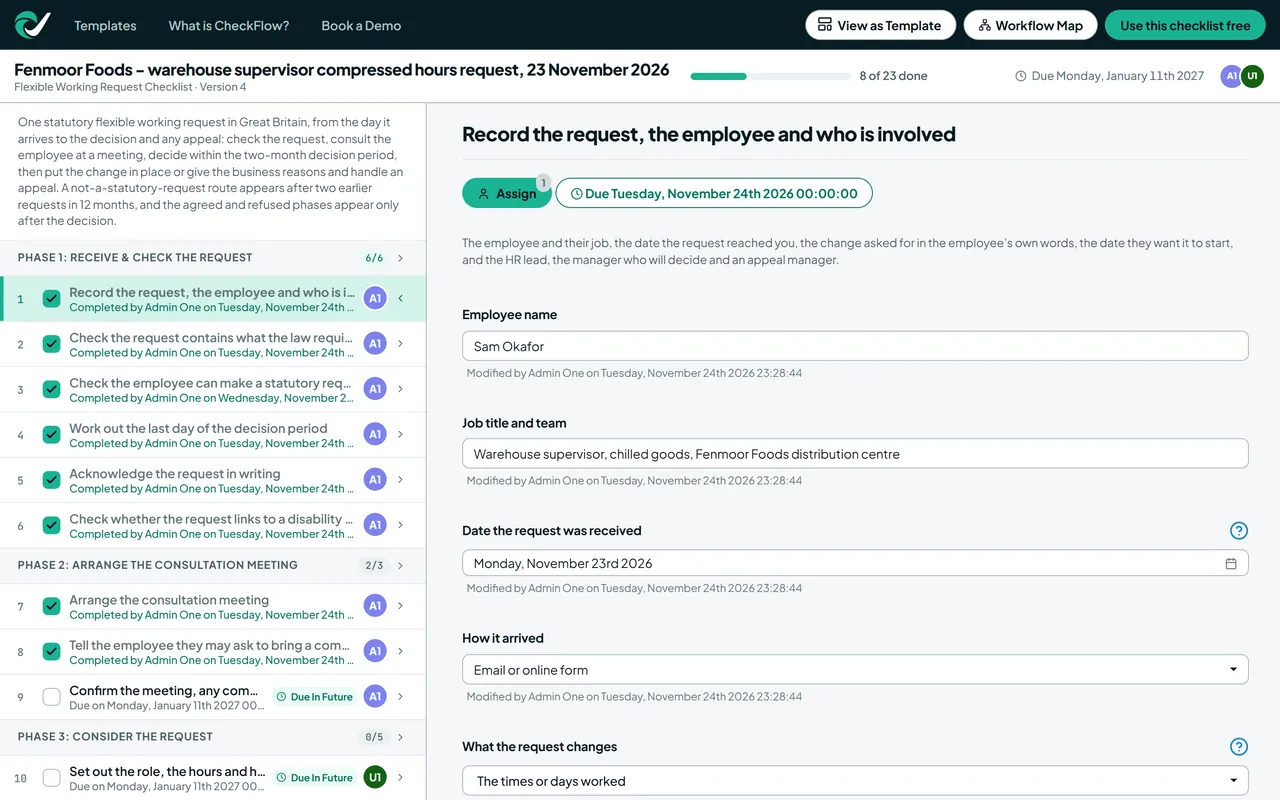
    • Record the request, the employee and who is involved — the employee and their job, the date the request reached you, the change asked for in the employee’s own words, the date they want it to start, and the HR lead, the manager who will decide and an appeal manager
    • Check the request contains what the law requires — in writing and dated, a statement that it is a statutory request, the change to hours, times or place of work and the date it should start, and whether and when the employee made an earlier request
    • Check the employee can make a statutory request now — an employee rather than an agency worker (unless returning from parental leave), no other statutory request of theirs still being decided or appealed, and fewer than two statutory requests in the 12 months before this one
    • Not a statutory request: tell the employee how you will handle it — the statutory route is not open, so say so in writing with the reason, and say whether you will consider the request informally
    • Work out the last day of the decision period — two months beginning with the date the request was received, covering the decision and any appeal, unless the employee agrees to a longer period
    • Acknowledge the request in writing — the date it was received, who will consider it, that you will meet to discuss it before any refusal, and the date by which you will decide
    • Check whether the request links to a disability or another protected characteristic — a request can also be a request for a reasonable adjustment, which is a separate duty, and every request must be handled without unlawful discrimination
  2. Phase 2

    Phase 2: Arrange the Consultation Meeting

    3 tasks

    You must consult the employee before refusing a request, unless you agree to it in full. Set the meeting date here: every later due date counts from it, so hold it early enough for a decision and any appeal before the decision period ends.

    • Arrange the consultation meeting — a private meeting in person, by video or, if neither is possible, by phone, held without unreasonable delay, with the time and place given in advance
    • Tell the employee they may ask to bring a companion — a fellow worker, a trade union representative or a trade union official; there is no statutory right to be accompanied, but Acas says allow a reasonable request
    • Confirm the meeting, any companion and any adjustments — a reminder of the time and place, who is coming, and anything the employee needs to take part; rearrange it if they cannot attend
  3. Phase 3

    Phase 3: Consider the Request

    6 tasks

    Before the meeting, look at the request with an open mind. The Acas Code asks you to assess the effect of the change on both the business and the employee, and the foreword to the Code says the starting position should be to consider what may be possible.

    • Set out the role, the hours and how the work is covered — the current pattern, the work done at each time of day and week, who covers it now, and what the requested pattern would change
    • Assess the effect of the change against each business reason — the eight reasons in the Employment Rights Act, from additional costs to planned structural changes, with the evidence for each and whether the effect could be managed
    • Note the benefits for the employee and the business — what the change would make possible for the employee, and any gain for the business, such as keeping a skilled person or cover at other times
    • Disability: consider reasonable adjustments as a separate duty — the duty to make reasonable adjustments under the Equality Act 2010 is separate from the right to request flexible working, so consider both before deciding
    • Work out alternatives and whether a trial would help — part of the request, a different pattern, or a trial period to test the change, ready to discuss if the request cannot be agreed in full
    • Check how similar requests in the team were handled — earlier requests for the same kind of role and their outcomes, so this decision is consistent or the difference can be explained
  4. Phase 4

    Phase 4: The Consultation Meeting

    4 tasks

    Talk it through before any decision. The meeting is where the facts, the alternatives and any trial are discussed, and it is how this template meets the duty to consult before any refusal.

    • Hold the consultation meeting — with an open mind: the request, its effect on both sides, the practical points, changes to the request, alternatives or a trial, and any adjustment linked to a disability
    • Write up the meeting record and share it with the employee — an accurate written record of the discussion, shared with the employee so both sides agree what was said
    • Follow up any points left open at the meeting — information either side agreed to find, a check with another team, or an alternative to cost, finished before the decision
    • Agree any extension of the decision period in writing — if the decision and any appeal will not fit before the last day of the decision period, agree a longer period with the employee and confirm it in writing
  5. Phase 5

    Phase 5: The Decision

    1 task

    The manager decides: agree in full, agree with changes or a trial, or refuse for one or more of the eight business reasons. This is the gate: nothing after it can be completed until the decision is made.

    • Decide the request — agree it in full, agree it with changes or a trial, or refuse it only for one or more of the eight business reasons after consulting the employee, before the last day of the decision period
  6. Phase 6

    Phase 6: Agreed: Put the Change in Place

    9 tasks

    Applies only when the request is agreed in full, with changes or as a trial. Confirm the arrangement in writing, talk through how it will work, and put the contract change in writing within one month.

    • Write to the employee confirming the agreed arrangement — the arrangement agreed, the date it starts, any trial period and its review date, and an invitation to discuss next steps
    • Discuss how the arrangement will work in practice — the start date, any change to pay or leave, handing over work, keeping in touch, training and the dates to review it, with a written record
    • Trial: agree how the trial will be judged — the trial’s length, what will be looked at, the review dates, and an extension of the decision period in writing if the trial ends after it
    • Give the employee the contract change in writing — a written statement of the changed terms within one month, or for a trial, the temporary terms and the review date
    • Update the rota, payroll and HR records — the new hours, times or place in the rota and the HR system, pay and holiday adjusted where hours change, and equipment or access for a new place of work
    • Tell the team what changes for them — the new cover and handover arrangements, without sharing the employee’s reasons for asking
    • Check how the arrangement is working — a conversation with the employee about six weeks after the meeting, or at the dates agreed, with any further change made by agreement or by a new request
    • Trial: review the trial with the employee before it ends — what worked, what did not and any changes, in a meeting before the trial ends; the due date assumes an eight-week trial
    • Trial: confirm the outcome in writing — the arrangement made permanent, changed, or ended for a business reason you can explain, within the decision period or the extension agreed
  7. Phase 7

    Phase 7: Refused: Reasons & Appeal

    7 tasks

    Applies only when the request is refused. Give the business reasons in writing and offer an appeal. There is no statutory right of appeal, but the Code calls it good practice, and any appeal must be decided within the decision period or any extension agreed.

    • Check the reasons against the facts before you write — each reason relied on is one of the eight in the Act and is supported by the facts found before and at the meeting
    • Write to the employee with the decision, the business reasons and how to appeal — the business reason or reasons, the information that explains them, and how and by when to appeal
    • Record whether the employee appeals — an appeal in writing by the date in the letter, with the reasons; with no appeal, the request is concluded
    • Appeal: arrange the appeal meeting — with the appeal manager, who was not involved before wherever possible, the time and place given in advance and the option of a companion
    • Appeal: hold the appeal meeting — impartially, on the grounds of appeal and any new information, with a written record of the discussion
    • Appeal: decide the appeal and write to the employee — what was decided and why, in writing, before the last day of the decision period or the extension agreed
    • Appeal upheld: put the agreed change in place — the arrangement confirmed in writing, the rota, payroll and records updated, and a written statement of the change within one month
  8. Phase 8

    Phase 8: Close & Records

    5 tasks

    Keep the record of every request: it is how you count two requests in 12 months, show the request was handled reasonably and make sure nobody is treated worse for asking.

    • Withdrawn: confirm the withdrawal in writing — when the employee withdraws, or you treat the request as withdrawn because they missed two meetings without good reason, tell them in writing
    • File the request, the meeting notes and every letter — the request, the acknowledgement, the meeting record, the decision, any appeal and the written statement of the change, in the employee’s file
    • Log the request for the two-in-12-months count — the date received and the outcome in your flexible working log, so the next request from this employee can be checked
    • Check the employee is not treated worse for asking — with the manager, that rotas, overtime, reviews and opportunities have not changed because the employee made a request
    • Close the request and note any change to your policy — what went well, what took too long, and any change needed to your flexible working policy, the handbook or manager training

Statutory Flexible Working Requests at a Glance

The statutory route at a glance

What the law and the Acas Code say about one request, with the provision each point comes from.

PointThe rule in Great BritainSource
Who can askAny employee, from the first day of the job; agency workers only when returning from parental leaveERA 1996 s.80F(8); Acas Code para 3
What can changeThe hours, the times of work, or where the employee works as between home and a place of businesss.80F(1)
What the request must sayIn writing and dated; that it is a statutory request; the change and the date it should start; whether and when an earlier request was mades.80F(2); Flexible Working Regulations 2014 reg 4
How manyTwo in any 12 months, and none while another is still proceedings.80F(4)
When it counts as madeThe day it is received: an email on the day sent (where the employer accepts email requests), a letter on the day it would arrive by post, a handed-in letter on the day handed inRegulations 2014 reg 5
Decision periodTwo months beginning with the date it was made, covering any appeal, unless both sides agree to longers.80G(1)(aa), (1A) to (1C)
ConsultationNo refusal unless the employee has been consulted; the Code says invite them to a meetings.80G(1)(aza); Acas Code para 12
Grounds for refusalOnly one or more of eight business reasons, from additional costs to planned structural changess.80G(1)(b)
Telling the employeeWrite with the decision; for a refusal, the business reasons and how to appealAcas Code paras 20 to 25
AppealNo statutory right, but offering one is good practice; any appeal is decided within the decision periodAcas Code paras 25 to 30
Missed meetingsTreated as withdrawn after two missed meetings without good reason, but only once the employee is tolds.80G(1D)
Contract changePut changed terms in writing within one monthAcas; ERA 1996 s.4
Tribunal complaintsFailing to handle the request properly, a refusal based on incorrect facts, or wrongly treating it as withdrawn; six months to claim where the problem arose on or after 1 October 2026s.80H; GOV.UK

What has changed and what is coming

Flexible working law in Great Britain changed in 2024 and is changing again under the Employment Rights Act 2025. Dates still to come are the government’s expectations and depend on Parliament.

ChangeStatus on 24 November 2026Source
Day-one right, two requests in 12 months, two-month decision period, consultation before refusalIn force since 6 April 2024Employment Relations (Flexible Working) Act 2023; SI 2023/1328
Six-month time limit for tribunal claims (was three months)In force since 1 October 2026Employment Rights Act 2025 Sch 12; SI 2026/954
A refusal must be reasonable on the business reason given, and the letter must explain whyNot yet in force (only for making regulations); GOV.UK expects October 2027Employment Rights Act 2025 s.9; SI 2026/3
Consultation steps set out in regulationsRegulations still to be made; expected with the change aboveEmployment Rights Act 2025 s.9(5)
An updated Acas Code of PracticeDraft out for consultation until 17 December 2026; the 2024 Code still appliesAcas

Sources. The Employment Rights Act 1996, sections 80F to 80I, the Flexible Working Regulations 2014, the Acas Code of Practice on requests for flexible working (April 2024) and its 2026 draft, GOV.UK’s flexible working guide and the government’s Employment Rights Act timeline, all read on 24 November 2026. Northern Ireland has its own rules (nidirect). This table is not legal advice.

Why Run Flexible Working Requests in CheckFlow?

1

No request runs out of time

Enter the date the request arrived and the date of the meeting, and every step gets a due date counted in business days, and the last day of the two-month decision period is recorded at the start, so the decision and any appeal can be planned inside it. Open requests show on the Reports Grid, and overdue alerts go to the people assigned.

2

A refusal never changes the contract

The manager’s decision is a gate. Agreed in full, with changes or as a trial shows the letter, the contract change and the trial review. Refused shows only the reasons letter and the appeal, assigned to an appeal manager named at the start. See how approval steps work.

3

Reasons you can show

The eight business reasons sit in a table on the assessment task, with the evidence for each, and the activity log shows who did what and when. Two earlier requests in 12 months show the informal route, and a request linked to a disability shows the reasonable adjustments task.

CheckFlow does not decide whether a request should be agreed or whether a business reason applies. The manager decides, with HR and, where needed, legal advice. CheckFlow makes sure each step happens on time, that every task has an owner and that the request leaves a complete record. HR checklist software shows how requests, leave and reviews run from templates across a team.

When the request relates to a disability, run the Reasonable Accommodation Request Checklist alongside it. Plan a parent’s leave with the Parental Leave Checklist, set office days for a team with the Return to Office Checklist, handle a complaint about the outcome with the Grievance Procedure Checklist, and publish your flexible working policy with the Employee Handbook Update & Rollout Checklist.

AI generator

Didn’t find what you need? Describe it.

Describe the process in a sentence and the AI checklist generator drafts the phases and tasks for you.

Frequently Asked Questions

What should a flexible working request checklist include?

Every step of one statutory request: recording the date it arrived, checking it contains what the law requires and that the employee can make it, working out the last day of the decision period, acknowledging it, a consultation meeting, an assessment against the eight business reasons, the decision, a written outcome, the contract change or an appeal, and the records. This template puts them in that order with due dates.

How long does an employer have to decide a flexible working request?

Two months beginning with the date the request was received, and that period also covers any appeal (section 80G of the Employment Rights Act 1996). The employer and employee can agree a longer period, before it ends or within three months after. Acas says confirm any extension in writing. This template works out the last day in Phase 1 and asks about an extension after the meeting.

How many flexible working requests can an employee make in a year?

Two statutory requests to the same employer in any 12 months, and only one at a time: a new request cannot be made while an earlier one is still being decided or appealed. The right applies from the first day of employment. An employee who has already made two can still ask informally, and this template shows a task to explain that.

On what grounds can an employer refuse a flexible working request?

Only for one or more of eight business reasons in section 80G: additional costs, customer demand, being unable to reorganise work or recruit, quality, performance, too little work at the proposed times, and planned structural changes. The employer must consult the employee first. When the Employment Rights Act 2025 change starts, expected in October 2027, the refusal must also be reasonable and the letter must explain why.

Does an employer have to meet the employee before refusing?

Since 6 April 2024 an employer cannot refuse a statutory request unless it has consulted the employee. The Acas Code says to invite them to a meeting held without unreasonable delay, in private, in person or by video, or by phone if neither is possible. No meeting is needed if you agree to the request in full. Allowing a companion is good practice.

Can an employee appeal a refused flexible working request?

There is no statutory right of appeal, but the Acas Code calls offering one good practice, and the refusal letter should say how and by when to appeal. A manager not involved before should hear it where possible, and the appeal decision must be given within the same two-month decision period unless it is extended. This template shows the appeal tasks only when an appeal is made.

What does the Employment Rights Act 2025 change for flexible working?

It adds a test that a refusal must be reasonable on the business reason given, a duty to explain why in the letter, and consultation steps to be set out in regulations. On 24 November 2026 section 9 was in force only for making regulations; GOV.UK expects the change in October 2027, and Acas’s draft updated Code is out for consultation until 17 December 2026. The six-month tribunal time limit already applies.

Do the same flexible working rules apply in Northern Ireland?

No. This template follows the law in England, Scotland and Wales. In Northern Ireland, nidirect says an employee needs 26 weeks’ continuous service and can make one statutory request in 12 months. Use Northern Ireland’s own guidance for a request there.

Is CheckFlow free for this template?

14-day free trial, no card required. The Business plan is $10 per user per month after the trial. Full details at checkflow.io/pricing.

Answer Every Flexible Working Request on Time

Free trial — no credit card required.

14-day free trial, no credit cardFull refund in your first 30 daysUS hosting, EU on request