Layered Process Audit (LPA) Checklist Template

Layered audits only work when every layer audits on time, every failure is fixed or raised as an action, and the questions change when the line does.

Last reviewed: November 2026

Printed from checkflow.io/templates/quality-assurance/layered-process-audit-checklist

This free layered process audit (LPA) checklist is for quality managers, LPA co-ordinators and production managers in plants that run short, frequent audits of their process controls, in automotive supply and elsewhere. One run is one LPA cycle, a month, on one line or area. The co-ordinator reads the last cycle’s results, reviews the questions for each layer against the control plan, the PFMEA and recent complaints, rotates them, publishes the schedule and briefs the auditors. Each week the team leader’s daily audits and the supervisor’s weekly audit are recorded with OK or Not OK for each question, and the plant manager audits once in the cycle. Failures are fixed on the spot or raised as actions, overdue actions and repeat failures are escalated, and the reviewer signs off the results and trends before the question changes pass to the next cycle. The layers and frequencies are this template’s default: use the ones in your plant’s own LPA plan.

Layered Process Audit, Compliance Audit or Gemba Walk?

A layered process audit is a short check, done often, that the controls a process depends on are in place: the right work instruction at the station, the error-proofing device working, the first-off check signed, the gauge in calibration. It is layered because people at different levels of the plant ask the questions, from team leaders on every shift to the plant manager. AIAG publishes the CQI-8 Layered Process Audit Guideline (2nd Edition), and a vehicle maker’s customer-specific requirements can ask its suppliers to run layered audits, as General Motors’ and Stellantis’ do. This checklist runs one month of them on one line.

An LPA sits beside the plant’s other audits without replacing them. The ISO 9001 Internal Audit Checklist checks the quality management system against the standard on the plant’s audit programme, and the 5S Audit Checklist scores how well an area keeps Sort, Set in Order, Shine, Standardise and Sustain. An LPA question can cover one of their points, but it is checked in minutes, at the line, and fixed on the spot where it can be.

This checklist

Layered process audit

Asks: are the controls this process depends on in place today, at this station?

When: daily, weekly and monthly through a cycle, by team leaders, supervisors and managers, as the plant’s LPA plan sets.

Output: OK or Not OK for each question, failures fixed on the spot or raised as actions, results and trends by layer, and the questions for the next cycle.

Compliance audit

QA compliance audit

Asks: does this process or system meet its requirements, procedures and standards?

When: on the audit programme, by trained auditors, in the QA Compliance Audit Process Checklist.

Output: findings graded as non-conformances, corrective actions and a report to management. An LPA failure that needs a root cause goes to a corrective action instead.

Observation

Gemba walk

Asks: how is the work really done here, and what gets in the way of the people doing it?

When: regularly, led by managers who go and see, in the Gemba Walk Checklist.

Output: observations and agreed actions, with no pass or fail. An LPA asks set questions and records an answer to each.

What the Layered Process Audit Checklist Covers

Nine phases follow one LPA cycle on one line. Phase 1 sets up the cycle and reviews the questions for each layer, Phase 2 publishes the schedule and briefs the auditors, Phases 3 to 6 record each week’s audits with OK or Not OK for each question, and Phases 7 to 9 follow up the actions, review the results and pass the question changes to the next cycle. An open customer complaint or rejection adds an audit of the process that caused it in week 1 and a check of its corrective action at the end. Overdue actions add a task to escalate them, and a repeat failure also adds a task to open a corrective action. Nothing after the cycle review can be completed until the reviewer signs it off, and a review that is not yet approved adds a task for the co-ordinator first.

  1. Phase 1

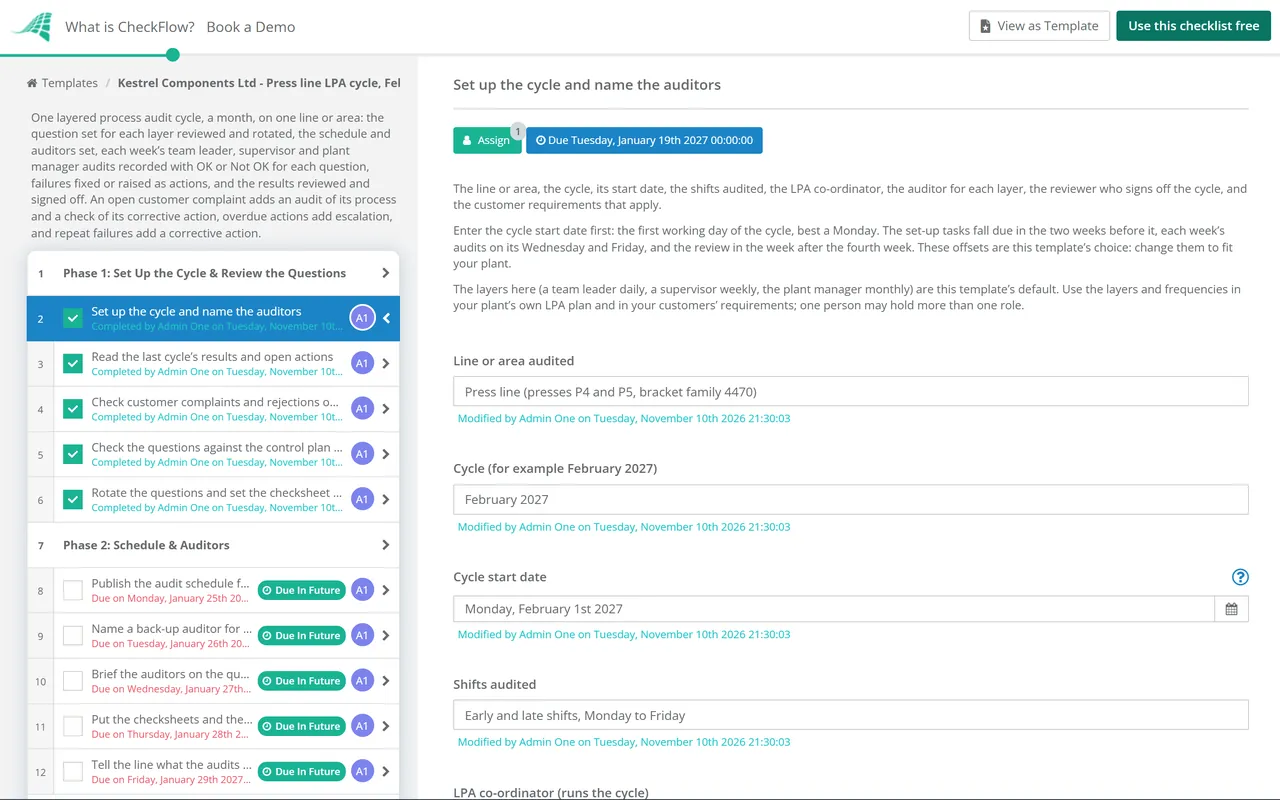
    Phase 1: Set Up the Cycle & Review the Questions

    5 tasks

    The LPA co-ordinator sets up the cycle in the two weeks before it starts. Enter the cycle start date on the first task first: every due date counts in working days from it. Then check what the last cycle found and review the questions for each layer.

    • Set up the cycle and name the auditors — the line or area, the cycle, its start date, the shifts audited, the LPA co-ordinator, the auditor for each layer, the reviewer who signs off the cycle, and the customer requirements that apply
    • Read the last cycle’s results and open actions — the pass rate by layer and by question, the audits missed, repeat failures, actions still open, and questions that always pass
    • Check customer complaints and rejections on this line — complaints, returns and customer rejections since the last cycle, and internal scrap or rework that points at a process control
    • Check the questions against the control plan and PFMEA — each question tied to a control the process depends on, such as a key characteristic, a check, an error-proofing device or a work instruction, and the changes to the line, the product or the control plan since the last review
    • Rotate the questions and set the checksheet for each layer — keep the core questions, retire ones that always pass, add ones from failures, complaints and changes, and word each one so it is answered yes or no by looking
  2. Phase 2

    Phase 2: Schedule & Auditors

    5 tasks

    In the week before the cycle the co-ordinator publishes the schedule, arranges cover and briefs the auditors, so every audit has a name and a date before the first shift of the cycle.

    • Publish the audit schedule for each layer — who audits on which day and shift, the weekly supervisor audits and the plant manager’s audit, posted where the line and the auditors can see it
    • Name a back-up auditor for each layer — cover for holidays, absence, shift changes and planned shutdowns, so an audit moves to someone else rather than being missed
    • Brief the auditors on the questions and the method — what changed in the question set, how to check by looking rather than asking, how to fix a failure on the spot and when to raise an action instead, with new auditors trained before their first audit
    • Put the checksheets and the action route at the line — the current checksheets at the point of use, old ones removed, the board or log for results and actions, and who to call when a failure cannot be fixed
    • Tell the line what the audits are for — the operators and team leaders know the audits check the process and its controls, not the people, and that a failure found and fixed is a good result
  3. Phase 3

    Phase 3: Week 1 Audits

    4 tasks

    Week 1 starts on the cycle start date. The team leader audits every day the line runs, the supervisor audits once in the week, and failures that could not be fixed on the spot become actions by Friday. An open complaint adds an audit of the process that caused it.

    • Audit the process behind the complaint — the supervisor audits the process that caused the open complaint or rejection, with questions on its cause and its containment, early in week 1
    • Do the supervisor’s audit for week 1 — the layer 2 auditor checks the line against the checksheet, records OK or Not OK for each question, fixes what can be fixed and gives the rest an action number
    • Record the team leader’s daily audits for week 1 — one row for each day the line ran: the questions checked, how many were not OK, which ones, and whether each was fixed on the spot or raised as an action
    • Raise actions for week 1’s failures — each failure not fixed on the spot gets an action with an owner and a date, and a failure that affects product goes to the supervisor the same day
  4. Phase 4

    Phase 4: Week 2 Audits

    3 tasks

    The same audits in the second week. The supervisor checks that week 1’s fixes have held as well as asking the checksheet’s questions.

    • Do the supervisor’s audit for week 2 — the layer 2 auditor checks the line against the checksheet, records OK or Not OK for each question, and checks that last week’s fixes have held
    • Record the team leader’s daily audits for week 2 — one row for each day the line ran, with the questions not OK and whether each was fixed on the spot or raised as an action
    • Raise actions for week 2’s failures — each failure not fixed on the spot gets an action with an owner and a date, and a question that failed in both weeks is marked as a repeat
  5. Phase 5

    Phase 5: Week 3 Audits & the Plant Manager’s Audit

    4 tasks

    The third week adds the top layer: the plant manager audits the line once in the cycle, looks at the results so far and talks to the operators.

    • Do the supervisor’s audit for week 3 — the layer 2 auditor checks the line against the checksheet, records OK or Not OK for each question, and checks the open actions from weeks 1 and 2
    • Do the plant manager’s audit — the layer 3 auditor checks a sample of the questions at the line, looks at the results board and the open actions, and asks the operators what gets in the way
    • Record the team leader’s daily audits for week 3 — one row for each day the line ran, with the questions not OK and whether each was fixed on the spot or raised as an action
    • Raise actions for week 3’s failures — each failure not fixed on the spot, including those the plant manager found, gets an action with an owner and a date
  6. Phase 6

    Phase 6: Week 4 Audits

    3 tasks

    The last week of the cycle. This template’s cycle is four weeks: in a month with a fifth week, either start the next cycle on its Monday, or add the fifth week’s days to week 4’s table and do Phases 7 and 8 when it ends.

    • Do the supervisor’s audit for week 4 — the layer 2 auditor checks the line against the checksheet, records OK or Not OK for each question, and lists the actions still open
    • Record the team leader’s daily audits for week 4 — one row for each day the line ran, with the questions not OK and whether each was fixed on the spot or raised as an action
    • Raise actions for week 4’s failures — each failure not fixed on the spot gets an action with an owner and a date before the cycle closes
  7. Phase 7

    Phase 7: Actions & Escalation

    5 tasks

    After the fourth week the co-ordinator checks which audits were missed and follows every open action. Overdue actions add a task to escalate them, a question failing again and again also adds a corrective action, and an open complaint adds a check that its corrective action holds.

    • Check the audits done against the schedule — the audits planned and done for each layer, the ones missed and why, and where the cover did not work
    • Follow up every open action from the cycle — each action’s owner, date and status, closed only when the fix has been checked at the line
    • Escalate overdue actions and repeat failures — overdue actions and questions that failed on three or more audits go to the next layer up, with what is needed to close them
    • Open a corrective action for a repeat failure — a question that keeps failing needs its root cause found through the plant’s corrective action process, not another fix on the spot
    • Check the complaint’s corrective action with a layered audit — a layered audit of the process behind the complaint confirms the corrective action is in place and holding before the complaint is closed
  8. Phase 8

    Phase 8: Results Review & Sign-Off

    5 tasks

    The co-ordinator works out the results and the trends, and the reviewer signs off the cycle. Nothing after the sign-off can be completed until the reviewer completes it.

    • Work out the results by layer — the audits planned and done, the questions checked, the number not OK and the pass rate for each layer and for the cycle
    • Find the questions that failed most and the trends — the questions with the most failures, failures repeated across layers or weeks, and how this cycle compares with the last
    • Compare the audit results with the line’s quality results — scrap, rework, complaints and downtime beside the pass rate, since a high pass rate on a line with quality problems suggests the questions are missing something
    • Do what the cycle review asked for — the extra audits, actions or analysis the reviewer asked for, done before the reviewer changes the decision and completes the review
    • Review and sign off the cycle — the reviewer reads the results, the trends, the missed audits and the open actions, and approves the question changes for the next cycle
  9. Phase 9

    Phase 9: Next Cycle

    4 tasks

    Applies only when the cycle review is approved or approved with conditions. The co-ordinator shares the results, carries the open actions and the question changes into the next cycle and files the records.

    • Share the results with the line — the pass rate, the questions that failed most and what was done about them, on the line’s board and at the team brief
    • Record the question changes for the next review — the questions to retire, add or reword and why, ready for the next cycle’s question review
    • Carry open actions into the next cycle — the actions still open, with their owners and dates, listed for the next cycle’s first task
    • File the cycle’s records — the checksheets, results, actions and sign-off, kept where the plant keeps its quality records for as long as its record rules say

LPA Layers, Frequencies and What Each Layer Checks

The layers, people and frequencies below are this template’s default for one line, set by practice rather than by any rule. Use the ones in your plant’s own LPA plan and in your customers’ requirements; a plant with more lines or shifts adds rows, not layers.

Layer Who audits (this template) How often (this template) What they look at
Layer 1Team leader or area leaderEvery day the line runs, on the shifts the plan namesThe line’s own controls: the work instruction at each station, first-off and patrol checks, error-proofing, gauges, labels and the segregation of rejects
Layer 2Production supervisorOnce a weekThe same checksheet with fresh eyes, whether last week’s fixes have held, and whether actions are moving
Layer 3Plant manager or a member of the management teamOnce a monthA sample of the questions at the line, the results board and open actions, and what the operators say gets in the way
Complaint auditSupervisor or managerAfter a customer complaint or rejection, and again to check its corrective actionThe process that caused the issue, its containment, and whether the fix holds

Writing questions. Each question should be answered yes or no by looking at the process, a record or a device, not by asking the operator whether they follow it. Tie each one to something the control plan or the PFMEA says matters. This template rotates questions that always pass and adds ones from failures, complaints and changes. AIAG’s page for the CQI-8 guideline says the 2nd Edition gives “expanded guidelines for writing effective LPA checksheet questions”; the guideline itself is a paid document and is not quoted here.

Customer requirements. IATF 16949:2016 has a clause on manufacturing process audits (9.2.2.3); it is a paid standard and is not paraphrased here. Vehicle makers add their own customer-specific requirements, published on the IATF’s site. General Motors’ requirements for IATF 16949 (effective 30 October 2025) ask its certified suppliers to run layered process audits under that clause: led by competent management, with a schedule of frequencies and locations, layers that “include different levels of employees, including top management”, an audit triggered by customer complaints or rejections, all departments covered, findings recorded and measured, findings not corrected during the audit moved to an action plan, records kept, questions reviewed periodically, and layered audits as part of corrective action verification. Stellantis’ requirements (Version 1, effective July 2025) also ask suppliers to run layered process audits under 9.2.2.3, in all manufacturing and logistics areas and on all shifts. Other customers ask for different things or nothing: read the requirements of each customer the line supplies. GM’s list covers all departments, so a GM supplier runs one checklist for each line or area its plan names, offices included. The IATF says a second edition of IATF 16949 is being written, with publication planned for mid-2027 and dates it calls indicative (Stakeholder Communiqué SC-2026-005, July 2026).

Why Run Layered Process Audits in CheckFlow?

1

Every layer audits on time, or someone knows why

The co-ordinator, the auditor for each layer and the reviewer are chosen on the first task, and each week’s audits are assigned to the person who does them with a due date counted from the cycle start. After the fourth week the co-ordinator records the audits planned and done for each layer, so a missed audit is a fact rather than a gap in a spreadsheet.

2

A failure is fixed or it becomes an action

Each week ends with a task that turns every failure not fixed on the spot into an action with an owner and a date. When actions run late or a question keeps failing, the checklist adds tasks to escalate them and to open a corrective action.

3

The questions keep up with the line

The cycle starts by checking the questions against the control plan, the PFMEA and recent complaints, and ends by recording the changes for the next review. An open complaint adds an audit of the process that caused it and a later check that its corrective action holds.

4

The cycle closes with a sign-off

The reviewer signs off the results and trends before the cycle closes, and nothing after that approval step can be completed until they do. Each month’s run shows its progress in the Reports Grid, and a schedule can start the next cycle’s checklist every month (recurring checklists; enter the cycle start date on each new run).

CheckFlow does not replace your checksheets, your control plan or your corrective action system. It runs the cycle around them: who audits when, what each audit found, which failures became actions, what was escalated and what changes for next month. CheckFlow’s manufacturing checklist software shows how plants run their other routines the same way.

Find the controls worth auditing with the FMEA Checklist, work a repeat failure through the CAPA (Corrective & Preventive Action) Checklist or the Root Cause Analysis (8D) Checklist, and write down a new way of working with the Process Standardization Checklist.

AI generator

Didn’t find what you need? Describe it.

Describe the process in a sentence and the AI checklist generator drafts the phases and tasks for you.

Frequently Asked Questions

What is a layered process audit?

A layered process audit, or LPA, is a short and frequent check that the controls a process depends on are in place, done by people at several levels of the plant. Team leaders audit often, supervisors less often and managers less often again, each asking set questions answered yes or no at the line. Failures are fixed on the spot where possible and raised as actions where not. AIAG’s guideline for them is CQI-8.

What are the layers in a layered process audit?

Each layer is a level of the organisation. This template uses three: a team leader who audits every day the line runs, a supervisor who audits once a week and the plant manager who audits once a month, plus an audit of the process behind any customer complaint. General Motors’ requirements, for example, say the layers must include top management. Use the layers your plant’s LPA plan and your customers set.

How often should layered process audits be done?

No single rule sets it. The frequencies are set by the plant’s own LPA plan and by any customer requirement that applies; General Motors’ requirements, for example, ask for a schedule that includes the frequency and locations of audits. This template’s default is daily for team leaders, weekly for supervisors and monthly for the plant manager, in a monthly cycle. Change the offsets to fit your plan.

What questions go on an LPA checklist?

Questions about the controls that matter most on that line, each answered yes or no by looking: is the work instruction at the station current, is the error-proofing device working, was the first-off check signed, is the gauge in calibration, are rejects segregated. Tie each to the control plan or PFMEA, keep the same numbers on every layer’s checksheet, and rotate questions that always pass.

What happens when an LPA question fails?

The auditor fixes it on the spot if that can be done safely there and then, and records the failure either way. A failure that cannot be fixed during the audit becomes an action with an owner and a date, followed until someone has seen the fix at the line. If product may be affected, the supervisor is told at once. Repeat failures and overdue actions are escalated and given a corrective action.

Does IATF 16949 require layered process audits?

IATF 16949:2016 is a paid standard, so its wording is not quoted here; its clause 9.2.2.3 covers manufacturing process audits. Vehicle makers can add a requirement for layered audits through their customer-specific requirements. General Motors’ requirements (effective 30 October 2025) and Stellantis’ (effective July 2025) ask their suppliers to run them under that clause. Read the requirements of each customer you supply, and ask your certification body how they audit them.

What is the AIAG CQI-8 guideline?

CQI-8 is AIAG’s Layered Process Audit Guideline, now in its 2nd Edition. AIAG’s page says it covers the LPA planning team, roles and responsibilities, writing checksheet questions, conducting audits and recording findings, linking LPA to key performance indicators, management review and LPA metrics. It is a paid document; this template does not quote it or depend on it.

How is a layered process audit different from a gemba walk or a 5S audit?

A layered process audit asks set questions about process controls and records OK or Not OK for each. A gemba walk watches the work and asks open questions, with no pass or fail, in the Gemba Walk Checklist. A 5S audit scores how well an area is organised and kept, in the 5S Audit Checklist. A plant can run all three: each answers a different question.

Is CheckFlow free for this template?

14-day free trial, no card required. The Business plan is $10 per user per month after the trial. Full details at checkflow.io/pricing.

Run Every Layer of Every Audit, Every Month

Free trial — no credit card required.

14-day free trial, no credit cardFull refund in your first 30 daysUS hosting, EU on request