CAPA (Corrective & Preventive Action) Checklist Template

Auditors rarely fault the fix. They fault the CAPA closed the day the fix went in, with no evidence that it worked and no answer to whether the same thing could happen on the next line.

A CAPA is the formal loop a quality system runs whenever something does not meet a requirement. This free CAPA checklist takes one record from intake to closure: log the source, correct and contain, rate the risk and decide whether corrective action is needed at all, investigate, plan and approve the actions, implement them through change control, and check effectiveness against criteria set before any work started. Supplier-caused problems add a SCAR, and medical device manufacturers get the extra checks ISO 13485 asks for.

Use This Template Free See Live Example
No Credit Card Required

What the Standards Ask of a CAPA Process

The wording differs between frameworks, but the skeleton is shared: react to the problem, decide whether its cause needs removing, act in proportion to the risk, and prove the action worked. The table summarises where each framework puts it. It is a summary, not the text, so check the current edition you are certified or inspected against.

FrameworkWhereWhat it expects
ISO 9001:202610.2 Nonconformity and corrective actionControl and correct the nonconformity and deal with its consequences; evaluate whether the cause needs eliminating, including whether similar nonconformities exist or could occur; implement, review effectiveness, update risks and opportunities if needed, and keep documented information. Published accounts say this clause changed little from 2015.
ISO 9001:20266.1 Risks and opportunitiesNo separate preventive action clause, as in 2015. Prevention comes through planning for risks, which the 2026 edition now treats separately from opportunities.
ISO 13485:20168.5.2 Corrective action and 8.5.3 Preventive actionDocumented procedures for both, with actions proportionate to the effects. Corrective actions must be checked so they do not harm regulatory compliance or the safety and performance of the device, and their effectiveness reviewed.
FDA QMSR, 21 CFR Part 820In force since 2 February 2026Part 820 now incorporates ISO 13485:2016 by reference, plus FDA’s own supplemental provisions. The old Quality System Regulation section 820.100 on CAPA is gone; the requirement now arrives through clauses 8.5.2 and 8.5.3.

A CAPA record is not a defect log and it is not an investigation method. Individual defects found at inspection are triaged in the Defect Reporting & Resolution Checklist, and only the ones that matter become CAPAs. When a CAPA needs a full team investigation, it calls the Root Cause Analysis (8D) Checklist and waits for its verified root cause. This checklist owns everything around that: the decision to act, the approved plan, the evidence and the closure.

What the CAPA Checklist Covers

Seven phases follow one CAPA record. A correction-only answer at triage skips straight to closure with a recorded reason. The investigation method decides which analysis task appears, supplier problems add the SCAR tasks, and medical device work adds the ISO 13485 checks. The quality manager approves the action plan and, after the effectiveness check, the closure.

Intake

Phase 1: Log the CAPA

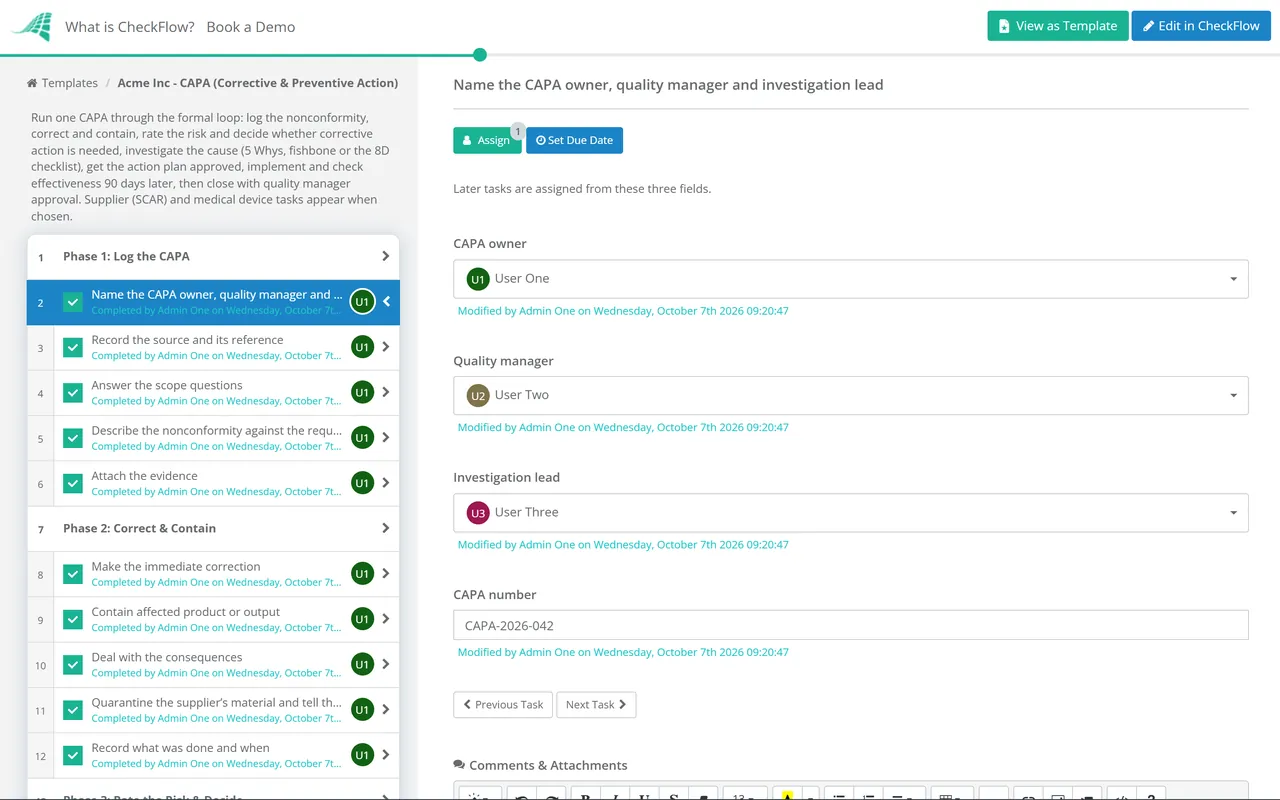
Owned by the CAPA owner. Scope questions: supplier-caused (Yes/No), regulated medical device QMS (Yes/No). The source dropdown (Audit finding / Customer complaint / Internal nonconformity / Supplier / Trend / Near miss) is kept for the record and the trend report.

  • Name the CAPA owner, quality manager and investigation lead — later tasks are assigned from these three fields
  • Record the source and its reference — audit finding, customer complaint, internal nonconformity, supplier, trend or near miss, with the audit, complaint or report number
  • Answer the scope questions — whether a supplier caused the problem, and whether this CAPA sits in a regulated medical device QMS
  • Describe the nonconformity against the requirement — what the procedure, specification or contract required, what was found, and where
  • Attach the evidence — the audit report, complaint, photos, measurements or records that show the gap
Contain

Phase 2: Correct & Contain

Assigned to the CAPA owner. Correction deals with the item in front of you; it does not touch the cause. The supplier task is shown only when “Supplier-caused?” is Yes.

  • Make the immediate correction — rework the part, re-issue the document, recalibrate the gauge or complete the missed training
  • Contain affected product or output — hold stock, stop shipments and check what has already gone out since the last good check
  • Deal with the consequences — customer notices, credits, re-inspection or a re-audit, as the situation needs
  • Quarantine the supplier’s material and tell the supplier — lot numbers, quantities and the date of the hold
  • Record what was done and when — the correction and containment dates are the baseline for everything that follows
Triage

Phase 3: Rate the Risk & Decide

Assigned to the quality manager. Scope question: is corrective action needed (Yes / No, correction only). No hides Phases 4 to 6 and shows the reason task. The reporting task is shown only for a regulated medical device QMS.

  • Rate the risk — severity and likelihood of recurrence on your own risk matrix, with the score recorded
  • Search for earlier occurrences — the CAPA log, complaints and audit history for the same nonconformity here or at other sites
  • Decide whether corrective action is needed — Yes, or No when a correction alone is proportionate to the risk
  • Record why a correction is enough — for example a one-off, low risk, with the cause already known and removed
  • Assess regulatory reporting — the regulatory lead decides under your complaint handling and vigilance procedures whether this must be reported
Investigate

Phase 4: Investigate the Cause

Assigned to the investigation lead and hidden for correction only. Scope question: investigation method (5 Whys / Fishbone / 8D using the RCA checklist), which shows the matching task. The SCAR tasks are shown only when “Supplier-caused?” is Yes.

  • Choose the investigation method — 5 Whys, Fishbone, or 8D using the RCA checklist, in proportion to the risk rating
  • Run a 5 Whys with the people who do the work — one chain of causes, stopping at a cause the organisation controls
  • Draw a fishbone and test the likely causes — collect data on the two or three strongest candidates before picking one
  • Run the Root Cause Analysis (8D) Checklist and link it here — paste the link to the 8D run and record its verified root cause
  • Issue a supplier corrective action request (SCAR) — the nonconformity, the evidence and a date for the supplier’s root cause and actions
  • Review the supplier’s response — send it back if the cause is “operator error” or the action is “retrain” with nothing else
  • Record the root cause with its evidence — one or two sentences a stranger could check against the data
Plan

Phase 5: Plan & Approve the Actions

Hidden for correction only. The device check is shown only for a regulated medical device QMS. The action plan approval is assigned from the quality manager field and halts the checklist until it is Approved.

  • Define a corrective action for each root cause — the change to the process, design, document, training or supplier that removes it
  • Look for the same cause elsewhere — similar products, lines, sites and suppliers, each added to the plan or ruled out with a reason
  • Write the effectiveness criteria now — the measure, target, period and data source that will prove the action worked
  • Give each action an owner and a due date — one named person per action, never a department
  • Check the actions do not affect device safety, performance or compliance — record the assessment, as ISO 13485 clause 8.5.2 expects
  • Quality manager approval of the action plan — actions, owners, dates and effectiveness criteria agreed before work starts
Verify

Phase 6: Implement & Check Effectiveness

Hidden for correction only. The effectiveness check is due 90 days after the implementation date; change the offset in the template to suit how often the problem could recur. The supplier verification is shown only when “Supplier-caused?” is Yes.

  • Make the changes through change control — drawings, programs, equipment and settings changed and released together
  • Update documents and train the people affected — procedures, work instructions and forms, with training records attached
  • Record the implementation date — the date the last action was complete, which sets the effectiveness check due date
  • Verify the supplier’s actions — evidence of their change, then tightened incoming inspection on the next lots
  • Check effectiveness against the criteria — compare the data with the targets set in Phase 5 and record met or not met
  • Reopen the investigation if the criteria are not met — return to Phase 4 with the new data rather than adding another action
Close

Phase 7: Close, Trend & Review

The closure approval is assigned from the quality manager field and halts the checklist until it is Approved. The supplier record task is shown only when “Supplier-caused?” is Yes.

  • Confirm every action is complete with evidence — or, for correction only, that the reason is recorded and the correction done
  • Quality manager approval to close the CAPA — effectiveness shown, or the correction-only reason accepted
  • Update the supplier’s performance record — the SCAR, its response time and the result, for the next supplier review
  • Update the risks and opportunities register — add any new risk the CAPA revealed and revise ratings that changed
  • Add the CAPA to the trend report — source, cause category, risk rating and days open
  • Feed the management review — trends in nonconformities and corrective actions, with overdue and reopened CAPAs called out

Correction, Corrective Action or Preventive Action?

A correction fixes the thing that went wrong. A corrective action removes the cause so it does not happen again. A preventive action removes the cause of a problem that has not happened yet. Most weak CAPAs record a correction and call it corrective action. Four examples:

ProblemCorrectionCorrective actionPreventive action
An audit finds a torque wrench past its calibration dateCalibrate it and assess the product it tightened since its last good checkMake the recall list flag instruments a month before they fall dueApply the same advance flag to every other recurring check
A customer receives the wrong label on a cartonReplace the cartons and confirm stock at the customerAdd a barcode scan of label against order at packingFit the same scan to the two packing lines that have not had the error yet
A supplier ships resin outside the moisture limitReturn the lot and sort parts already mouldedThe supplier changes its drying process under a SCARAsk for test certificates on other moisture-sensitive materials
An operator runs a new machine without the training recordComplete and record the trainingLink machine access to the training record in the start-up procedureAdd the same link to the next machine on the installation plan

Effectiveness criteria are written in Phase 5, before the action, so nobody adjusts the target to match the result. Good ones name a measure, a target and a period, for example:

  • No repeat of the labelling error across three months of shipments from all packing lines.
  • Ten of ten sampled jobs follow the revised work instruction at a follow-up audit 60 days after release.
  • Scrap for the failure mode below the agreed rate for 12 consecutive weeks, against the rate before the change.
  • The supplier’s next five lots pass incoming inspection with test certificates attached.

“Action implemented” is not an effectiveness criterion. Neither is “operators retrained”. Both describe effort, not the result. If the criteria are not met, the cause was probably wrong, which is why the checklist sends a failed check back to the investigation.

Why Run CAPA in CheckFlow?

1

A clean path for correction only

Not every nonconformity deserves an investigation. Answering “No, correction only” at triage hides the investigation, plan and effectiveness phases, and the closure still needs the quality manager to accept the recorded reason.
2

Effectiveness checks that arrive on time

The check falls due a set number of days after the implementation date, assigned to a named owner. Two approvals halt the checklist: the action plan before work starts, and the closure after the data is in.

3

One record an auditor can follow

Evidence, the SCAR response and the linked 8D sit on the tasks that produced them, and every step carries a name and a timestamp in the audit trail. The REST API and MCP server let another system open a CAPA run automatically.

CheckFlow is not an eQMS, and it does not replace a validated system your regulator expects you to use. It runs the human process of each CAPA, so every record follows the same steps whoever owns it. CheckFlow for compliance teams covers recurring regulatory checks, and CheckFlow for manufacturing covers the production side. ISO 13485 clause 4.1.6 expects software used in a medical device QMS to be validated before first use, in proportion to the risk.

Most CAPAs start with an audit finding. The ISO 9001 Internal Audit Checklist produces findings in a form this checklist can log directly, and out-of-tolerance results from the Calibration Management Checklist often open one too.

Frequently Asked Questions

What are the steps of a CAPA process?

+

Log the nonconformity and its source, make the immediate correction and contain affected output, rate the risk and decide whether corrective action is needed, investigate the root cause, plan and approve actions with owners, dates and effectiveness criteria, implement through change control, check effectiveness after a set period, then close the record and feed the trend into management review.

Does ISO 9001 still require preventive action?

+

Not as a separate clause. ISO 9001:2015 dropped the preventive action clause in favour of risk-based thinking under clause 6.1, and the 2026 edition keeps that approach. ISO 13485:2016 is different: clause 8.5.3 still requires a documented preventive action procedure, so medical device manufacturers keep the P in CAPA.

Does every nonconformity need a CAPA?

+

Every nonconformity needs a response, but not every one needs corrective action. ISO 9001 asks you to evaluate the need for action on the cause, in proportion to the effects. A low-risk one-off with an obvious cause can close with a correction and a recorded reason. Repeats, customer complaints and anything touching safety deserve the full loop.

How long should we wait before checking effectiveness?

+

Long enough for the problem to have come back if the fix had failed. A defect seen weekly can be judged in a month or two; one that appears at an annual audit needs the next audit. Set the period with the criteria in the action plan, not when the check falls due.

What changed for CAPA under the FDA QMSR?

+

From 2 February 2026, 21 CFR Part 820 incorporates ISO 13485:2016 by reference, and the old section 820.100 no longer exists. FDA now looks for corrective and preventive action through clauses 8.5.2 and 8.5.3, alongside the supplemental provisions in Part 820 itself. Check the current regulation and FDA’s guidance for your device class.

Is CheckFlow free for this template?

+

14-day free trial, no card required. The Business plan is $10 per user per month after the trial. Full details at checkflow.io/pricing.

Close Every CAPA With Evidence It Worked

Free trial — no credit card required.