The area team scores itself
Good for: frequent checks, ownership and catching drift between formal audits.
Watch for: scores that creep up because the team stops seeing its own clutter.
Typical rhythm: weekly or after each changeover.
No Credit Card Required
Printed from checkflow.io/templates/quality-assurance/five-s-audit-checklist
This free 5S audit checklist scores one work area against Sort, Set in Order, Shine, Standardise and Sustain, the English names for seiri, seiton, seiso, seiketsu and shitsuke. The auditor walks the area as it normally is, red-tags what does not belong, photographs the worst examples, scores each S from 0 to 4 and turns every finding into an action with an owner. The area owner signs off the action plan, and the score is compared with the last three audits so you can see whether the area is improving or slipping. Add Safety as a sixth S with one answer.
5S comes from Japanese manufacturing and is closely associated with the Toyota Production System. The Lean Enterprise Institute notes that Toyota itself traditionally speaks of four Ss, with the discipline of sustaining built into its audits. The five-step version reached most Western plants through Hiroyuki Hirano’s book, translated from Japanese and published in English by Productivity Press in 1995 as 5 Pillars of the Visual Workplace. Takashi Osada’s The 5S’s is the other framework you will meet.
Whichever framing you use, the audit is what keeps 5S alive. Most sites run three kinds, and the checklist records which one this is so that scores are compared like for like.
Good for: frequent checks, ownership and catching drift between formal audits.
Watch for: scores that creep up because the team stops seeing its own clutter.
Typical rhythm: weekly or after each changeover.
Good for: fresh eyes, consistent scoring across the site and sharing good ideas between areas.
Watch for: auditors trading soft scores. Rotate the pairs.
Typical rhythm: monthly.
Good for: showing 5S matters, and clearing blockers the area cannot fix alone.
Watch for: a special clean the day before. Walk the area as it normally runs.
Typical rhythm: quarterly.
The rhythms are common practice, not a rule. What matters is that the same area is scored against the same scale on a fixed cadence, and that each audit checks whether the last one’s actions were done.
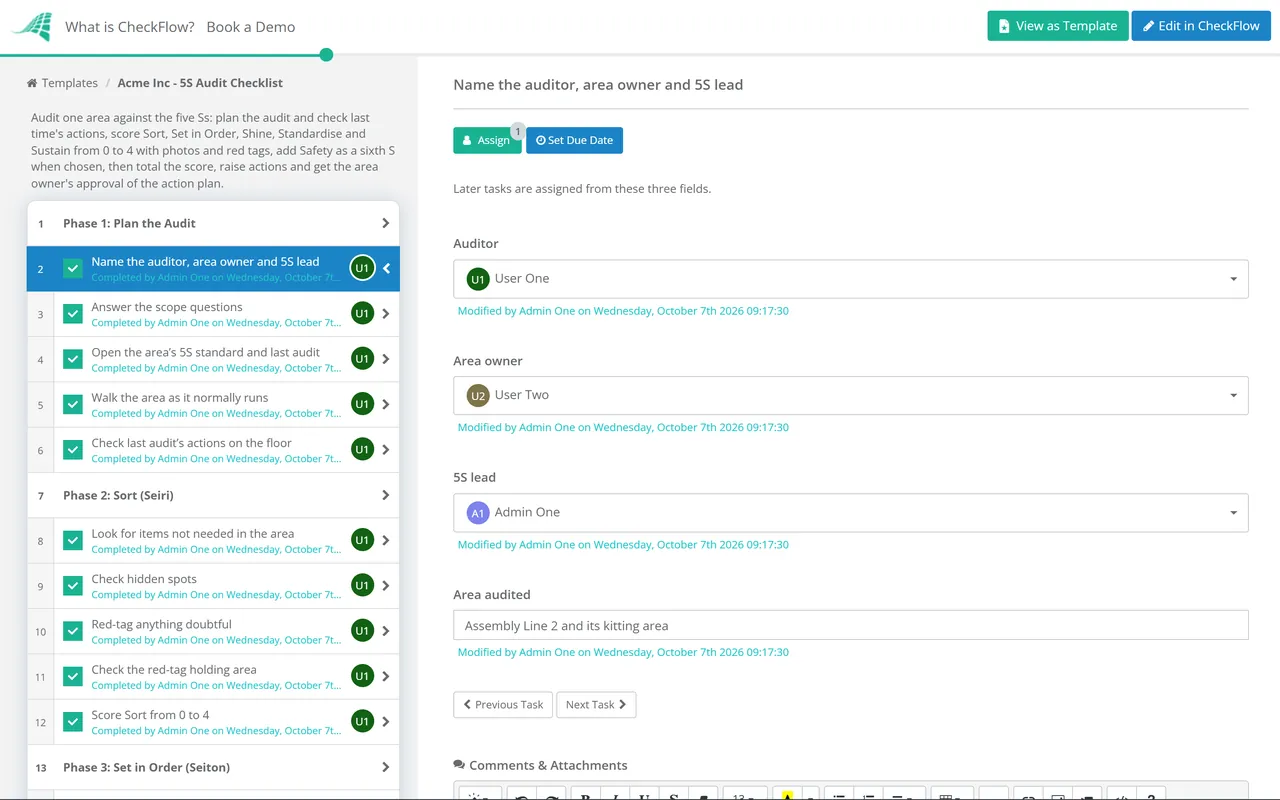
Seven phases take one area from planning to a signed-off action plan. Each S is checked and scored in its own phase, Standardise and Sustain share one, and the Safety phase appears only when you choose to run a 6S audit. The area owner approves the action plan before the audit closes.
Owned by the auditor. Scope questions: include Safety as a sixth S (Yes/No), audit type (Self-audit / Cross-area / Management walk). The audit type is recorded with the score for trending.
Assigned to the auditor. Score 0 to 4 against the scale below, with a photo of the worst example.
Assigned to the auditor. A good test: ask someone to fetch a named tool and time it.
Assigned to the auditor. Shine is cleaning as inspection: an abnormality found while cleaning is a finding.
Assigned to the auditor. These two Ss are about whether the first three hold without an audit.
Shown only when “Include Safety as a sixth S?” is Yes. Assigned to the auditor. It looks at the workplace order that keeps people safe, not the full safety inspection.
The action plan approval is assigned from the area owner field, and the checklist halts until it is Approved. The approval is due 7 days after the audit start date.
A score only means something if two auditors would give the same number. The scale below describes what each level looks like so scoring does not depend on mood. There is no official 5S scale; adapt the wording to your areas, then keep it fixed so the trend stays honest.
| Score | Level | What the auditor sees | Example for Set in Order |
|---|---|---|---|
| 0 | Not started | No standard and no visible effort | Tools kept wherever the last person left them |
| 1 | Started | Some effort, many gaps; problems obvious at a glance | A shadow board exists but half the outlines are empty or wrong |
| 2 | Partly in place | The basics are there, but only some people follow them | Most tools have homes; a few always end up on the bench |
| 3 | In place | Standard met throughout, with minor lapses | Every tool has a labelled home and almost all are in it |
| 4 | Sustained | Standard met, owned by the team and improved by them | The team redesigned the board after a changeover and nobody had to ask |
Five Ss at 0 to 4 give a maximum of 20, or 24 with Safety. Report the result as a percentage and keep each S as its own line on the chart, because the total hides the pattern. A common one is Shine holding steady while Sustain falls: the area is cleaned before audits, but nobody is doing it in between. Another is a jump in score after a new auditor joins, which is a calibration problem rather than an improvement. That is why the audit type is recorded: compare self-audits with self-audits, and use cross-area scores to check that the self-audits are honest.
The checks in each phase are written for a production cell. Rewrite them for the area you audit. In a warehouse, Set in Order is about labelled locations and clear pick faces; in a laboratory, Shine includes the state of benches and fume cupboards; in an office or a shared drive, Sort is about old files and duplicate folders. Keep the five headings and the 0 to 4 scale the same everywhere, so a site-wide chart compares like with like.
A recurring schedule creates each area’s audit on time and assigns it to the right auditor, so 5S does not fade the month somebody is on holiday. Each audit carries a due date, so nobody has to remember it.
Each score carries its photo and comments on the task that produced it, so the area owner sees exactly which bench or shelf the auditor meant. Every audit starts by checking the last one’s actions on the floor.
The area owner’s approval halts the checklist until the action plan is agreed, and the audit trail shows who scored what and when, audit after audit.
CheckFlow is not an MES or a CMMS. It runs the human routines around them: audits, changeovers, maintenance checks and the actions they raise. CheckFlow’s manufacturing checklist software shows how plants schedule those routines, and the guide to lean manufacturing principles explains where 5S sits among the other lean tools and why the audit, not the painted lines, is what lasts.
5S keeps a workplace in order; it does not write the procedures or run the improvement cycle. Use the Process Standardization Checklist to write the standard work an area follows, and the Continuous Improvement Cycle Process for a PDCA project. When the same leak or mess comes back audit after audit, find the cause with the Root Cause Analysis (8D) Checklist.
Describe the process in a sentence and the AI checklist generator drafts the phases and tasks for you.
A check of last audit’s actions, then specific, observable checks for each S: unneeded items and red tags for Sort, marked homes and clear aisles for Set in Order, cleanliness and sources of dirt for Shine, a posted standard and named owners for Standardise, and daily routines for Sustain. Each S needs a score against a defined scale, photos of the worst examples, and actions with owners and dates.
Seiri means separating what is needed from what is not and removing the rest. Seiton is arranging what is left so everything has a place. Seiso is cleaning. Seiketsu is the standardised condition that comes from doing the first three regularly, and shitsuke is the discipline to keep doing them. Sort, Set in Order, Shine, Standardise and Sustain are the usual English names, though some sites say Straighten for seiton.
There is no standard frequency. Many sites have the area team self-audit weekly, run a cross-area audit monthly and add a management walk each quarter. Pick a cadence you can keep, because a monthly audit that happens every month beats a weekly one that is skipped half the time.
6S adds Safety to the five Ss: emergency equipment reachable, exits and walkways clear, chemicals labelled and PPE in place. It is a local extension, not a separate method. It checks the order that keeps people safe, but it does not replace a full safety inspection or your risk assessments.
A label put on any item whose need is in doubt during Sort. It records the date, who tagged it and why, and the item moves to a holding area for a set period. If nobody claims it with a reason, it is disposed of, returned to stores or moved to where it is used. The holding area needs checking too, or it becomes the new clutter.
Usually because the effort stops at Shine and 5S becomes housekeeping. Audits slip, findings have no owner, and the team learns that nothing happens if the area slides. A fixed schedule, actions with names and dates, and a visible score trend are what keep it going.
14-day free trial, no card required. The Business plan is $10 per user per month after the trial. Full details at checkflow.io/pricing.
14-day free trial, no credit cardFull refund in your first 30 daysUS hosting, EU on request