The process that depends on the most experienced person in the room to run correctly is not a standardised process — it is a key-person dependency. When that person leaves, retires, or is absent, the process degrades.
Every time a task is performed differently by different people — or differently by the same person on different days — it introduces variation. Variation is the root cause of defects, inconsistent customer experiences, and unpredictable quality outcomes. Process standardisation is the discipline of removing unnecessary variation by documenting the single best-known way to perform each important task, training everyone to that standard, and making the standard easy to follow and easy to update when a better method is found. Toyota’s production system — arguably the most influential manufacturing operating model in history — places standard work at the centre of quality management: without a documented standard, there is no baseline from which to measure performance, no basis for training, and no foundation for improvement. A structured process standardisation checklist makes this discipline operational: identifying which processes need standardising and in what priority, developing SOPs that are fit for purpose and actually usable, implementing them consistently, and maintaining them as living documents rather than filing them and forgetting them. This free checklist gives quality managers, operations leads, and process improvement teams a structured framework for the full process standardisation lifecycle.
Choosing the Right Document Format for the Process
Standard Operating Procedure
Standard Operating Procedure (SOP)
What it is: A document describing the overall process: the purpose, scope, responsibilities, relevant regulatory or quality requirements, and the high-level sequence of activities.
Level of detail: “What” and “why” — the overview of the process.
Best for: Processes with multiple stakeholders; regulatory compliance documentation; QMS-level process description.
Length: Typically 2–10 pages.
Work Instruction
Work Instruction
What it is: A step-by-step description of how to perform a specific task within the process — precise enough that someone with the right skill level can follow it without verbal instruction.
Level of detail: “How” — the specific steps, in order, with parameters, tolerances, tools, and acceptance criteria.
Best for: Production tasks, quality inspection steps, technical procedures.
Length: Typically 1–3 pages; ideally usable at the workstation.
Process Map
Process Map
What it is: A visual flowchart of the process — the sequence of steps, decision points, and handoffs between functions or roles.
Level of detail: Visual overview — shows the flow without detailed step instructions.
Best for: Complex multi-party processes; training; process analysis; showing decision points.
Use with: SOPs (as an appendix) and to analyse current vs future state.
The Process Standardisation Checklist
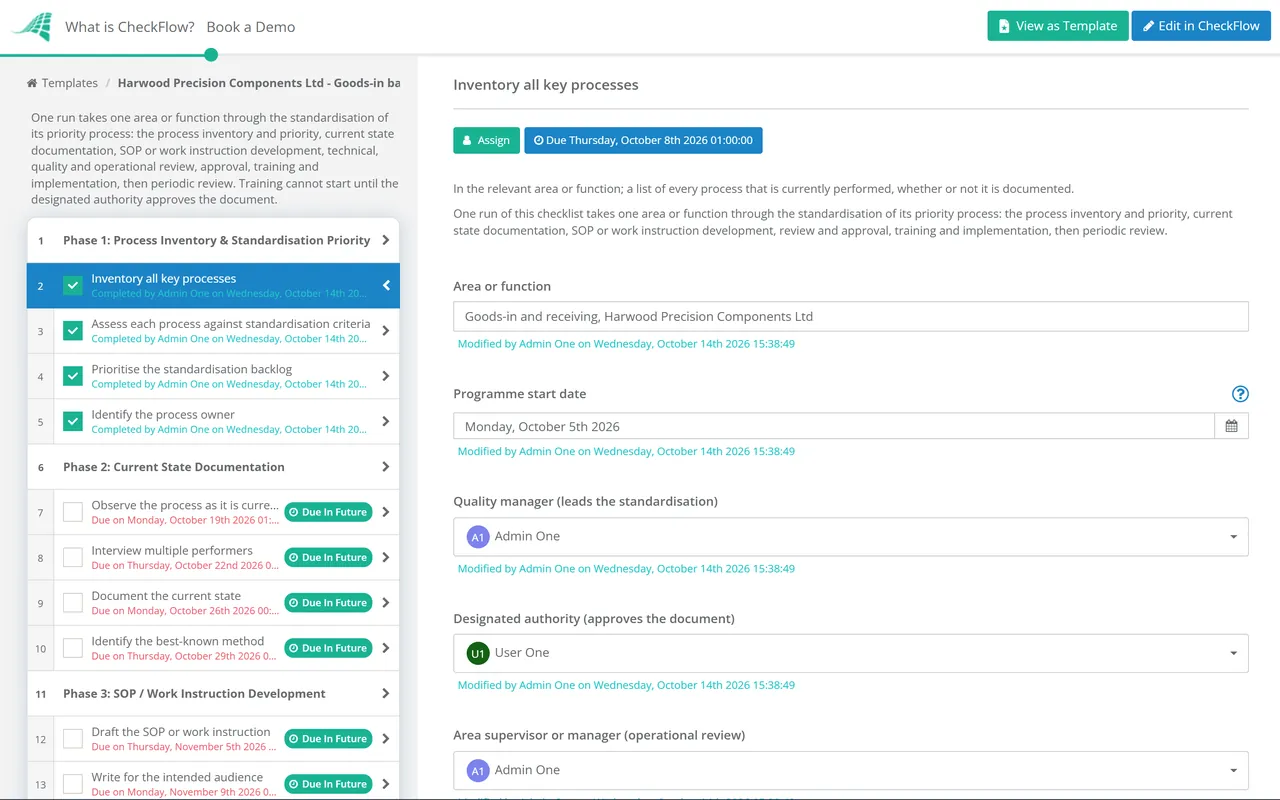
Six phases from process inventory and priority-setting through SOP development, review, training, implementation, and ongoing document maintenance.
Phase 1
Phase 1: Process Inventory & Standardisation Priority
Not every process needs a written SOP. The processes that most benefit from standardisation are those that are high-frequency, high-impact on quality or safety, prone to variation, or critical to regulatory compliance. Start there.
Inventory all key processes — in the relevant area or function; a list of every process that is currently performed, whether or not it is documented
Assess each process against standardisation criteria: High frequency (performed daily or weekly) = High priority; High quality or safety impact = High priority; High variation (different people do it differently; complaints or rework cluster here) = High priority; Regulatory or customer compliance requirement = Mandatory regardless of frequency
Prioritise the standardisation backlog — start with the highest-priority undocumented or inadequately documented processes
Identify the process owner — a named person responsible for each process’s documentation; the person who best understands the correct way to perform the process
Phase 2
Phase 2: Current State Documentation
Observe the process as it is currently performed — by the most experienced and most capable performer; not from memory; from direct observation
Interview multiple performers — how do different people perform this process? Where are the variations? Which variations affect quality outcomes?
Document the current state — as a process map and/or narrative; what is happening now, not what should happen
Identify the best-known method — across all observed performers; the combination of steps that consistently produces the best quality outcome
Phase 3
Phase 3: SOP / Work Instruction Development
Draft the SOP or work instruction — based on the best-known method identified in Phase 2; with the process owner; using the organisation’s document template
Write for the intended audience — the person who will perform the task; their vocabulary, their skill level; no unnecessary jargon
Include all required elements: Purpose; Scope; Responsibilities; Materials/tools/equipment required; Step-by-step instructions (with tolerances and acceptance criteria where applicable); Reference documents; Document control information (version, date, author, approver)
Test the draft document — have someone unfamiliar with the process attempt to follow the SOP; any confusion or missing step is a gap in the document, not a gap in the reader
Phase 4
Phase 4: Review & Approval
Technical review — by the process owner and a senior subject matter expert; accuracy confirmed
Quality review — by the QA team; compliance with relevant standards, regulatory requirements, and QMS document control requirements
Operational review — by a supervisor or manager responsible for the area; practicable in the current environment?
Document approval and version control — approved by the designated authority; version number assigned; effective date set; previous version superseded and archived
Phase 5
Phase 5: Training & Implementation
The SOP that is approved, issued, and then filed in a binder that nobody opens has not been implemented. Implementation means every person who performs the process has been trained, has confirmed understanding, and is performing the process to the standard.
Deliver training to all affected personnel — using the SOP or work instruction; demonstration + supervised practice for procedural tasks
Document training completion — training record for each person; confirming they have been trained to the current version
Make the document accessible at the point of use — at the workstation, in the quality system, or wherever the person needs to reference it while performing the task
Confirm implementation — QA or supervisor observes the process being performed to the new standard within 2–4 weeks of training

Phase 6
Phase 6: Document Maintenance & Periodic Review
Review all SOPs on a defined schedule — annually for most processes; more frequently for high-risk or high-change processes
Trigger review when the process changes — any process change, equipment change, material change, or regulatory change that affects the process triggers an immediate review; out-of-date SOPs are worse than no SOPs
Incorporate improvement cycle outputs — when a continuous improvement cycle produces a better method, update the SOP immediately; the standard must always reflect the current best-known method
Confirm all personnel are retrained — when a new version is issued; training records updated
Why Run Your Process Standardisation Programme in CheckFlow?
1
Standardised checklists that ARE the documented procedure
An SOP that lives in a binder competes with the worker’s memory and habits for every execution. A CheckFlow checklist that IS the standardised procedure — requiring each step to be confirmed complete before proceeding — removes the competition. The documented standard and the execution tool are the same artefact.
2
Training completion tracked across the team
ISO 9001 requires evidence that personnel are competent to perform the documented procedures. CheckFlow records the completion of every training task — who was trained, when, on which version of the document — creating the competency evidence that audit requires.
3
Document review scheduled automatically before documents become stale
The SOP with no review date becomes the SOP that was never reviewed. CheckFlow’s recurring review task fires automatically at the defined review interval — ensuring the quality manager reviews every document on schedule, not only when a problem reveals it is out of date.
Process standardisation produces the documented standards that continuous improvement cycles then optimise. CheckFlow’s Continuous Improvement Cycle Checklist covers the PDCA process for improving standardised processes. See the Continuous Improvement Cycle Checklist →
CheckFlow is purpose-built for SOP and process documentation. See how CheckFlow’s SOP software features make process standardisation operational rather than a document management exercise. See CheckFlow for SOP Management →
What should a process standardisation checklist include?
+
A process standardisation checklist covers six phases: process inventory and prioritisation (identifying all key processes, scoring against frequency, quality/safety impact, variation level, and compliance requirements, prioritising the standardisation backlog), current state documentation (direct observation, multi-person interviews, best-known method identification), SOP/work instruction development (drafting based on best-known method, written for the intended audience, including all required elements, tested with an unfamiliar user), review and approval (technical, quality, and operational review; document control with version number and effective date), training and implementation (all affected personnel trained, training documented, document accessible at point of use, implementation observed), and monitoring and review (annual review schedule, change-triggered review, improvement cycle integration, retraining on new versions).
What should be included in an SOP?
+
A standard operating procedure should include: purpose (why this process exists and what it achieves), scope (the processes, products, locations, and roles to which it applies), responsibilities (who does what in the process), definitions (any technical terms or acronyms that are not universally understood), materials/tools/equipment required, the step-by-step procedure (in logical order, with specific parameters, tolerances, and acceptance criteria for each step where applicable), reference documents (drawings, specifications, related SOPs), safety considerations, and document control information (document number, version, effective date, author, and approver).
How often should SOPs be reviewed?
+
SOPs should be reviewed at least annually for standard processes, and more frequently for high-risk or high-change processes. In addition to the scheduled review, a review should be triggered immediately by: any change to the process, equipment, or materials; a regulatory or standard change affecting the process; a quality incident or defect that reveals the SOP was inadequate or not being followed; or the output of a continuous improvement cycle that changes the best-known method. ISO 9001 requires documented information to be controlled, which includes reviewing it for continuing suitability.
What is the relationship between process standardisation and ISO 9001?
+
ISO 9001 clause 7.5 requires a quality management system to maintain documented information to the extent necessary to support the operation of processes and to retain documented information as evidence that processes have been carried out as planned. In practice, this means that the processes most critical to quality outcomes, regulatory compliance, and consistent delivery must be documented in SOPs or work instructions. ISO 9001 clause 8.1 further requires that operational processes be planned, implemented, and controlled in a manner consistent with achieving quality objectives.
Is CheckFlow free for this template?
+
You can start a free 14-day trial with no credit card required, giving you full access to all features including this template. The Business plan is $10 per user per month after the trial. Full details at checkflow.io/pricing.
Document Every Process Standard, Train to It, and Keep It Current — Automatically
Free trial — no credit card required.
Do you like cookies? 🍪 We use cookies to ensure you get the best experience on our website. Learn more