Equipment Qualification (IQ/OQ/PQ) Checklist Template

Take one piece of GMP equipment from its user requirements to release for use: the risk assessment, design qualification where it applies, the validation plan, IQ, OQ and PQ to protocols QA has approved, deviations closed and QA’s release.

Last reviewed: November 2026

Printed from checkflow.io/templates/quality-assurance/equipment-qualification-checklist

This free IQ OQ PQ checklist is for validation, engineering and quality teams at medicine manufacturers and their laboratories working under GMP. One run qualifies one piece of equipment, counted back from the target release date. It starts with the user requirement specification and a risk assessment, adds design qualification for a new or customised design, and sets out the validation plan, with QA approving the IQ and OQ protocols before any test is run. FAT and SAT results are relied on where the plan says so. Installation qualification covers the installation, the materials and the calibration of critical instruments; operational qualification the functions and the operating limits; performance qualification the equipment under normal operating conditions, as its own protocol, with OQ or within process validation. Deviations are investigated and closed, every requirement is traced to a passed test, and the summary report goes to QA, who alone releases the equipment for use. The run ends with change control, the calibration and maintenance schedules and the periodic review date. It follows EU GMP Annex 15, the FDA’s process validation guidance and 21 CFR 211.63, 211.67 and 211.68.

Qualification, Acceptance Testing or Calibration?

Equipment qualification is the documented evidence that one piece of GMP equipment is fit for its intended use, from its user requirements to QA’s release. This checklist runs it for one item, such as a granulator, a filling machine, an autoclave or a laboratory instrument. It relies on acceptance tests and leads into routine calibration, but it is neither.

The supplier’s test before shipping follows the Factory Acceptance Test (FAT) Checklist. A site acceptance test, where you run one, has its own steps; this checklist records the results it relies on. Periodic calibration after release follows the Calibration Management Checklist. A new laboratory’s fit-out is the New Laboratory Setup Checklist, building systems are commissioned with the Building Commissioning Checklist, and a GMP self-inspection is the GMP Audit Checklist. Computerised system validation (GAMP 5, EU GMP Annex 11, 21 CFR Part 11), cleaning validation and process validation are separate work. This template is written for medicines under EU GMP and 21 CFR Part 211; medical devices have their own rules (21 CFR Part 820 and ISO 13485), which it does not cover.

This checklist

One piece of equipment, qualified and released

Use it when: new or replacement GMP equipment is bought, installed and needs QA’s release before routine use.

Covers: the URS, the risk assessment, design qualification, the validation plan, IQ, OQ, PQ, deviations, the summary report and QA’s release.

Output: equipment released for use, with an approved report, a complete trace matrix and a periodic review date.
Before it ships

Factory acceptance test

Use it when: the supplier tests the equipment at its works before delivery.

Covers: the FAT protocol, the tests, the punch list, the sign-off and the release to ship.

Output: a signed FAT report this checklist can rely on, in the Factory Acceptance Test (FAT) Checklist.

After release

Calibration management

Use it when: an instrument is due for its periodic calibration.

Covers: booking, calibration in-house or at an accredited lab, the certificate review and any out-of-tolerance impact.

Output: the instrument back in service, in the Calibration Management Checklist.

What the Equipment Qualification Checklist Covers

Nine phases take one piece of GMP equipment from its user requirements to QA’s release for use and the handover. The first task records the target release date, which sets every due date, and the validation lead, system owner, engineering lead and QA approver. The design answer in Phase 1 adds design qualification or a standard design check. The validation plan’s answers add the FAT and SAT tasks and decide where PQ is done, and a deviation adds the investigation and closure tasks. QA approves each protocol before it is run, and the checklist halts at QA’s release.

  1. Phase 1 — Requirements

    Phase 1: Requirements & Set-Up

    5 tasks

    Owned by the validation lead, as soon as the equipment is needed. Enter the target release date on the first task: every due date counts back from it in working days, and the handover counts forward. Write the user requirement specification and get QA’s approval of it, then choose the supplier and say whether the design is new or a standard item.

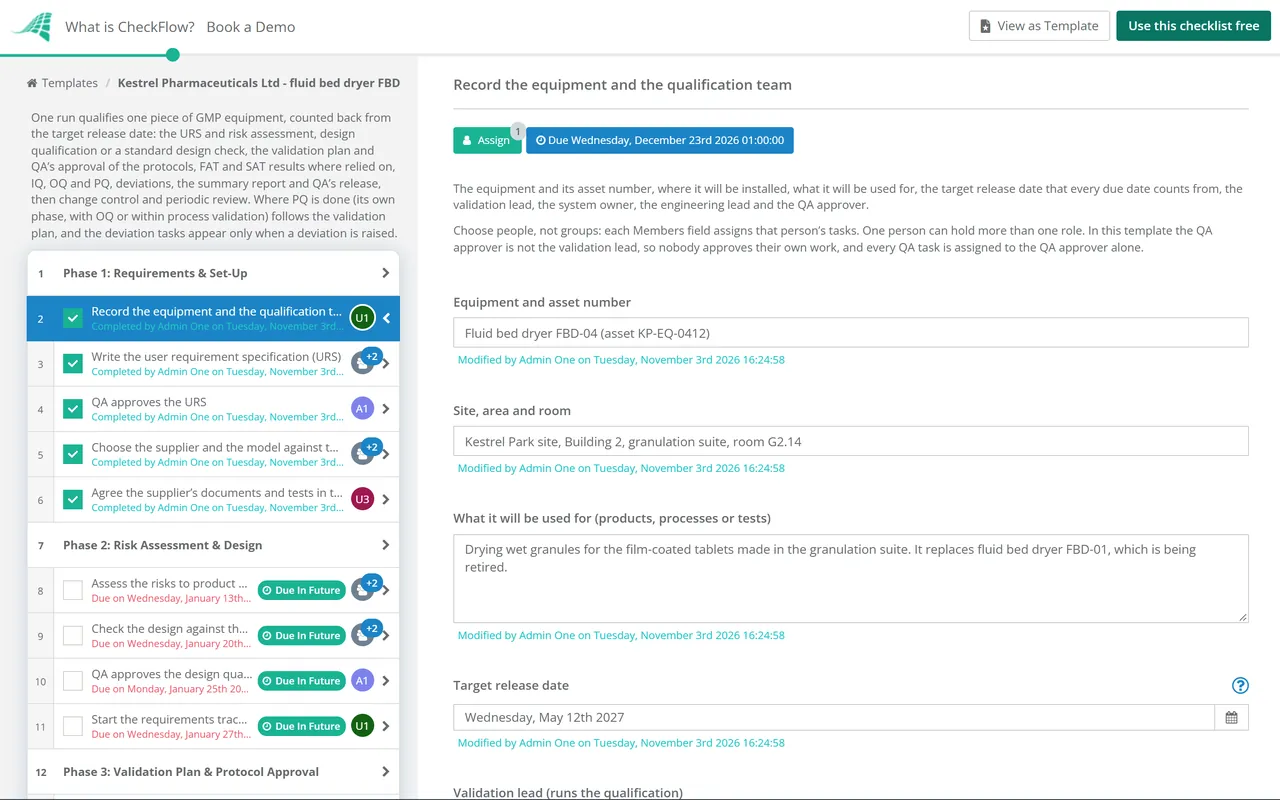
    • Record the equipment and the qualification team — the equipment and its asset number, where it will be installed, what it will be used for, the target release date that every due date counts from, the validation lead, the system owner, the engineering lead and the QA approver
    • Write the user requirement specification (URS) — what the equipment must do and the conditions it must meet: its intended use, capacity and operating ranges, product-contact materials, cleaning, utilities, controls and data, safety, and the documents the supplier must provide
    • QA approves the URS — the system owner has confirmed it describes the intended use, and QA approves it as the reference for the whole qualification
    • Choose the supplier and the model against the URS — the supplier, model and options that meet the URS, and whether the design is new, customised or modified, or a standard catalogue item used as designed
    • Agree the supplier’s documents and tests in the order — the drawings, material certificates, calibration certificates, manuals and the factory acceptance test the supplier will provide, and which of them your qualification will rely on
  2. Phase 2 — Design

    Phase 2: Risk Assessment & Design

    5 tasks

    Owned by the validation lead with the engineering lead. The risk assessment decides which functions and parameters are critical and how much testing each needs. A new, customised or modified design gets a design qualification; a standard item used as designed gets a recorded check of the supplier’s design against the URS instead (the answer on the supplier task in Phase 1).

    • Assess the risks to product quality — which functions, parameters and parts of the equipment could affect product quality, how each could fail and how serious that would be, and how much testing each needs; the scope of the qualification follows from it
    • Check the design against the URS — the drawings, specifications, materials and control design reviewed against every URS requirement, including GMP points such as cleanability and product-contact materials
    • QA approves the design qualification — the design qualification report, with every requirement the design does not meet resolved or accepted with a reason
    • Check the standard design against the URS — the supplier’s published specification and options checked against every URS requirement, with the reason no design qualification protocol is needed, taken from the risk assessment
    • Start the requirements trace matrix — each URS requirement against the test that will verify it: the design check, the FAT, the SAT, IQ, OQ or PQ
  3. Phase 3 — Plan

    Phase 3: Validation Plan & Protocol Approval

    6 tasks

    Owned by the validation lead, approved by QA. The plan says which tests are run where, which FAT or SAT results are relied on and where performance qualification is done; its answers add the FAT and SAT tasks and decide where PQ appears. No IQ or OQ test is run before QA approves the protocols at the end of this phase.

    • Write the validation plan — the scope, the qualification stages and their order, the tests and how acceptance criteria are set, which FAT or SAT results are relied on, where PQ is done, who does what, and how deviations and changes are handled
    • QA approves the validation plan — QA reviews and approves the plan before the protocols are written to it
    • Write the IQ protocol — the installation checks against drawings and specifications, the materials of construction, the documents to collect and the instruments to calibrate, each with its acceptance criterion
    • Write the OQ protocol — the functional tests, alarms and interlocks, and tests at the upper and lower operating limits or worst case, each with its acceptance criterion; add the PQ tests here when PQ is combined with OQ
    • Check any protocols written by the supplier or a contractor — each one checked for suitability and against your own procedures before approval, with extra tests added where it falls short
    • QA approves the IQ and OQ protocols — QA approves each protocol before any test in it is run
  4. Phase 4 — Arrive

    Phase 4: FAT, SAT & Delivery

    4 tasks

    Owned by the engineering lead. The FAT itself has its own checklist; here you check the FAT results the protocols rely on, receive and install the equipment and, where the plan relies on one, witness the site acceptance test. The FAT and SAT tasks appear from the answer on the validation plan task.

    • Check the FAT results the protocols rely on — the FAT report, its deviations and how each was closed, and evidence that transport and installation do not affect the functions tested, for every FAT test that IQ or OQ will not repeat
    • Receive and inspect the equipment — checked against the order on arrival: damage, parts and options, serial numbers and the supplier’s documents
    • Install and connect the equipment — installed in its room by the supplier or your engineers, with utilities connected and start-up checks done, ready for site testing and IQ
    • Witness the site acceptance test and review its report — the SAT run at your site to the agreed plan, its results and deviations recorded, and the tests IQ and OQ will rely on marked in the trace matrix
  5. Phase 5 — IQ

    Phase 5: Installation Qualification

    5 tasks

    Owned by the validation lead, run to the IQ protocol QA approved in Phase 3. IQ shows the equipment is installed as designed. Record every result that misses its acceptance criterion as a deviation at once, in the log in Phase 8, answer Yes to the deviation question there, and tell QA. QA releases IQ to OQ at the end of the phase.

    • Verify the installation against the drawings and specifications — components, instruments, pipework, wiring and services checked against the engineering drawings, the specifications and the protocol’s criteria
    • Verify the materials of construction — product-contact materials and finishes checked against the URS and the certificates supplied
    • Collect the supplier’s operating and maintenance instructions — manuals, maintenance requirements, spare parts lists and as-built drawings filed in the qualification file
    • Calibrate the critical instruments — each instrument the risk assessment marks critical calibrated, with a traceable certificate, before OQ relies on its readings
    • QA reviews IQ and releases it to OQ — the executed IQ reviewed, every deviation closed or assessed as having no significant impact on OQ (investigated on the deviation tasks in Phase 8, which appear once a deviation is logged), and OQ released to start
  6. Phase 6 — OQ

    Phase 6: Operational Qualification

    7 tasks

    Owned by the validation lead, run to the OQ protocol QA approved, once QA has released IQ. OQ shows the equipment works as intended across its operating ranges, including its limits. A successful OQ lets the operating, cleaning and maintenance procedures be finalised and the operators trained.

    • Run the functional tests — controls, sequences, alarms, interlocks and safety functions tested to the OQ protocol, with the results recorded at the time
    • Test the upper and lower operating limits and worst case — each critical parameter run at its upper and lower limits, or under the worst-case conditions the protocol defines
    • Finalise the operating, cleaning and maintenance procedures — the operating procedure, the cleaning procedure and the preventive maintenance plan written from what OQ showed, then approved
    • Train the operators — the people who will run, clean and maintain the equipment trained on the new procedures, with training records kept
    • Run the PQ tests in the combined OQ and PQ protocol — the performance tests with production materials, qualified substitutes or simulated product under normal operating conditions, as the combined protocol sets out
    • QA reviews OQ and releases the next stage — the executed OQ reviewed, every deviation closed or assessed (investigated on the deviation tasks in Phase 8, which appear once a deviation is logged), and the next stage released: PQ, or the summary report when PQ was combined with OQ or is done within process validation
    • Agree how process validation completes PQ — the process validation protocol that will show the equipment performs effectively and reproducibly, the batches it covers, and the condition on release that the equipment is used only for those batches until the process validation report is approved
  7. Phase 7 — PQ

    Phase 7: Performance Qualification

    4 tasks

    Applies only when PQ is a separate protocol after OQ (the answer on the validation plan task in Phase 3). PQ shows the equipment performs effectively and reproducibly with the approved process and product, under normal operating conditions. QA approves the PQ protocol before any PQ run.

    • Write the PQ protocol — the PQ tests with production materials, qualified substitutes or simulated product under normal operating conditions, worst-case batch sizes, the sampling frequency with its justification, and the acceptance criteria
    • QA approves the PQ protocol — QA approves the protocol before any PQ run
    • Run the PQ — the runs the protocol sets out, across the operating range of the intended process, by trained operators using the approved procedures
    • Review the PQ results against the acceptance criteria — every result compared with its criterion, a deviation raised for any that misses, and the conclusion recorded
  8. Phase 8 — Release

    Phase 8: Deviations, Report & QA Release

    8 tasks

    Owned by the validation lead, with QA. Every deviation is investigated and closed or assessed, every URS requirement is traced to a passed test and the summary report gives a recommendation. QA alone decides on release, and the checklist halts there: nothing in Phase 9 can be completed until the decision is recorded.

    • Collect every deviation and protocol change — every result that missed its acceptance criterion and every significant change to an approved protocol during testing, each logged as a deviation as it happens, in IQ, OQ or PQ
    • Investigate each deviation and its impact — the cause, the effect on the result and on the qualification, and whether earlier stages or other equipment are affected; start as soon as a deviation is logged, so it is assessed before QA releases that stage
    • Correct, retest and record each deviation — the correction or corrective action, any retest under the protocol, and the scientific justification for any acceptance criterion that changed
    • QA closes each deviation — each deviation closed, or left open with a documented assessment of its impact for the release decision
    • Complete the requirements trace matrix — every URS requirement traced to a test that passed, or to a deviation that is closed or assessed
    • Write the qualification summary report — the results summarised against the acceptance criteria, the deviations and their outcome, any changed criteria with their justification, and a recommendation on release
    • Put right what stopped the release — after Not released only: what QA objected to, the work, retests or documents needed, and a new target release date on the first task if it has to move
    • QA releases the equipment for use — Released for use, Released with conditions or Not released, with the reasons, recorded by the QA approver alone after reviewing the summary report
  9. Phase 9 — Handover

    Phase 9: Change Control & Periodic Review

    6 tasks

    Applies only when the equipment has been released: a Not released decision in Phase 8 hides this phase until a new decision is recorded. The equipment goes under change control, into the calibration, maintenance and cleaning schedules and onto the periodic review schedule, and the qualification file is archived.

    • Update the equipment’s status and logbook — the status label, the equipment logbook and the site’s list of qualified equipment show it as released, with any condition
    • Put the equipment under change control — any change to the equipment, its software, its parts or its procedures from now on goes through change control, which assesses the effect on the qualified state and plans any requalification
    • Add it to the calibration, maintenance and cleaning schedules — its critical instruments into the calibration programme, and its preventive maintenance and cleaning into their schedules, so the qualified state is kept
    • Meet the release conditions — each condition QA set, met and recorded, such as an open deviation closed or the process validation report approved
    • Set the periodic review date — when the equipment will next be evaluated to confirm it remains in a state of control, with the period justified and the criteria defined
    • Archive the qualification file — the URS, risk assessment, design records, plan, approved and executed protocols, deviations, trace matrix, report and release, filed where they can be retrieved

What Each Stage Verifies, and the Rules Behind It

The qualification stages in EU GMP Annex 15

Annex 15 (Qualification and Validation, in force since 1 October 2015) is part of EudraLex Volume 4, the EU guidelines for good manufacturing practice, and the same annex is in the PIC/S GMP Guide. Its paragraph numbers are in brackets. It says decisions on the scope and extent of qualification should rest on a documented risk assessment.

Stage What Annex 15 says it covers In this template
User requirement specification (3.2)The equipment’s specification, with the essential elements of quality built in; the reference point for the whole life cyclePhase 1
Design qualification (3.3)Showing that the design complies with GMP, with the URS requirements verifiedPhase 2, for a new, customised or modified design; a standard design check otherwise
FAT and SAT (3.4 to 3.7)Tests at the supplier before delivery and at your site after receipt; documentation review and some tests need not be repeated in IQ or OQ, where appropriate and justified and where it can be shown that transport and installation do not affect the functionalityPhase 4, where the validation plan relies on them
Installation qualification (3.8, 3.9)Installation against drawings and specifications, the supplier’s instructions and maintenance requirements, calibration of instruments and materials of constructionPhase 5
Operational qualification (3.10 to 3.12)Tests that the equipment operates as designed and at its upper and lower limits or worst case; then procedures, training and maintenance finalisedPhase 6
Performance qualification (3.13, 3.14)Tests with production materials, qualified substitutes or simulated product under normal operating conditions, across the intended operating rangePhase 7, or Phase 6 with OQ, or within process validation
Requalification (4.1, 4.2)Evaluation at an appropriate frequency to confirm the equipment remains in a state of controlPhase 9

The US rules for equipment

21 CFR Part 211, subpart D is binding law for finished pharmaceuticals; the FDA’s process validation guidance contains nonbinding recommendations. In that guidance PQ means process qualification, not performance qualification.

Rule or guidance What it says, in short In this template
21 CFR 211.63Equipment of appropriate design, adequate size and suitable location for its intended use and for its cleaning and maintenanceThe URS and the design checks, Phases 1 and 2
21 CFR 211.67Cleaning and maintenance at appropriate intervals, written procedures for them, and recordsProcedures after OQ (Phase 6) and the schedules (Phase 9)
21 CFR 211.68Automatic, mechanical and electronic equipment calibrated, inspected or checked under a written program, with records; controls over computer systemsCalibration in IQ (Phase 5) and the calibration programme (Phase 9); computerised system validation is separate
FDA, Process Validation: General Principles and Practices (January 2011)Equipment qualification as part of Stage 2, process qualification, with a plan and a report the quality unit reviews and approvesThe validation plan (Phase 3) and the summary report (Phase 8)

Annex 15 is being revised. A joint EMA and PIC/S concept paper was open for comments from 9 February to 9 April 2026. It proposes extending Annex 15 to active substance manufacturers and updating it for ICH Q9(R1). Its timetable, revised after the consultation (EMA, 15 July 2026), plans a draft for consultation in December 2026 and publication in April 2028; no draft had been published when this page was reviewed in November 2026, so the 2015 text applies. ISPE’s Baseline Guide on commissioning and qualification, ASTM E2500 and GAMP 5 describe ways of doing this work; they are paid documents and are not quoted here.

Why Run Equipment Qualification in CheckFlow?

1

Every test falls due after its protocol is approved

QA approves the URS, the validation plan and each protocol on its own task, assigned to the QA approver alone, and every IQ, OQ and PQ test falls due after the approval it depends on. QA also releases IQ to OQ and OQ to the next stage, the formal release between stages that Annex 15 describes. Only QA’s final release halts the checklist; the earlier approvals come first by due date, and each phase says not to start before them.

2

Only the steps this equipment needs

A standard item gets a design check instead of a full design qualification, the FAT and SAT tasks appear only when the plan relies on them, PQ appears where the plan puts it, and the deviation tasks appear only when a deviation is raised. Change an answer and the tasks follow.

3

Released by QA, then kept qualified

The checklist halts at QA’s release decision. Not released adds a task to put things right and keeps the handover hidden. A release adds change control, the calibration, maintenance and cleaning schedules and the periodic review date, and the Reports Grid lists every qualification in progress.

CheckFlow does not replace your quality management system, your document control or your validation software: the approved protocols and executed records stay where your procedures say. Whether a CheckFlow record can serve as a GMP record is for your own computerised system assessment (EU GMP Annex 11, 21 CFR Part 11). Nothing on this page is regulatory advice. CheckFlow makes sure every piece of equipment gets the same stages in the same order, with an owner and a due date for each, QA’s approval before each stage and a record of what was done.

Run the supplier’s test with the Factory Acceptance Test (FAT) Checklist, keep instruments in calibration with the Calibration Management Checklist, investigate deviations with the Root Cause Analysis (8D) Checklist and the CAPA (Corrective & Preventive Action) Checklist, and check the whole site with the GMP Audit Checklist.

AI generator

Didn’t find what you need? Describe it.

Describe the process in a sentence and the AI checklist generator drafts the phases and tasks for you.

Frequently Asked Questions

What are IQ, OQ and PQ?

They are the three main stages of qualifying equipment. In EU GMP Annex 15, installation qualification (IQ) checks that the equipment as installed matches the approved design and the manufacturer’s recommendations. Operational qualification (OQ) checks that it works as intended across its expected operating ranges. Performance qualification (PQ) checks that it performs effectively and reproducibly with the approved process and product. In this template each stage runs to a protocol QA has approved, and QA releases each stage before the next.

Does every piece of equipment need design qualification?

Annex 15 lists design qualification as the stage after the URS, where the design’s compliance with GMP is shown and the URS requirements are verified. It also says the criteria it suggests for each stage depend on the project and may be different, and that the scope of qualification should follow a documented risk assessment. This template runs a design qualification for a new, customised or modified design, and a recorded check of the supplier’s design against the URS for a standard item used as designed.

Can FAT and SAT results be used instead of repeating tests in IQ and OQ?

Yes, where it is appropriate and justified. Annex 15 says documentation review and some tests can be done at the FAT or other stages without repeating them on site, if it can be shown that transport and installation do not affect the functionality, and that a SAT can supplement the FAT. In this template the validation plan names the results relied on, and the trace matrix shows where each requirement was verified.

Does every piece of equipment need a PQ?

Annex 15 lists PQ as a qualification stage and offers no route that leaves it out. It says PQ should normally follow successful IQ and OQ, and that it may in some cases be appropriate to do it in conjunction with OQ or with process validation. The FDA’s guidance expects equipment to be qualified before process performance qualification, so the process validation route is for Annex 15 sites. In this template the validation plan records where PQ is done.

What is the difference between equipment qualification and process validation?

Qualification shows that equipment and utilities are suitable for their intended use and work properly. Process validation shows that the process run on them consistently makes product of the right quality. The FDA’s 2011 guidance puts equipment qualification inside Stage 2 of process validation, which it calls process qualification, before the process performance qualification (PPQ). In that guidance PQ means process qualification. This template ends at the equipment’s release; process validation is separate work.

What happens when a qualification test fails?

Annex 15 says a result that misses its predefined acceptance criterion should be recorded as a deviation and fully investigated, with any effect on the validation discussed in the report. A significant change to an approved protocol during testing is also documented as a deviation and scientifically justified. In this template each deviation is logged, investigated, corrected and retested, then closed by QA, or left open with an assessment of its impact for the release decision.

Who approves equipment qualification documents?

Annex 15 says qualification documents should be approved and authorised by the people the pharmaceutical quality system names, with quality oversight over the whole life cycle. The FDA’s guidance says the quality control unit must review and approve the qualification plan and report. In this template QA approves the URS, the validation plan, every protocol before it is run, each stage release and the final release, and every approval task is assigned to the QA approver alone.

Is EU GMP Annex 15 being revised?

Yes. The version in force dates from 2015. A joint EMA and PIC/S concept paper on revising it was open for comments from 9 February to 9 April 2026. It proposes extending Annex 15 to active substance manufacturers and updating it for ICH Q9(R1) on quality risk management. Its timetable, revised after the consultation (EMA, 15 July 2026), plans a draft for consultation in December 2026 and publication in April 2028. No draft had been published when this page was reviewed in November 2026.

When does qualified equipment need requalification?

Annex 15 says equipment should be evaluated at an appropriate frequency to confirm it remains in a state of control, that a fixed requalification period should be justified, and that planned changes go through change control, which plans any requalification needed. The FDA’s guidance says qualification status is kept through monitoring, maintenance and calibration, with qualification data assessed periodically. This template ends by putting the equipment under change control and setting its periodic review date.

Is CheckFlow free for this template?

14-day free trial, no card required. The Business plan is $10 per user per month after the trial. Full details at checkflow.io/pricing.

Qualify Every Piece of Equipment the Same Way

Free trial — no credit card required.

14-day free trial, no credit cardFull refund in your first 30 daysUS hosting, EU on request