
Factory acceptance test
Where: at the vendor’s works, before the equipment is packed.
Proves: it was built and works as specified, with simulators where your plant is not connected.
Output: a signed FAT report and the punch items left for site.
Last reviewed: November 2026
No Credit Card Required
Printed from checkflow.io/templates/manufacturing-production/site-acceptance-test-checklist
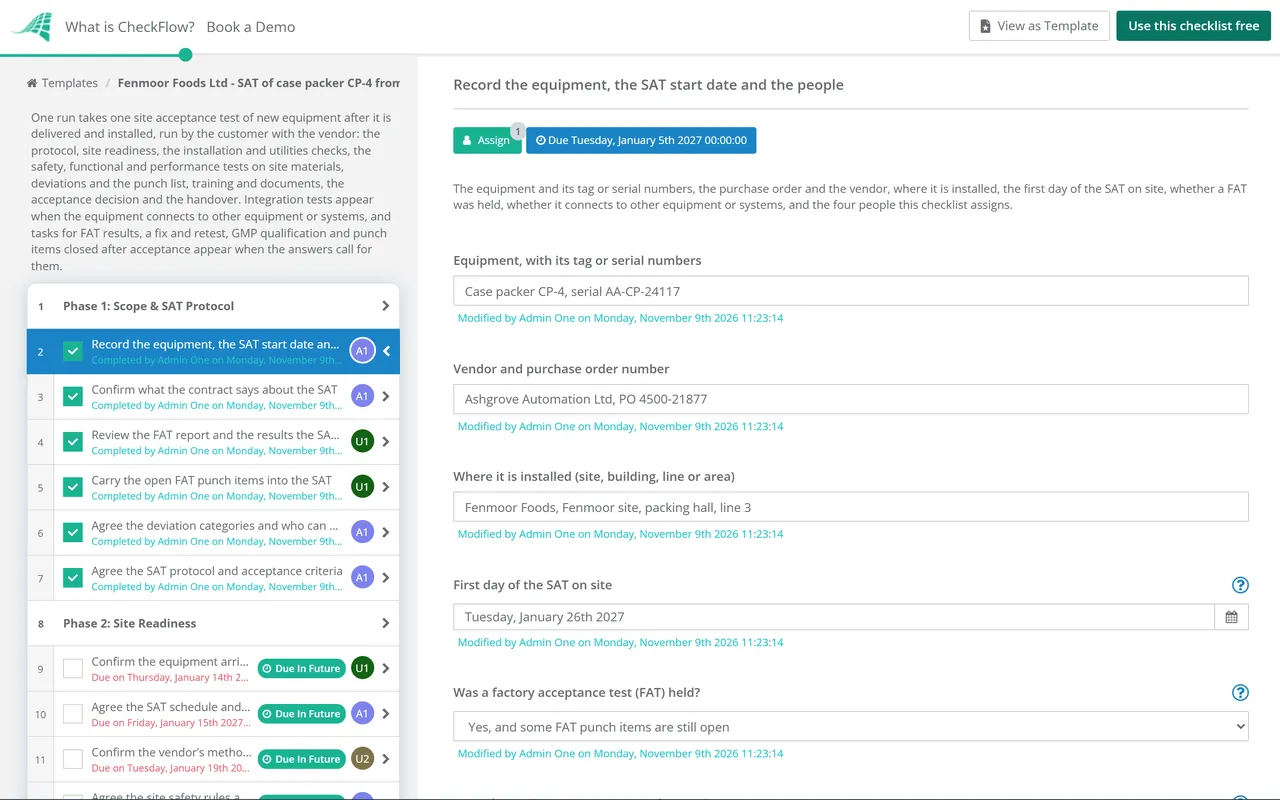
This free site acceptance test (SAT) checklist is for project and engineering leads, test engineers and operations teams accepting a new machine, process skid or control system at their own site, and for the vendors who install it. One run is one SAT after the equipment is delivered and installed, planned from the first day of the tests on site. It starts with what the contract says and a protocol both sides agree, often built from the FAT protocol, and carries over any FAT punch items. Site readiness covers the delivery, the schedule, safety rules for the vendor’s team, test materials and calibrated instruments. The tests check the installation and utilities, prove the emergency stops, guards and fault responses, test the links to connected equipment and systems, and run the equipment on your own materials. Failures are fixed and retested, open items go on a punch list with owners and dates, and the operators are trained and the documents handed over. The project lead decides acceptance, and the equipment is handed to production or, on a GMP site, to qualification.
A site acceptance test (SAT) checks new equipment at your own site after it has been delivered and installed: does it still work after transport, connected to your utilities, your other equipment and your systems, running on your own materials? The customer runs it with the vendor, against a protocol both sides agreed, and it ends in a decision to accept the equipment, accept it with punch items, or not accept it yet. This checklist runs one SAT.
The test at the vendor’s works before shipping is the Factory Acceptance Test (FAT) Checklist; this checklist picks up its report and open punch items. On a GMP site, the Equipment Qualification (IQ/OQ/PQ) Checklist runs alongside: quality witnesses the SAT and records the results it relies on, then runs IQ, OQ and PQ. Commissioning a whole building’s systems is the Building Commissioning Checklist, and signing off a software build against business requirements is the User Acceptance Testing (UAT) Checklist.
Where: at the vendor’s works, before the equipment is packed.
Proves: it was built and works as specified, with simulators where your plant is not connected.
Output: a signed FAT report and the punch items left for site.
Where: at your site, after delivery and installation.
Proves: it still works after transport, safely, connected to your utilities and systems, and to the agreed performance on your own materials.
Output: the acceptance decision, a punch list with owners and dates, and the equipment handed over.
Where: at your site, after the SAT, under your quality system.
Proves: through IQ, OQ and PQ, that the equipment is fit for GMP use.
Output: qualified equipment released by quality. It can rely on SAT results where justified.
Nine phases take one SAT from the agreed protocol to the handover. The first task records the first day of the SAT on site, which sets every due date, and asks whether a FAT was held, whether the equipment connects to other equipment or systems, whether it is GMP equipment and where it is installed. A connected machine adds the integration tests in Phase 5, a failed test adds a fix and retest, and the answers add tasks for the FAT report and its open items, GMP qualification and punch items closed after acceptance. The acceptance decision in Phase 8 is assigned to the project lead alone, and nothing after it can be completed until it is made.
Agree what the site acceptance test will prove, and how, well before the vendor’s engineers arrive. The protocol often starts from the FAT protocol: the tests to repeat after transport, the tests that can only be run on site, and the FAT punch items to close here. The protocol is approved last, once the FAT review, the deviation categories and, on a GMP site, quality’s needs are settled. Every due date counts from the first day of the SAT on site.
A site that is not ready loses SAT days: utilities not connected, test materials missing, instruments out of date or the vendor’s team not inducted. Check each one before the vendor’s engineers travel.
Before anything runs, check the equipment is installed as designed and connected to the right utilities. Transport and installation are where damage, loose connections and missing guards appear.
Prove every safety function on site, as installed, then run the equipment’s own functional tests before it is tested with the equipment and systems around it. A safety function that passed at the FAT can fail after transport or when wired into the site.
Applies only when the equipment connects to other machines, the line’s controls or site systems. Prove the signals, interlocks and data links work with the real equipment around it, which the FAT could only simulate.
Run the equipment as production will, on your own materials, and measure it against the acceptance criteria. This is the test the FAT could not fully run.
Fix what failed and repeat the test in full, list everything else on one punch list with an owner and a date, and record any deviation accepted without a fix.
Before acceptance, your people are trained, the documents are handed over and both sides agree the SAT report. The acceptance decision is assigned to the project lead alone, and nothing after it can be completed until it is made.
Hand the accepted equipment to the people who will run it, or on a GMP site to qualification, record what acceptance triggers under the contract, and close the remaining punch items.
No single rule requires a site acceptance test, but several decide what is checked before new equipment goes into use. Use the table as a starting point.
| Topic | What the source says | At the SAT |
|---|---|---|
| Inspection after installation (Great Britain) | PUWER 1998, regulation 6: where the safety of work equipment depends on the installation conditions, it is inspected after installation and before being put into service for the first time, to ensure it has been installed correctly and is safe to operate. The result is recorded and kept until the next inspection is recorded. | Phase 3 records the installation check. Decide with your competent people whether it is the regulation 6 inspection or a separate one. |
| Information and training (Great Britain) | PUWER 1998, regulations 8 and 9: people who use or supervise the use of work equipment have adequate health and safety information, written instructions where appropriate, and adequate training in its methods of use, risks and precautions. | Phase 8 records the training given and the manuals received before the equipment goes into use. |
| Instructions and declaration (Great Britain) | Supply of Machinery (Safety) Regulations 2008, regulation 7(2): before machinery is placed on the market or put into service, the responsible person provides the information needed to operate it safely, such as instructions, and a copy of the declaration of conformity accompanies it. Regulation 8: partly completed machinery comes with assembly instructions and a declaration of incorporation. | Phase 8 checks they arrived. The duty is the responsible person’s: the manufacturer or its authorised representative (regulation 2). The FAT checklist covers what to agree before shipping. |
| Testing under lockout (US) | 29 CFR 1910.147(f)(1): where lockout or tagout devices are temporarily removed to energise and test a machine, clear it of tools and materials, remove employees, remove the devices, energise and test, then de-energise and reapply the controls. (f)(2): the on-site and outside employers inform each other of their lockout or tagout procedures. | Phases 2 and 3 agree isolation with the vendor’s team and record the power-up. |
| GMP equipment (EU) | EU GMP Annex 15, sections 3.4 to 3.7: equipment may be evaluated at the vendor before delivery; where appropriate and justified, documentation review and some tests need not be repeated at IQ or OQ if it can be shown that transport and installation do not affect the functionality; the FAT may be supplemented by a SAT after receipt at the manufacturing site. | Phase 1 agrees with quality which SAT results qualification relies on; Phase 9 hands over to qualification. |
| Automation systems in the process industry | IEC 62381:2024 (edition 3) sets out requirements and checklists for the factory acceptance test, the optional factory integration test, the site acceptance test and the site integration test of automation systems in the process industry. It is a paid standard and is not quoted here. | A basis for the protocol of a control or automation system, if you work to it. |
Where this comes from. PUWER 1998 regulation 6, regulation 8 and regulation 9, and the Supply of Machinery (Safety) Regulations 2008, regulations 2, 7 and 8, on legislation.gov.uk; HSE’s inspection of work equipment page; 29 CFR 1910.147 on eCFR; EU GMP Annex 15 (2015); and the IEC webstore entry for IEC 62381:2024 (its summary). All read on 9 November 2026. No law sets out how to run a SAT: the protocol you agree with the vendor does that. Northern Ireland has its own work equipment regulations. This is a starting point, not legal advice.
The acceptance decision is assigned to the project lead alone, and the checklist halts there: the handover, the contract milestone and the records cannot be completed until it is made. Not accepted shows a task above the decision; leave the decision open until the points are put right.
Answers on the first task add the integration tests for a connected machine, the FAT report review and its open punch items, the factory checks when no FAT was held, and the GMP steps. A failed test adds a fix and retest, and acceptance with punch items adds the task to close them.
Name the project lead, the test lead, the vendor’s site lead and the operations lead on the first task, and every step is assigned from those fields and dated from the first day of the SAT. The vendor’s site lead can be invited as a Guest, who opens and completes only the tasks assigned to them (CheckFlow docs). Track every SAT in progress in the Reports Grid.
CheckFlow does not test equipment or set your acceptance criteria: that stays with your engineers, the vendor and the protocol. CheckFlow makes sure every test is run, witnessed and recorded in order, by the right person, with the evidence kept together.
Test the equipment at the vendor’s works first with the Factory Acceptance Test (FAT) Checklist, take a change to a hazardous process through the Management of Change (MOC) Checklist, and once it is in service, run it with the Preventive Maintenance Checklist and the Equipment Maintenance Workflow Checklist.

Factory Acceptance Test (FAT) Checklist

Equipment Qualification (IQ/OQ/PQ) Checklist

Construction Punch List Checklist
Management of Change (MOC) Checklist

Building Commissioning Checklist
Describe the process in a sentence and the AI checklist generator drafts the phases and tasks for you.
An agreed SAT protocol with acceptance criteria, the FAT report and its open punch items, site readiness (delivery, schedule, safety rules, test materials, calibrated instruments), the installation and utilities checks, the safety and interlock tests, integration tests with connected equipment and systems, a performance run on your own materials, deviations and retests, a punch list with owners and dates, training, documents, the SAT report signed by both sides and the handover. This template covers those steps for one SAT.
A test of new equipment at the customer’s site after it has been delivered and installed, run by the customer with the vendor against an agreed protocol. It checks that the equipment still works after transport, is installed correctly and safely, works with the site’s utilities and systems and meets the agreed performance on the site’s own materials. It ends in the customer’s decision to accept the equipment, with or without punch items.
Both sides sign the SAT report: the vendor’s site lead to agree the results and the punch list, and the customer’s project or engineering lead to accept the equipment. Who may accept a deviation or a concession on each side is agreed before the tests. In this template the acceptance decision is assigned to the project lead named on the first task, and only they can complete it.
No law requires a SAT as such; the contract and the protocol do. Some rules overlap with it. In Great Britain, PUWER regulation 6 requires work equipment whose safety depends on the installation conditions to be inspected after installation and before first use, with the result recorded, and regulations 8 and 9 require information and training for users. Your contract may also tie a payment or the warranty start to acceptance.
The protocol decides. Tests that transport or installation could affect, such as safety functions, connections and alignment, are repeated on site, along with the tests only the site can run: utilities, interlocks with other equipment, data links and a performance run on your own materials. On a GMP site, EU GMP Annex 15 (section 3.6) allows some FAT tests not to be repeated at IQ or OQ where that is justified and it can be shown that transport and installation do not affect the functionality.
The failure is recorded and graded, the vendor finds and fixes the cause, and the whole test is repeated and witnessed. Minor deviations go on the punch list with an owner and a date. At the end the project lead accepts the equipment, accepts it with punch items to close by agreed dates, or does not accept it yet, in which case the decision is left open until the points are put right.
A test of how the equipment works with the systems around it on site: signals to and from the control system, interlocks with machines upstream and downstream, and data passed to supervisory or business systems. IEC 62381:2024 treats it as a separate stage for automation systems in the process industry. This template runs those tests in Phase 5 when the equipment is connected.
Only if the contract says so. A contract may tie a payment, the release of a retention, the transfer of risk or the start of the warranty to site acceptance, or to something else, such as delivery or a period in production. This template reads those terms before the protocol is written and records what acceptance triggered after the decision.
14-day free trial, no card required. The Business plan is $10 per user per month after the trial. Full details at checkflow.io/pricing.
14-day free trial, no credit cardFull refund in your first 30 daysUS hosting, EU on request