
Started by the tenant’s report
- One fault at a time, as and when it is reported
- Response times set by urgency
- Closes when the repair is done and confirmed
- Run with the Property Management Maintenance Checklist
Last reviewed: October 2026
No Credit Card Required
Printed from checkflow.io/templates/property-management/annual-property-inspection-checklist
Once a tenancy is running, most landlords see inside the property only when something breaks. A planned yearly visit is the one time you look at the whole home on your own terms, and confirm the year’s safety checks are done. This free annual property inspection checklist is for landlords, letting agents and property managers. It covers scheduling and written notice of entry, the exterior and common parts, a room-by-room interior inspection, alarms and the tenant conversation, the annual compliance checks in England, HUD and local requirements in the US, and a report with landlord-approved repairs. The England and US phases appear only for properties in that jurisdiction.
Three kinds of visit get called “inspections”, and mixing them up is how things get missed. The move-in and move-out inspection records condition against the inventory at each end of a tenancy, for the deposit. Repairs are reactive: the tenant reports a fault and you fix it. The annual inspection is planned and landlord-led. It looks for what nobody has reported, checks the property is still safe and fit to live in, and makes sure the yearly certificates are in date.
In England, the law gives you the right to make that visit. Where the landlord’s repairing obligation under section 11 of the Landlord and Tenant Act 1985 applies, the tenant must allow the landlord, or someone authorised in writing, to enter at reasonable times of day to view the condition and state of repair, on 24 hours’ written notice. It also gives you the duty that makes the visit worth doing: since 20 March 2019 the Homes (Fitness for Human Habitation) Act 2018 has required rented homes to be fit to live in at the start and throughout the tenancy, judged against the 29 hazards of the Housing Health and Safety Rating System (HHSRS).
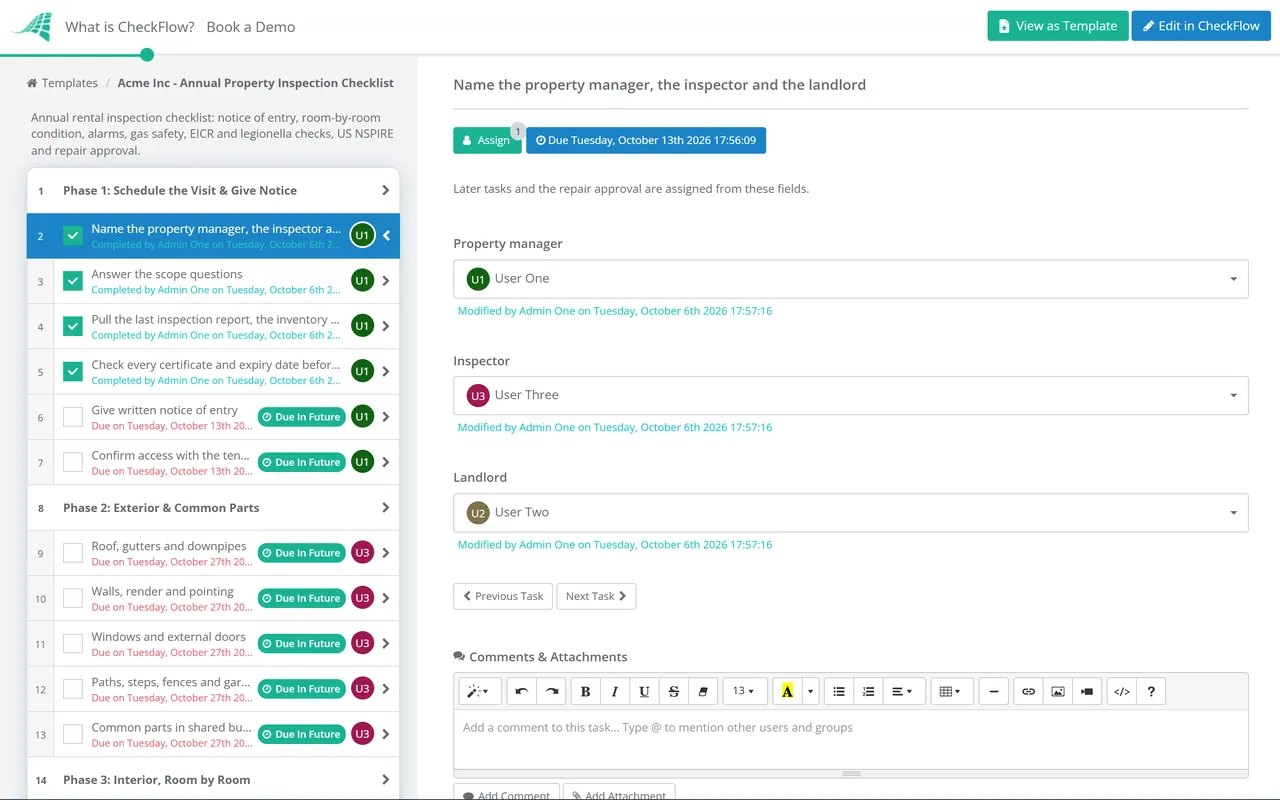
Seven phases run from notice of entry to the follow-up repairs. Phase 5 appears only for properties in England and Phase 6 only for properties in the US, with gas and HUD tasks shown only where they apply.
Answer the three scope questions first. They decide which compliance tasks and phases this inspection shows.
Shown only for properties in England. The gas task is shown only when the property has gas appliances.
Shown only for properties in the US. The NSPIRE task is shown only for HUD-assisted properties.
Not every check is annual, but the annual inspection is the right moment to confirm each one is in date. The table covers private rented homes in England and the main US rules. Wales, Scotland and Northern Ireland have their own regimes, so check local requirements there.
| Check | How often | What the rule says |
|---|---|---|
| Gas safety (England) | Every 12 months | Gas Safety (Installation and Use) Regulations 1998: a Gas Safe registered engineer checks appliances and flues; record to existing tenants within 28 days and to new tenants before they move in; keep records for two years. A check done 10 to 12 months after the last one keeps the original anniversary date |
| Electrical (England) | At least every 5 years | Electrical Safety Standards in the Private Rented Sector (England) Regulations 2020: report to the tenant within 28 days, to the council within 7 days if asked, and remedial work within 28 days or sooner if specified |
| Smoke and CO alarms (England) | Checked on the first day of each new tenancy; repaired when reported | Smoke alarm on every storey with living accommodation; CO alarm in any room with a fixed combustion appliance other than a gas cooker (since 1 October 2022) |
| Legionella (UK) | Reviewed periodically | Landlords must assess and control the risk under health and safety law; HSE says no “legionella test certificate” is required |
| Energy rating (England & Wales) | EPC valid for 10 years | Minimum rating E unless exempt; the Warm Homes Plan sets 1 October 2030 for privately rented homes to reach band C or equivalent |
| HUD-assisted housing (US) | Set by program | NSPIRE applies to public housing since 1 July 2023 and to HUD multifamily properties since 1 October 2023; the compliance date for Housing Choice Vouchers and Project-Based Vouchers is 1 February 2027 |
| Notice of entry (US) | Each visit | Set by state law, for example California Civil Code §1954 (24 hours’ written notice presumed reasonable) and Washington RCW 59.18.150 (two days’ written notice to inspect) |
What the Renters’ Rights Act 2025 changes for inspections. The Act’s first phase took effect in England on 1 May 2026, moving tenancies onto assured periodic terms and abolishing section 21 evictions. The property condition measures come later. Phase 2 starts rolling out the private rented sector database from late 2026. Applying a Decent Homes Standard to private rentals is planned for 2035, and extending Awaab’s Law, with its fixed timescales for damp, mould and other serious hazards, to private landlords still needs consultation and regulations. Until then, the fitness duty and HHSRS remain the standard, and a dated inspection record is your best evidence.
A yearly schedule per property starts the inspection a few weeks before it is due, with the notice-of-entry task dated first, so no home in the portfolio goes two years without a visit.
The inspector works through the checklist in a phone browser and attaches photos to the task they belong to. The report builds itself as the visit goes, and can be exported to PDF for the landlord.
The landlord’s approval holds the checklist until they answer, so no repair is ordered without sign-off. The completion history shows when you gave notice, inspected and acted, which is the evidence a council or tribunal will ask for.
The annual visit sits between two other inspections. Record condition at each end of the tenancy with the Move-In / Move-Out Inspection Checklist, and hand the faults you find to the Property Management Maintenance Checklist. If the visit falls near the end of a fixed term, the Lease Renewal Checklist picks up from there.
Managing blocks or houses in multiple occupation? The common parts need a Fire Risk Assessment Checklist as well. Run the whole portfolio with property management checklist software, or read our property management checklist guide.

Move-In / Move-Out Inspection Checklist
Property Management Maintenance Checklist

Lease Renewal Checklist

Seasonal Property Maintenance Checklist
Property Management Template
Describe the process in a sentence and the AI checklist generator drafts the phases and tasks for you.
English law sets no general inspection frequency for private landlords, and US rules vary by state and programme. A full inspection at least once a year is a sensible minimum, with lighter visits more often for older properties, shared houses or where there have been problems. Mortgage lenders, insurers, HUD programmes or local licensing may set their own requirements, and the gas safety check is due every 12 months regardless.
In England, at least 24 hours’ written notice, and the visit must be at a reasonable time of day. In the US it depends on the state: California presumes 24 hours’ written notice is reasonable, while Washington requires two days’ written notice to enter for an inspection. Outside emergencies, enter only with proper notice, and record when and how you gave it.
A tenant can ask to move a visit to a better time, and landlords should not enter without agreement outside an emergency. If access is repeatedly refused, keep a record of each request and take advice before going further; in England the tenancy agreement and the implied right of entry under section 11 of the Landlord and Tenant Act 1985 are the starting points.
Only the gas safety record is strictly annual. The electrical installation condition report is needed at least every five years, the energy performance certificate lasts ten years, and smoke and carbon monoxide alarms must be working at the start of each tenancy. A legionella risk assessment is needed but no certificate is. The annual inspection is the right time to confirm all of them are in date.
The date, who inspected and when notice was given; condition by area with dated photos; any hazards such as damp, mould or missing alarms; certificates checked and their expiry dates; issues raised by the tenant; and the repairs agreed, with who approved them and when they will be done.
14-day free trial, no card required. The Business plan is $10 per user per month after the trial. Full details at checkflow.io/pricing.
14-day free trial, no credit cardFull refund in your first 30 daysUS hosting, EU on request