Seasonal Property Maintenance Checklist Template

A gutter left blocked in autumn becomes damp in winter, and a boiler that has not run since spring fails on the first cold night. A planned round each season finds these jobs while they are still small.

Last reviewed: October 2026

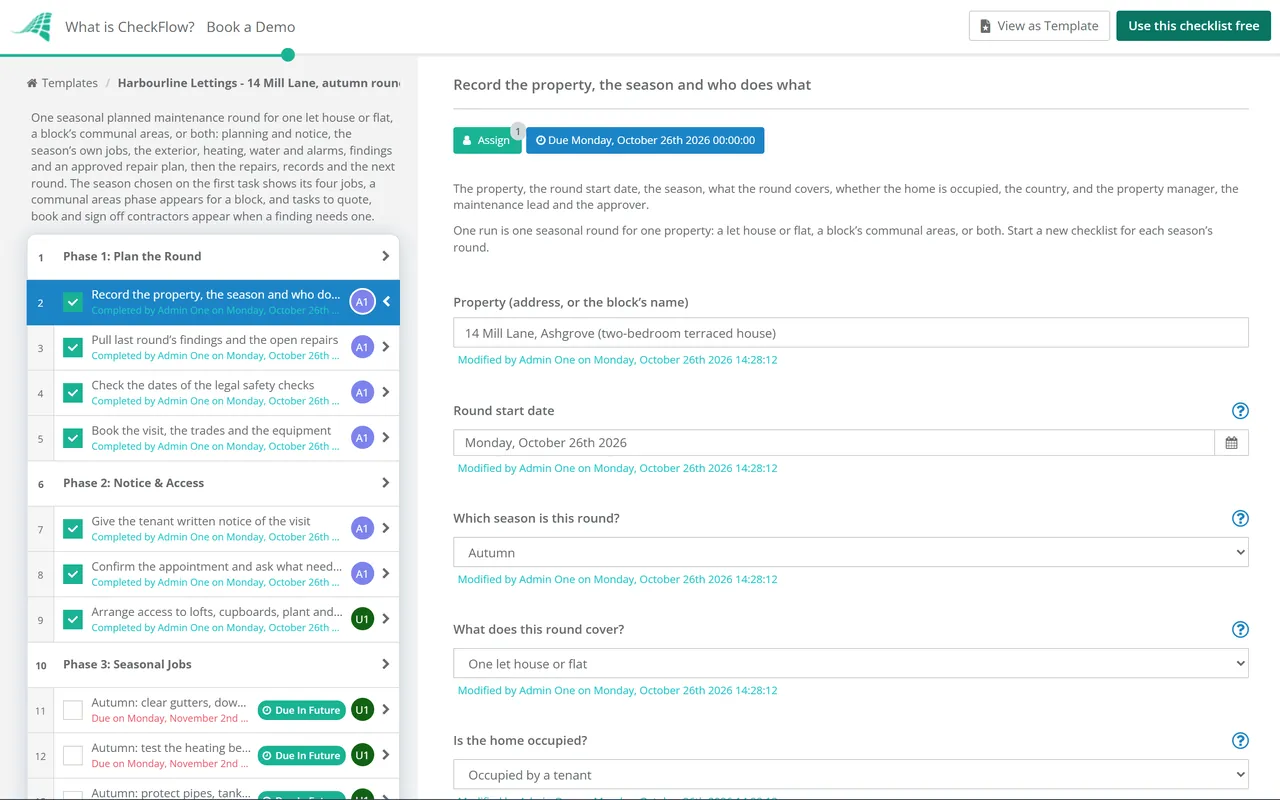
This free seasonal property maintenance checklist is for landlords, letting agents and property managers who look after let homes and blocks of flats. One run is one seasonal round for one property: a let house or flat, a block’s communal areas, or both. Choose the season on the first task and that season’s jobs appear: putting right winter damage in spring, outside work in summer, gutters, heating and frost protection in autumn, or warmth, frozen pipes, damp and storm damage in winter. Every round gives an occupied home’s tenant written notice, then checks the exterior, the heating, hot water and water system and the smoke and carbon monoxide alarms in a let home, and the communal areas where there are any. Findings are recorded with photos and priced, the landlord or property manager approves the repair plan before any contractor is booked, and the round ends with the records filed, the tenant updated and the next round set up. Short notes cover England, Scotland, Wales and Northern Ireland, and readers outside the UK are pointed to local codes and the lease.

A Seasonal Round, Not a Repair Log or an Annual Inspection

Planned maintenance is the work nobody reports: gutters that will block after the leaves fall, a boiler that has not run since spring, pipes that will freeze in the first cold spell. This checklist runs one round of that work for one property each season, with the visit, the findings, the approver’s decision on costs and the records in one place.

It sits beside three other property checklists. The Property Management Maintenance Checklist sets up a property’s whole maintenance system: the log of repairs the tenant reports, emergency repairs, periodic inspections, the yearly planned maintenance calendar and the certificate register. This checklist runs one of the seasonal rounds in that calendar, in detail. The Annual Property Inspection Checklist looks at the whole home once a year and checks the year’s certificates, and the Move-In / Move-Out Inspection Checklist records condition against the inventory at each end of a tenancy. The annual gas safety check and the electrical inspection are separate legal checks with their own dates: this round notes when each is due and leaves it to its own visit.

Seasonal round

Gets the property ready for the coming season

Asks: is the property ready for the season ahead, and has last season’s wear been put right?

When: four times a year, started on a recurring schedule.

Output: findings with photos, an approved repair plan, the repairs done and a record for the property file.

Maintenance system

Sets up the maintenance system

Asks: are repair requests, inspections, planned work and certificates all under control?

When: when you take on a property, then through the year.

Output: a repair log, an inspection routine, a planned maintenance calendar and a certificate register.

Annual inspection

Looks at the whole home once a year

Asks: is the home still safe and in repair, and are the year’s certificates in date?

When: once a year, with written notice of entry.

Output: an inspection report and the repairs the landlord approves.

What the Seasonal Property Maintenance Checklist Covers

Nine phases take one seasonal round for one property from planning to the next round. One run is one round because the work repeats each season: the checks in Phase 4 happen on every visit and those in Phases 5 and 6 whenever the round includes a let home, Phase 3 shows the four jobs for the season chosen on the first task, and Phase 7 appears only for a block’s communal areas. When a finding needs a contractor, tasks appear to get quotes, book the work and sign it off, and the approver agrees the plan and costs before anyone is booked.

  1. Phase 1

    Phase 1: Plan the Round

    4 tasks

    Answer the questions on the first task first. They show this season’s jobs, the communal areas phase for a block, the notice or empty-property tasks, and short notes for your country. Every due date counts from the round start date in working days, and the visit falls on the fifth working day.

    • Record the property, the season and who does what — the property, the round start date, the season, what the round covers, whether the home is occupied, the country, and the property manager, the maintenance lead and the approver
    • Pull last round’s findings and the open repairs — items carried over from the last round, open repair requests, warranties and guarantees on recent work, and anything the tenant has reported since
    • Check the dates of the legal safety checks — the gas safety check, the electrical inspection, the alarm records, the legionella risk assessment and the energy performance certificate, each a separate check with its own date, so book any that fall due rather than folding them into this round
    • Book the visit, the trades and the equipment — a date for the visit, anyone needed for work at height or on the boiler, ladders or access equipment, keys, and a phone or camera for photos
  2. Phase 2

    Phase 2: Notice & Access

    5 tasks

    An occupied home gets written notice before anyone visits. An empty home gets its own checks instead, and a block’s residents are told about work in the communal areas.

    • Give the tenant written notice of the visit — shown when the home is occupied: in writing, at least 24 hours before, with the date, the time window, the purpose and who will attend
    • Confirm the appointment and ask what needs looking at — shown when the home is occupied: who will be in, pets, keys and parking, and any repair or problem the tenant wants looked at on the day
    • Check the empty property before the visit — shown when the home is vacant: heating set to protect against frost, taps and showers run at least once a week, post and security checked, and the insurer’s conditions for an empty property met
    • Tell residents about work in the communal areas — shown for a block’s communal areas: a notice in the block or a message to each flat with the dates, any areas or services affected and a contact
    • Arrange access to lofts, cupboards, plant and outside areas — keys for loft hatches, meter cupboards, plant rooms and bin stores, and agreement from a neighbour or the freeholder where a ladder or scaffold needs their land
  3. Phase 3

    Phase 3: Seasonal Jobs

    16 tasks

    Only the four jobs for the season chosen on the first task appear. Spring puts right the winter’s wear, summer suits outside work, autumn gets the property ready for the cold, and winter keeps the home warm, dry and its pipes intact. These jobs are this template’s practice, not law, except where a task names a rule.

    • Spring: check the roof, chimney and flashings after winter — shown for the spring round: slipped or missing tiles or slates, lifted flashings, chimney pots and pointing, and moss build-up, checked from the ground or by a roofer
    • Spring: clear the gutters, gullies and drains of winter debris — shown for the spring round: leaves, moss and silt cleared, joints checked for leaks, and downpipes and gullies running freely in heavy rain
    • Spring: check outside walls, render and paintwork for frost damage — shown for the spring round: cracked render, failed pointing, flaking paint and failed seals around windows and doors, with anything to decorate added to the summer round
    • Spring: plan garden, tree and hedge work around nesting birds — shown for the spring round: fences, gates and paths checked, and any hedge or tree cutting planned after a check for nests in use, with consent first for protected trees
    • Summer: carry out outside decoration and repairs in dry weather — shown for the summer round: painting of windows, doors, fascias and soffits, and the repointing and render repairs approved after the spring round, booked while the weather is dry; anything new goes on this round’s findings list for approval
    • Summer: check trees, hedges and plants close to the building — shown for the summer round: overhanging branches, roots near drains and walls, and ivy on walls and gutters, with nests checked before any cutting
    • Summer: check ventilation, window restrictors and security — shown for the summer round: windows open and close, restrictors on upper-floor windows work, trickle vents are open, extractor fans run, and locks and outside lights work
    • Summer: book the boiler service and the autumn gutter clear — shown for the summer round: the boiler service booked before the heating season, with the gas safety check kept on its own date unless the engineer does both, and gutter clearing booked for after leaf fall
    • Autumn: clear gutters, downpipes and drains after leaf fall — shown for the autumn round: leaves and debris cleared from gutters, valleys, downpipes and gullies, with leaks and loose brackets noted for repair before the winter rain
    • Autumn: test the heating before the cold weather — shown for the autumn round: the boiler fires, every radiator heats and is bled if cold at the top, the thermostat and timer work, and the tenant knows how to use the controls and top up the boiler pressure if it needs it
    • Autumn: protect pipes, tanks and outside taps from frost — shown for the autumn round: lagging on pipes and tanks in the loft and on outside walls, outside taps isolated and drained, and the stopcock working, labelled and known to the tenant
    • Autumn: check windows, doors and draught-proofing — shown for the autumn round: seals, draught strips, door thresholds and letterboxes, with extractor fans and trickle vents left working so the home stays warm without condensation
    • Winter: check the home is keeping warm — shown for the winter round: the boiler shows no fault codes and holds its pressure, every room heats, hot water reaches the taps, and a tenant who struggles to heat the home is offered advice or pointed to support
    • Winter: check for frozen or burst pipe risks — shown for the winter round: lagging still in place, the loft hatch closed, outside taps off, and the tenant told how to turn off the water and who to call in a freeze or a leak
    • Winter: look for damp, condensation and mould — shown for the winter round: behind furniture, in window reveals, bathrooms and cupboards on outside walls, with the cause found and dealt with rather than the mould only wiped away
    • Winter: check the roof, gutters and paths after storms and snow — shown for the winter round: slipped tiles, blocked or broken gutters, fallen branches and fences, and ice on outside steps and paths the landlord looks after
  4. Phase 4

    Phase 4: Exterior & Grounds

    4 tasks

    Check these on every round, whatever the season. In England, where section 11 of the Landlord and Tenant Act 1985 applies, the landlord must keep in repair the structure and exterior of the home, including drains, gutters and external pipes.

    • Look over the roof, chimney and gutters from the ground — missing or slipped tiles, sagging or overflowing gutters, damp patches or staining on the walls below, and anything that needs a closer look by a roofer
    • Check drains, gullies and outside pipes run freely — gullies clear, inspection covers in place, no smell or standing water, and downpipes and waste pipes firmly fixed and not leaking
    • Check walls, windows and outside doors — cracks, damp, rot and failed seals, windows that open and lock, outside doors that close and lock, and no cracked glazing
    • Check paths, steps, boundaries and gardens — trip hazards, loose handrails and steps, fences and gates, outside lighting, and the parts of the garden the tenancy says the tenant looks after
  5. Phase 5

    Phase 5: Heating, Water & Ventilation

    4 tasks

    Applies only when the round includes a let home; it is hidden for a round of a block’s communal areas only, whose shared plant and water tanks are checked in Phase 7. In England, section 11 also covers the installations for water, gas, electricity, sanitation, space heating and heating water. For legionella in a home, HSE’s advice is to keep the hot water hot, the cold water cold and keep it moving.

    • Check the boiler, heating and controls — the boiler’s pressure and any fault codes, the service date, radiators and valves, the thermostat and timer, and signs of a problem such as staining or sooting, which need a Gas Safe registered engineer
    • Check hot water and the legionella controls — hot water reaching the taps hot, a hot water cylinder storing water at 60°C, a tight lid on any cold water tank, little-used outlets run, showerheads clean, and the risk assessment reviewed if anything has changed
    • Check for leaks and test the stopcock — under sinks and around baths, showers, toilets and the boiler, stains on ceilings below, and the stopcock turning off and on and easy to reach
    • Check ventilation, extractor fans and signs of damp — extractor fans in the kitchen and bathroom running and clearing steam, trickle vents open, and early signs of condensation or mould noted for the findings list
  6. Phase 6

    Phase 6: Alarms & Safety

    4 tasks

    Applies only when the round includes a let home; it is hidden for a round of a block’s communal areas only. Test every alarm on each round. The law in each UK nation sets where alarms go; in England it asks for them to be checked on the day a new tenancy begins and repaired or replaced when a reported alarm is found faulty. Testing them each season is this template’s practice.

    • Test every smoke alarm and heat alarm — the alarms the rules require for your country in place, each one tested with its test button, its expiry date checked, and any that fail replaced the same day
    • Test every carbon monoxide alarm — an alarm in every room the rules require, usually where there is a boiler, fire or stove, each one tested and in date, and the tenant shown how to test it
    • Look for signs of unsafe gas, electrical or solid fuel appliances — staining or sooting around boilers and fires, blocked flues or air vents, damaged sockets, scorch marks and overloaded adaptors, with nothing dismantled and a Gas Safe registered engineer or an electrician called
    • Check escape routes and the tenant’s safety information — hallways and stairs clear, fire doors closing where the home has them, and the tenant knowing where the stopcock, the consumer unit and any gas shut-off are
  7. Phase 7

    Phase 7: Communal Areas

    4 tasks

    Applies only when the round covers a block’s communal areas; it is hidden for a single house or flat. It works alongside the block’s fire risk assessment, which is a separate document with its own review date.

    • Check communal lighting and emergency lighting — stairs, landings, entrances, car parks and bin stores lit, timers and sensors set for the season, and emergency lighting tested as the fire risk assessment says
    • Check fire doors, escape routes and fire safety equipment — communal fire doors closing fully on their self-closers, stairs and escape routes clear of stored items, and signs, extinguishers and alarm panels as the fire risk assessment lists them
    • Check bin stores, roof access, plant rooms and shared water tanks — bin stores clean and clear, roof and plant room doors locked, lids tight on shared water tanks, and shared pumps and boilers serviced on their dates
    • Check communal grounds, paths and car parks — paths and steps free of trip hazards, leaves and ice, drains clear, fences and gates secure, and trees looked at for dead or overhanging branches
  8. Phase 8

    Phase 8: Findings, Repair Plan & Approval

    4 tasks

    List everything found, decide what needs a contractor, price it and get the approver’s decision. Nothing after the approval can be completed until the approver records a decision, so no contractor is booked without it.

    • Record every finding with photos and a priority — each item with where it is, what was found, its priority, and whether it can be done in-house, needs a contractor or can wait for a later round, with anything dangerous made safe on the day
    • Get quotes for the contractor works — shown when a contractor is needed: a quote for each job, more than one for larger jobs if your management agreement asks for it, with the scope, price and start date, and the contractor’s insurance and any registration checked
    • Prepare the repair plan and costs — every repair and contractor job with its priority, price, timing and who will do it, the total against the spending limit, and items moved to a later round with the reason
    • Approve the repair plan and costs — the approver records Approved, Approved with changes or Not approved, with any changes or reasons, before any contractor is booked
  9. Phase 9

    Phase 9: Repairs, Records & Next Round

    6 tasks

    Book only what was approved, check the work before the invoice is paid, keep the records together and set up the next round.

    • Book the approved contractors — shown when a contractor is needed: each contractor instructed in writing with the approved scope and price, access arranged with the tenant with written notice, and a date for the work
    • Update the tenant on what was found and what happens next — shown when the home is occupied: what was checked, what will be repaired and when, what they can do, such as reporting faults and keeping vents open, and who to contact
    • Carry out the small repairs — the in-house jobs on the approved plan done, such as bleeding a radiator, resealing a bath, replacing an alarm or easing a sticking door
    • Check and sign off the contractor works — shown when a contractor is needed: the work inspected or photographed when done, any certificate or warranty received, and each invoice checked against the approved quote before it is paid
    • File the round’s records — the visit notes, photos, findings, approval, invoices and certificates kept with the property’s records, so you can show when you checked, what you found and when you fixed it
    • Set up the next seasonal round — the next season’s round started or scheduled, its start date set, and the items moved to it noted on its first task

Season by Season, and the Rules Behind the Round

What each season’s round adds to the checks done on every visit. The timings and jobs are this template’s practice, not law; adjust them for your climate and your properties.

Season When to run it (this template’s suggestion) Main risks Jobs the round adds
SpringMarch to AprilWinter damage to roofs, gutters and walls; birds nesting in hedges and treesRoof, chimney and flashings; gutters and drains; walls and paintwork; garden, tree and hedge plans
SummerJune to JulyOutside work best done in dry weather; growth near the building; warm rooms with poor ventilationOutside decoration; trees and hedges; ventilation, window restrictors and security; booking the boiler service and the autumn gutter clear
AutumnOctober to November, after the leaves fallBlocked gutters; heating faults found on the first cold day; the first frostsGutters after leaf fall; a heating test; frost protection for pipes, tanks and outside taps; draught-proofing
WinterDecember to FebruaryFrozen and burst pipes; condensation and mould; storm and snow damage; homes that are hard to heatKeeping the home warm; frozen pipe risks; damp, condensation and mould; the roof, gutters and paths after storms

The rules behind the round, for England unless a row says otherwise. Each is quoted or summarised from the legislation or the regulator’s own page.

Topic What the rule says Source Where it shows
Repairs to the structure and exteriorThe landlord keeps in repair the structure and exterior, “including drains, gutters and external pipes”Landlord and Tenant Act 1985, section 11(1)(a)Phases 3 and 4
Repairs to installationsThe landlord keeps in repair and proper working order the installations for water, gas, electricity and sanitation, and for space heating and heating waterLandlord and Tenant Act 1985, section 11(1)(b) and (c)Phase 5
Entry to view conditionAt reasonable times of day, on 24 hours’ written notice to the occupierLandlord and Tenant Act 1985, section 11(6)Phase 2
Access for repairsIn an assured tenancy, the tenant gives access and reasonable facilities for repairs the landlord is entitled to carry outHousing Act 1988, section 16Phase 9
Smoke and carbon monoxide alarmsA smoke alarm on each storey with a room used as living accommodation; a CO alarm in any such room (a bathroom, lavatory, hall or landing counts) with a fixed combustion appliance other than a gas cooker; checked on the day a new tenancy begins; repaired or replaced when a reported alarm is found faultySmoke and Carbon Monoxide Alarm (England) Regulations 2015, regulation 4, as amended from 1 October 2022Phase 6
LegionellaAssess and control the risk; most landlords can do it themselves; no “legionella test certificate” is requiredHSE, Legionella and landlords’ responsibilities (Health and Safety at Work etc. Act 1974, COSHH and ACOP L8)Phases 2 and 5
Gas safety check (Great Britain)Each gas appliance and flue checked for safety at intervals of not more than 12 months, with a record keptGas Safety (Installation and Use) Regulations 1998, regulation 36Phase 1, as a separate check
Electrical inspectionInspected and tested at intervals of no more than 5 years, or sooner if the last report says soElectrical Safety Standards in the Private Rented Sector (England) Regulations 2020, regulation 3Phase 1, as a separate check
Fire doors in blocks above 11 metresCommunal fire doors checked at least every 3 months; flat entrance doors, best endeavours at least every 12 monthsFire Safety (England) Regulations 2022, regulation 10Phase 7
Nesting birds (England and Wales)An offence to intentionally take, damage or destroy the nest of any wild bird while it is in use or being builtWildlife and Countryside Act 1981, section 1Phase 3
Protected treesWritten consent for work on a tree under a Tree Preservation Order; 6 weeks’ notice for most work on trees in a conservation areagov.uk, Tree Preservation Orders and trees in conservation areasPhase 3

Wales, Scotland and Northern Ireland. In Wales, sections 92 and 98 of the Renting Homes (Wales) Act 2016 set the landlord’s repairing obligation and a right of entry on at least 24 hours’ notice, and regulation 5 of the Renting Homes (Fitness for Human Habitation) (Wales) Regulations 2022 asks for mains-powered, linked smoke alarms on each storey. In Scotland, sections 181 and 184 of the Housing (Scotland) Act 2006 give the landlord a right of entry on at least 24 hours’ notice. In Northern Ireland, nidirect sets out the landlord’s default repairing responsibilities, and the Smoke, Heat and Carbon Monoxide Alarms for Private Tenancies Regulations (Northern Ireland) 2024 add smoke, heat and carbon monoxide alarms.

Outside the UK. In the United States and elsewhere, local building and housing codes and the lease set the landlord’s maintenance duties, the notice needed to enter and the alarms required. Take advice; the seasonal jobs still apply, adjusted for your climate.

Where sources differ. gov.uk’s private renting guide still says a carbon monoxide alarm is needed in any room with a solid fuel burning appliance. Since 1 October 2022 the England regulations have said any room used as living accommodation with a fixed combustion appliance other than a gas cooker, which includes gas and oil boilers.

Why Run Seasonal Maintenance in CheckFlow?

1

The round fits the season and the property

The first task records the season, what the round covers and whether the home is occupied. Only that season’s four jobs appear, the communal areas phase appears for a block and the in-home checks only when there is a home in the round, the notice tasks appear for an occupied home and the empty-property checks for a vacant one, and short notes cover England, Scotland, Wales, Northern Ireland or outside the UK.

2

No contractor booked without approval

The approver is chosen on the first task. The approval is assigned to them, and nothing after the approval step can be completed until they record a decision. When a finding needs a contractor, tasks appear to get quotes, book the work and check it before the invoice is paid.

3

Four rounds a year for every property

Start each property’s rounds on a recurring schedule; the property manager enters the round start date on the first task and every due date follows from it. The Reports Grid lists every round with its answers, with filters and export, and Analytics shows overdue and late tasks by person and step.

CheckFlow does not replace the tenancy agreement, the management agreement, manufacturers’ instructions or advice from a qualified engineer, roofer or surveyor. It runs the round around them: who checks what, when, with what evidence, and who approved the spend. CheckFlow’s property management checklist software shows how the same approach handles the rest of a portfolio.

A block’s fire safety is assessed with the Fire Risk Assessment Checklist, and the whole tenancy, from letting to check-out, runs on the Property Management Checklist.

AI generator

Didn’t find what you need? Describe it.

Describe the process in a sentence and the AI checklist generator drafts the phases and tasks for you.

Frequently Asked Questions

What should a seasonal property maintenance checklist include?

Planning and written notice for the tenant, then the checks every round needs: the roof, gutters, drains, walls, windows and paths, the heating, hot water and water system, ventilation and damp, and the smoke and carbon monoxide alarms, plus the communal areas in a block. Add the season’s own jobs, such as gutters after leaf fall in autumn or frost protection before winter. Finish with findings and photos, an approved repair plan, the repairs, the records and the next round’s date.

What maintenance should a landlord do before winter?

In this template’s autumn round: clear gutters, downpipes and drains after the leaves fall, test the heating and bleed the radiators, lag pipes and tanks in the loft and on outside walls, isolate and drain outside taps, check the stopcock works, and check draught-proofing without blocking ventilation. The winter round then checks the home is keeping warm, looks for frozen pipe risks, damp, condensation and mould, and checks the roof, gutters and paths after storms and snow.

How often should a landlord carry out maintenance?

No law sets one timetable for planned maintenance. In England, section 11 of the Landlord and Tenant Act 1985 says what the landlord must keep in repair, and some checks have fixed intervals: the gas safety check at least every 12 months and the electrical inspection at least every 5 years. The government’s damp and mould guidance says landlords should inspect their properties regularly and have a regular programme of maintenance. This template suggests one round each season, alongside an annual inspection.

How much notice must a landlord give before a maintenance visit?

In England, where section 11 applies, the landlord or someone they authorise in writing may enter at reasonable times of day to view the condition and state of repair on 24 hours’ written notice (Landlord and Tenant Act 1985, section 11(6)). Wales (Renting Homes (Wales) Act 2016, section 98) and Scotland (Housing (Scotland) Act 2006, sections 181 and 184) also require at least 24 hours’ notice, though Scotland’s rule allows less when it is urgent. In the United States, state and local law and the lease set it.

Are landlords responsible for clearing gutters?

In England, where section 11 of the Landlord and Tenant Act 1985 applies, the landlord must keep in repair the structure and exterior of the home, “including drains, gutters and external pipes”. A blocked gutter that leaks into a wall soon becomes a repair the landlord has to make. Clearing gutters each autumn and checking them each spring is this template’s practice, and the tenancy agreement may say more. Gutter clearing is work at height, so use someone with the right equipment.

Do landlords have to test smoke alarms during a tenancy?

In England, the Smoke and Carbon Monoxide Alarm (England) Regulations 2015 require the alarms to be checked on the day a new tenancy begins and repaired or replaced once a reported fault is confirmed; they set no testing schedule during the tenancy. Government guidance suggests landlords show tenants how to test their alarms and share the manufacturer’s instructions. This template tests every alarm on each seasonal visit, as practice, and records the result.

Do landlords need a legionella test?

Usually not. HSE says landlords must assess and control the risk from legionella, but most can do the assessment themselves, testing is not usually needed for domestic water systems, and health and safety law does not require a “legionella test certificate”. Simple controls keep the risk low: hot water stored at 60°C in a cylinder, a tight lid on any cold water tank, clean showerheads, and outlets in an empty property run at least once a week.

Does this checklist include the gas safety check and the electrical inspection?

No. They are separate legal checks with their own dates. In Great Britain each gas appliance and flue in a let home must be checked for safety at intervals of not more than 12 months, and in England the electrical installation must be inspected and tested at least every 5 years, or sooner if the last report says so. The first phase records when each is due so you can book it, and the Annual Property Inspection Checklist checks they were done.

Is CheckFlow free for this template?

14-day free trial, no card required. The Business plan is $10 per user per month after the trial. Full details at checkflow.io/pricing.

Run Each Season’s Round, With Repairs Approved Before Anyone Is Booked

Free trial — no credit card required.

14-day free trial, no credit cardFull refund in your first 30 daysUS hosting, EU on request