Property Management Checklist Template

A rental property managed without a structured process is a rental property managed reactively — responding to problems that a checklist would have prevented, chasing compliance certificates that have quietly lapsed, and discovering maintenance issues at the worst possible time.

Property management involves more simultaneous responsibilities than most professional disciplines — and the consequences of getting any of them wrong are disproportionately severe. A gas safety certificate that lapses is not just an administrative oversight — it is a criminal offence for a landlord in England. A tenant not properly screened is not just a risk — it can be a twelve-month battle to recover the property through the courts. A maintenance issue not addressed promptly is not just an inconvenience — it is a disrepair claim and a potential rent withholding. The property manager who tries to carry all of this in their head — or in a series of spreadsheets and email reminders — will miss something. A structured property management checklist converts the full property lifecycle into a defined process: every compliance certificate tracked and renewed before expiry, every tenant communication documented, every maintenance request acknowledged and resolved within the appropriate timeframe, every rent payment tracked, and every lease renewal or end managed with proper notice. This free checklist gives property managers, portfolio landlords, and property management companies a structured framework for the full property management lifecycle.

Use This Template Free See Live Example
No Credit Card Required

Process framework, not legal advice. Property and tenancy law varies significantly between England, Scotland, Wales, Northern Ireland, and US states. This checklist is a process guide. Always consult a qualified solicitor or lawyer for advice on your specific circumstances and jurisdiction.

The Six Phases of the Property Management Lifecycle

Phase 1

Property Setup

Property legally compliant for letting, all safety certificates in place, EPC valid, inventory prepared, property listed.

Phase 2

Tenant Acquisition

Marketing, viewings, application intake, tenant screening, selection, and referencing.

Phase 3

Move-In

Lease signing, deposit collection and protection, move-in inspection, key handover, utility transfers, welcome communication.

Phase 4

Ongoing Management

Rent collection, maintenance request management, periodic inspections, compliance certificate renewals, tenant communication.

Phase 5

Lease Renewal or End

Renewal offer and negotiation, or notice serving and move-out process; deposit reconciliation and release; property re-marketing.

Phase 6

Annual Review

Property performance review, rent benchmarking, planned maintenance programme, regulatory change review, insurance renewal.

The Property Management Checklist

Six phases covering the full property management lifecycle — from initial setup and compliance through tenant acquisition, ongoing management, lease renewal or end, and annual review.

Phase 1

Property Setup & Legal Compliance

A property that is not legally compliant to let cannot be let legally. Every compliance item below is a legal requirement in England — not a recommendation. Equivalent requirements apply in other UK jurisdictions and US states.

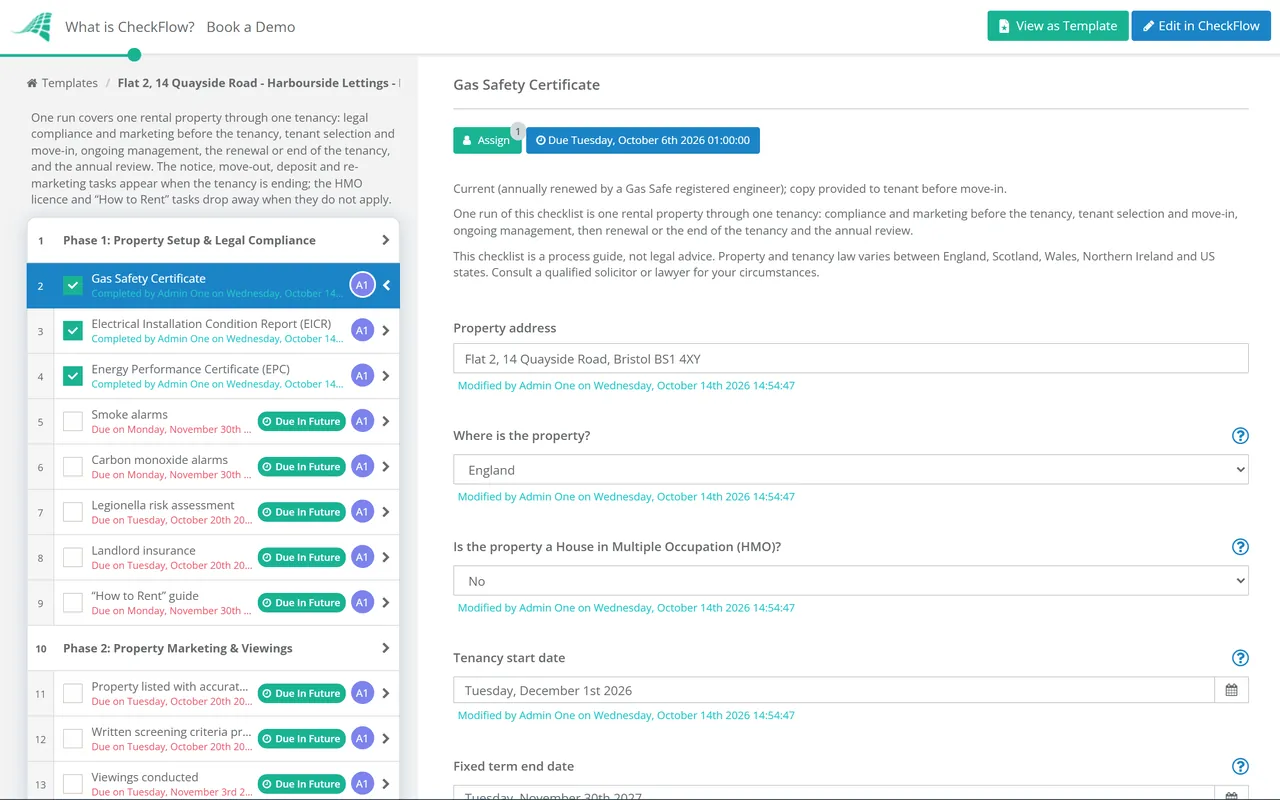
  • Gas Safety Certificate — current (annually renewed by a Gas Safe registered engineer); copy provided to tenant before move-in
  • Electrical Installation Condition Report (EICR) — current (every 5 years or at each change of tenancy); copy provided to tenant
  • Energy Performance Certificate (EPC) — current rating of E or above (UK); renewed every 10 years; copy provided to tenant
  • Smoke alarms — fitted on every floor; functioning; tested at start of tenancy
  • Carbon monoxide alarms — in every room with a combustible fuel appliance or open fire (England: since October 2022); functioning; tested at start of tenancy
  • Legionella risk assessment — completed; landlord legal duty of care; documented
  • HMO licence (if applicable) — if the property is a House in Multiple Occupation with 5+ tenants in 2+ households; current licence required
  • Landlord insurance — appropriate landlord policy (not standard home insurance) covering building, liability, and optional rent guarantee
  • “How to Rent” guide — (England only); current version provided to tenant before or at lease commencement; failure to do so may prevent serving notice
Phase 2

Property Marketing & Viewings

  • Property listed with accurate description and professional photos — on primary portals (Rightmove, Zoopla UK; Zillow, Apartments.com US); rent benchmarked against comparable local properties
  • Written screening criteria prepared before any applications received — income requirements, credit criteria, reference standards; applied consistently to every applicant (Fair Housing/Equality Act compliance)
  • Viewings conducted — in-person or virtual; property presented in lettable condition
  • Viewing record maintained — names and contact details of all serious enquiries
Phase 3

Tenant Selection & Lease Execution

  • Tenant screening completed — per the Tenant Screening Checklist (income verification, credit check, references, Right to Rent check)
  • Tenancy agreement signed — Assured Shorthold Tenancy (England) or equivalent jurisdiction-appropriate form; both parties retain signed copies
  • Deposit collected and protected — within 30 days of receipt in an approved Tenancy Deposit Scheme (England: DPS, MyDeposits, TDS); prescribed information served; failure is a financial penalty and prevents serving eviction notice
  • Move-in process completed — per the Tenant Onboarding Checklist
Phase 4

Ongoing Property Management

  • Rent collection tracked monthly — payment received; confirmed; any arrears addressed promptly (arrears ignored become the largest bar to successful eviction proceedings)
  • Maintenance requests acknowledged within 24 hours — logged; assessed; routine repairs scheduled; emergency repairs actioned immediately
  • Periodic property inspections — quarterly or biannually; with notice to tenant (minimum 24 hours notice in England); condition and maintenance needs documented
  • Compliance certificate renewals — gas safety certificate annually; EICR at 5-year intervals; EPC at 10-year intervals; each tracked in a certificate register
  • Tenant communication documented — all significant communications (maintenance requests, complaints, notices) in writing; logged in the property file
Phase 5

Lease Renewal or End of Tenancy

  • Renewal offer issued — 2–3 months before lease expiry; with proposed rent and any revised terms
  • Notice served correctly — if ending the tenancy; per the applicable legal requirements for the jurisdiction and grounds; see the Tenant Eviction Process Checklist
  • Move-out inspection conducted — with the tenant if possible; compared to the move-in inventory; condition documented with photos
  • Deposit reconciled and released — within the prescribed timeframe (England: 10 days if no disputes; via the deposit scheme if disputed); any deductions evidenced and documented
  • Property re-marketed — as soon as the end date is confirmed; aim for zero void period
Phase 6

Annual Review & Compliance Audit

  • Benchmark rent — against current market; consider rent increase at renewal in line with market and relevant legislation
  • Review all compliance certificates — expiry dates; renewals scheduled in advance
  • Review the planned maintenance programme — what is due in the next 12 months? Decorating cycle, boiler service, external maintenance?
  • Review for regulatory changes — any new legislation affecting landlord obligations in the relevant jurisdiction
  • Review landlord insurance — cover adequate? Renewal premium competitive?
  • Review the property’s financial performance — rent received vs voids; maintenance costs; net yield

The Compliance Certificates Every UK Landlord Must Keep Current

Certificate Frequency Who Issues Note
Gas Safety Certificate Annual Gas Safe registered engineer Criminal offence to let without a current certificate
EICR (Electrical Installation Condition Report) Every 5 years Qualified electrician Mandatory since 2020 (England)
Energy Performance Certificate (EPC) 10 years Accredited assessor Minimum E rating required (England/Wales)
“How to Rent” Guide Each tenancy / when updated Gov.uk (landlord provides) Failure may prevent serving a valid notice to end the tenancy
Smoke Alarms Checked at start of tenancy Landlord Mandatory; must be fitted on every floor
Carbon Monoxide Alarm Checked at start of tenancy Landlord Required with combustible fuel appliances (England: since October 2022)
Legionella Risk Assessment Periodically (no fixed interval) Landlord / competent person Landlord’s legal duty of care
HMO Licence 5 years (varies by council) Local authority Mandatory for qualifying Houses in Multiple Occupation

Why Run Your Property Management in CheckFlow?

1

Compliance certificate renewal alerts that fire before expiry — not after

A gas safety certificate that expired last month is a criminal offence for the landlord who did not notice. An EICR that lapsed at the last tenancy change is an invalidated deposit scheme entry. CheckFlow tracks every compliance certificate with advance renewal alerts — 90 days, 30 days, and 7 days before expiry — ensuring no certificate quietly lapses while the property is occupied.


2

A property file that documents everything, automatically

The landlord who needs to evidence how they managed a maintenance request, when they served notice, and what the deposit deduction was for — in court, in a tribunal, or in a tenancy deposit dispute — needs a dated, attributed record. Every interaction logged through CheckFlow’s property management process is timestamped and stored, producing the property file that turns disputes into resolutions.

3

The same consistent process across every property in the portfolio

A portfolio landlord or property management company needs the same compliance standard applied to every property, regardless of which property manager is responsible. CheckFlow deploys the same property management checklist across every property in the portfolio, with central visibility of compliance status, outstanding maintenance, and overdue renewals across all properties.

Tenant acquisition begins with a structured screening process. CheckFlow’s Tenant Screening Checklist covers the full tenant evaluation process. See the Tenant Screening Checklist →

Property maintenance is one of the most compliance-critical ongoing responsibilities for landlords. CheckFlow’s Property Maintenance Checklist covers the structured maintenance management process. See the Property Maintenance Checklist →

Frequently Asked Questions

What does a property management checklist include?

+

A comprehensive property management checklist covers six phases: property setup and legal compliance (gas safety certificate, EICR, EPC, smoke and CO alarms, legionella risk assessment, appropriate insurance, and the How to Rent guide for English tenancies), marketing and viewings (listing, written screening criteria, viewings), tenant selection and lease execution (screening, tenancy agreement, deposit protection, move-in), ongoing management (rent collection, maintenance request management, periodic inspections, compliance certificate renewals), lease renewal or end (renewal offer, notice service, move-out inspection, deposit reconciliation), and annual review (rent benchmarking, certificate audit, planned maintenance, regulatory change review, insurance, and financial performance).

What compliance certificates do UK landlords need?

+

UK landlords in England must maintain: a Gas Safety Certificate (annually, by a Gas Safe registered engineer — failing to have a valid certificate before a tenant moves in is a criminal offence), an Electrical Installation Condition Report (every 5 years or at each new tenancy), a valid Energy Performance Certificate (every 10 years, with a minimum E rating required), smoke alarms on every floor, carbon monoxide alarms in rooms with combustible fuel appliances, a legionella risk assessment, and an HMO licence where applicable. Landlords must also provide tenants with the current version of the “How to Rent” guide — failure to do so can prevent serving a valid notice to end the tenancy.

How often should a landlord inspect a rental property?

+

Most landlords conduct property inspections quarterly or every six months during a tenancy. In England, landlords must give tenants at least 24 hours notice before entering the property. Inspections should be documented with a written report and photographs, particularly for anything that might be relevant to a future deposit deduction or maintenance obligation. A detailed move-in inventory signed by the tenant is the essential baseline against which all inspection reports and eventual move-out condition assessments are compared.

What should be in a landlord’s property file?

+

A comprehensive property file should contain: signed tenancy agreement and any addenda, completed and signed move-in inventory with photographs, all compliance certificates (Gas Safety, EICR, EPC), deposit protection confirmation and prescribed information, “How to Rent” guide provision evidence, all maintenance request records and completion evidence, inspection reports with photographs, all written tenant communications, any notices served, and ultimately a move-out inspection report and deposit reconciliation records.

Is CheckFlow free for this template?

+

You can start a free 14-day trial with no credit card required, giving you full access to all features including this template. The Business plan is $10 per user per month after the trial. Full details at checkflow.io/pricing.

Manage Every Property Compliance Obligation, Maintenance Task, and Tenant Communication — Without Missing Anything

Free trial — no credit card required.