Property Management Maintenance Checklist Template

A landlord who fails to complete a notified repair within a reasonable time does not just have an unhappy tenant — they have a disrepair claim, potential local authority action, a rent withholding dispute, and a property whose condition is now deteriorating on their watch.

Maintenance is the most time-consuming, complaint-generating, and liability-intensive aspect of property management. The dripping tap the landlord ignored for three months is now a damp problem. The boiler that ran without annual service failed in January. The gutters that were not cleared in autumn are causing water ingress in the first floor bedroom. Every one of these is a maintenance failure that started as a low-cost intervention and became an expensive remediation — and in all three cases, the landlord’s legal obligation under Section 11 of the Landlord and Tenant Act 1985 was breached once the repair was notified and not completed within a reasonable time. A structured property maintenance checklist converts reactive firefighting into a proactive maintenance programme: a defined process for logging and responding to repair requests, a scheduled calendar of preventive maintenance tasks, a periodic inspection cycle that catches developing issues early, and a compliance certificate register that never lapses. This free checklist gives landlords and property managers a structured framework for the full property maintenance management process.

Use This Template Free See Live Example
No Credit Card Required

What “Reasonable Time” Means — UK Repair Response Standards

Emergency

24-Hour Response

No heating or hot water in winter; gas leak; electrical fault creating safety risk; burst pipe or major water leak; blocked or broken toilet (only toilet in property); roof leak into property; unsecured external door or window.

The landlord must act immediately upon notification.

Urgent

3–5 Day Response

Boiler fault (heating in warmer months); partial loss of power; significant plumbing leak (contained); loss of hot water; significant pest infestation; partial roof leak not causing structural damage.

Non-Urgent

Up to 28 Days

Dripping taps; stiff door locks; minor plasterwork damage; cupboard door off hinge; minor electrical faults (non-safety-critical); general decoration (if tenant-caused damage, may be at tenant’s cost).

These timeframes are guidelines based on common practice and case law. What is “reasonable” depends on the circumstances, including the impact on the tenant. The most important step is to acknowledge and log every repair request immediately and begin investigation promptly.

The Property Management Maintenance Checklist

Six phases covering the full property maintenance management process — from repair request intake and emergency response through routine repairs, periodic inspections, planned maintenance, and compliance certificate management.

Phase 1

Maintenance Request Intake & Logging

Every maintenance request must be logged, dated, and attributed. The landlord who cannot evidence when a repair was reported and when it was completed loses every disrepair dispute where timing is contested.

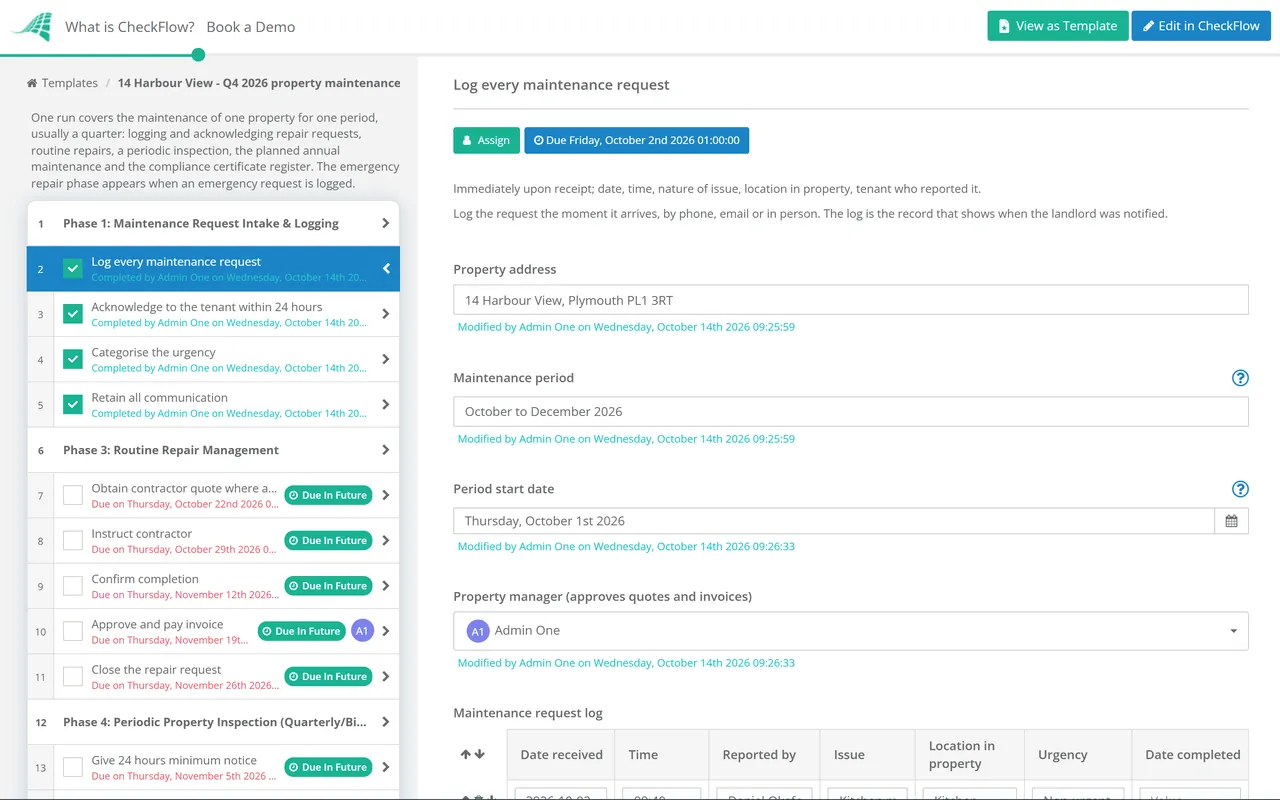
  • Log every maintenance request — immediately upon receipt; date, time, nature of issue, location in property, tenant who reported it
  • Acknowledge to the tenant within 24 hours — confirmation that the request has been received and will be assessed; prevents the tenant feeling ignored and escalating
  • Categorise the urgency — emergency, urgent, or non-urgent; based on the nature of the issue and the impact on habitability
  • For emergencies: contact contractor immediately — within hours; not the next working day
  • Retain all communication — all repair requests and responses in writing; all contractor communications documented
Phase 2

Emergency Repair Response

  • Instruct emergency contractor immediately — out-of-hours service where required; the cost of out-of-hours is lower than a disrepair claim
  • Confirm attendance time with tenant — when the contractor will arrive; provide a temporary solution where possible (electric heaters if boiler fails in winter)
  • Document the emergency and the response — when reported, when contractor instructed, when attended, what work was done
  • Confirm resolution with tenant — issue resolved? Further works required?
Phase 3

Routine Repair Management

  • Obtain contractor quote where appropriate — for non-emergency repairs above a defined cost threshold; quote approved before works commence
  • Instruct contractor — with clear scope of work; agree access arrangements with tenant (minimum 24-hour notice in England)
  • Confirm completion — with the tenant; work done to the required standard? Follow-up visit by the property manager if significant works
  • Approve and pay invoice — against the agreed scope and price; retain for landlord records and tax purposes
  • Close the repair request — in the maintenance log; with the completion date and resolution
Phase 4

Periodic Property Inspection (Quarterly/Biannual)

  • Give 24 hours minimum notice — in writing; England: landlord must give at least 24 hours notice; cannot enter without consent or notice except in genuine emergency
  • Conduct a systematic inspection — every room; exterior; garden (where applicable); roof/gutters visible; condition against the inventory baseline
  • Inspect for structural issues — cracks, damp, water staining, plaster deterioration, roof damage, gutter blockage
  • Inspect all services — heating and hot water functioning; electrical fittings not damaged; plumbing not leaking; ventilation adequate
  • Inspect for tenant damage — beyond fair wear and tear; documented with photographs; raised with the tenant
  • Produce a written inspection report — dated; with photographs; filed in the property record
Phase 5

Planned Maintenance Schedule (Annual)

  • Annual boiler service — by a Gas Safe registered engineer (combines with the gas safety certificate where applicable)
  • Annual gutter clean — particularly important for older properties; blocked gutters are a primary cause of damp
  • External decoration cycle — typically every 5–7 years for paintwork; assessed during inspections
  • Internal decoration — assessed at each tenancy change and at periodic inspections; budgeted and scheduled
  • Damp and ventilation check — mould-prone areas inspected annually; ventilation adequate?
  • Test all smoke and CO alarms — at the start of each tenancy and annually; replace as required
Phase 6

Compliance Certificate Register & Renewal Schedule

  • Maintain a certificate register — for every property; listing all compliance certificates with issue date, expiry date, and next renewal date
  • Gas Safety Certificate renewal — scheduled 30 days before expiry; Gas Safe engineer booked in advance; new certificate provided to tenant within 28 days of renewal
  • EICR renewal — at 5-year intervals or at each change of tenancy; electrician booked in advance
  • EPC review — valid for 10 years; note upcoming minimum standard changes (proposed increase to C rating for new tenancies in England — monitor for implementation date); budget for improvement works if required

Why Manage Property Maintenance in CheckFlow?

1

Every repair request logged, acknowledged, and tracked to completion

The landlord who cannot produce a dated log of when a repair was reported, when it was instructed, and when it was completed is the landlord who loses every disrepair dispute where timing is contested. CheckFlow logs every request on receipt with a timestamp, tracks the assignment and progress, and closes the record when completion is confirmed.

2

Planned maintenance scheduled automatically — not from memory

The annual boiler service, the autumn gutter clean, the smoke alarm check, and the gas safety certificate renewal all have defined intervals — and all get missed when a property manager relies on memory or a spreadsheet that was last updated six months ago. CheckFlow’s recurring feature generates each planned maintenance task automatically at its defined interval.

3

A complete maintenance record for every property

When a tenant makes a disrepair claim, when an insurance policy is queried, or when a property is sold and the buyer asks for the maintenance history — the maintenance record matters. Every request, every inspection, every contractor instruction, and every completed repair logged through CheckFlow produces the property file that demonstrates systematic, responsible maintenance management.

Property maintenance connects to the compliance certificate requirements tracked in the full property management process. CheckFlow’s Property Management Checklist covers the overarching property lifecycle. See the Property Management Checklist →

For commercial properties, the facility inspection process covers the broader building systems assessment. CheckFlow’s Facility Inspection Checklist covers the comprehensive commercial inspection process. See the Facility Inspection Checklist →

Frequently Asked Questions

What should a property management maintenance checklist include?

+

A property management maintenance checklist covers six phases: maintenance request intake and logging (immediate logging, 24-hour acknowledgement, urgency categorisation), emergency repair response (immediate contractor instruction, tenant confirmation, documentation), routine repair management (quote approval, contractor instruction, completion confirmation, invoice processing), periodic property inspections (advance notice to tenant, systematic room-by-room inspection, written report with photographs, maintenance works identified), planned maintenance schedule (annual boiler service, gutter clean, decoration cycle, damp check, alarm testing), and compliance certificate register (certificate register maintained, renewal alerts set for gas safety, EICR, and EPC).

What are landlords legally required to repair in the UK?

+

Under Section 11 of the Landlord and Tenant Act 1985 (England and Wales), landlords are legally required to keep in repair and proper working order: the structure and exterior of the property (roof, walls, windows, doors, gutters, drains), the installations for the supply of water, gas, and electricity, the heating and hot water installations, and the drains, baths, sinks, toilets, and other sanitary appliances. These obligations apply once the landlord has been notified of the disrepair — the landlord cannot be required to repair something they do not know about. Once notified, repairs must be completed within a reasonable time, which varies by severity.

What happens if a landlord fails to complete a repair?

+

If a landlord fails to complete a notified repair within a reasonable time in England and Wales, the tenant has several remedies: they can report to the local authority (council) for environmental health action under the Housing Health and Safety Rating System (HHSRS), which can result in the council serving an improvement notice on the landlord; they can make a disrepair claim in the civil courts for damages and costs; in severe cases they may be entitled to withhold rent. Legal proceedings for disrepair can result in the landlord being ordered to carry out the works and to pay the tenant’s legal costs and compensation.

How often should a landlord inspect a rental property?

+

Most landlords conduct formal property inspections quarterly or biannually — every three to six months. In England, 24 hours minimum notice must be given before entering the property. Inspections should be documented with a written report and photographs. In addition to formal inspections, the landlord should conduct a check at any time when a contractor visits for maintenance, when a compliance certificate is renewed, and when a tenancy ends.

Is CheckFlow free for this template?

+

You can start a free 14-day trial with no credit card required, giving you full access to all features including this template. The Business plan is $10 per user per month after the trial. Full details at checkflow.io/pricing.

Track Every Repair, Inspection, and Compliance Certificate Across Your Property Portfolio

Free trial — no credit card required.