
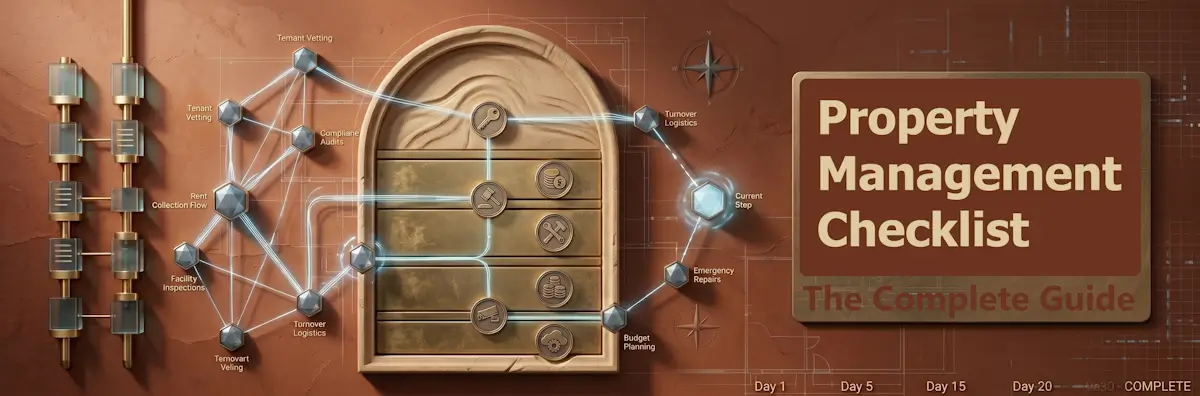
The U.S. property management industry generates $134.2 billion in annual revenue (2025), serves 49.5 million rental units across approximately 330,000 companies, and employs nearly half a million people. The 94% of property management companies that expect revenue to grow over the next two years all face the same constraint: how to scale operations without scaling headcount proportionally.
The constraint is process. A single property manager handling 50–100 units is running dozens of recurring workflows simultaneously — move-ins, move-outs, routine inspections, seasonal maintenance, lease renewals, owner reporting, compliance audits. When those workflows live in the property manager's head, or in an informal email thread, they are not scalable. A new team member can't replicate the institutional knowledge. A missed step in a move-out inspection becomes a security deposit dispute. A forgotten smoke detector check becomes a liability.
This guide is written for landlords and property managers at every scale — from self-managing investors with a handful of properties to regional portfolio managers handling hundreds of units — who want to systemise their operations, reduce liability, and deliver a consistent tenant experience. It provides a complete set of property management checklists for every phase of the tenancy lifecycle: move-in, move-out, turnover, routine maintenance, seasonal inspections, and lease renewals — plus the compliance context and industry benchmarks that help property managers understand what operational excellence actually looks like.
What Property Management Involves
Property management is the operation, control, maintenance, and oversight of real estate on behalf of property owners. It spans three property types, each governed by a different body of law.
Residential: Single-family homes, multifamily apartments, condos, student housing, and mobile homes. Governed by residential landlord-tenant law — tenants are treated as consumers and benefit from significant statutory protections.
Commercial: Office, retail, industrial, warehouse, and flex space. Governed by commercial lease law — tenants are business entities with more negotiating leverage and far fewer consumer protections.
Mixed-use: Ground-floor retail with residential above. Requires compliance with both residential and commercial law simultaneously; the Fair Housing Act can apply to the commercial portions in certain circumstances.
The five core responsibility areas
- Tenant relations — screening, leasing, communication, dispute resolution, renewal, and eviction proceedings.
- Maintenance — preventive scheduling, emergency repairs, vendor management, and work order tracking.
- Leasing — marketing vacancies, showings, application processing, lease execution, and renewals.
- Financial management — rent collection, accounts payable/receivable, owner distributions, financial reporting, CAM reconciliation (commercial), and budgeting.
- Compliance — Fair Housing Act, habitability standards, safety codes, disclosure requirements, rent control ordinances, and insurance requirements.
The scale of the industry tells you how fragmented it is: there are 330,400 property management companies in the U.S. The top 20 companies manage 3.2 million rental units combined, and the largest single company manages 798,272 units — but most operators are small regional businesses managing dozens to low hundreds of units. That fragmentation is exactly why documented, repeatable processes are a competitive advantage: the operators who systemise grow faster and with less risk than the operators who improvise.
Move-In Checklist
The move-in condition report is the single most important document in the tenancy lifecycle. It is the baseline against which every security deposit claim is evaluated. Without a signed, dated, photographed condition report, landlords cannot legally deduct for damage in 17 states — and in practical terms, courts consistently rule against landlords who lack documented evidence in all states.
The legal context is unambiguous. Seventeen states mandate a formal written move-in condition report as a prerequisite for withholding any portion of a security deposit. California AB 2801 (effective July 1, 2024) requires before-and-after photographs for any security deposit deduction. New York requires an offer of in-person inspection with a written damage agreement. The move-in checklist is not paperwork for its own sake — it is the evidentiary foundation that protects the owner months later. The Move-In / Move-Out Inspection Checklist runs the same room-by-room report at both ends of the tenancy, so the move-out comparison has a baseline to work from.
Before the tenant arrives
- Property deep-cleaned and rent-ready
- All appliances tested and functional
- Smoke detector tested; battery fresh; expiration date confirmed (replace if >10 years old)
- CO detector tested; battery fresh; expiration date confirmed (replace if >5–7 years old)
- HVAC filter replaced; system tested for heating and cooling
- All lights functional; bulbs replaced where needed
- All keys, fobs, access codes, and parking passes prepared and counted
- Utility meter readings recorded (electricity, gas, water)
- Welcome packet prepared
Move-in walkthrough — room by room (with tenant present)
Kitchen
- Appliances (range, oven, dishwasher, refrigerator): operational and cosmetic condition
- Cabinets and drawers: hardware functional; interior clean
- Countertops: no burns, chips, or stains
- Sink and disposal: operational, no leaks
- Flooring condition; walls and ceiling
Bathrooms (each)
- Tub/shower: caulk and grout intact; no mould
- Toilet: flush function; seat condition
- Fixtures: no drips or corrosion
- Exhaust fan functional
- Flooring, walls, and mirror condition
Bedrooms and living areas
- Walls: no significant holes, marks, or stains
- Flooring: no stains, tears, or burns
- Windows: open, close, and lock; screens intact; blinds functional
- Closet doors and hardware
- Light fixtures and outlets functional
- Ceiling fans if installed
Exterior / common areas
- Yard and landscaping condition
- Driveway/parking: cracks, damage
- Garage door function (if applicable)
- Fencing condition
- Mailbox
Completion and documentation
- Utility meter readings recorded at time of walkthrough
- Photographs taken: every room, every documented item, every existing blemish
- Move-in condition report signed by both landlord and tenant
- Tenant receives a copy
- Keys and access devices issued; count documented with tenant acknowledgment
- Security deposit receipt provided (required in some states)
Move-Out Checklist
The move-out checklist closes the loop the move-in report opened. Its purpose is to compare current condition against the documented baseline, separate chargeable damage from normal wear and tear, and produce a defensible security deposit disposition within the state-mandated deadline.
Pre-move-out communication
- Move-out notice received and date confirmed
- Move-out instructions sent to tenant (cleaning expectations, key return procedure, final inspection date)
- Vendors pre-booked (cleaning, painting, maintenance) based on anticipated scope
- Final inspection appointment confirmed with tenant
The move-out inspection
Conduct the inspection within one week of vacancy. Compare directly against the move-in condition report and photographs — room by room, item by item.
- Photographs of current condition, each room and area
- Compare against move-in photos: identify damage vs. normal wear and tear
- Document all chargeable items with description and photo
Damage vs. normal wear and tear — the critical distinction
This is where most security deposit disputes are won or lost. Normal wear and tear is the expected deterioration from ordinary use and cannot be charged to the tenant. Damage is the result of negligence, carelessness, or abuse and can be.
| Chargeable Damage | Normal Wear and Tear |
|---|---|
| Large holes in walls | Small nail holes from picture hanging |
| Broken fixtures or hardware | Faded paint from sunlight exposure |
| Pet stain damage to carpet | Light carpet wear from foot traffic |
| Burns or deep scratches on countertops | Minor scuffs on baseboards |
| Broken window glass | Normal door hinge wear |
Final inspection checklist items
- Appliances: cleaned inside and out; operational
- Cabinets: clean; no damage
- Countertops: damage documentation
- Floors throughout: vacuum/mop condition; stain/damage documentation
- Walls throughout: holes, marks, excessive scuffs
- Windows: glass intact; locks functional
- Blinds: slats intact, not bent
- Bathrooms: clean, grout/caulk condition, fixtures
- Smoke and CO detectors: present and functional
- All personal belongings removed (if not, follow state abandoned property procedure)
- All keys returned: count matches move-in record
Security deposit disposition
- Forwarding address obtained from tenant
- Itemised deduction list prepared (with repair estimates or receipts)
- Security deposit return (or itemised statement) sent within the state-mandated deadline
| State | Security Deposit Deadline |
|---|---|
| California | 21 days (+ before/after photos for any deduction) |
| Texas | 30 days |
| Florida | 15–30 days |
| Washington | 30 days |
| New York | 14 days for itemisation notice |
Tenant Turnover (Make-Ready) Checklist
Turnover is where profitability is made or lost. The average baseline cost of turnover in 2025 is approximately $1,750 per unit. Each month a unit sits vacant costs 8–10% of annual rent. The average national vacancy window is 20 days — and professionally managed properties achieve vacancy windows roughly 40% shorter than self-managed properties. The difference between a 20-day turn and a 35-day turn, repeated across a portfolio, is the difference between a profitable year and a marginal one. A structured turnover process is the single highest-leverage operational discipline in property management.
Phase 1: Move-out notice and preparation
- Move-out date logged; lease end date confirmed
- Turnover task list created with vendors and milestone dates
- Cleaning, painting, and maintenance vendors pre-booked before move-out
- Owner notified with estimated turn timeline and preliminary cost range
Phase 2: Move-out inspection
- Final walkthrough completed (see move-out checklist)
- Scope of work identified: cleaning, repairs, painting, replacements
- Cost estimates prepared per category
- Owner approval obtained for any work above agreed threshold (e.g., >$500 single item)
Phase 3: Make-ready work
- Re-key or change locks
- Replace HVAC filter; test heating and cooling
- Test smoke and CO detectors; replace batteries; confirm not expired
- Deep clean: kitchen appliances inside/out, bathrooms (scrub tub, regrout/recaulk if needed), all floors vacuumed and mopped
- Carpet: clean or replace; odour treatment for pet units
- Walls: fill nail holes; touch-up paint or full repaint as needed
- Blinds and window coverings: repair or replace damaged items
- All appliances: test operational; clean
- Light bulbs: replace all burned-out bulbs
- Exterior: sweep/clean entry, refresh landscaping if needed
Phase 4: Marketing and leasing
- Photographs taken (post make-ready) for listing
- Listing created and syndicated to Zillow, Apartments.com, and relevant local platforms
- Rental price confirmed against current market comps
- Showings scheduled; automated confirmation sent
- Applications received; tenant screening completed
- Lease executed; move-in funds collected
Phase 5: Move-in handoff and owner reporting
- Move-in checklist completed (see Move-In Checklist)
- Welcome packet delivered
- Turn cost summary compiled with receipts and before/after photos
- Vacancy days and turn time reported to owner
- Security deposit from prior tenant returned or itemised per state deadline
Routine Maintenance Inspection Checklist
Preventive maintenance costs 3–5x less than emergency repairs. Well-executed preventive programmes reduce equipment breakdowns by up to 70% and extend asset lifespan by 20–40%. A simple HVAC filter delivery programme reduced HVAC maintenance tickets by 38% in a measured data study (Second Nature). With the average maintenance cost per unit rising 12% in 2024, preventive maintenance is the single most effective lever a property manager has for controlling cost — and the routine inspection is how you find the small problem before it becomes the emergency call.
For the yearly visit itself, and the safety certificates that tend to fall due around it, the Annual Property Inspection Checklist covers notice of entry, the room-by-room condition check and the follow-up repairs.
Recommended inspection frequency
- Single-family homes: semi-annually (spring and fall)
- Multifamily communal areas: monthly or quarterly
- HVAC: semi-annually (before summer and before winter)
- HVAC filters: monthly check; change every 1–3 months depending on filter type
- Plumbing: quarterly checks for leaks
- Smoke/CO detectors: at every move-in; annual battery check
Interior inspection
Kitchen and bathrooms
- Appliances: operational; gas lines secure; no unusual odours
- Caulk and grout: intact; no gaps or mould growth
- Drainage: no slow drains; no standing water
- Under-sink plumbing: no leaks, staining, or moisture
- Shut-off valves: accessible and operational
- Exhaust fan: functional
Living areas and bedrooms
- Windows: open, close, and lock properly; screens intact; no broken seals
- Smoke detector: test function; battery condition; expiration date
- CO detector: test function; battery condition; expiration date
- GFCI outlets (kitchen, bathrooms, garage): test
- Ceiling fans: balanced, no wobble
Basement and utility
- Water heater: temperature set to 120°F; pressure relief valve accessible; no signs of rust or leaks
- Moisture or mould indicators: water stains, musty odour
- Electrical panel: accessible, labelled, no tripped breakers
Exterior inspection
- Roof: no visibly missing or damaged shingles; no sagging; flashing intact
- Gutters and downspouts: clear; properly sloped; directing water away from foundation
- Foundation: no new cracks; no water infiltration at base
- Siding and paint: no peeling, rot, or gaps
- Driveway and walkways: no trip hazards; cracks documented
- Exterior lighting: functional
- Fencing: post stability; gate hardware functional
Systems inspection
| System | Key Inspection Items |
|---|---|
| HVAC | Filter condition, coil fins, drain pans, thermostat calibration, emergency shutoff accessible |
| Plumbing | Under-sink leaks, ceiling stains (below bathrooms/laundry), water pressure, water heater |
| Electrical | Panel condition, outlet/switch function, GFCI test, exterior lighting |
| Fire Safety | Smoke detectors (test + expiration), CO detectors, fire extinguisher (class and expiration) |
| Security | Door and window locks, deadbolts, garage door sensors |
Seasonal Maintenance Checklist
Seasonal maintenance aligns the property's upkeep with the weather it has to withstand. The goal is to service systems before peak demand — the A/C before the first heat wave, the furnace before the first freeze — and to catch weather-related damage early. Organise the year into four season blocks.
Spring (post-winter)
- Inspect roof for winter damage: missing/cracked shingles, flashing failures
- Clean and inspect gutters and downspouts; clear winter debris
- Check foundation for freeze-thaw cracks
- Service HVAC cooling system: clean coils, replace filters, test A/C before summer demand
- Inspect exterior paint and siding for winter damage
- Check window and door caulking; replace worn weatherstripping
- Inspect driveway and walkways for frost heave cracks
- Inspect attic for winter condensation, moisture, or mould
- Test all smoke and CO detectors; replace batteries
- Check outdoor plumbing and hose bibs; inspect for freeze damage
- Service landscaping equipment; prepare yard
Summer
- Monitor A/C performance under peak load; schedule tune-ups proactively
- Inspect roofing and siding after significant storms
- Pest control inspection (insects, rodents, wasps)
- Check humidity levels; prevent mould in high-humidity regions
- Inspect window screens for holes
- Maintain landscaping: trimming, irrigation, drainage
Fall (pre-winter / winterisation)
- Service HVAC heating system: furnace tune-up, filter replacement, ductwork inspection
- Clear gutters of fallen leaves before first freeze
- Caulk windows and doors; replace worn weatherstripping
- Check insulation in attic and crawl spaces
- Drain and winterise outdoor irrigation systems and hose bibs
- Inspect chimney and fireplace if applicable
- Check roof ahead of snow/ice season
- Inspect sump pump if applicable
- Check carbon monoxide detectors — high-risk season as heating systems activate
- Trim trees and branches near structure
Winter
- Monitor heating system performance; prioritise emergency heating failures
- Maintain minimum interior temperature (55°F+) in vacant units; insulate exposed pipes
- Monitor for ice dams on roof edges after snowfall
- Keep walkways and driveways clear of ice and snow (liability)
- Monitor exterior walls for condensation and mould indicators
- Inspect roof after heavy snowfall or ice events
Lease Renewal Checklist
The lease renewal process should start 60–90 days before lease expiration. Send the formal renewal offer no later than 60 days before expiration (some states require 90 days; Washington requires 90 days statewide, and Seattle requires 180 days). Target a tenant response no later than 30 days before expiration so there is time to re-lease if the tenant declines. The Lease Renewal Checklist starts those steps on a timetable counted back from the expiry date.
Rent increase notice requirements (selected states)
- California: 90 days (AB 1482 properties); cap is 5% + local CPI, or 10% — whichever is lower
- Washington (2026): 90 days statewide; 180 days in Seattle; maximum increase 9.683% (2026 cap under HB 1217)
- Oregon: 90 days; statewide cap of CPI + 3% (maximum 10%)
- 32 states have no rent control — check local ordinances
Complete renewal checklist
- Review existing lease: identify any expired or outdated terms (pet addendum, parking, utility splits)
- Assess current market rent against comparable properties in the area
- Determine rent increase amount; confirm compliance with state and local notice requirements
- Review any changes to property rules since last lease execution
- Conduct tenant re-screening if significant time has passed: income verification, credit check re-run (where legally permitted), lease violation review
- Verify renter's insurance: active policy, current coverage amounts, landlord/PM named as additional insured
- Update emergency contact information
- Send formal renewal offer with updated terms (rent, term, any rule changes)
- Negotiate any requested modifications
- Execute amended lease or renewal addendum with fresh signatures from all parties
- Update records in property management software
- Calendar new lease expiration date for next renewal cycle
Tenant retention is one of the highest-ROI activities in property management. A lease renewal at even a 3–5% rent increase beats the alternative: 20 days vacancy ($1,300+ lost rent for a $2,000/month unit), $1,750+ in turnover costs, marketing time, and leasing fees. Building a structured renewal process that starts 90 days out dramatically increases renewal rates.
Never Miss a Renewal Window or Inspection Deadline Again
CheckFlow triggers your property management checklists automatically — lease renewals at 90 days, move-in inspections at lease start, seasonal maintenance in spring and fall. Every workflow tracked, every task documented, every deadline met.
Start free trialNew Tenant Onboarding Checklist
Onboarding goes beyond the move-in inspection — it is the full experience of bringing a new tenant into the property. A well-structured onboarding process reduces tenant disputes by up to 35% and sets the tone for the entire tenancy. Done well, it produces a tenant who understands the rules, knows how to reach you, and has every disclosure on file.
Pre-move-in (before keys are handed over)
- All lease addenda signed (pet addendum, parking agreement, utility addendum, mould disclosure, lead paint disclosure if applicable)
- First month's rent and security deposit collected and receipted
- Renter's insurance: active policy verified, minimum coverage confirmed ($100,000+ liability standard), landlord/PM named as additional insured
- Utility transfers confirmed: tenant account active for electricity, gas, and (where applicable) water
- Lead-based paint disclosure provided if property built before 1978
Move-in day
- Move-in condition report completed with tenant (see Move-In Checklist)
- Keys, fobs, access codes, parking passes, and mailbox keys issued; count documented
- Welcome packet delivered
Welcome packet contents
- Emergency contacts: maintenance hotline, after-hours emergency number
- Utility provider contact information
- Internet and cable provider options
- Parking rules and assigned space
- Trash/recycling schedule and procedures
- Laundry access if communal
- Pet policies and registration (if applicable)
- Maintenance request procedure
- HOA or community rules if applicable
- Lease expiration date reminder
- Local ordinances affecting tenants
First 30–90 days
- Confirm utilities are functioning correctly
- Confirm tenant has portal access established (if using PM software)
- Address any warranty-of-entry maintenance items noted at move-in
- Follow up on renter's insurance (confirm annual renewal reminder is calendared)
Commercial Property Management
Commercial property management runs on different rules. Commercial tenants are businesses, not consumers; leases are heavily negotiated; and the landlord-tenant relationship is more contractual and far less protected by statute. Several workflows are unique to the commercial side.
Common Area Maintenance (CAM) charges
CAM reconciliation is one of the most operationally intensive workflows in commercial property management. Tenants pay monthly CAM estimates based on their pro-rata share of the property (their leased square footage as a percentage of total leasable area). At year-end, the landlord compiles actual CAM expenses and issues a reconciliation statement — tenants either pay the difference or receive credits.
- Annual CAM budget prepared and communicated to tenants at year start
- Monthly estimated charges invoiced accurately
- Year-end actual CAM expenses compiled by category
- Pro-rata share calculated for each tenant based on leased sq.ft. as % of total
- Reconciliation statement prepared with line-item expense detail
- Statements issued within lease-required deadline (typically 90–120 days after year end)
- Credits processed or additional charges invoiced
- Tenant disputes resolved with documented expense support
What CAM covers: Lobbies, corridors, parking lots, landscaping, common area utilities, building insurance (prorated), property taxes (prorated), elevator maintenance, HVAC for common areas, and janitorial services.
What CAM excludes: Tenant improvement allowances, leasing commissions, capital expenditures (unless specifically included in the lease), and landlord income taxes.
Lease abstracting
For portfolios with complex leases, lease abstracting extracts key data from full lease documents (often 50–100+ pages) into a concise 1–2 page summary covering: term dates, renewal options, CAM caps, rent escalation clauses, tenant improvement allowances, permitted use, assignment rights, and exclusivity provisions. The abstract is what the management team actually works from day to day.
Commercial management fees typically run 4–8% of monthly rent — a lower percentage than residential, but higher dollar amounts due to the larger rents involved.
Compliance and Legal Requirements
Compliance is the area where a single missed step carries the most financial and legal risk. The following is a practical overview of what property managers must actively track.
Fair Housing Act
The Fair Housing Act prohibits housing discrimination based on seven protected classes: race, colour, national origin, religion, sex, familial status, and disability. In 2024, 32,321 fair housing complaints were investigated — one of the highest totals in two decades. Disability is the largest category at 54.6% of complaints. Civil penalties can exceed $21,000 for first offences. Property managers must train all staff on Fair Housing requirements and apply screening criteria consistently across all applicants.
Habitability standards
All tenants have a legal right to habitable housing. Minimum standards include a waterproof structure, working heat, functional plumbing, adequate lighting, clean premises, structural safety, and working smoke/CO detectors. Failure to maintain habitability can entitle tenants to repair-and-deduct remedies, rent withholding, or lease termination rights.
Lead-based paint disclosure
Required for all residential properties built before 1978. Landlords must provide the EPA pamphlet "Protect Your Family From Lead in Your Home," include a Lead Warning Statement in the lease, and disclose all known lead hazards. As of January 12, 2026, the EPA lowered dust-lead action levels to essentially any detectable level — making lead-safe work practices mandatory for virtually any paint disturbance. The penalty for non-disclosure: civil penalties exceeding $21,000 per violation.
Smoke and CO detector requirements
All 50 states require smoke detectors. Most states now also require CO detectors in properties with fossil fuel appliances, attached garages, or fireplaces. Landlords must install working detectors at every tenancy start; smoke detectors must be replaced after 10 years and CO detectors after 5–7 years.
Rent control and just-cause eviction laws
California (5% + CPI, max 10%), Oregon (CPI + 3%, max 10%), and Washington (2026 maximum: 9.683%) have statewide rent caps. Just-cause eviction laws — requiring documented specific grounds for eviction — exist in California, Oregon, Washington, New Hampshire, New Jersey, and multiple New York municipalities. Thirty-two states preempt local rent control. Property managers operating across multiple states must track each jurisdiction's requirements separately.
Security deposits
Limits range from 1–2 months' rent (California SB 567 now limits most residential leases to 1 month's rent). Return timelines range from 14–30 days with itemised deductions required. Some states (Washington) require deposits to be held in a separate trust account.
Common Property Management Mistakes
Most expensive property management failures are not exotic — they are the same handful of process gaps repeated across the industry. Each one below is preventable with a documented checklist.
Mistake 1: Skipping the move-in condition report. Without a signed, photographed move-in condition report, security deposit deductions are legally indefensible in 17 states and practically indefensible everywhere else. Fix: A standard move-in condition report with photos, signed by both parties, at every tenancy commencement.
Mistake 2: Delaying the move-out inspection. Every day between move-out and inspection is a day the landlord can't prove the condition was caused by the outgoing tenant. Fix: Conduct the final inspection within 24–72 hours of the tenant vacating; compare directly against move-in documentation.
Mistake 3: Missing security deposit deadlines. Late or improperly formatted security deposit returns expose landlords to statutory damages — in some states, 2–3x the deposit amount plus attorney's fees. Fix: Calendar the return deadline on the move-out date. Itemised list with receipts; send before the deadline.
Mistake 4: No preventive maintenance programme. Reactive maintenance costs 3–5x more than preventive. A unit that misses HVAC service in September often produces an emergency heating call in November. Fix: A semi-annual inspection schedule with vendor bookings made in advance, plus an HVAC filter programme.
Mistake 5: Not requiring renter's insurance. Without renter's insurance, a tenant's kitchen fire becomes the landlord's full insurance claim. Fix: Require renter's insurance in the lease; verify the active policy at move-in; calendar an annual renewal check.
Mistake 6: Inconsistent tenant screening. Applying different screening standards to different applicants is a Fair Housing violation even if unintentional. Fix: Written, documented screening criteria applied identically to every applicant. Any exception must be documented with a non-discriminatory justification.
Mistake 7: Starting the lease renewal process too late. Waiting until 30 days before expiration to discuss renewal gives the tenant no time to decide and the landlord no time to re-lease if the tenant declines. Fix: Begin the renewal process 90 days before expiration. First contact at 90 days; offer sent at 60 days; decision by 30 days.
Mistake 8: Tribal-knowledge operations. When operational processes live in one person's memory, every hire requires full retraining from scratch and every absence creates operational gaps. Fix: Document every recurring process as a checklist SOP. Train new team members from the documented process, not from individual instruction.
Property Management Checklist Templates
The checklists in this guide translate directly into reusable templates. CheckFlow includes property management templates that cover the full tenancy lifecycle — each one assigns tasks to the right team member, tracks completion with timestamps, and produces the documented audit trail that protects you in a deposit dispute or compliance review. Click any card to view the full template.


Build Your Property Management SOPs Once. Run Them Every Time.
CheckFlow turns your property management checklists into repeatable, trackable workflows — automatically triggered, assigned to team members, and documented with a complete audit trail. Scale your portfolio without scaling the paperwork.
See How It WorksHow CheckFlow Supports Property Managers
Property management platforms like AppFolio, Buildium, and Yardi handle transactions well — rent collection, maintenance request intake, lease management, and financial reporting. What they are not designed to do is document and enforce the operational processes that actually run a property management company: how a turnover is executed, how a seasonal inspection is conducted, how a new property is onboarded, how a new team member is trained.
That gap is where property management checklist software like CheckFlow operates. The processes in this guide are exactly the kind of recurring, multi-step, multi-owner workflows that need structure — and CheckFlow's recurring checklists are built for them.
Specific capabilities for property managers
- Recurring triggers: The move-in checklist triggers automatically when a new lease is created. Seasonal inspection checklists trigger in March and September. The lease renewal workflow triggers 90 days before any expiration date. No one has to remember.
- Task assignment with deadlines: Each checklist step has a named owner and a due date. The operations manager sees in real time which inspections are complete, which are overdue, and which haven't been started.
- Audit trail for every action: Every completed step is timestamped with user attribution — the evidence base for security deposit disputes, maintenance liability claims, and Fair Housing audit documentation.
- Conditional logic: If a smoke detector fails the test, the workflow automatically branches to an emergency maintenance escalation task. Standard inspection to emergency response in one workflow.
- Portfolio consistency: When all 12 properties in a portfolio follow the same move-in process, every property manager on the team delivers the same experience — regardless of experience level or familiarity with the specific property.
- Staff training through documented SOPs: New team members work from the documented checklist, not from shadowing the most experienced person. Turnover training time drops; process quality stays consistent.
This is particularly valuable for property management companies scaling from solo operators to small teams, portfolio managers onboarding new properties to their management contracts, and operators building out the documented processes needed to grow from 30 units to 300.
Frequently Asked Questions
What should a property management move-in checklist include?
A move-in checklist should document the condition of every room and system in the property at the point of tenancy commencement. Room by room: walls (marks, holes, stains), floors (scratches, stains, damage), ceilings, windows (operation, locks, screens, condition), fixtures, and appliances (operational test and cosmetic condition). Systems: HVAC visible condition, water heater, electrical panel accessibility, smoke and CO detector tests. Utility meter readings at the move-in date. Keys, fobs, and access codes issued — document the count. The checklist should be completed with the tenant present, signed by both parties, and both receive a copy. Timestamped photographs of every room and any existing damage are essential. In 17 states, a written move-in condition report is legally required as a prerequisite for withholding any security deposit funds. In California (AB 2801, effective July 1, 2024), any security deposit deduction must be accompanied by before-and-after photographs.
What is the average cost of tenant turnover?
The average baseline cost of tenant turnover in 2025 is approximately $1,750 per unit — covering cleaning, minor repairs, painting touch-up, marketing, and leasing labour. This figure rises dramatically when damage is involved or when the market is slow to fill the vacancy; the full range runs from half a month's rent for a quick, clean turnover to three full months' rent for a damaged unit in a soft market. The largest single component is usually lost rent during the vacancy window. The national average vacancy window is 20 days (2025), and each month vacant represents approximately 8–10% of annual rent lost. Professionally managed properties achieve vacancy windows approximately 40% shorter than self-managed properties (4 weeks vs. 4.6 weeks) — a direct return-on-investment argument for structured turnover processes.
What are landlords' legal obligations for smoke and CO detectors?
All 50 U.S. states require working smoke detectors in residential rental properties. The majority of states now also require carbon monoxide detectors, particularly where properties have fossil fuel appliances (furnaces, water heaters, gas stoves), attached garages, or fireplaces. California requires CO detectors in all rentals with fossil fuel appliances or attached garages. New York's Amanda's Law requires CO detectors in all residences including rentals. Landlords are generally required to install working detectors with fresh batteries at the start of each tenancy and ensure functionality at move-in. Tenants are typically responsible for battery replacement and must notify the landlord of malfunction. Smoke detectors have a typical lifespan of 10 years; CO detectors typically 5–7 years — replacement at expiration is the landlord's responsibility. Failure to comply can result in court-ordered compliance, monetary damages, and potential lease termination rights for the tenant.
How often should rental properties be inspected?
Inspection frequency depends on property type and lease terms, but best practice guidelines are: move-in inspection (at lease commencement, with tenant present); move-out inspection (within one week of vacancy); routine inspections every 6–12 months (semi-annual is best practice for single-family; quarterly walk-throughs are common for multifamily communal areas); seasonal inspections aligned with maintenance cycles (spring and fall at minimum); and post-event inspections after severe weather. HVAC systems should be serviced semi-annually (before summer and winter). Gutters should be cleared at least twice per year. Smoke and CO detector functionality should be confirmed at every move-in. The key legal constraint: landlords must provide appropriate advance notice before entering an occupied property (typically 24–48 hours, varying by state).
What does property management software not handle that checklist software addresses?
Property management platforms like AppFolio, Buildium, and Yardi are optimised for transactions — rent collection, maintenance request intake, lease management, and financial reporting. They do not natively support: custom SOP documentation and version control for operational processes; recurring non-maintenance operational checklists (owner onboarding, staff training, pre-inspection prep, compliance audit workflows); cross-property team task assignment with completion tracking and audit trail; conditional logic workflows that branch based on inspection findings; or ad-hoc operational processes like new property acquisition onboarding. Checklist software fills this gap — turning the processes that good property managers carry in their heads into documented, assignable, trackable workflows that are consistent whether the team has two members or twenty.
Related Articles

Run Your Property Management Operations on CheckFlow
Recurring schedules, auto-assigned tasks, conditional logic, and a complete audit trail — everything you need to run move-ins, turnovers, inspections, and renewals consistently across your whole portfolio. Free trial, no credit card required.
Start free trial Book a Demo