Most renewal problems are timing problems. The notice went out a week late, the rent increase was capped, or the tenant had already signed somewhere else by the time anyone asked.
Printed from checkflow.io/templates/property-management/lease-renewal-checklist
A renewal is a decision the owner makes with a deadline the law sets, and the deadline usually arrives before anyone has looked at the file. This free lease renewal checklist gives property managers, letting agents and landlords a workflow that starts well ahead of lease expiry or the rent review date. It covers the dates and lease terms, a review of the tenancy, a market rent check and an owner-approved decision, then the notices and paperwork for the place you let in. One question at the start shows the US renewal phase, the England section 13 rent review introduced by the Renters’ Rights Act, or the commercial lease phase.
What “Renewal” Means Now in the US and in England
In most of the US a residential lease still runs for a fixed term, typically a year, and renewal means agreeing a new term or letting the lease roll to month-to-month. The landlord can usually raise the rent or decline to renew, subject to notice periods and, in some places, rent caps and just-cause rules that remove the option of simply not renewing.
England changed on 1 May 2026. The Renters’ Rights Act 2025, which received Royal Assent on 27 October 2025, turned existing assured shorthold tenancies into assured periodic tenancies, abolished section 21 and stopped new fixed terms being granted. There is no lease to renew. The tenancy simply continues until the tenant gives two months’ notice or the landlord obtains possession on a statutory ground. What remains of “renewal” is the annual rent review, which must now go through section 13 of the Housing Act 1988. Rent review clauses in tenancy agreements stopped applying from that date, so the formal notice is the only route.
The review steps are the same either way: check the tenant, check the market, decide, tell the owner. The paperwork afterwards is what differs, which is why the template splits there.
US residential
A new term, or an exit
Renewal offer or rent increase notice inside the state or city notice period
Rent caps in some states, such as California and Oregon, and rent-stabilised units
Just-cause rules limit non-renewal in some places after the first year
Signed renewal lease or extension addendum
England from 1 May 2026
A rent review, not a renewal
All private tenancies periodic; no fixed term to renew or let lapse
Rent increases once a year, by section 13 notice on Form 4A
At least two months’ notice before the new rent takes effect
Tenant can ask the First-tier Tribunal to set a market rent
What the Lease Renewal Checklist Covers
Seven phases run from setting the dates to filing the signed paperwork. Phase 4 appears only for US residential leases, Phase 5 only for residential tenancies in England and Phase 6 only for commercial leases.
1
Scope
Phase 1: Set the Dates & Scope
5 tasks
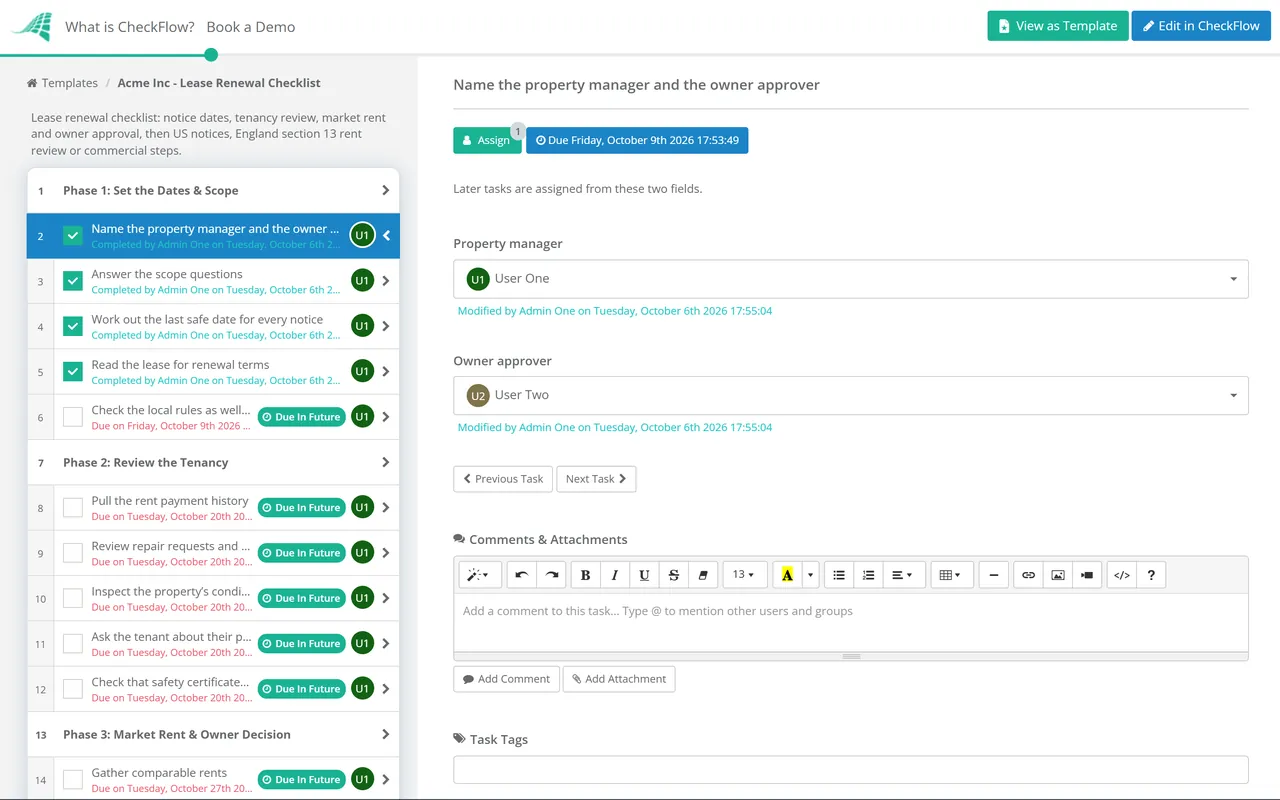
Answer the two scope questions first. They decide which notice phase and rent-cap task this renewal shows.
Name the property manager and the owner approver — later tasks are assigned from these two fields
Answer the scope questions — is this a US residential lease, a residential tenancy in England or a commercial lease, and is the unit rent-capped or rent-stabilised
Work out the last safe date for every notice — count back from the lease end or review date using the notice period that applies
Read the lease for renewal terms — options to renew, automatic renewal, break clauses, rent review wording and notice addresses
Check the local rules as well as the state or national ones — many US cities add their own notice and rent rules
2
Review
Phase 2: Review the Tenancy
5 tasks
Pull the rent payment history — late payments, arrears and any payment plan, for the whole tenancy
Review repair requests and complaints — from the tenant and about them, and how each was resolved
Inspect the property’s condition — and compare it with the move-in report and the last periodic inspection
Ask the tenant about their plans — an early conversation tells you whether you are pricing a renewal or a vacancy
Check that safety certificates and disclosures are current — anything that lapses during the next term goes on the calendar now
3
Decide
Phase 3: Market Rent & Owner Decision
5 tasks
Gather comparable rents — current listings and recent lets for similar units nearby, with dates and sources
Estimate what a vacancy would cost — empty weeks, letting fees, works and cleaning, set against the proposed increase
Check the legal limit on the increase — shown only for rent-capped or rent-stabilised units
Write the recommendation — renew at the same rent, renew with an increase, or end the tenancy, with reasons
Owner approval of the decision and the new rent — required before any offer or notice is sent
4
US
Phase 4: US Renewal Offer & Notices
5 tasks
Shown only when the scope answer is US residential lease.
Serve the renewal offer or rent increase notice in time — using the longest notice period that applies to this unit
Before declining to renew, check just-cause rules — some states and cities allow it only for listed reasons, some with relocation payments
Track the tenant’s response — accepted, negotiating or leaving, with the date each answer came in
Prepare the renewal lease or extension addendum — new rent, term, any changed terms and current disclosures
If the tenant is leaving, start the move-out inspection — and book it with the tenant now
5
England
Phase 5: England Rent Review Under Section 13
5 tasks
Shown only when the scope answer is Residential tenancy in England.
Confirm the tenancy is now assured periodic — any fixed term ended on 1 May 2026 or the tenancy started after it
Check that 12 months have passed — since the tenancy began or since the last increase took effect
Serve Form 4A with at least two months’ notice — keep proof of how and when it was served
Watch for a tribunal application — the tenant can challenge before the new rent takes effect, and the tribunal will not set more than you asked
Update the rent ledger and payment instructions — from the date the new rent applies
6
Commercial
Phase 6: Commercial Lease Renewal
4 tasks
Shown only when the scope answer is Commercial lease.
Check whether the lease has statutory renewal rights — in England and Wales, whether it was contracted out of the 1954 Act
Serve or answer the statutory notice — a section 25 notice or section 26 request, 6 to 12 months ahead
Agree heads of terms for the new lease — rent, length, breaks, repair, service charge and any incentive
Instruct solicitors on the new lease — and diarise every date in the statutory timetable they give you
7
Close
Phase 7: Sign, File & Diarise
4 tasks
Collect signatures from every tenant and the landlord — on the renewal, extension or new lease, where one is needed
Check the deposit against the new rent — any top-up must stay within the legal cap and, in England, be protected
File the notices with proof of service — and the owner’s approval, together with the signed documents
Set the next review date — and the start date for next year’s renewal checklist
Notice periods are where renewals go wrong, because each jurisdiction counts them differently and many US cities add a layer on top of the state. The table shows England and four US examples. Set the template’s due dates from the longest period that applies to each property, and add the city rules that apply where you let.
Where
Rent increase
Ending or not renewing
England (assured periodic tenancies)
Once a year by section 13 notice on Form 4A, at least two months ahead; no increase in the first 12 months; tenant can apply to the First-tier Tribunal
No section 21. Possession only on a statutory ground; selling or moving in needs four months’ notice and cannot be used in the first 12 months
California
30 days’ notice for increases of 10% or less, 90 days above 10%; where the Tenant Protection Act applies, no more than 5% plus inflation, capped at 10%, in any 12 months
For covered units, after 12 months of occupancy only for just cause stated in the notice; no-fault terminations require one month’s rent in relocation assistance
Oregon
No increase in the first year; then 90 days’ written notice, once in 12 months; 2026 maximum 9.5% for covered tenancies
After the first year, only for tenant cause or a qualifying landlord reason, some with one month’s rent in relocation payment
New York State
Written notice of 30, 60 or 90 days for an increase of 5% or more, depending on how long the tenant has lived there or the lease length
The same 30, 60 or 90 days’ notice for non-renewal; without it the tenancy continues on existing terms until the notice period runs out
New York City rent-stabilised
Renewal offer on the state renewal form between 90 and 150 days before the lease ends, at the rate the Rent Guidelines Board allows
The tenant has 60 days to accept; the owner must offer a renewal except on limited grounds
Commercial leases run on a different clock. In England and Wales, a business tenancy protected by Part II of the Landlord and Tenant Act 1954 continues after its contractual end date until it is ended under the Act. The landlord ends it with a section 25 notice, which must give a termination date between 6 and 12 months after it is served and say whether the landlord will oppose a new tenancy. The tenant can serve a section 26 request on the same 6 to 12 month window. Leases that were contracted out of the Act end on their expiry date, so the first task is finding out which kind you have. The Renters’ Rights Act does not apply to commercial lettings.
Treat every tenant the same way. In the US the Fair Housing Act prohibits different terms or conditions of rental based on race, colour, religion, sex, disability, familial status or national origin, and a renewal decision is a term of rental. Running the same review for every tenancy, and recording the reasons for each decision, is the simplest way to show the decision was made on the facts.
Why Run Lease Renewals in CheckFlow?
1
Deadlines counted from the start
Every task carries a due date offset from the day the checklist starts, so a renewal begun four months out lands the notice task before the legal cut-off. You can start each renewal from your lease data through the API.
2
The owner decides on the record
The recommendation stops at an approval step until the owner answers, so no offer or notice goes out on a rent the owner never agreed. The approval sits in the history beside the comparables it was based on.
3
The right rules for each property
One dropdown shows the US notices, the England section 13 review or the commercial lease steps. A portfolio across several jurisdictions runs one template, and reports show which renewals are close to their notice dates.
Managing renewals across a portfolio? CheckFlow for property management runs renewals alongside inspections, maintenance and tenant onboarding, so every tenancy follows the same steps whoever manages it.
Describe the process in a sentence and the AI checklist generator drafts the phases and tasks for you.
Frequently Asked Questions
When should a landlord start the lease renewal process?
Early enough to review the tenancy, check the market, get the owner’s decision and still serve notice inside the longest period that applies. For most US residential leases that means starting about four months before expiry: California needs 90 days’ notice for an increase above 10%, and New York City rent-stabilised renewals go out 90 to 150 days ahead. Commercial leases in England and Wales need at least a year, because a section 25 notice can be served up to 12 months ahead.
Can I still renew a fixed-term tenancy in England?
Not for private residential lettings. Since 1 May 2026 the Renters’ Rights Act 2025 has made assured tenancies periodic, including existing assured shorthold tenancies, so there is no fixed term to renew. The tenancy continues until the tenant gives two months’ notice or the landlord gets possession on a statutory ground. Rent is reviewed once a year with a section 13 notice.
How much notice do I need to give for a rent increase?
It depends on where the property is. In England it is at least two months, on Form 4A, no more than once a year. In California it is 30 days for an increase of 10% or less and 90 days above that. Oregon requires 90 days. New York State requires 30, 60 or 90 days for increases of 5% or more, depending on how long the tenant has been there. Check city rules too.
Can a landlord refuse to renew a lease?
In much of the US, yes, with proper notice, provided the reason is not discriminatory or retaliatory. California’s Tenant Protection Act and Oregon require a just cause or qualifying reason once a tenant has been in place for a year, and rent-stabilised tenants in New York City have a right to a renewal offer. In England the landlord now needs a statutory possession ground to end a private tenancy.
What should a lease renewal checklist include?
The key dates and the last day to serve each notice, the lease’s own renewal terms, a review of payment history and property condition, comparable rents, any legal cap on the increase, the owner’s decision, the notice or renewal offer with proof of service, the signed paperwork and the date of the next review.
Is CheckFlow free for this template?
14-day free trial, no card required. The Business plan is $10 per user per month after the trial. Full details at checkflow.io/pricing.
Start Every Renewal Before the Notice Deadline, Not After It