Landlord Compliance Checklist (UK)

Every certificate, check and registration a let home in England needs, in one run a year: the checks before a new tenant moves in, a sign-off before they do, and each renewal planned before its date.

Last reviewed: November 2026

Printed from checkflow.io/templates/property-management/landlord-compliance-checklist

This free landlord compliance checklist is for landlords and managing agents letting a home in England. One run covers one home for one year, from the year start date: the day a new tenancy starts, or its anniversary for a tenancy already running. It records every certificate, check and registration with its renewal date in one register, then checks the gas safety record, the electrical report, the smoke and carbon monoxide alarms and the legionella risk before the year starts. A new tenancy adds the Right to Rent checks, the written statement of terms the Renters’ Rights Act requires from 1 May 2026, deposit protection and the records the tenant gets before moving in, and a compliance approver signs the home off before the tenant moves in. Through the year the run keeps a repairs log, books the inspection visit, renews the gas check and any electrical report or licence that falls due, covers HMO duties where they apply, and registers the home on the new Register your rental property service, which opens region by region from 15 December 2026. It ends by starting next year’s run. Wales, Scotland and Northern Ireland have their own rules, named where they differ.

Landlord Compliance, Property Management or Annual Inspection?

A landlord compliance checklist lists the legal checks, certificates and registrations a let home needs and the date each one must be renewed. This one covers a home let in England for one year: the register of dates, the safety checks before the year starts, the tenant checks and information for a new tenancy, a sign-off before the tenant moves in, the year’s repairs, renewals and reviews, and the start of next year’s run.

It is the compliance calendar for one home, and it links to the checklists that hold the rest of the work. The Property Management Checklist runs the whole letting, from setting up a property to the end of a tenancy. The Annual Property Inspection Checklist is the visit itself. Work between two tenancies runs on the Make-Ready Checklist, the move-in on the Tenant Onboarding Checklist, the fire risk assessment for an HMO’s shared parts on the Fire Risk Assessment Checklist, and a full legionella control scheme on the Legionella Risk Assessment & Water Hygiene Checklist.

This checklist

Landlord compliance for one year

Covers: every certificate and registration with its renewal date, the safety checks, the tenant checks and information, the sign-off before a new tenant moves in, repairs, renewals and the next year’s run.

Planned around: the year start date: the day a new tenancy starts, or its anniversary.

Output: one home kept compliant for the year, with a dated record of each check.

The whole letting

Property management checklist

Covers: setting up a property, marketing and viewings, choosing a tenant and signing the lease, managing the tenancy, renewal or the end of it, and an annual review.

Planned around: the letting from start to finish.

Output: a let property managed end to end, in the Property Management Checklist.

The visit

Annual property inspection

Covers: notice to the tenant, the outside and common parts, each room, alarms and hazards, and a report with follow-up.

Planned around: the day of the visit.

Output: an inspection report and repairs to make, in the Annual Property Inspection Checklist.

What the Landlord Compliance Checklist Covers

Nine phases take one let home through one year. The first task records the year start date, which sets every due date, and says whether a new tenancy starts and whether the home has gas. A new tenancy adds the Right to Rent checks, the written statement of terms, deposit protection, the records given before move-in and the alarm check on the first day, with a sign-off before the tenant moves in: the checklist halts there, and Not approved keeps it halted and adds a task to put right what failed. A later year checks the running tenancy’s records instead and is confirmed without a halt. Gas adds the gas record and the yearly gas safety check, an electrical report due before the year ends adds its inspection and follow-up, a council licence adds its renewal and an HMO adds the manager’s duties.

  1. Phase 1

    Phase 1: Set Up the Year

    2 tasks

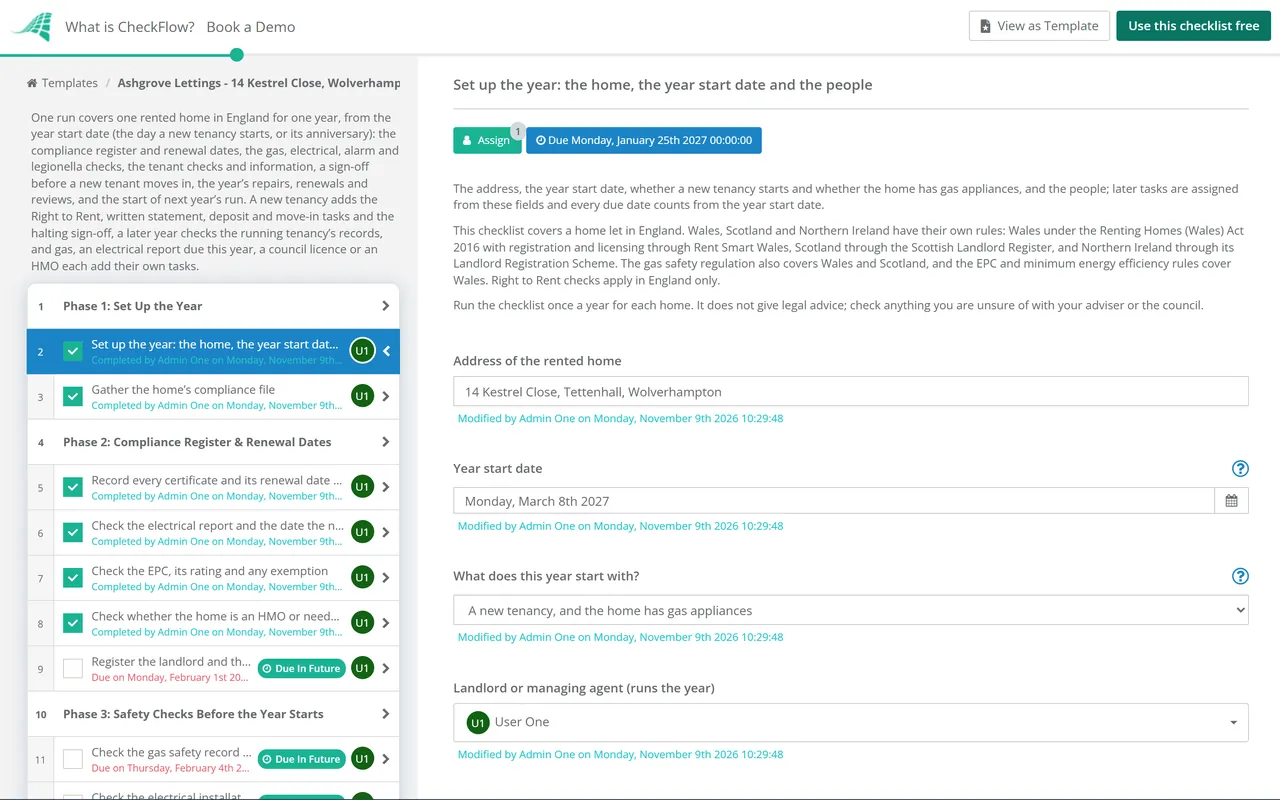
    Owned by the landlord or managing agent. Enter the year start date on the first task: for a new tenancy, the day it starts; for a later year of the same tenancy, the anniversary of that day. Checks before it count back in working days and the year’s renewals count forward in months. The first task also says whether a new tenancy starts and whether the home has gas, which decides the tasks that show.

    • Set up the year: the home, the year start date and the people — the address, the year start date, whether a new tenancy starts and whether the home has gas appliances, and the people; later tasks are assigned from these fields and every due date counts from the year start date
    • Gather the home’s compliance file — the last gas safety record, the electrical installation condition report, the EPC, any licence, the tenancy agreement or written terms, the deposit certificate, the Right to Rent copies, where the alarms are and the legionella risk assessment, kept together for the year
  2. Phase 2

    Phase 2: Compliance Register & Renewal Dates

    5 tasks

    One register lists every certificate, check and registration with its date and its renewal date, so the year’s renewals can be planned. The answers here decide what shows later: an electrical report due before the year ends adds its renewal tasks, a council licence adds the licence task, and an HMO adds the HMO duties in Phase 6.

    • Record every certificate and its renewal date in the register — each item with the date it was done or issued, the date it must be renewed by and where the record is kept; the law sets each deadline from the record, not from this checklist
    • Check the electrical report and the date the next inspection is due — the date of the last inspection and test, the date the report gives for the next one, and any further investigative or remedial work it asks for
    • Check the EPC, its rating and any exemption — the certificate on the Find an energy certificate service, its rating and the date it ends; a home let in England or Wales must be band E or above unless an exemption is registered
    • Check whether the home is an HMO or needs a council licence — ask the council whether the home needs a mandatory HMO licence, an additional HMO licence or a selective licence, and whether it is an HMO even where no licence is needed
    • Register the landlord and the home on the Register your rental property service — by the end date of the home’s region, with the gas, electrical and EPC evidence and the tenancy details added within 28 days of registering the home; the fee is £65 a property a year, reduced during the roll-out
  3. Phase 3

    Phase 3: Safety Checks Before the Year Starts

    4 tasks

    The gas, electrical, alarm and water checks that must be in place on the year start date. For a new tenancy they are the checks the law asks for before it begins; for a later year they confirm nothing has lapsed. The gas task shows only when the home has gas appliances.

    • Check the gas safety record covers the year start — every gas appliance and flue checked by a Gas Safe registered engineer in the 12 months before the year start, as the law asks before a new tenancy and at most every 12 months after, with the record on file; book a check if it will be out of date
    • Check the electrical installation is inspected and any work is done — for a new tenancy, an inspection and test before it starts, or a report under 5 years old that asks for no further work; for a later year, the report in date; any remedial work done within 28 days and confirmed in writing
    • Check the smoke and carbon monoxide alarms are fitted and working — a smoke alarm on every storey with a room used as living accommodation, and a carbon monoxide alarm in every such room with a fixed combustion appliance other than a gas cooker; each one tested, with where it is
    • Assess the legionella risk and flush the water system — a simple assessment of the hot and cold water system, kept under review; before a new tenancy, or after the home has stood empty, flush the system through
  4. Phase 4

    Phase 4: Tenant Checks & Information

    7 tasks

    Owned by the tenancy contact. A new tenancy adds the Right to Rent checks, the written statement of terms before the tenancy is agreed, deposit protection and the records the tenant gets before moving in. A later year checks the same records for the tenancy already running instead.

    • Do the Right to Rent checks for every adult who will live there — every tenant aged 18 and over, checked before the tenancy starts, in the 28 days before it for anyone whose permission to stay is time-limited; copies kept during the tenancy and for one year after
    • Give the written statement of terms before the tenancy is agreed — the landlord’s name and an address in England or Wales for notices, the tenants, the address, the start date, the rent and when it is due, the rent increase statement, any bills, the deposit, the tenant’s notice and the rest of the information the 2026 regulations list, given before the tenancy is signed or agreed
    • Protect the deposit and give the prescribed information within 30 days — the deposit placed in a government-approved scheme and the prescribed information given to the tenant and anyone who paid it, both within 30 days of receiving it
    • Give the tenant the gas record, electrical report and EPC before they move in — a copy of the last gas safety record (where the home has gas), the most recent electrical report and the EPC, free of charge, before the tenant occupies the home, with the date and how each was given
    • Check the tenant has the information the law requires — for a tenancy that began before 1 May 2026 with written terms, the Renters’ Rights Act Information Sheet 2026, due by 31 May 2026; for one agreed only verbally, the written terms by the same date; for one that began on or after 1 May 2026, the written statement given before it was agreed; where a section 21 or section 8 notice given before 1 May 2026 has stopped being valid or its court case has ended without possession, the Information Sheet within one month of that date
    • Check the deposit is protected and the prescribed information was given — the scheme certificate on file and in date, the prescribed information on file, and the protection still in place for the year ahead
    • Check the Right to Rent records and any follow-up date — copies of each tenant’s check on file, and the date of any follow-up check for a tenant whose permission to stay is time-limited
  5. Phase 5

    Phase 5: Sign-Off & the First Day

    4 tasks

    On a new tenancy the alarms are checked on the day the tenancy begins, a fixed date, so that task comes first and never waits for the sign-off. The compliance approver checks every record before the tenancy starts, and the checklist halts at that sign-off: nothing after it can be completed until it is approved, and Not approved keeps it halted and adds a task to put right what failed. A later year has no new tenancy to hold back, so the approver confirms the records instead and nothing halts.

    • Check the alarms on the day the tenancy begins — each smoke and carbon monoxide alarm checked to be in proper working order on the day the tenancy begins, with who checked it; it sits above the sign-off because the law fixes the day, so do it on that day whatever the sign-off says
    • Put right what the sign-off found — after a Not approved decision only: fix each item the approver recorded, then ask them to change the decision to Approved and complete the sign-off; if the tenancy start moves, change the year start date on the first task and every due date moves. The first-day alarm check and, in an HMO, the HMO duties still apply while the sign-off is open
    • Approve the home as ready for the new tenancy — Approved or Not approved, recorded by the compliance approver alone after checking the gas record, the electrical report, the alarms, the EPC, the Right to Rent checks, the written statement and the deposit
    • Confirm every record is in date for the year ahead — for a later year: the compliance approver confirms the gas, electrical, alarm, EPC, licence, deposit and register records are in date, and lists anything to put right with a date
  6. Phase 6

    Phase 6: HMO Duties

    4 tasks

    Applies only when the home is a house in multiple occupation. The Management of Houses in Multiple Occupation (England) Regulations 2006 set the manager’s duties for the whole time the home is let, licensed or not. The fire risk assessment for the shared parts runs on the Fire Risk Assessment Checklist.

    • Display the manager’s name, address and phone number — made available to each household and clearly displayed in a prominent position in the HMO, as regulation 3 asks
    • Keep the escape routes clear and the fire alarms working — means of escape kept free of obstruction and in good repair, fire fighting equipment and fire alarms in good working order, and, where the HMO has more than four occupiers, the notices showing the escape routes clearly visible, as regulation 4 asks
    • Review the fire risk assessment for the shared parts — the common areas of the HMO assessed by the responsible person (for common areas, the landlord, freeholder or managing agent, gov.uk says), with the actions done; run it on the Fire Risk Assessment Checklist
    • Keep the common parts, fittings and lighting in repair — common parts in good and clean decorative repair, safe and working, with handrails, stair coverings, windows and lighting in repair and shared fixtures and appliances working, as regulation 7 asks; the latest gas record sent to the council within 7 days of a written request, as regulation 6 asks
  7. Phase 7

    Phase 7: During the Tenancy: Repairs & Alarms

    3 tasks

    Through the year the landlord keeps the home in repair and fit to live in, acts on what the tenant reports, and repairs or replaces any alarm reported faulty. The inspection visit itself runs on the Annual Property Inspection Checklist.

    • Log repairs and hazards the tenant reports, and fix them — each report with the date, what was done and when, for the structure and exterior, the water, gas, electricity, sanitation, heating and hot water, and anything that makes the home unfit to live in
    • Book the year’s inspection visit — a visit arranged with the tenant and run on the Annual Property Inspection Checklist, with anything it finds added to the repairs log
    • Test the alarms during the year and fix any reported fault — each alarm tested at the visit, as this template’s choice, and any alarm the tenant reports as faulty checked and repaired or replaced as soon as reasonably practicable
  8. Phase 8

    Phase 8: Renewals & Yearly Reviews

    7 tasks

    The renewals the register shows for this year. The law’s deadline is the date on each record; this template’s due dates are a plan counted from the year start, so where a record’s date comes first, do the task by that date. The electrical tasks show when the report falls due this year, the gas tasks when the home has gas, and the licence task when the council requires a licence.

    • Have the electrical installation inspected before the report’s date — a qualified person inspects and tests every installation by the date on the last report, and at most 5 years after it, and gives a report with the date of the next one
    • Send the report and finish any remedial work within 28 days — a copy to the tenant within 28 days of the inspection, any further investigative or remedial work done within 28 days or sooner if the report says, the written confirmation sent to the tenant and the council within 28 days of the work, and the register updated
    • Keep the licence conditions and renew it before it ends — the conditions the council set kept, the yearly gas record sent to the council where the licence asks for it, and a renewal applied for before the licence ends
    • Book the yearly gas safety check before the deadline — a Gas Safe registered engineer booked for every appliance and flue before 12 months from the last check; a check in the 2 months before that deadline keeps the same deadline
    • Have the gas safety check done and give the tenant the record within 28 days — the check done and the record made, a copy given to the tenant within 28 days of the check, the record kept until two further checks have been made, and the register updated
    • Review the legionella risk assessment — checked at a routine visit such as the gas safety check, and reviewed again whenever the water system changes
    • Do any follow-up Right to Rent check that falls due — for a tenant with time-limited permission, just before the later of the end of their permission and 12 months after the last check; tell the Home Office about a tenant who fails it, and mark this task not applicable when no tenant has a time limit
  9. Phase 9

    Phase 9: Year-End Review & Next Year

    4 tasks

    The year ends by carrying its lessons and any change in the law into next year’s run, starting that run about six weeks before the next year start, and renewing the register entry.

    • Review the year: what was late and what to change — each renewal and check against its deadline, anything done late and why, and what to change in next year’s run
    • Check what has changed in the law this year — the Renters’ Rights Act stages still to come, such as the landlord ombudsman, Awaab’s Law for private renting and register numbers in adverts, the Decent Homes Standard from 2035, the energy efficiency standard’s rise to band C from 1 October 2030 and any bill that changes it, and the council’s licensing schemes, with what changes for this home
    • Start next year’s run for this home — a new run with the next year start date, started about six weeks before it, with the register carried forward
    • Renew the register entry and pay the annual fee — by the register renewal date recorded in Phase 2, one year from the first home the landlord registered; if that date comes before this task’s due date, do it by then; the annual fee paid and every record on the register up to date

The Rules Behind the Year, and the Renewal Calendar

The rules behind the year

Each rule as read on legislation.gov.uk, gov.uk and hse.gov.uk on 9 November 2026. The checklist’s task notes repeat the parts each task needs.

Rule Where it applies What it asks Where it shows
Gas Safety (Installation and Use) Regulations 1998, regulations 36 and 36AEngland, Wales and ScotlandEach appliance and flue checked by a Gas Safe registered engineer within 12 months before a new tenancy and at most every 12 months; a check in the 2 months before the deadline keeps it; a copy to the tenant within 28 days of the check and to a new tenant before they move in; each record kept until two further checksPhases 3 and 8
Electrical Safety Standards in the Private Rented Sector and Social Rented Sector (England) Regulations 2020, regulation 3EnglandAn inspection and test before a new tenancy (a report under 5 years old asking for no work is enough, the guidance says) and at least every 5 years; the report to the tenant within 28 days; remedial work within 28 days; the council gets the report within 7 days of askingPhases 2, 3 and 8
Smoke and Carbon Monoxide Alarm (England) Regulations 2015, regulation 4, as amendedEnglandA smoke alarm on each storey with living accommodation, a carbon monoxide alarm in each such room with a fixed combustion appliance other than a gas cooker, every alarm checked on the day a new tenancy begins, and a faulty alarm repaired or replaced after a reportPhases 3, 5 and 7
Energy Performance of Buildings (England and Wales) Regulations 2012, regulation 6, and the minimum energy efficiency standardEngland and WalesA valid EPC, free of charge, to prospective tenants and to the tenant; valid for 10 years; no letting below band E unless an exemption is registered; band C from 1 October 2030, confirmed on 21 January 2026Phases 2 and 4
Immigration Act 2014, Right to RentEnglandEvery adult tenant checked before the tenancy, in the 28 days before it where permission is time-limited; follow-up checks; copies kept for the tenancy and one year afterPhases 4 and 8
Assured Tenancies (Private Rented Sector) (Written Statement of Terms etc and Information Sheet) (England) Regulations 2026England, from 1 May 2026The written statement of terms before a new tenancy is agreed; for an existing written tenancy, the Information Sheet by 31 May 2026Phase 4
Housing Act 2004, section 213EnglandA deposit for an assured tenancy protected in an authorised scheme, and the prescribed information given, within 30 days of receiving itPhase 4
Housing Act 2004, Parts 2 and 3 (licensing)England and WalesA licence for a large HMO, and where the council has a scheme, for smaller HMOs (additional) or other lets (selective); a licence lasts at most 5 yearsPhases 2 and 8
Management of Houses in Multiple Occupation (England) Regulations 2006England, HMOsThe manager’s details displayed, escape routes and fire alarms kept in order, common parts kept in repair, the gas record to the council within 7 days of a requestPhase 6
Health and Safety at Work etc Act 1974 and COSHH, as HSE applies them to landlordsGreat BritainThe legionella risk assessed and controlled; no test certificate required; a full scheme runs on the Legionella Risk Assessment & Water Hygiene ChecklistPhases 3 and 8
Landlord and Tenant Act 1985, sections 11 and 9AEnglandThe structure, exterior and installations kept in repair and working, and the home fit for human habitationPhase 7
Renters’ Rights Act 2025, Register your rental property serviceEngland, by region from 15 December 2026Landlords and let homes registered by the region’s end date, evidence within 28 days, changes within 28 days, £65 a property a yearPhases 2 and 9

The renewal calendar

What the register tracks, how often each item is renewed and when the tenant gets a copy. The deadline is always the date on the record.

Item Renew Copy to the tenant Where it shows
Gas safety checkAt most every 12 monthsWithin 28 days of the check; a new tenant before moving inPhases 3 and 8
Electrical installation condition reportAt most every 5 years, or the report’s earlier dateWithin 28 days of the inspection; a new tenant before moving inPhases 2, 3 and 8
EPCEvery 10 years, and in date when the home is marketed or letFree of charge, to the new tenantPhase 2
Smoke and carbon monoxide alarmsChecked on the first day of a new tenancy; this template also tests them yearlyNot applicablePhases 3, 5 and 7
Legionella risk assessmentNo set interval; reviewed when anything changesNot applicablePhases 3 and 8
HMO, additional or selective licenceBefore it ends; at most 5 yearsNot applicablePhases 2 and 8
Right to Rent follow-upThe later of the end of the permission and 12 months after the last checkNot applicablePhase 8
Register your rental propertyEvery year, from the first home registeredNot applicablePhase 9

What has changed, and what is still to come. The Renters’ Rights Act tenancy changes took effect on 1 May 2026: new tenancies get a written statement of terms, and the How to Rent guide was withdrawn the same day. Since 22 June 2026 councils can fine a landlord for a category 1 hazard that could reasonably have been removed. The Register your rental property guidance, published 29 October 2026, opens registration region by region from 15 December 2026 to 14 November 2027. The government’s implementation roadmap (13 November 2025) expects a landlord ombudsman in 2028. The new Decent Homes Standard will apply to private renting from 2035 (policy statement, 28 January 2026), a consultation on extending Awaab’s Law to private renting runs to 18 December 2026, and on 21 January 2026 the government confirmed the energy efficiency standard rises to band C from 1 October 2030. The electrical regulations were renamed and extended to social housing from 1 November 2025 and 1 May 2026.

Wales, Scotland and Northern Ireland. The gas safety regulation covers Wales and Scotland, and the EPC and energy efficiency rules cover Wales. The other rules above are England’s. Wales has the Renting Homes (Wales) Act 2016 and Rent Smart Wales registration and licensing, Scotland the Scottish Landlord Register and Northern Ireland its Landlord Registration Scheme; adapt the tasks to the nation’s own rules.

Why Run Landlord Compliance in CheckFlow?

1

A sign-off before the new tenancy starts

On a new tenancy the compliance approver alone signs the home off after checking the gas record, the electrical report, the alarms, the EPC, the Right to Rent checks, the written statement and the deposit. The checklist halts there, so the year’s work waits for the approval; the first-day alarm check sits above the sign-off, because the law fixes its day. Not approved keeps it halted and adds a task to put right what failed, with the way back in its text.

2

Every renewal on one register

The register records each certificate and registration with its renewal date. Answers on it add only the tasks this home needs: the gas safety check when it has gas, the electrical inspection when the report falls due this year, the licence renewal when the council licenses it, and the HMO duties when it is an HMO.

3

One run a year, assigned and dated

Name the landlord or agent, the tenancy contact and the compliance approver on the first task, and every task is assigned from those fields. Due dates count from the year start date, so one date sets the year. The Reports Grid shows every home’s run with its answers, and Analytics shows overdue and late tasks by person and step.

CheckFlow does not give legal advice, carry out a gas or electrical check, or check anyone’s right to rent: those stay with you, your advisers, Gas Safe registered engineers and qualified electricians. It makes sure every step of the year is done in order, with an owner and a due date, a sign-off before a new tenant moves in and a record of who did what. CheckFlow’s property management checklist software shows how the same approach runs a whole portfolio.

Moving a tenant in? The Tenant Onboarding Checklist covers the move-in day. Renewing a tenancy uses the Lease Renewal Checklist.

AI generator

Didn’t find what you need? Describe it.

Describe the process in a sentence and the AI checklist generator drafts the phases and tasks for you.

Frequently Asked Questions

What is a landlord compliance checklist?

A landlord compliance checklist lists the legal checks, certificates and registrations a rented home needs, with the date each one must be renewed. In this template one run is one home in England for one year: the register of dates, the safety checks before the year starts, the tenant checks for a new tenancy, a sign-off before the tenant moves in, the year’s repairs and renewals, and the start of next year’s run.

What must a landlord in England do before a new tenant moves in?

Check the right to rent of every adult who will live there, give the written statement of terms before the tenancy is agreed, protect any deposit and give the prescribed information within 30 days, and give the tenant the gas safety record, the electrical report and the EPC before they move in. The gas check must be under 12 months old, the EPC band E or above unless an exemption is registered, and the alarms checked on the first day.

What replaced the How to Rent guide?

The government withdrew the How to Rent guide on 1 May 2026, keeping it only for tenancies where a section 21 notice was served before then. For a new tenancy in England the landlord now gives a written statement of the tenancy’s terms before it is agreed. For an existing tenancy with written terms, the landlord had to give the Renters’ Rights Act Information Sheet 2026 by 31 May 2026. Missing either can mean a fine of up to £7,000.

When do landlords have to join the Register your rental property service?

Registration opens region by region from 15 December 2026, starting with the West Midlands, and each region has 3 months; the last, the South West, closes on 14 November 2027. During the roll-out landlords register homes that are let or become let. The fee is £65 a property a year, reduced during the roll-out, and the certificate evidence follows within 28 days. The guidance says empty homes will later need registering before they are advertised.

Can a landlord do the gas safety check early and keep the same renewal date?

Yes, within limits. Under regulation 36A of the Gas Safety (Installation and Use) Regulations 1998, a check done in the 2 months before the deadline counts as done on the deadline, so the next one is still due 12 months after that date. The landlord gives the tenant a copy of the record within 28 days of the check and keeps each record until two further checks have been made.

Does this checklist work for landlords in Wales, Scotland or Northern Ireland?

It is written for England. The gas safety regulation also covers Wales and Scotland, and the EPC and minimum energy efficiency rules cover Wales. Wales has its own renting law under the Renting Homes (Wales) Act 2016, with registration and licensing through Rent Smart Wales; Scotland has the Scottish Landlord Register; Northern Ireland has its Landlord Registration Scheme. Right to Rent checks apply in England only. Adapt the tasks to the nation’s own rules.

Which Renters’ Rights Act changes are still to come?

As of November 2026 the tenancy changes have applied since 1 May 2026 and the register opens from 15 December 2026. Still to come: a landlord ombudsman that landlords must join, which the government’s roadmap expects in 2028; Awaab’s Law for private renting, on which the government is consulting until 18 December 2026 before it sets a date; a Decent Homes Standard for private renting from 2035; and, under the register guidance, empty homes registered before advertising and register numbers in adverts, with no date yet.

Is CheckFlow free for this template?

14-day free trial, no card required. The Business plan is $10 per user per month after the trial. Full details at checkflow.io/pricing.

Keep Every Let Home Compliant, One Year at a Time

Free trial — no credit card required.

14-day free trial, no credit cardFull refund in your first 30 daysUS hosting, EU on request