Vendor Oversight Checklist Template

The contract was signed three years ago, the SOC 2 report on file covers a period that ended more than a year ago, and nobody has asked who the vendor now subcontracts to. A vendor oversight review checks every vendor you already depend on, finds what has changed and puts the gaps in front of the people who own the risk.

Last reviewed: October 2026

Printed from checkflow.io/templates/procurement-supply-chain/vendor-oversight-checklist

This free vendor oversight checklist is for procurement, vendor management, risk and compliance teams who review the vendors and outsourced services already in place, across the whole portfolio, once or twice a year or every quarter. One run is one review, about six weeks from set-up to the meeting that receives the report. It updates the vendor inventory and the criticality tiers, reviews each critical vendor's SLAs and KPIs, continuity tests and incidents, and brings every vendor issue into one log. It checks the certificates, assurance reports and insurance due to expire, the audit rights, subcontracting and data terms in the contracts, and the contracts renewing in the next year. It then looks at concentration on single vendors and at each critical vendor's exit plan, agrees actions with owners, and sends the report to the risk committee, board or accountable executive, who approves it before the follow-up tasks can be completed. A serious open issue with a critical vendor adds an escalation phase, a missing or untested exit plan adds the task to fix it, and answers on the first task add tasks for a first review, a repeat review and firms under the UK, EU or US outsourcing rules.

Vendor Oversight Reviews the Whole Portfolio, Not One Vendor

Vendor oversight is the ongoing monitoring of vendors you have already chosen: are they delivering what the contract says, is the evidence they gave you still current, has anything changed at the vendor, and could you leave if you had to. Some risks only show across the portfolio: several critical services with one vendor group, one cloud provider behind several vendors, or a register that has fallen behind the contracts. This checklist runs that review for every vendor at once and ends with a report and an action plan that someone accountable approves.

Other templates look at one vendor or one moment. The Vendor Risk Assessment Checklist assesses one vendor in depth before you sign or at renewal, and keeps that vendor's rating. The Supplier Performance Evaluation Checklist scores one supplier against its KPIs. The Vendor Onboarding Process Checklist and the Vendor Offboarding Checklist cover a vendor joining and leaving, the Third-Party Remote Access Review Checklist checks how vendors reach your systems, and the Supply Chain Risk Assessment Checklist looks down the supply chain behind your products. This checklist points to each of them when a vendor needs the closer look.

This checklist

Every vendor already in place

Covers: the whole vendor portfolio: inventory and tiers, SLA reviews for critical vendors, issues, expiring evidence, contract compliance, concentration and exit plans.

Planned around: a yearly, half-yearly or quarterly review, ending at the risk committee, board or executive meeting.

Output: an approved oversight report and action plan, updated vendor records and the next review date.
Joining and leaving

Onboarding and offboarding

Covers: bringing one vendor on, from documents and checks to the first invoice, or moving away from one, from notice to the last access removed.

Planned around: the contract start or end date.

Output: a vendor ready to work in the Vendor Onboarding Process Checklist, or a clean exit in the Vendor Offboarding Checklist. An exit decided in this review is carried out there.

What the Vendor Oversight Checklist Covers

Nine phases take one review from scope and tiers to the next review date. The first task asks whether this is the first portfolio review and which outsourcing rules apply, and each answer adds the tasks it needs. A serious open issue with a critical vendor adds the escalation phase, and a missing or untested exit plan adds the task to fix it. Nothing after the approval can be completed until a decision is recorded, and Approved with changes or Not approved adds the task that follows.

  1. Phase 1

    Phase 1: Scope, Owners & Review Standard

    5 tasks

    Decide which vendors this review covers, who does each part and what each criticality tier is checked on, before anyone collects data. The questions in the first task add the tasks for a first review or a repeat review, and for a firm under outsourcing rules. Every due date counts in working days back from the meeting that receives the report.

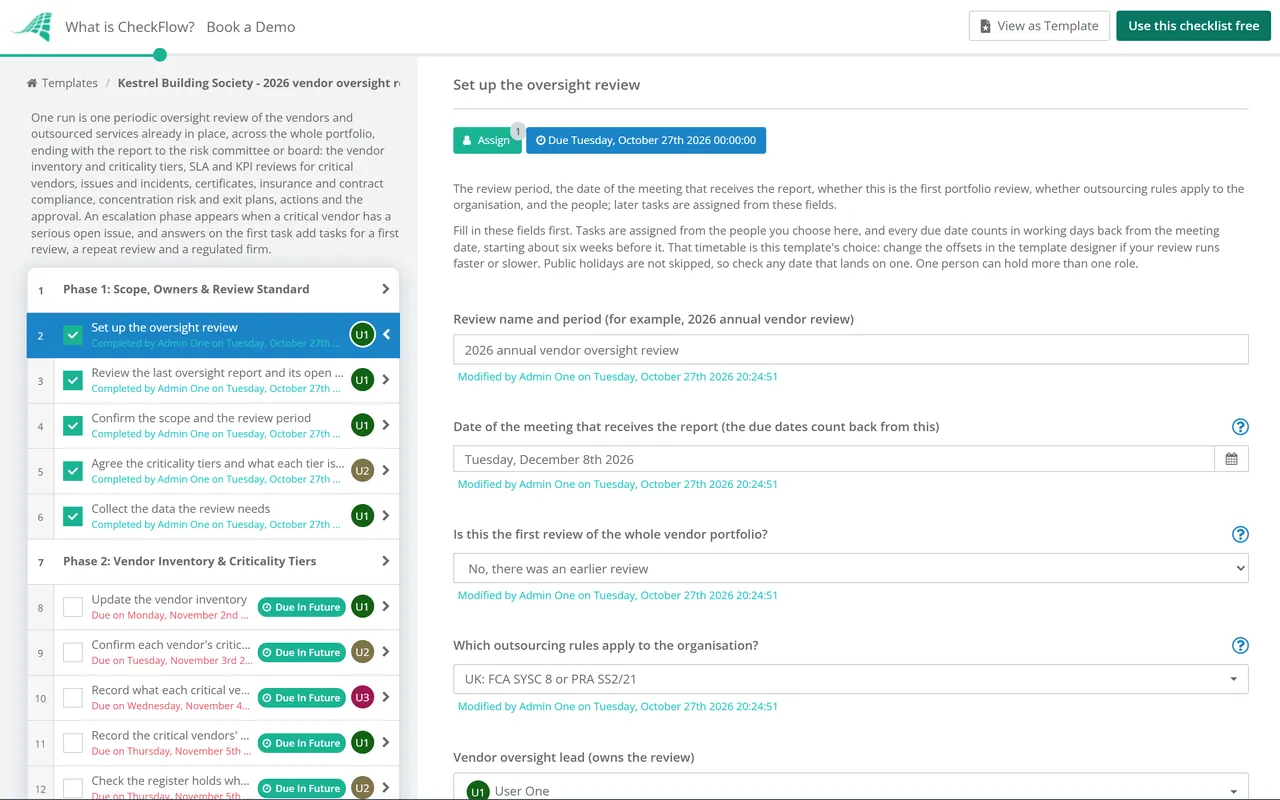
    • Set up the oversight review — the review period, the date of the meeting that receives the report, whether this is the first portfolio review, whether outsourcing rules apply to the organisation, and the people; later tasks are assigned from these fields
    • Review the last oversight report and its open actions — a repeat review only: what the last review found, which actions were done, which are still open, and what the approver asked to see this time
    • Confirm the scope and the review period — which vendors and outsourced services are in scope (every third party that provides a service, or those above a spend or risk threshold), the period reviewed and anything left out, with the reason
    • Agree the criticality tiers and what each tier is reviewed on — what makes a vendor Critical, High, Medium or Low, and what each tier gets: critical vendors an SLA review, a meeting, current attestations and an exit plan; lower tiers lighter checks
    • Collect the data the review needs — spend by vendor from accounts payable, the contract register, service reports, incident and complaint records, certificates and insurance documents already on file
  2. Phase 2

    Phase 2: Vendor Inventory & Criticality Tiers

    6 tasks

    Oversight starts with a complete list. Bring the vendor inventory up to date, check each vendor's tier against the agreed criteria, and record what the critical vendors hold or can reach and who they pass work to.

    • Build the vendor list from payments and contracts — a first review only: every vendor paid or under contract in the last 12 months, from accounts payable, purchase orders, card spend and the contract register, so nothing is missed
    • Update the vendor inventory — vendors added and ended since the last review, changes to the services they provide, the business owner of each, annual spend and contract end dates
    • Confirm each vendor's criticality tier — re-tier any vendor whose service, data access, spend or importance has changed since it was last tiered, and record why
    • Record what each critical vendor holds or can reach — personal and confidential data it holds or processes, its access to your systems, networks and premises, and where the data is stored
    • Record the critical vendors' material subcontractors — the subcontractors that do a material part of a critical service, what they do and where they work, and any added since the last review
    • Check the register holds what your regulator expects — regulated firms only: the information the outsourcing register must hold for your regulator, and which arrangements count as critical or important under its definition
  3. Phase 3

    Phase 3: SLA & KPI Reviews for Critical Vendors

    5 tasks

    For each critical vendor, compare what was delivered in the period with what the contract promised. Read the service and continuity reports, check that service credits were claimed, and meet the vendor to agree what needs to change.

    • Collect each critical vendor's service reports for the period — the vendor's own service level reports, your incident and ticket data, and the business owner's view of the service
    • Compare performance with the SLAs and KPIs in each contract — each service level and KPI against its target for the period, the misses, and whether the vendor's figures match your own records
    • Check service credits and remedies were claimed — credits due under the contract for missed service levels, whether they were claimed and received, and any remedy or improvement plan the contract requires
    • Review the vendors' continuity tests and incident reports — each critical vendor's latest business continuity and disaster recovery test results, its incident reports for the period and how it responded
    • Hold a review meeting with each critical vendor — performance, open issues, changes planned at the vendor, and improvements agreed, with notes kept
  4. Phase 4

    Phase 4: Issues, Incidents & Changes at Vendors

    3 tasks

    Bring every problem with a vendor in the period into one log, then look for the signs that a vendor is weakening: its finances, its owners, its key people and the subcontractors it uses. A serious open issue with a critical vendor adds the escalation phase.

    • Update the vendor issue and incident log — service failures, security incidents, data breaches, complaints and audit findings involving vendors in the period, with severity, owner and status, and whether a critical vendor has a serious open issue
    • Check the critical vendors' financial health — filed accounts, credit reports and alerts, late filings, insolvency notices, and signs such as requests for early payment or changed bank details
    • Check for changes at the critical vendors — a change of owner, a merger, new key people, a new strategy or locations, and new or changed subcontractors that could affect the service
  5. Phase 5

    Phase 5: Escalation of a Serious Vendor Issue

    4 tasks

    Applies only when a critical vendor has a serious open issue. Tell the accountable executive now rather than in the report, work out who is affected, agree a fix and a date with the vendor, and decide whether to step up oversight, use the contract's remedies or start the exit plan.

    • Escalate the issue to the accountable executive — a serious open issue only: what happened, which service and customers it affects, what the vendor has said and what has been done so far
    • Assess the impact on customers, operations and obligations — customers and services affected, legal, contractual and regulatory obligations touched, and whether anyone outside must be told
    • Agree a remediation plan and dates with the vendor — what the vendor will fix, by when, how you will check it, and the extra reporting you need until it is fixed
    • Decide whether to step up oversight, use the contract's remedies or start the exit plan — the accountable executive's decision on the next step, with the reason, recorded before the report is written
  6. Phase 6

    Phase 6: Certificates, Insurance & Contract Compliance

    6 tasks

    Check that the evidence each vendor gave you is still current and that the contract terms are being kept: certificates, assurance reports and insurance due to expire, audit and access rights, subcontracting consent, data terms and the dates when contracts renew or end.

    • Check certificates and attestations due to expire — each critical vendor's certificates and assurance reports, such as an ISO/IEC 27001 certificate, a SOC 2 report, Cyber Essentials or a PCI DSS attestation of compliance, the period they cover and when they expire
    • Check vendors' insurance cover and expiry dates — the covers each contract requires (for example professional indemnity, public liability or cyber), the amounts, the expiry dates and any change or lapse in cover
    • Check audit and access rights in the critical contracts — the right to audit, inspect and get information from each critical vendor, whether it was used in the period and whether it still works in practice
    • Check subcontracting terms were followed — whether vendors asked before adding subcontractors or sub-processors where the contract requires it, and whether you were told of changes in time to object
    • Check data protection and security terms are in place — a processing agreement for every vendor that processes personal data, breach notification terms, where the data is stored, and how it is returned or deleted at the end
    • List contracts renewing or ending in the next 12 months — each contract's end or renewal date, the notice period and the date by which a decision to renew, renegotiate or leave must be made
  7. Phase 7

    Phase 7: Concentration Risk & Exit Plans

    5 tasks

    Look at the portfolio as a whole: too much depending on one vendor, its group or one hidden provider behind several vendors. Then check that each critical vendor could be replaced and that its exit plan exists and has been tested. A missing or untested exit plan adds the task to fix it.

    • Check concentration on single vendors and providers — several critical services with one vendor or its group, one cloud or data centre provider behind several vendors, and one vendor in several places in your supply chain
    • Rate how easily each critical vendor could be replaced — easy, medium, hard or impossible to replace, how long a move would take, and whether the service could be brought back in-house
    • Review the exit plan for each critical vendor — whether each critical vendor has a documented exit plan, when it was last reviewed or tested, and whether it still works with today's service, data and contract
    • Write exit plans for critical vendors that have none — a missing exit plan only: the trigger for leaving, the alternative, the time and cost, the data and assets to get back, and who does what, with a date if it cannot be finished before the report
    • Plan a test of each untested exit plan — an untested exit plan only: the kind of test (a desk walk-through, a data export or a trial move of part of the service), its date and owner, added to the action plan
  8. Phase 8

    Phase 8: Findings, Report & Approval

    9 tasks

    Turn the findings into ratings and actions with owners, write the report and send it ahead of the meeting. The approver records the decision on the report and the action plan, and nothing after the approval can be completed until they do. Approved with changes and Not approved each add the task that follows from them.

    • Rate each critical vendor's risk after the review — an overall rating for each critical vendor, the main reason, and whether it has risen or fallen since the last review
    • Agree actions and owners for each finding — the action plan: each finding, the action, the owner, the due date, and the risks proposed for acceptance without an action
    • Check whether the regulator must be told about anything found — regulated firms only: material changes or severe events affecting outsourcing arrangements, and any new reliance on a third party for critical or important functions, against your regulator's notification rules
    • Write the oversight report — the portfolio and tier changes, critical vendor performance and ratings, issues and escalations, expiring evidence, contract gaps, concentration and exit plans, the action plan and the risks proposed for acceptance
    • Check the report with the risk and information security leads — the ratings, findings and actions are fair and consistent, and nothing found in the review is left out
    • Send the report and the action plan to the approver — with the meeting papers, in time for the approver and the committee or board to read them before the meeting
    • Approve the oversight report and the action plan — the approver records Approved, Approved with changes or Not approved, the changes or reasons, and the risks accepted
    • Make the changes and record them — Approved with changes only: each change made to the report or the action plan, with its owner and date
    • Rework the report and ask for a new decision — Not approved only: make the changes the approver asked for, then ask them to change the decision on the approval task, or to un-complete it and record a new one
  9. Phase 9

    Phase 9: Follow-Up & the Next Review

    6 tasks

    Oversight continues between reviews. Tell vendors and action owners what was agreed, update the records, set up the signs that should start an early review, and put the next review in the diary before closing the run.

    • Tell vendors about the actions that need them — the improvements, evidence, contract changes and dates agreed with each vendor, confirmed in writing
    • Brief the action owners — each owner knows their actions and dates, and how progress will be reported
    • Update the vendor inventory, tiers and contract records — the tiers, owners, expiry dates, ratings and exit plan status agreed in this review, so the next review starts from them
    • Set up monitoring between reviews — reminders for expiring certificates, insurance and notice dates, alerts on vendor finances and news, and the events that should start an early review of a vendor
    • Set the next review date — when the portfolio will be reviewed again, and a schedule for it, with critical vendors reviewed more often if the approver asked
    • Close the review and file the record — the final report, approval, action plan and evidence stored where the next review and any auditor will find them

Outsourcing Rules for Regulated Firms, and What They Say About Oversight

Outside the rules below, how you oversee your vendors is your own choice. In the UK, the EU and the US, banks, insurers, investment firms and payment institutions have rules or supervisory expectations about it, and any organisation that uses a processor for personal data has contract terms to keep. The table summarises the parts this checklist follows. It is not legal advice: read the rules that apply to you.

Rules Who they apply to Ongoing oversight Exit and termination
UK: FCA Handbook SYSC 8.1Common platform firms as rules; SYSC 8.1.6 R also binds other firms that outsource critical or important functions, and other firms take account of the rest as guidanceMethods to assess the service provider's performance and review the service on an ongoing basis, and action if it may not be performing effectively (8.1.8 R(2) and (4))Able to end the arrangement where necessary without harm to the continuity and quality of services to clients (8.1.8 R(7)), keeping the service going by moving it or doing it in-house (8.1.8 R(12))
UK: PRA SS2/21, Outsourcing and third party risk managementUK banks, building societies, PRA-designated investment firms, Solvency II insurers, and UK branches of overseas banks and insurers (parts also apply to credit unions and non-directive firms)Boards approve, regularly review and implement a written outsourcing policy (4.10); records of outsourcing arrangements are kept (4.15)For each material outsourcing arrangement, a business continuity plan and a documented exit strategy for stressed and non-stressed exits, developed, maintained and tested (10.1)
EU: EBA Guidelines on outsourcing arrangements (EBA/GL/2019/02)Institutions and payment institutionsA register of all outsourcing arrangements (52), risk-based monitoring focused on critical or important functions (100), periodic reports to the management body (102) and concentration risk (103)A documented exit strategy for critical or important functions (106), with exit plans documented and, where appropriate, sufficiently tested (107)
US: Interagency Guidance on Third-Party Relationships: Risk Management (June 2023)Banking organisations supervised by the Federal Reserve, the FDIC and the OCCMonitoring matched to the risk, with more for critical activities; factors include the third party's finances, insurance, key people and subcontractors; periodic reporting to the boardTermination planning: transition options, time, costs, data retention and destruction, system access and joint intellectual property
UK GDPR Article 28Any organisation that uses a processor to handle personal dataThe processor contract allows for audits, including inspections (28(3)(h)); no other processor without prior specific or general written authorisation (28(2))At the controller's choice, the processor deletes or returns all the personal data at the end of the services (28(3)(g))

Where the rules come from, and what has changed. SYSC 8.1 is in the FCA Handbook. The PRA's SS2/21 was first published in March 2021; the version in force was published in November 2024, and an update published on 18 March 2026 takes effect on 18 March 2027. The EBA's Guidelines on outsourcing arrangements have applied since 30 September 2019. On 18 September 2026 the EBA published final Guidelines on the sound management of third-party risk for non-ICT services, which will repeal the 2019 guidelines once they apply; the final report leaves the date of application open, and the EBA describes a two-year transitional period. ICT services fall under the Digital Operational Resilience Act (DORA, Regulation (EU) 2022/2554) instead. The interagency guidance was issued by the Federal Reserve, the FDIC and the OCC on 6 June 2023 and replaced their earlier guidance; it says supervisory guidance does not have the force and effect of law. Article 28 of the UK GDPR sets the terms of a contract with a processor. Outside these rules, how often to review and what to check is your choice, and this checklist's tiers, timetable and checks are the template's choices.

Why Run Your Vendor Oversight Review in CheckFlow?

1

Each check goes to the person who owns it

Name the oversight lead, risk, information security, contracts and the approver on the first task, and every task is assigned from those fields. Due dates count back in working days from the meeting date, so the Tasks Grid shows each of them what is due this week. Run it on a recurring schedule so the next review starts on time.

2

Only the tasks this review needs

A first review builds the vendor list from payments and contracts; a repeat review starts from the last report's open actions. A regulated firm gets the register and notification checks, with a note for the UK, EU or US rules ticked. A serious issue with a critical vendor adds the escalation phase, and a missing or untested exit plan adds the task to fix it.

3

The report is approved before follow-up starts

The approver's decision halts the checklist, so vendors are not told about new actions and the review is not closed until the report and the action plan are approved. Changes and rework get their own tasks. See how approvals that halt a checklist work.

CheckFlow does not score vendors, monitor the news or hold your contract register. It keeps the review in one place: who does what and by when, the inventory, SLA, issue, certificate and exit plan tables, the evidence on the task it came from, the action plan and the approval, with a record of what was done. The Reports Grid lists every review with its answers, so the next one starts from this one.

Need a closer look at one vendor? Use the Vendor Risk Assessment Checklist for a vendor's security and data handling, the Supplier Performance Evaluation Checklist for its scorecard and the Third-Party Remote Access Review Checklist for its remote access. Track a notice date with the Contract Renewal Reminder Checklist, review a new software tool with the SaaS Procurement Security Review Checklist, and carry out an exit with the Vendor Offboarding Checklist.

AI generator

Didn’t find what you need? Describe it.

Describe the process in a sentence and the AI checklist generator drafts the phases and tasks for you.

Frequently Asked Questions

What should a vendor oversight checklist include?

The scope and the criticality tiers; an up-to-date vendor inventory with an owner for each vendor; SLA and KPI reviews and meetings for critical vendors; an issue and incident log; checks on vendors' finances and changes; certificates, assurance reports and insurance due to expire; audit, subcontracting and data terms; contracts renewing soon; concentration risk and exit plans; actions with owners; and a report that an accountable person approves.

How is vendor oversight different from assessing one vendor?

Assessing one vendor means looking at it in depth, before you sign or at renewal: its security, data handling and contract terms. Vendor oversight is the ongoing monitoring of every vendor you already use, reviewed together: performance against the contract, issues, expiring evidence, changes at the vendor, concentration and exit plans. Use the Vendor Risk Assessment Checklist when the review shows one vendor needs a closer look.

How often should vendors be reviewed?

No single rule sets a frequency for every organisation, so this template asks you to set the next review date at the end of each run and record why. This template suits a yearly review of the whole portfolio, with critical vendors reviewed more often if the approver asks; choose what fits your risk, and check any rules that apply to you. Phase 9 also sets the events that should start an early review of one vendor.

What makes a vendor critical?

This template treats a vendor as critical when a failure would stop a service your customers rely on, breach a legal or regulatory obligation, or have a significant impact on your finances or operations. The US interagency guidance describes critical activities in similar terms and notes that an activity that is critical for one organisation may not be critical for another. Write your criteria down in Phase 1 so tiers are applied consistently.

What is vendor concentration risk?

It is the risk that too much depends on one vendor or provider, so a single failure hits several services at once. It shows across the portfolio: several critical services with one vendor or its group, or one cloud provider underneath several of your vendors. The EBA outsourcing guidelines ask institutions to monitor and manage these concentration risks, and this checklist records them in Phase 7.

What should a vendor exit plan cover?

What would trigger an exit, the alternative (another vendor or bringing the service in-house), how long and how much a move would take, the data, assets and help you need from the vendor, and who does what. The PRA's SS2/21 expects the exit plans of the firms it covers to include stressed exits, such as the vendor's failure, as well as planned ones. This checklist checks each critical vendor's plan is documented and tested, and adds tasks when one is missing or untested.

What do outsourcing rules require of regulated firms?

In the UK, SYSC 8 in the FCA Handbook and the PRA's SS2/21 cover how firms oversee outsourced functions, keep records and plan exits. In the EU, the EBA's 2019 outsourcing guidelines apply to institutions and payment institutions until new third-party risk guidelines, published in September 2026, take effect. US banks follow the interagency third-party guidance of June 2023. The table above summarises each; it is not legal advice.

Can this checklist be used for IT outsourcing?

Yes. Managed IT services, cloud hosting and software vendors are reviewed like any other vendor here, with extra weight on what they hold or can reach, their security certificates and their continuity tests. For their remote access to your systems use the Third-Party Remote Access Review Checklist, and before buying a new software tool use the SaaS Procurement Security Review Checklist.

Who should approve the vendor oversight report?

This template has the risk committee, the board or an accountable executive approve it, because it accepts some risks and commits people to actions. The approver records Approved, Approved with changes or Not approved, and nothing after the approval can be completed until they do. The US interagency guidance says a bank's board of directors has ultimate responsibility for providing oversight for third-party risk management.

Is CheckFlow free for this template?

14-day free trial, no card required. The Business plan is $10 per user per month after the trial. Full details at checkflow.io/pricing.

Know Where Every Vendor Stands Before the Risk Committee Asks

Free trial — no credit card required.

14-day free trial, no credit cardFull refund in your first 30 daysUS hosting, EU on request