A supplier scorecard that is calculated and filed without a performance conversation tells the supplier nothing, changes nothing, and produces the same scorecard next quarter. The value of evaluation is in the improvement it drives — not the measurement it records.
Supplier performance evaluation is one of the most consistently under-resourced activities in procurement. Procurement teams often spend significant effort qualifying suppliers before they enter the supply chain and relatively little systematically measuring and managing their performance after. The results are predictable: supplier performance drifts gradually below the level that was demonstrated during qualification, delivery reliability declines as the supplier prioritises newer or more demanding customers, and quality issues accumulate to a level where they affect operations before they are addressed. World-class supply chains — Toyota’s near-zero defect supply base, Walmart’s relentless focus on on-time and in-full delivery — are built on systematic, data-driven supplier performance management where suppliers know exactly what is expected, are measured consistently against those expectations, and receive regular, honest performance feedback. A structured supplier performance evaluation process creates exactly this discipline — turning the periodic performance review from a polite conversation into a data-driven improvement engine. This free checklist gives procurement managers, category managers, and supply chain analysts a structured framework for the full supplier performance evaluation cycle.
Quality, Cost, Delivery, Responsiveness — The Four Dimensions of Supplier Performance
Quality
Primary metrics
Defect rate (PPM or percentage), return/rejection rate, specification compliance rate, quality escapes (defects that reached the production line or end customer), CAPA effectiveness.
World-class target
Sub-1% defect rate; Toyota’s supplier base benchmarks near-zero defects.
Cost
Primary metrics
Price variance vs contracted rate (are suppliers invoicing at contracted prices?), cost savings delivered, total cost of ownership vs quoted price (including cost of quality failures, expediting, and returns).
World-class target
100% invoice at contracted rate; demonstrable cost improvement over the contract period.
Delivery
Primary metrics
On-time delivery rate (OTD — deliveries confirmed on or before the committed date as a percentage of total deliveries), on-time in-full (OTIF — correct quantity delivered on time), lead time adherence.
World-class target
95%+ OTIF for most categories; Walmart requires high OTIF from its supplier base.
Responsiveness
Primary metrics
Response time to queries (hours/days), issue resolution time (days to close a raised quality or delivery issue), proactive communication (advanced warning of delivery issues or quality concerns), flexibility.
World-class target
Issues acknowledged within 24 hours; resolved within the agreed timeframe; proactive communication is a differentiator.
What the Supplier Performance Evaluation Checklist Covers
Six phases covering the complete evaluation cycle — from performance framework setup through data collection, scorecard calculation, supplier review meeting, improvement planning, and contract renewal or exit decision.
Phase 1
Performance Framework Setup
Supplier performance frameworks should be established at onboarding — not after the first performance issue. Introducing KPIs after a supplier relationship is established creates the impression that the requirements are a response to poor performance rather than an established standard.
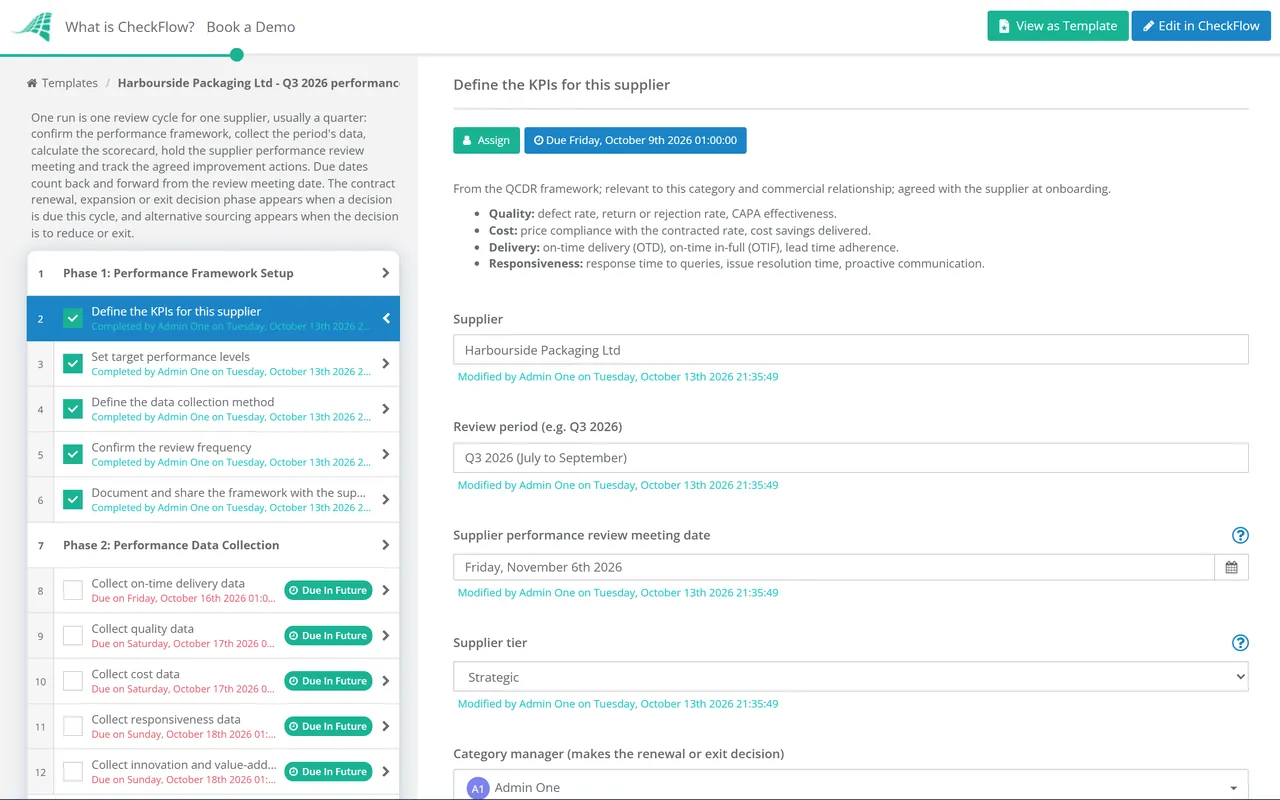
Define the KPIs for this supplier — from the QCDR framework; relevant to this category and commercial relationship; agreed with the supplier at onboarding
Set target performance levels — for each KPI; what is “good”, what is “needs improvement”, what is “at risk”?
Define the data collection method — where does performance data come from? ERP system, quality system, manual tracking?
Confirm the review frequency — quarterly for strategic and preferred suppliers; annually for approved; ad hoc for transactional
Document and share the framework with the supplier — the supplier should know how they will be measured
Phase 2
Performance Data Collection
Collect on-time delivery data — for the review period; from the procurement system or ERP; confirmed delivery dates vs committed delivery dates; by order and in aggregate
Collect quality data — defect reports raised, quantities returned or rejected, CAPA closure rates; from the quality management system
Collect cost data — invoices received vs contracted rates; any surcharges or price increases; any cost savings achieved
Collect responsiveness data — open issues log; time to acknowledge, time to resolve; subjective assessment from buyers and quality team
Collect innovation and value-add data (where relevant) — for strategic suppliers; any cost-saving suggestions, process improvements, or capability developments the supplier has brought to the relationship
Phase 3
Scorecard Calculation
Calculate each KPI score — for the review period; using the defined formulas (OTD% = on-time deliveries / total deliveries × 100; defect rate = defective units / total received × 1,000,000 for PPM; etc.)
Assign performance ratings — against the defined targets; green (at target or better), amber (within 5% of target), red (below acceptable threshold)
Calculate the overall weighted score — if a composite scorecard is used; weights reflecting the relative importance of each dimension for this category
Compare to prior period — is performance improving, stable, or declining?
Identify the most significant performance issues — the specific incidents or patterns that most affected the score; these are the items for the performance conversation
Phase 4
Supplier Performance Review Meeting
The scorecard is a data document; the review meeting is where the improvement happens. A well-run supplier performance review is a direct, professional, data-driven conversation about what needs to change — not a general discussion or a courtesy call.
Send the scorecard in advance — minimum 5 business days before the meeting; the supplier should have time to review the data and prepare
Attend at the right level — for strategic suppliers, the meeting should be at an account management level on both sides
Review performance against each KPI — with the data; for underperforming areas, the supplier provides their explanation and root cause analysis
Agree specific improvement actions — not “we will try harder”; specific actions, responsible person, measurable target, and completion date
Recognise strong performance — suppliers that consistently perform well deserve acknowledgement; the relationship dynamic should not be purely deficit-focused
Phase 5
Performance Improvement Plan Tracking
Document all agreed improvement actions — from the review meeting; in writing; shared with the supplier
Track progress between reviews — at the agreed intervals; is the supplier implementing the agreed actions? Are the metrics moving in the right direction?
Escalate where agreed actions are not being implemented — to the supplier’s account manager or senior management; documented
Review the improvement plan at the next quarterly scorecard — were the actions completed? Has performance improved to target?
Phase 6
Contract Renewal, Expansion, or Exit Decision
Assess cumulative performance trend — across the review history; a supplier that has been consistently amber or red despite agreed improvement actions is a supplier with a structural performance problem
Make the strategic decision — renew (performance is satisfactory, relationship is valuable), develop (performance has upside potential with investment), reduce (reduce spend and dependency while an alternative is developed), or exit (performance is consistently below acceptable; replacement is the right decision)
Initiate alternative sourcing if exiting — supplier onboarding for the replacement should begin well before the exit is executed; do not exit before a replacement is operational
Document the renewal or exit decision — with rationale; the performance record supports the decision
The Eight Supplier KPIs Every Procurement Team Should Track
On-Time Delivery (OTD) Rate
Formula: (On-time deliveries / Total deliveries) × 100%
Target: 95%+ for most categories
On-Time In-Full (OTIF) Rate
Formula: (Orders delivered on time AND in full / Total orders) × 100%
Target: 95%+ for Tier 1 suppliers
Defect Rate (PPM or %)
Formula: (Defective units / Total received) × 1,000,000 for PPM or × 100 for %
Target: <1% for most; near-zero for critical components
Return / Rejection Rate
Formula: (Units returned / Total received) × 100%
Target: <0.5% for well-qualified suppliers
Price Compliance Rate
Formula: (Invoices at contracted rate / Total invoices) × 100%
Target: 100%
Lead Time Adherence
Measure: Actual lead time / Quoted lead time
Target: ≤1.0 (actual no greater than quoted)
Issue Resolution Time
Measure: Average calendar days from issue raised to issue closed
Target: Set by contract; typically 5–10 business days for quality CAPAs
CAPA Effectiveness Rate
Formula: (CAPAs with no recurrence / Total CAPAs closed) × 100%
Target: 95%+ (recurrence indicates root cause not addressed)
Why Run Your Supplier Performance Evaluation in CheckFlow?
1
Consistent quarterly evaluation for every supplier in scope
Supplier performance evaluation that happens only when there is a problem is not a programme — it is crisis management. CheckFlow’s recurring evaluation workflow generates the performance data collection, scorecard calculation, and review preparation tasks automatically at the defined quarterly interval for every supplier in scope.
2
Performance conversations documented and action plans tracked
The supplier review meeting where improvement actions are agreed verbally but never documented produces the same performance conversation next quarter. CheckFlow documents the meeting outputs — agreed actions, responsible parties, and deadlines — and tracks completion between meetings.
3
A performance history that supports renewal and exit decisions
The decision to renew a strategic supplier contract or replace an underperforming one should be based on a performance record, not a recent impression. Every quarterly evaluation conducted through CheckFlow creates a timestamped record — the complete performance history that makes renewal and exit decisions defensible and data-driven.
Supplier performance evaluation connects back to the onboarding process — the KPIs established at onboarding are the ones measured in the evaluation. CheckFlow’s Supplier Onboarding Checklist covers the qualification and KPI definition that precedes the evaluation programme. See the Supplier Onboarding Checklist →
Procurement compliance reviews assess whether supplier performance evaluation programmes are being run consistently. CheckFlow’s Procurement Compliance Review covers the audit of procurement programme compliance. See the Procurement Compliance Review →
What should a supplier performance evaluation include?
+
A supplier performance evaluation covers six phases: performance framework setup (KPI definition in QCDR framework, target setting, data collection method, review frequency — done at onboarding), data collection (OTD data, quality data, cost compliance, responsiveness data, and innovation/value-add data for strategic suppliers), scorecard calculation (KPI scores, performance ratings, weighted overall score, and prior-period comparison), supplier performance review meeting (advance scorecard distribution, senior-level attendance, KPI-by-KPI review, specific improvement action agreement), improvement planning and tracking (documented actions, progress monitoring, escalation for non-implementation), and contract renewal or exit decision (trend analysis, strategic decision, alternative sourcing initiation, and decision documentation).
What are the most important supplier KPIs?
+
The most important supplier KPIs are: On-Time Delivery (OTD) rate (percentage of deliveries confirmed on or before the committed date — Walmart’s supply chain benchmarks high OTD as a fundamental requirement), On-Time In-Full (OTIF) rate (on time AND in the correct quantity), defect rate in PPM or percentage (Toyota’s near-zero defect supply base demonstrates what world-class quality performance looks like), price compliance rate (are contracted prices being honoured?), and issue resolution time (how quickly does the supplier acknowledge and resolve quality or delivery issues?). Responsiveness — the supplier’s ability to communicate proactively and resolve issues quickly — is increasingly recognised as a differentiating supplier capability alongside the core QCDR metrics.
How often should supplier performance reviews be conducted?
+
Strategic and preferred suppliers should be reviewed quarterly — frequent enough to catch performance trends before they become serious and enable responsive course correction. Annual reviews for this tier are insufficient for active performance management. Approved suppliers may be reviewed annually unless a significant issue triggers an ad hoc review. Transactional suppliers are typically not formally reviewed unless a pattern of issues emerges. The review frequency should be documented in the supplier record and the supplier should know when they will be reviewed.
What makes a supplier performance review effective?
+
An effective supplier performance review is: prepared (the scorecard is sent in advance; both parties have reviewed the data), specific (the discussion is anchored in data and specific incidents, not general impressions), direct (underperformance is named clearly and its business impact described, not softened to the point of ambiguity), constructive (improvement actions are specific, achievable, and agreed rather than imposed), and documented (agreed actions are recorded in writing and tracked). The reviews that produce the most improvement are the ones where the supplier understands exactly what is expected, exactly where they are falling short, and exactly what they need to do differently — and where they know the buyer will follow up on agreed actions.
Is CheckFlow free for this template?
+
14-day free trial, no card required. The Business plan is $10 per user per month after the trial. Full details at checkflow.io/pricing.
Turn Supplier Performance Data Into Supply Chain Improvement — Every Quarter
Free trial — no credit card required.
Do you like cookies? 🍪 We use cookies to ensure you get the best experience on our website. Learn more