The auto-renewal clause that locks you in for another year. The termination notice window you missed by two weeks. The rate increase embedded in the renewal that no one negotiated. All preventable — if the renewal process starts early enough.
The most costly contract management failures are rarely dramatic — they are quiet. A software vendor’s auto-renewal locks the company into a three-year commitment at rates that were negotiated three years ago and are now 40% above market, because no one noticed the 60-day termination notice window. A professional services agreement auto-renews at the same scope even though the scope requirement has significantly reduced. A landlord’s lease rolls to a market review rent because the tenant’s option notice was missed by ten days. These are not legal failures — they are process failures, and they are entirely preventable with a structured contract renewal management process that starts early, evaluates deliberately, and executes correctly. World Commerce & Contracting research shows that poor contract management causes 9% of value erosion — and auto-renewal misses are among the highest-cost, most preventable contributors to that figure. This free checklist gives legal, procurement, and operations teams a structured framework for the full contract renewal cycle.
This checklist describes a process framework. It does not constitute legal advice. Consult qualified legal counsel for advice specific to your contracts and jurisdiction.
Renew, Renegotiate, Terminate, or Rebid — the Decision That Determines the Value of Your Renewal
Renew as-is
When: The contract terms are fair market, the relationship is strong, and the cost of switching exceeds any savings.
Risk of inaction: None, provided the renewal is confirmed in writing and any required notice is given.
Lead time needed: 30 days before expiry minimum to confirm and document.
Renegotiate
When: Rates have drifted above market; scope has changed; new terms (data protection, liability caps, SLAs) need updating; volume has changed enough to warrant different pricing.
Risk of inaction: Auto-renewal at current terms eliminates the negotiating leverage that expiry creates.
Lead time needed: 90–120 days before expiry to allow negotiation time before the auto-renewal window closes.
Terminate
When: The service or relationship is no longer needed or performing; an internal capability has been built; the relationship has broken down.
Risk of inaction: Auto-renewal locks in a further term regardless of satisfaction.
Lead time needed: Know the notice period exactly; typically 60–90 days before expiry or the auto-renewal trigger date.
Rebid / market test
When: The contract value is large enough that a competitive tender is warranted; market rates may have shifted significantly; governance or policy requires periodic tendering.
Risk of inaction: Never testing the market means never knowing if the current arrangement is competitive.
Lead time needed: 6–12 months before expiry to run a proper tendering process.
The Contract Renewal Reminder Checklist
Six phases covering the full contract renewal cycle — from proactive tracking and performance review through to renegotiation, notice management, and register update.
Phase 1
Contract Renewal Register & Proactive Tracking
The renewal process cannot begin if you do not know what is coming up for renewal. The contract register — with expiry dates, notice dates, and auto-renewal dates — is the starting point.
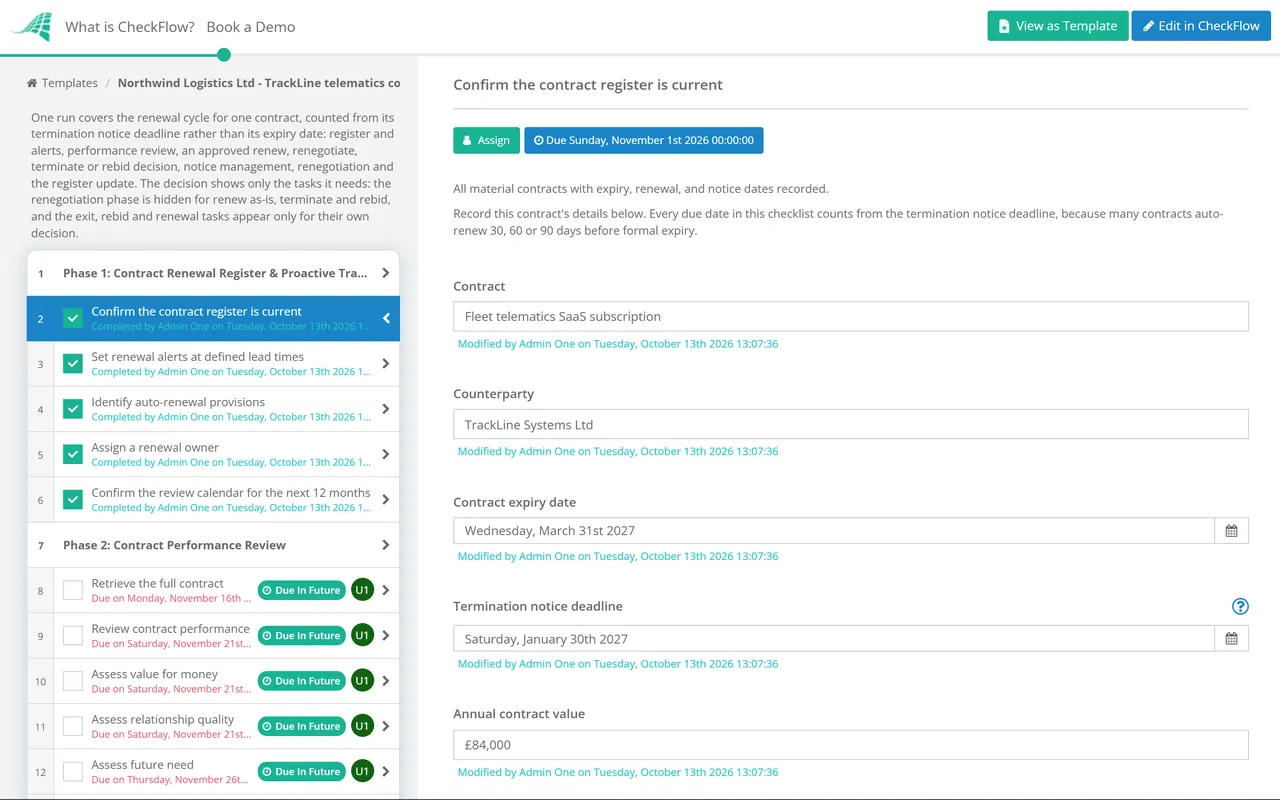
Confirm the contract register is current — all material contracts with expiry, renewal, and notice dates recorded
Set renewal alerts at defined lead times — at minimum: 12 months for high-value contracts; 6 months for mid-value; 90 days for standard; earlier for contracts requiring a competitive tender
Identify auto-renewal provisions — flag every contract with an auto-renewal clause and the exact notice deadline required to prevent auto-renewal
Assign a renewal owner — for every upcoming renewal; the business owner most familiar with the contract and its performance
Confirm the review calendar for the next 12 months — all contracts expiring within 12 months listed, with their assigned owners and decision deadlines
Phase 2
Contract Performance Review
Retrieve the full contract — current signed version including any amendments; confirm you are reviewing the current operative version
Review contract performance — has the counterparty delivered against its obligations? Any material service failures, SLA breaches, or pricing disputes?
Assess value for money — are the rates or fees still at or below market? Benchmark against available market data or comparable contracts
Assess relationship quality — is the relationship working? Does the counterparty respond promptly, manage issues constructively, and invest in the relationship?
Assess future need — is the scope of the contract still appropriate for the business’s current and foreseeable needs?
Gather stakeholder input — from the business teams who use the service or work under the contract; their assessment is the primary evidence for the renewal decision
Phase 3
Renewal Decision & Approval
Document the recommended decision — renew as-is, renegotiate, terminate, or rebid; with rationale based on performance review
Obtain approval for the recommended decision — at the appropriate authority level per the contract and the signatory authority matrix
For rebid decisions — confirm the procurement or tender process is initiated well in advance of the expiry date; allow time for TUPE/employee transfer implications where a service changes hands
Confirm the exit plan if terminating — service continuity, data return or destruction, transition obligations, and any wind-down costs
Phase 4
Notice & Deadline Management
The termination notice date is almost always the most critical date in any renewal process — not the expiry date. Many contracts auto-renew 30, 60, or 90 days before formal expiry. Missing this date by one day is often as costly as missing it by six months.
Confirm the exact notice deadline — re-read the contract; confirm whether the notice period runs from the expiry date or an earlier auto-renewal trigger
Confirm notice method requirements — many contracts require notice in a specific form (registered mail, specific email address, or named officer); confirm and follow exactly
Draft and send the notice — if terminating or triggering a renegotiation clause; in the correct form; within the deadline; retain proof of delivery
For renewals — confirm the renewal acknowledgement or confirmation is issued if required; update the contract register with the new expiry date
Phase 5
Renegotiation Process
Prepare the negotiation position — target terms, minimum acceptable terms, walk-away position; confirm internally before engaging the counterparty
Open negotiation promptly — before the auto-renewal window closes; leverage evaporates if you are negotiating after auto-renewal has already occurred
Negotiate any updated terms — price, scope, SLAs, data protection addendum, liability caps, IP ownership, and any other outdated provisions
Confirm all agreed changes are captured in writing — a formal amendment, new agreement, or at minimum a clearly documented exchange; verbal agreements on contract terms are not enforceable
Obtain the required signatures — per the signatory authority matrix; on both sides
Phase 6
Documentation & Contract Register Update
File the renewed, amended, or terminated contract — in the central contract repository; all versions and correspondence retained
Update the contract register — new expiry date, new terms summary, new notice deadline; set new renewal alerts for the next cycle
Notify relevant stakeholders — business owner, finance (for budget implications), IT (for system access changes), and any other affected parties
Confirm handover if terminating — all transition obligations under the contract are managed; data returned or destroyed per the contract requirements
This checklist is available as a free, runnable template in CheckFlow — scheduled automatically at the appropriate lead time for each contract tier, with renewal decisions tracked to execution and the contract register updated on completion.
How Auto-Renewal Clauses Work — and How to Stop Being Caught by Them
An auto-renewal clause typically states that the contract will automatically renew for a further term — often the same duration as the original — unless one party gives written notice of its intention not to renew by a specified date before the expiry date. That notice date is frequently set 90 or 60 days before expiry — meaning the effective decision date is significantly earlier than the contract end date. An organisation that reviews a contract 30 days before its expiry date has often already lost the ability to prevent auto-renewal.
The remedy is straightforward: at the point of signing any contract containing an auto-renewal clause, immediately calculate and diary the notice deadline — not the expiry date — and set a review alert at least 30 days before that notice deadline. A contract expiring on 31 December with a 90-day notice requirement has an effective decision deadline of 1 October. The review must begin no later than 1 September.
Why Run Contract Renewals in CheckFlow?
1
Renewal alerts that trigger at the right lead time — automatically
CheckFlow’s recurring contract renewal checklist triggers at the lead time defined for each contract tier — 12 months for high-value contracts, 90 days for standard. The notice deadline, not the expiry date, is the anchor for the checklist. Renewals that need decisions made early enter the process early — without relying on anyone to remember.
A structured decision process before every renewal
Renewing a contract without reviewing its performance, testing the market, or evaluating current terms is renewing by default. CheckFlow’s renewal checklist requires a performance review and an approved decision before notice is issued — ensuring every renewal reflects a deliberate choice rather than an automatic outcome.
When a department head asks “how much did we pay for this last year and why did we renew?”, the answer is in CheckFlow — the performance review, the recommended decision, the approval, and the new terms are all recorded and linked to the contract record.
Contract renewal management connects to the broader contract review and approval process. CheckFlow’s Contract Review & Approval Checklist covers the full contract review lifecycle for new agreements. See the Contract Review & Approval Checklist →
Contract renewal tracking is a natural recurring checklist use case — the same process runs on a defined schedule for every contract approaching expiry. Learn more about recurring checklists →
What is an auto-renewal clause and why is it dangerous?
+
An auto-renewal clause (also called an evergreen or automatic rollover clause) provides that a contract will automatically renew for a further term — typically equal to the original term — unless one party gives written notice of its intention not to renew by a specified deadline before the expiry date. The danger is that the notice deadline is often set 60 to 90 days before expiry — meaning the practical decision point is significantly earlier than the contract end date. Organisations that review contracts only when they approach their stated expiry date frequently discover that the auto-renewal window has already passed. The remedy is to diary the notice deadline, not the expiry date, and begin the review process at least 30 days before that deadline.
How much notice is typically required to prevent auto-renewal?
+
Notice periods vary by contract type and jurisdiction. Commercial software and SaaS agreements commonly require 30 to 90 days’ notice. Commercial leases commonly require 3 to 12 months’ notice. Professional services agreements commonly require 60 to 90 days’ notice. Some contracts require notice to a specific individual, in a specific form (registered mail, specified email address), and at a specific address — and defects in the notice mechanism can render the notice invalid. The exact notice requirement in each contract should be confirmed from the contract itself — not from memory or general practice.
What should a contract renewal evaluation cover?
+
A contract renewal evaluation should cover five areas: performance (has the counterparty delivered against its obligations, met SLAs, and resolved issues effectively?), value for money (are the current rates at or below market compared to available alternatives?), relationship quality (is the relationship working, productive, and constructive?), future need (is the scope still appropriate for the business’s foreseeable requirements?), and term and structure suitability (are the contract’s duration, liability cap, data protection provisions, and other terms still appropriate?). The evaluation should produce one of four decisions: renew as-is, renegotiate, terminate, or rebid.
What happens if we miss the termination notice deadline?
+
Once the notice deadline has passed, the contract typically renews automatically for the full renewal term — often one year or more. The organisation is then bound by the renewed contract for that term, with no legal right to terminate early unless the contract contains a break clause or the counterparty commits a material breach. In some jurisdictions and under some contractual provisions, a missed notice deadline may be susceptible to challenge (particularly in consumer contracts or where the auto-renewal was not clearly disclosed), but this is uncertain and litigated rather than certain. Prevention is dramatically cheaper than cure.
Is CheckFlow free for this template?
+
You can start a free 14-day trial with no credit card required, giving you full access to all features including this template. The Business plan is $10 per user per month after the trial. Full details at checkflow.io/pricing.
Never Miss a Renewal Deadline or Auto-Renewal Window Again
Free trial — no credit card required.
Do you like cookies? 🍪 We use cookies to ensure you get the best experience on our website. Learn more