Supply Chain Risk Assessment Checklist Template

The approved supplier list shows three suppliers for a part, until one plant shuts and it turns out all three buy from it. A supply chain risk assessment finds the single sources, the shared dependencies and the weak suppliers before a disruption does.

Last reviewed: October 2026

Printed from checkflow.io/templates/procurement-supply-chain/supply-chain-risk-assessment-checklist

This free supply chain risk assessment checklist is for procurement, supply chain, operations and risk teams who review the risk in a whole supply chain, or in the chain behind one product or category. One run is one assessment, about eight weeks from the start date to the approval. It sets the scope and the rating scale, maps the tier 1 suppliers and what is known about their own sources, and finds the critical items, the single-source and sole-source items and the concentration in one country, region or supplier. Each critical supplier is then rated on financial health, continuity, cyber security and labour and human rights risk, from public records and one questionnaire. The ratings go into a risk register and a mitigation plan, with second sources, safety stock, contract terms and exit plans, each with an owner and a date. An executive approves the assessment, and nothing after the approval can be completed until a decision is recorded. The run ends with suppliers told, monitoring set up and the next review date. Answers on the first task add tasks for a first assessment, a periodic review or a review after a disruption, for suppliers that can reach your systems, for goods going into the US and for a modern slavery statement.

A Supply Chain Risk Assessment Looks at the Whole Chain, Not One Supplier

A supply chain risk assessment asks what could stop or harm supply across all the suppliers behind a product, a category or the business, and what to do about it. Some of the biggest risks only show at that level: an item with one supplier, several suppliers in one region, or two suppliers who buy from the same plant. It rates each critical supplier, but the output is a register and a mitigation plan for the chain.

Other templates look at one supplier or one report. The Vendor Risk Assessment Checklist goes deep on one vendor, mostly its data and security. The Supplier Audit Checklist checks one supplier's site and quality system on a visit, and the Supplier Performance Evaluation Checklist scores how a supplier has performed against its KPIs. The Modern Slavery Statement Checklist turns a year's work on labour risk into a public statement, and the Business Continuity Plan Testing Checklist tests your own continuity plan. This checklist draws on all of them and points to them where a supplier needs a closer look.

This checklist

The risk across a whole supply chain

Covers: every supplier behind a product, category or business, mapped down the tiers, with critical items, single sources and concentration.

Planned around: a periodic review, or a review after a disruption or a major change.

Output: an approved risk register and mitigation plan with owners, and the next review date.

Related reviews

Modern slavery and continuity

Covers: the annual public statement on slavery and human trafficking, or testing your own business continuity plan.

Planned around: the financial year, or the exercise programme.

Output: a signed statement in the Modern Slavery Statement Checklist, or a tested plan in the Business Continuity Plan Testing Checklist. This checklist's labour and continuity findings feed both.

What the Supply Chain Risk Assessment Checklist Covers

Nine phases take one assessment from scope and criteria to the next review date. The first task asks what kind of run this is and three questions about the chain, and each answer adds the tasks it needs. A High or Critical rating in the register adds the tasks to brief the approver and act early. Nothing after the executive's approval can be completed until a decision is recorded, and Approved with conditions or Not approved adds the task that follows.

  1. Phase 1

    Phase 1: Scope, Owners & Risk Criteria

    7 tasks

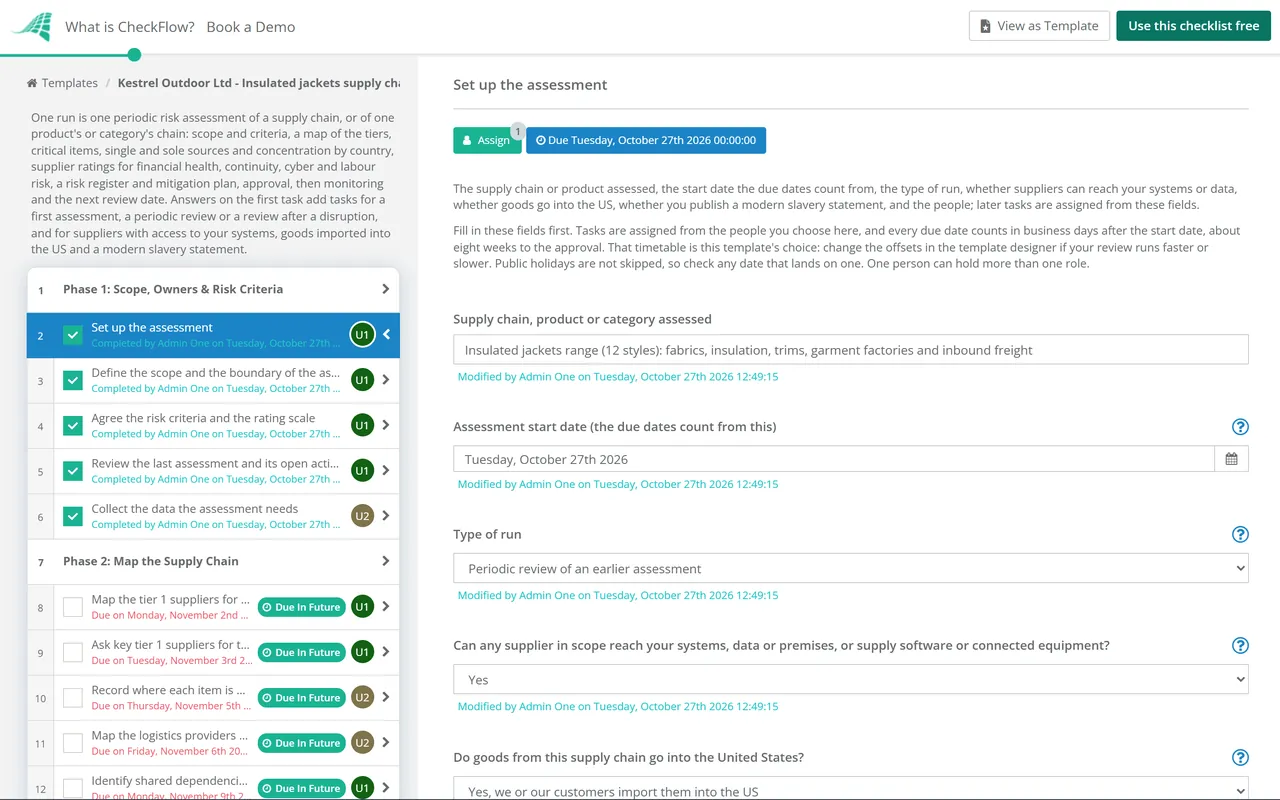
    Decide which supply chain this run assesses, who does each part and how risks will be rated before anyone collects data. The questions in the first task add the tasks for a first assessment, a periodic review or a review after a disruption, and for cyber access, US imports and a modern slavery statement. Every due date counts in working days from the start date.

    • Set up the assessment — the supply chain or product assessed, the start date the due dates count from, the type of run, whether suppliers can reach your systems or data, whether goods go into the US, whether you publish a modern slavery statement, and the people; later tasks are assigned from these fields
    • Record the disruption or change that triggered this review — a review after a disruption or change only: what happened, which items and suppliers it affected, how long supply was interrupted and what was done at the time
    • Define the scope and the boundary of the assessment — the products, categories, sites and business units covered, what is left out and why, and how far down the tiers the assessment will go
    • Agree the risk criteria and the rating scale — the likelihood and impact scale, what makes an item or supplier critical, and the level of risk the business will accept without a mitigation
    • Build the supplier list from purchase and payment data — a first assessment only: every supplier paid for the items in scope over the last 12 months, from purchase orders, accounts payable and contracts, so nothing is missed
    • Review the last assessment and its open actions — a periodic review only: what the last assessment found, which mitigations were done, which are still open and what has changed since
    • Collect the data the assessment needs — spend and volume by supplier, contracts and their end dates, lead times, current stock and any incidents or late deliveries in the last year
  2. Phase 2

    Phase 2: Map the Supply Chain

    5 tasks

    A risk you cannot see in the map cannot be rated. Map each item to its suppliers, then ask the important ones where their own inputs come from. Two suppliers that look independent may buy from the same plant or ship through the same port.

    • Map the tier 1 suppliers for each item in scope — which supplier provides each item or service, the share each one supplies and the contract that covers it
    • Ask key tier 1 suppliers for their own sources and sites — the tier 2 suppliers, raw materials and manufacturing sites behind each important item, as far as the agreed depth
    • Record where each item is made and shipped from — the country and site of manufacture, the port or border crossing and the main transport route for each item
    • Map the logistics providers and warehouses — carriers, freight forwarders, customs brokers and warehouses the chain depends on, including any third-party warehouse holding your stock
    • Identify shared dependencies further down the chain — a tier 2 source, raw material, port or region that several of your suppliers rely on, so one failure would hit them all at once
  3. Phase 3

    Phase 3: Critical Items, Single Sources & Concentration

    7 tasks

    Concentrate the effort where a failure would hurt most. Rank the items by impact, find those with one supplier or one country behind them, and compare how long your stock lasts with how long it would take to replace the supplier. Then record what each supplier holds or can reach and send the critical suppliers one questionnaire for Phases 5 and 6.

    • Rank the items by their impact on operations and customers — revenue or production that stops without the item, safety or regulatory effects, and whether a substitute exists, using the criteria agreed in Phase 1
    • Flag single-source and sole-source items — a single source is one supplier chosen although others exist; a sole source is the only supplier that can provide the item; each critical item gets one of the two labels or multiple
    • Check concentration by country or region — the share of spend or volume for each critical item that comes from one country, region or port, and the events that could stop it there
    • Check concentration on single suppliers — the share of a category bought from one supplier, and your share of that supplier's revenue, since dependence in either direction is a risk
    • Identify what suppliers hold or can reach — your information they hold or handle, and their physical and logical access to your systems and premises
    • Compare stock cover with the time to recover — how many weeks current and safety stock would last for each critical item, against how long it would take to qualify and switch to another source
    • Send the assessment questionnaire to critical suppliers — one request covering continuity, cyber security and labour practices, with the evidence wanted and a reply date before the reviews start
  4. Phase 4

    Phase 4: Financial Health & Ownership

    4 tasks

    A supplier that fails financially can stop supplying with little notice. These checks use public records and your own payment and delivery history, so they can start while suppliers answer the questionnaire.

    • Check each critical supplier's financial health from public records — filed accounts, a credit report, late or missing filings and any insolvency notices
    • Look for early warning signs — late or short deliveries, requests for early payment or changed bank details, key staff leaving, a change of owner or a lost major customer
    • Check ownership and screen against sanctions lists — who owns and controls each critical supplier, and a screen of the supplier and its owners against the sanctions lists that apply to you
    • Rate each critical supplier's financial risk — Low, Medium, High or Critical for each supplier on the agreed scale, with the reason
  5. Phase 5

    Phase 5: Continuity & Cyber Risk

    6 tasks

    Review what the critical suppliers sent back on continuity and cyber security, against what Phase 3 recorded about what each one holds or can reach. A yes to the cyber question on the first task adds two tasks on sub-contractors and incidents.

    • Review each critical supplier's continuity arrangements — their continuity plan, alternative sites or lines, how long they say recovery would take and when they last tested it
    • Rate each critical supplier's continuity risk — Low, Medium, High or Critical for each supplier, weighing their recovery time against your stock cover from Phase 3
    • Review the security evidence suppliers sent — certificates and reports such as Cyber Essentials, an ISO/IEC 27001 certificate or a SOC 2 report, questionnaire answers and any security incidents they disclosed
    • Check how suppliers control their own sub-contractors' access — suppliers with access only: who their sub-contractors are, what of yours they can reach and what security they have been asked to provide
    • Confirm incident notification and support terms — suppliers with access only: how quickly they will tell you about a security incident that affects you, who they will tell, and what help each side gives the other
    • Rate each critical supplier's cyber risk — Low, Medium, High or Critical for each supplier, covering both a breach of your information and an attack that stops their supply
  6. Phase 6

    Phase 6: Labour & Human Rights Risk

    4 tasks

    Look for the places where workers in the chain are most at risk, such as forced or child labour, recruitment fees, unsafe conditions and unpaid wages. Start with the country, the sector and the material, then check the supplier's own answers against them. A yes to the US question on the first task adds the forced labour import check.

    • Screen for high-risk countries, sectors and materials — where the items, their raw materials and their labour come from, and which of those places, sectors or materials carry a known risk of forced or child labour
    • Review supplier evidence on labour practices — a signed supplier code of conduct, recent social audit reports and their findings, how workers can raise a grievance and how agency workers are recruited
    • Check goods against the US forced labour import presumption — goods going into the US only: whether any input was mined, produced or manufactured in Xinjiang, or by an entity on the UFLPA Entity List, and the tracing evidence that shows where the inputs came from
    • Rate each critical supplier's labour and human rights risk — Low, Medium, High or Critical for each supplier, based on the screen and the evidence, with the reason
  7. Phase 7

    Phase 7: Risk Register & Mitigation Plan

    8 tasks

    Bring the ratings together, then agree what will be done about each risk the business will not accept as it is: a second source, more stock, better contract terms or a plan to leave. Every mitigation gets an owner and a date. A High or Critical rating adds the tasks to escalate it before the approval.

    • Consolidate the ratings into the supply chain risk register — one row per critical supplier with its financial, continuity, cyber and labour ratings and an overall rating, plus the single-source, concentration and stock-cover risks from Phase 3
    • Brief the approver on High and Critical risks — High or Critical ratings only: each risk, what could happen and the mitigation proposed, so the approver is not hearing about it first at the approval
    • Start interim actions for Critical risks now — Critical ratings only: actions that cannot wait for the approval, such as extra orders, moving stock or a call with the supplier, recorded with who agreed them
    • Agree second sources or alternatives for critical single-source items — qualify another supplier, split the volume between two, approve an alternative material or design, or record why the single source stays
    • Set safety stock or buffer levels for critical items — the stock to hold, where to hold it and what it costs, for items where the time to recover is longer than current cover
    • Agree contract terms with critical suppliers — notice of disruption, continuity and recovery commitments, security requirements and incident notification, flow-down to sub-contractors, audit rights and labour standards
    • Write exit plans for critical suppliers — how you would move away from each critical supplier if you had to, how long it would take and what you would need from them, such as tooling, data or stock
    • Assign an owner and a date to every mitigation — the mitigation plan: each risk, its mitigation, the owner, the due date and the residual rating expected once it is done
  8. Phase 8

    Phase 8: Review & Approval

    4 tasks

    The executive who owns the risk approves the assessment and the mitigation plan, including any risk accepted without a mitigation. Nothing after the approval can be completed until a decision is recorded. Approved with conditions and Not approved each add the task that follows from them.

    • Prepare the assessment summary for approval — the scope, the top risks and their ratings, the risks proposed for acceptance, the mitigation plan with its owners and costs, and the next review date proposed
    • Approve the assessment and the mitigation plan — the approver records Approved, Approved with conditions or Not approved, the conditions or reasons, and the risks they accept
    • Record the conditions and who will meet them — Approved with conditions only: each condition, its owner and its date, added to the mitigation plan
    • Rework the assessment and ask for a new decision — Not approved only: make the changes the approver asked for, then ask them to record a new decision on the approval task, or archive this checklist and start a new run
  9. Phase 9

    Phase 9: Communicate, Monitor & Set the Next Review

    7 tasks

    An assessment is a snapshot. Tell suppliers and the owners of each mitigation what was agreed, set up the signals that should trigger an early review, and put the next review in the diary before closing the run.

    • Tell critical suppliers what you need from them — the requirements, contract changes and actions agreed with each supplier, and the dates
    • Brief the owners of each mitigation — each owner knows their actions and dates, and how progress will be reported
    • Set up monitoring and early review triggers — alerts for supplier financial changes, sanctions list changes, news from key countries and sites, security incidents and falling delivery performance, and the events that will start an early review
    • Feed the findings into supplier onboarding and performance reviews — the checks new suppliers must pass and the risk measures added to the supplier scorecards
    • Pass the labour findings to the modern slavery statement owner — statement publishers only: the parts of the chain at risk and the steps taken to assess and manage that risk, for the next statement
    • Set the next review date — when this supply chain will be assessed again, earlier for chains with High or Critical risks, and a reminder or schedule for it
    • Close the assessment and file the record — the final register, mitigation plan, approval and evidence stored where the next review will find them

The Risk Areas This Checklist Rates, and the Evidence for Each

The table lists the risks the checklist looks at, where the evidence can come from, and the published guidance or law that names the risk, where there is one. The rating scale and the evidence you ask for are your own choice, set in Phase 1.

Risk area What to look at Evidence Named in
Single and sole sourcesCritical items with one supplier, or with only one supplier that existsPurchase data, the approved supplier list, suppliers' own sourcesNIST SP 800-161 Rev. 1: “overreliance on a single source of supply”
ConcentrationA high share of an item from one country, region, port or supplier, or shared tier 2 sourcesThe supply chain map, country of manufacture, shipping routesPractice: this template's check
Stock cover and recovery timeWeeks of stock against the time to qualify and switch to another sourceStock reports, lead times, qualification timesPractice: this template's check
Financial healthFiled accounts, credit rating, late filings, insolvency notices, early warning signsCompanies House, The Gazette, SEC EDGAR, a credit reportPractice: this template's check
Ownership and sanctionsWho owns and controls the supplier, and matches on the sanctions lists that apply to youOwnership records, a sanctions screenYour sanctions obligations
ContinuityThe supplier's continuity plan, alternative sites, recovery time and last testA plan summary and test record from the questionnaireNIST SP 800-161 Rev. 1: include critical suppliers in contingency planning
Cyber and information securityWhat the supplier holds or can reach, its controls, its sub-contractors, incident supportCyber Essentials, an ISO/IEC 27001 certificate, a SOC 2 report, questionnaire answersNCSC supply chain security guidance (12 principles); NIST SP 800-161 Rev. 1
Labour and human rightsForced and child labour, recruitment fees, unsafe conditions, grievance channelsCountry, sector and material risk, codes of conduct, social audit reportsModern Slavery Act 2015 s.54(5)(d); for US imports, the UFLPA presumption

Where the guidance comes from. The UK National Cyber Security Centre's supply chain security guidance sets out 12 principles in four stages: understand the risks, establish control, check your arrangements and continuous improvement. It says it is written for large organisations, the public sector and cyber security professionals, not for national security requirements. NIST Special Publication 800-161 Rev. 1, Cybersecurity Supply Chain Risk Management Practices for Systems and Organizations (May 2022, updated 1 November 2024), is the US guidance on identifying, assessing and mitigating cybersecurity risks throughout the supply chain. ISO 28000:2022 (Security and resilience: Security management systems: Requirements) is the international standard for security management systems, including aspects relevant to the supply chain; it is a paid standard, so buy it from ISO or your national standards body if you certify to it.

Labour rules. In the UK, section 54 of the Modern Slavery Act 2015 requires a slavery and human trafficking statement each financial year from commercial organisations that carry on business in the UK, supply goods or services and have a total turnover of at least £36 million, and says it may describe the parts of the supply chains at risk and the steps taken to assess and manage that risk. In the US, Customs and Border Protection applies a rebuttable presumption, in force since 21 June 2022, that goods made wholly or in part in Xinjiang, or by an entity on the UFLPA Entity List, are prohibited from import. The table is a summary, not legal advice.

Why Run Your Supply Chain Risk Assessment in CheckFlow?

1

Each part goes to the person who knows it

Name the assessment lead, operations, information security, finance, responsible sourcing and the approver on the first task, and every task is assigned from those fields. Due dates count in working days from the start date, so the Tasks Grid shows each of them what is due this week. Run it on a recurring schedule so the next review starts on time.

2

Only the tasks this assessment needs

A first assessment builds the supplier list; a periodic review starts from the last one's open actions; a review after a disruption records what happened. Suppliers with access to your systems add the sub-contractor and incident tasks, goods going into the US add the forced labour import check, and a High or Critical rating adds the briefing and interim actions.

3

The plan is approved before it is rolled out

The executive's decision halts the checklist, so suppliers are not told about new terms and the review is not closed until the assessment and its mitigation plan are approved. Conditions and rework get their own tasks. See how approvals that halt a checklist work.

CheckFlow does not score suppliers, monitor the news or hold your supplier master data. It keeps the assessment in one place: who does what and by when, the supply chain map, the evidence on the task it came from, the risk register, the mitigation plan and the approval, with a record of what was done. The Reports Grid lists every assessment with its answers, so the next review starts from this one.

Need a closer look at one supplier? Use the Vendor Risk Assessment Checklist for a vendor's security and data handling, the Supplier Audit Checklist for a site visit and the Supplier Performance Evaluation Checklist for its scorecard. Bring a new supplier on with the Supplier Onboarding Checklist, find a second source with the Supplier Sourcing & Tender Checklist, and publish the year's labour findings with the Modern Slavery Statement Checklist.

AI generator

Didn’t find what you need? Describe it.

Describe the process in a sentence and the AI checklist generator drafts the phases and tasks for you.

Frequently Asked Questions

What should a supply chain risk assessment checklist include?

The scope and the rating scale; a map of the tier 1 suppliers and what is known about their sources; the critical items, single and sole sources and concentration by country, region or supplier; stock cover against the time to recover; ratings for each critical supplier on financial health, continuity, cyber security and labour risk; a risk register and a mitigation plan with owners and dates; an executive's approval; and monitoring and the next review date.

What is the difference between a single source and a sole source?

A single source is one supplier you have chosen for an item although others could supply it. A sole source is the only supplier able to supply it, for example because of a patent, a unique process or a specification. Both leave the item exposed if that supplier fails, but a single source can be fixed by qualifying another supplier, while a sole source may need a redesign, more stock or a closer relationship with the supplier.

How is a supply chain risk assessment different from a vendor risk assessment?

A vendor risk assessment looks at one vendor in depth: its security, data handling and contract terms, before you depend on it and at each reassessment. A supply chain risk assessment looks across every supplier behind a product or category and finds risks that only show at that level, such as single sources, concentration in one region and shared tier 2 sources. Use the Vendor Risk Assessment Checklist when one supplier needs the deeper review.

How far down the supply chain should the assessment go?

As far as you need to understand the risk to your critical items. The NCSC's supply chain guidance asks organisations to think about how far down the chain they need to go, and notes they may have to rely on immediate suppliers for information about their sub-contractors. This template records the depth chosen in Phase 1, maps tier 1 fully and asks key suppliers for their own sources, and treats any supplier that will not say as a risk to rate.

How often should supply chain risk be assessed?

No single law sets a frequency for every organisation, so this template asks you to choose the next review date at the end of each run and record why. This template suggests an earlier date for chains with High or Critical risks. Phase 9 also sets the events that should start an early review, such as a supplier's financial trouble, a sanctions change or a disruption, and the review-after-a-disruption run type covers that case.

Which frameworks cover supply chain cyber security risk?

In the UK, the National Cyber Security Centre's supply chain security guidance sets out 12 principles in four stages, from understanding the risks to continuous improvement. In the US, NIST SP 800-161 Rev. 1 covers cybersecurity supply chain risk management, including risk assessments for products and services. ISO 28000:2022 specifies requirements for a security management system, including aspects relevant to the supply chain. This checklist's cyber tasks follow the NCSC principles.

How do you assess labour and human rights risk in a supply chain?

Start with where the items, materials and labour come from, since some countries, sectors and materials carry a known risk of forced or child labour. Then review each critical supplier's evidence: a code of conduct, social audit reports, grievance channels and how agency workers are recruited. For goods imported into the US, check exposure to the UFLPA presumption. Organisations that publish a UK statement can use the findings in the Modern Slavery Statement Checklist.

Who should approve a supply chain risk assessment?

This template has the executive who owns the risk approve it, because the mitigation plan spends money and some risks are accepted without a mitigation. They record Approved, Approved with conditions or Not approved, and nothing after the approval can be completed until they do. Agree the rating scale with them in Phase 1, and brief them on High or Critical risks before the approval.

Is CheckFlow free for this template?

14-day free trial, no card required. The Business plan is $10 per user per month after the trial. Full details at checkflow.io/pricing.

Find the Weak Links in Your Supply Chain Before a Disruption Does

Free trial — no credit card required.

14-day free trial, no credit cardFull refund in your first 30 daysUS hosting, EU on request