Export Compliance Checklist Template

Check every export the same way before it leaves: the item’s classification, every party screened, the destination and end use, the licence decision, and a release decision before the export filing.

Last reviewed: November 2026

Printed from checkflow.io/templates/procurement-supply-chain/export-compliance-checklist

This free export compliance checklist is for exporters in the US and the UK, and the export compliance, logistics, sales and engineering people who get a shipment ready. One run is one shipment, planned back from the day the goods leave: the order and every party to it, the item’s classification on the control list, restricted-party screening, the destination and sanctions, the end use and red flags, the licence decision, the documents, a release decision, the export filing and the records. It covers commercial and dual-use goods under the US Export Administration Regulations and the UK’s export controls; ITAR exports of defence articles are not covered. Use it as your trade compliance and export control checklist for each order, with the evidence kept on the task that produced it.

The Exporter’s Checks Before Goods Leave, Not the Importer’s

Export compliance is the exporter’s check that one shipment may lawfully leave: what the item is on the control list, where it is going, who will receive it, what they will do with it, and whether a licence is needed. It is done before the goods leave, and it is the exporter’s responsibility even when a forwarder makes the filing.

Goods coming in are the Import & Customs Compliance Checklist. A bank’s or regulated firm’s screening of its own customers and payments is the Sanctions Screening Checklist. Packing, marking and documenting hazardous goods for transport is the Dangerous Goods Shipment Checklist.

This checklist

One export shipment before it leaves

Who runs it: the exporter’s export compliance lead, with logistics, sales and engineering.

Covers: classification, restricted-party screening, destination and sanctions checks, end use and red flags, the licence decision, documents, the release decision, the export filing and records.

Output: a released shipment and its export control records.

Goods coming in

Import and customs compliance

Who runs it: the importer.

Covers: the commodity code, customs value and origin for duty, import licences, the entry and its corrections.

Output: a cleared import entry. Use the Import & Customs Compliance Checklist.

Customers and payments

Sanctions screening

Who runs it: a bank or other regulated firm.

Covers: screening customers and payments, alerts, asset freezes and reports to OFAC or OFSI.

Output: screening records and reports. Use the Sanctions Screening Checklist.

What the Export Compliance Checklist Covers

Nine phases take one shipment from the order to the records. The template allows four working weeks before the planned export date, which suits a first order or a new item; for a repeat order, enter a nearer date and the same checks fall due at once, in the same order. The first task asks where the goods leave from, and each task then shows the US or the UK rules. A possible match, a sanctions concern, unexplained red flags or a licence each add the tasks they need, and the release approver’s decision halts the checklist: nothing after it can be completed until the approver completes it, and Not released hides the export and shows the task to hold the shipment.

  1. Phase 1

    Phase 1: Set Up the Shipment

    4 tasks

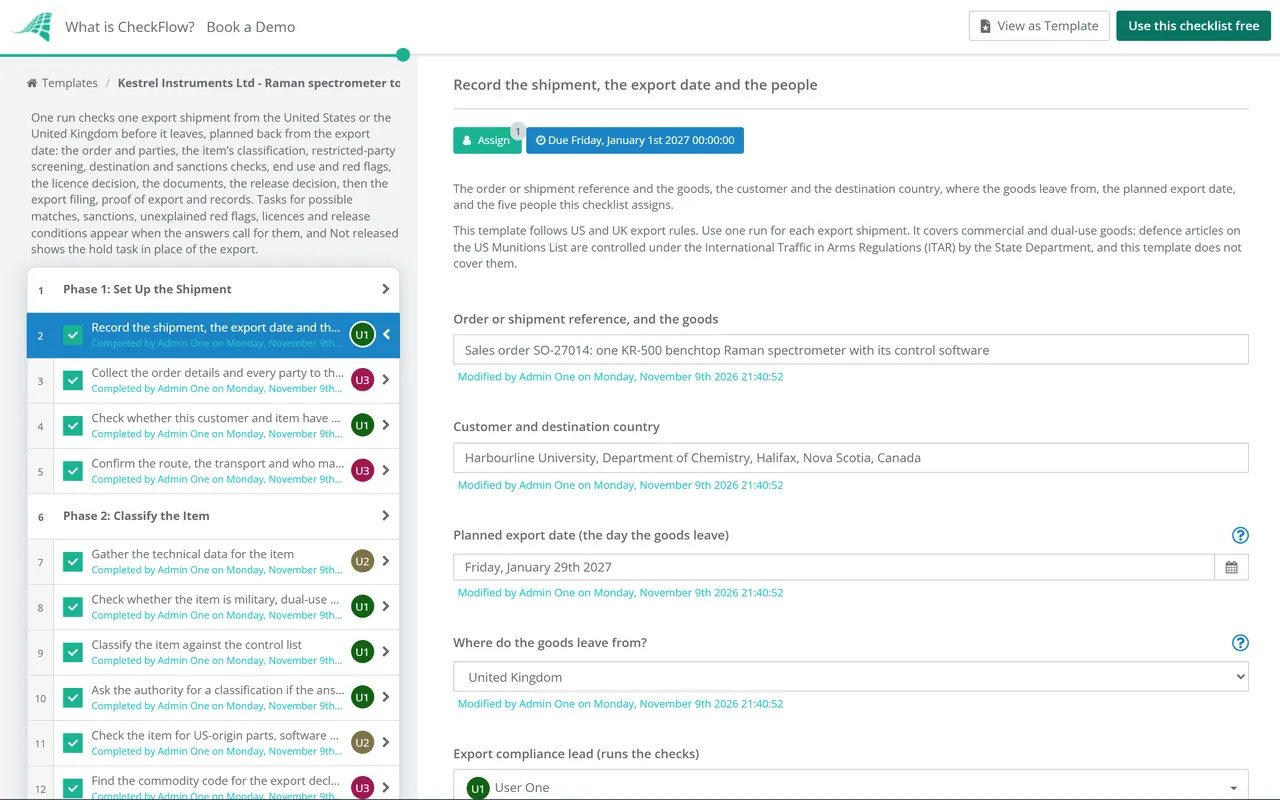
    Owned by the export compliance lead. Enter the planned export date, the day the goods leave: every due date counts from it in working days, and this template allows four working weeks before it. Say whether the goods leave the United States or the United Kingdom; each task then shows that country’s rules.

    • Record the shipment, the export date and the people — the order or shipment reference and the goods, the customer and the destination country, where the goods leave from, the planned export date, and the five people this checklist assigns
    • Collect the order details and every party to the transaction — the goods, quantities and value from the order, the Incoterms® rule, and every party: the buyer, any intermediate consignee, the ultimate consignee, the end user and the freight forwarder, with addresses
    • Check whether this customer and item have been exported before — earlier shipments of the same item to the same customer, the classification and licence used then, and anything that has changed since: the item, the end user, the destination or the rules
    • Confirm the route, the transport and who makes the export filing — how the goods travel, any country they pass through or are transhipped in, the freight forwarder or customs agent, and who makes the export filing
  2. Phase 2

    Phase 2: Classify the Item

    6 tasks

    Classification is what the item is for export control purposes: its place on the control list, or not listed. The engineer gives the technical data, and the export compliance lead classifies the item from it. The commodity code for the customs declaration is a separate number found in the same phase.

    • Gather the technical data for the item — the datasheet and specification, what the item does and its performance figures, any software or technology that goes with it, and any classification the manufacturer or supplier gives
    • Check whether the item is military, dual-use or neither — whether the item is specially designed or modified for military use, can have both civil and military uses, or is an ordinary commercial item, recorded before the classification
    • Classify the item against the control list — the control list entry that describes the item, or a record that it is not listed, with the reasons for control and how the answer was reached
    • Ask the authority for a classification if the answer is unclear — where the item could fall under more than one entry or none, a formal classification request to the export control authority, or a record that it was not needed
    • Check the item for US-origin parts, software or technology — whether a UK-made item contains US-origin parts, software or technology, and if so whether US re-export rules apply to it
    • Find the commodity code for the export declaration — the customs commodity code for the goods, which is a separate number from the control list classification
  3. Phase 3

    Phase 3: Screen Every Party

    4 tasks

    Every party in Phase 1’s table is checked against the restricted-party lists, and the owners of the customer and the end user too. A possible match is reviewed before anything else happens. Lists change daily, so Phase 8 screens the parties again just before the release.

    • Screen every party against the restricted-party lists — each name and address from the parties table searched on the lists that apply, with the date, the lists searched and the result for each party
    • Review each possible match and record the outcome — each possible match compared with the listing: full name, address, country, dates and identifiers, and recorded as a false positive or escalated as a match
    • Stop the transaction and escalate the confirmed match — no shipment, delivery or payment while the match is open, the release approver and your legal adviser told, and any report the law requires made
    • Check who owns and controls the customer and the end user — the owners of the customer and the end user, so far as you can find them, checked against the same lists, because some restrictions reach companies a listed party owns
  4. Phase 4

    Phase 4: Destination & Sanctions

    3 tasks

    The destination country, and any country the goods pass through, are checked for embargoes and sanctions that reach these goods. A sanctions concern adds a task to find out whether the export is banned or needs a sanctions licence.

    • Check the destination for embargoes and sanctions — the destination country checked for arms embargoes, trade sanctions and other restrictions that apply to these goods or this customer
    • Check whether the sanctions prohibit the export or need a sanctions licence — the sanctions measures read for these goods and parties, and a conclusion: prohibited, allowed under an exception, or allowed only with a sanctions licence
    • Check the route for transit and diversion risk — the route from Phase 1 checked for transit or transhipment countries that change the rules, and for a route that is unusual for these goods and this destination
  5. Phase 5

    Phase 5: End Use & End User

    4 tasks

    Who will use the goods and what for. The account manager asks the customer, and the export compliance lead checks the answers against the red flags and the end-use controls, which can require a licence even for an item that is not listed.

    • Get the end-use and end-user statement — a statement from the customer or end user of who will use the goods, where and for what, signed where your process or a licence application needs it
    • Review the order against the red flags — the order, the customer and the route checked against the red flag list, each one found recorded with the questions asked and the answers
    • Check the end-use controls that apply even to unlisted items — whether you know of, or have been told of, a weapons of mass destruction or military end use, or another end use the rules control, recorded with the reasons
    • Escalate the red flags that are not explained — the unexplained red flags taken to the release approver, with what was asked and why the answers are not enough, and a decision to stop, ask more or seek advice or a licence
  6. Phase 6

    Phase 6: Licence Determination

    4 tasks

    With the classification, the destination, the parties and the end use known, the export compliance lead decides whether the shipment needs a licence, is covered by a general authorisation, or needs none. An individual licence adds the application, and the planned export date may then move.

    • Decide whether a licence is needed — the classification checked against the destination, the parties and the end use, and the answer recorded: no licence needed, a general authorisation that covers it, or an individual licence, with the reasons
    • Apply for the individual licence — the licence application made with the classification, the parties, the end-use statement and the technical data, and its reference recorded
    • Check the conditions of the License Exception or open general licence — the exception or licence read in full, each condition and exclusion checked against this shipment, and the exporter registered to use it where the licence requires
    • Record the licence and its conditions — the licence number, its expiry date, the items, quantities and values it covers, and every condition that applies to this shipment
  7. Phase 7

    Phase 7: Documents & Filing Data

    4 tasks

    The documents that travel with the goods carry the licence or exception and the statements the rules require, and the forwarder or customs agent gets the data for the export filing. Nothing is filed yet: that waits for the release.

    • Check the customer can import the goods — the customer asked whether its country needs an import licence, permit or certificate for these goods, and what documents its customs will want
    • Prepare the commercial invoice and packing list — the invoice with the full description, value, parties and Incoterms® rule, and the packing list, both matching the order and the parties screened
    • Put the licence reference and control statements on the documents — the licence, exception or open general licence reference and any statement the rules require, on the invoice and the transport document
    • Give the forwarder or customs agent the export control data — the classification, the licence code or reference, the commodity code, the parties and the value, in writing, for the export filing
  8. Phase 8

    Phase 8: Release Decision

    5 tasks

    The parties are screened again, the export compliance lead sums up, and the release approver alone decides whether the shipment may leave. Nothing after the decision can be completed until the approver completes it. Not released hides Phase 9 and shows the task to hold the shipment.

    • Screen every party again before the release — every party screened again on the lists that apply, because lists change, with any change from Phase 3 recorded
    • Prepare the release summary and recommendation — the classification, the screening results, the destination and end-use checks, the licence route and the documents, with a recommendation to the release approver
    • Decide whether the shipment may be released — Released, Released with conditions or Not released, with the conditions or the reasons, recorded by the release approver alone
    • Hold the shipment and record why — not released only: logistics and the account manager told to hold the goods, the customer told what it can be told, the reasons and the records kept with this checklist
    • Meet the release conditions before the hand-over — each condition the release approver set, met and recorded before the goods are handed to the carrier
  9. Phase 9

    Phase 9: Export, Proof & Records

    6 tasks

    Applies only when the release approver releases the shipment, with or without conditions. The export filing is made, the goods and their documents go to the carrier, the export is confirmed, and the records are kept for the period the rules set.

    • Make the export filing and record its reference — the export filing made by you or your agent before the goods leave, or the exemption that applies, with the reference recorded
    • Hand the goods and documents to the carrier — the goods handed over on the export date with the invoice, the packing list, any licence and the filing reference, checked against the release
    • Confirm the goods left and keep the proof of export — confirmation that the goods left the country, kept with this checklist as proof of export
    • Record what the shipment used of the licence — the quantity and value shipped against an individual licence, or the use of the open general licence or License Exception, for the licence’s own records and reports
    • File the export records for the period the rules set — the classification, screening records, end-use statement, licence or exception, documents, filing reference and proof of export, filed together and kept for the period that applies
    • Update the records for the next shipment — the item’s classification in your product records, the customer’s screening and end-use file, and anything learned that changes how the next shipment to this customer is checked

US and UK Export Controls Side by Side

The same checks under two sets of rules

The first task asks where the goods leave from, and each task shows the notes for that country. The steps are the same; the lists, the licences and the filings differ.

Check United States United Kingdom
Who sets the rulesThe Bureau of Industry and Security (BIS) under the Export Administration Regulations (EAR), 15 CFR parts 730 to 774. Defence articles fall under ITAR (State Department), which this template does not cover.The Export Control Joint Unit (ECJU) under the Export Control Act 2002, the Export Control Order 2008 and the assimilated dual-use Regulation (EC) 428/2009. Northern Ireland follows Regulation (EU) 2021/821 for dual-use items.
The control listThe Commerce Control List (supplement no. 1 to part 774). An item subject to the EAR that is not on it is EAR99.The UK Strategic Export Control List of military and dual-use items, checked with ECJU’s OGEL and Goods Checker Tools.
Is a licence needed?The ECCN’s reasons for control against the Commerce Country Chart (738.4), then the ten general prohibitions (736.2) and any License Exception (part 740).A listed item needs a licence: an open general export licence where one covers the item and destination, otherwise an individual licence. An unlisted item can need one under the end-use controls or sanctions.
Restricted-party listsThe Consolidated Screening List, which combines Commerce, State and Treasury lists, including the Entity List and OFAC’s SDN List, updated daily.The UK Sanctions List, the only list of UK sanctions designations since 28 January 2026.
Owners of a listed partyOFAC’s 50 Percent Rule (ownership, not control). BIS’s Entity List affiliates rule is suspended until 10 January 2027.Asset freezes and some other sanctions carry down to entities a designated person owns or controls.
End-use controlsPart 744: nuclear, missile, chemical and biological weapons end uses, and military end uses and end users in the countries 744.21 names.WMD end-use controls when you are aware or informed of a WMD purpose; military end-use controls for destinations under an arms embargo.
Statement on the documentsThe Destination Control Statement on the commercial invoice for items on the Commerce Control List, not EAR99 (758.6).Under the dual-use OGEL, the OGEL wording or SPIRE reference on the documents and the licence reference on the customs declaration.
Licence applicationsSNAP-R (748.1(d)).GOV.UK’s Apply to export controlled goods service (LITE) for most SIELs; SPIRE for OGEL registration and some licence types, as read on 9 November 2026.
Export filingEEI in AES before departure: 24 hours before vessel loading, 2 hours before a flight, 1 hour before a truck reaches the border (30.4). Rail 2 hours before the border; mail and other modes 2 hours before export. Most shipments to Canada and items of $2,500 or less per Schedule B number are exempt, unless a licence is needed or 758.1(b) requires EEI whatever the value.An export declaration in the Customs Declaration Service before the goods leave: at least 1 hour before departure by road, 30 minutes before a flight, 2 or 24 hours by sea (24 hours before loading for most containers), 1 or 2 hours by rail.
RecordsFive years from the export or a later event (762.6), and five years for export filing documents (30.10).Article 29 records for general licence users, kept three or four years from the end of the calendar year or longer if the licence says (four for the dual-use OGEL); invoices and customs paperwork.

Changes in 2026. The UK Sanctions List became the only list of UK designations on 28 January 2026 (GOV.UK). The UK’s dual-use open general export licence was first published on 25 June 2026 and covers more destinations from 14 October 2026 (GOV.UK). The End-User and Stockist Undertaking form was updated on 30 September 2026 (GOV.UK). In the US, BIS extended the suspension of its Entity List affiliates rule to 10 January 2027 on 9 November 2026 (91 FR 70789); check whether it is in force when you ship.

Where this comes from. eCFR, title 15, as up to date on 5 November 2026: part 732 (the steps and BIS’s red flags), 734.4, 736.2, 738.4, 740.2, part 744, 748.1, 758.1, 758.6, 762.6, 30.2, 30.4, 30.10, 30.36 and 30.37; the International Trade Administration’s Consolidated Screening List; OFAC. GOV.UK: UK strategic export controls, the OGEL collection, Apply to export controlled goods, trade sanctions and embargoes, making a full export declaration and VAT Notice 703; the Export Control Order 2008, article 29. All read on 9 November 2026. This table is a summary to organise the work, not legal advice: check the rules for your item and destination, and ask your adviser where the answer is not clear.

Why Run Export Compliance in CheckFlow?

1

One answer sets the rules

The first task asks whether the goods leave the United States or the United Kingdom, and every task then shows that country’s lists, licences and filing notes. A UK export adds the check for US-origin content.

2

Nothing leaves before someone releases it

The release decision is assigned to the release approver alone, and the checklist halts there: the export filing and the hand-over cannot be completed until the approver completes it. Not released hides the export and shows the task to hold the shipment.

3

A record for every shipment

The classification and its evidence, the screening record, the end-use statement, the licence or exception, the release decision and the filing reference sit on the tasks that produced them, with who did each one and when.

CheckFlow does not classify items, search the restricted-party lists or make export filings: those stay with your team, the official lists and tools, and your forwarder or customs agent. It keeps one shipment’s checks in one place, with who does what and by when. The Reports Grid lists every shipment with its answers, so the next order to the same customer starts from this one.

Bringing goods in? Use the Import & Customs Compliance Checklist. Shipping hazardous goods? Add the Dangerous Goods Shipment Checklist. Follow the shipment with the Shipment Tracking Workflow Checklist, and review the wider chain with the Supply Chain Risk Assessment Checklist.

AI generator

Didn’t find what you need? Describe it.

Describe the process in a sentence and the AI checklist generator drafts the phases and tasks for you.

Frequently Asked Questions

What should an export compliance checklist include?

The order and every party to it; the item’s classification on the control list, or a record that it is not listed; restricted-party screening of every party and its owners; embargo and sanctions checks on the destination; the end use and end user, checked against red flags; the licence decision; the licence or exception on the documents; a release decision; the export filing; and the records. This template puts them in that order, with US or UK notes on each task.

What is an ECCN, and what does EAR99 mean?

An Export Control Classification Number (ECCN) is the entry that describes an item on the US Commerce Control List, with its reasons for control. EAR99 is the designation for an item that is subject to the Export Administration Regulations but not described by any ECCN. EAR99 does not mean licence-free: a licence can still be needed for an embargoed destination, a listed party or a prohibited end use (15 CFR 732.1 and part 744).

How do I know if my goods need a UK export licence?

Check the item against the UK Strategic Export Control List, or with ECJU’s OGEL and Goods Checker Tools. GOV.UK says you must apply for a licence if your items are on the list, or if you have concerns, or have been told of concerns, about the end use or end user. A listed item may be covered by an open general export licence for its destination; otherwise it needs an individual licence. Sanctions can need a separate licence.

What is restricted-party screening?

Checking every party to an export (the buyer, the consignees, the end user and the forwarder) against the government lists of people and companies you may not deal with, or may deal with only under a licence. In the US that is the Consolidated Screening List, which combines Commerce, State and Treasury lists; in the UK, the UK Sanctions List. Check the owners too, and screen again just before the goods leave, because the lists change.

What are red flags in export control?

Signs that an export may be heading for a use, user or destination it should not reach. BIS’s list includes a customer reluctant to say what the item is for, a product that does not fit the buyer’s business, declined installation or training, vague delivery dates, a freight forwarder named as the final destination and an unusual route. BIS’s guidance says to ask questions when you see one and, if concerns remain, to refrain from the transaction or put the facts to BIS in a licence application.

Do exports from the US to Canada need an AES filing?

Not always. Most shipments from the United States to Canada are exempt from EEI filing (15 CFR 30.36), but not goods stored in Canada for a third country or moving through Canada to one. Items of $2,500 or less per Schedule B number are also exempt (30.37(a)). Neither exemption covers a shipment that needs a licence or that the EAR requires to be reported whatever its value (30.2(a)(1)(iv) and 758.1(b)), such as 600 series items, License Exception STA, or listed items to China, Russia or Venezuela.

How long must export control records be kept?

In the US, records of transactions subject to the EAR are kept for five years from the export or a later event, such as a known re-export or the end of the transaction (15 CFR 762.6), and export filing documents for five years from the date of export (15 CFR 30.10). In the UK, a general licence user keeps records under Article 29 of the Export Control Order 2008 for three or four years from the end of the calendar year, or longer if the licence says so.

Does ITAR apply to my export?

The International Traffic in Arms Regulations (ITAR, 22 CFR parts 120 to 130) apply to defence articles on the US Munitions List and are run by the State Department’s Directorate of Defense Trade Controls, not by the Commerce Department under the EAR. This template does not cover ITAR exports: if your item is a defence article, follow your ITAR procedure. In the UK, military items are on the UK Strategic Export Control List and need a licence from ECJU.

What is the difference between export controls and customs?

Export controls decide whether goods may leave at all, and on what licence: they turn on what the item is, where it goes, who gets it and what for. Customs deals with declaring the goods, their commodity code and value, and any duty. One export needs both: this template covers the export controls and the export filing. For goods coming in, use the Import & Customs Compliance Checklist.

Is CheckFlow free for this template?

14-day free trial, no card required. The Business plan is $10 per user per month after the trial. Full details at checkflow.io/pricing.

Check Every Export Before It Leaves

Free trial — no credit card required.

14-day free trial, no credit cardFull refund in your first 30 daysUS hosting, EU on request