Business Continuity Plan Testing Checklist Template

Most continuity plans are approved once and then tested only by the disruption they were written for. The payroll team should find out its workaround needs a laptop nobody has in a meeting room, not on the morning the office is closed.

This free business continuity plan testing checklist is for business continuity managers, risk and resilience leads and operations directors who have to show the plan works. It takes each exercise from start to finish: objectives drawn from the business impact analysis, a short scenario, the right people in the room, a facilitated run with observers, the hot wash, a post-exercise report, and the updates that follow to the plan, the BIA and the training schedule. The exercise type you choose changes the checklist. A tabletop stays discussion-only, while functional and full-scale exercises add a phase of controls for work done live. In the annual cycle a final phase covers the programme review and plan sign-off. The output is a post-exercise report, an action log with named owners and a plan whose version history shows it was tested and improved.

Use This Template Free See Live Example
No Credit Card Required

Business Continuity Exercises vs IT Disaster Recovery Tests

Business continuity asks how the organisation keeps delivering its prioritised activities during a disruption: people, premises, suppliers, communications and the manual workarounds that run while systems are down. IT disaster recovery asks how the technology comes back. The two meet at the recovery times in the business impact analysis, but they are tested by different people in different ways. A continuity exercise puts heads of department in a room, or at an alternate site, and asks what they would do. A DR test puts engineers in front of a restore console.

ISO 22301:2019, the international standard for business continuity management systems, requires an exercise programme in clause 8.5. Exercises are based on appropriate scenarios with defined objectives, run at planned intervals, and each one produces a formal post-exercise report. This checklist is built around that cycle and deliberately stops short of the technology. The IT recovery capability is assessed by the Disaster Recovery Audit Checklist, and routine restores are proved by the Backup Verification & Restore Test Checklist.

Business continuity exercise

Owned by the business continuity manager

Who takes part: heads of function and their deputies, the crisis team, communications, facilities and HR.

What it tests: decisions, escalation, workarounds, call trees, alternate working and supplier contact.

Output: a post-exercise report, an updated plan and BIA, and training actions.
IT disaster recovery test

Owned by IT operations

Who takes part: infrastructure engineers, application owners and hosting or cloud providers.

What it tests: restores, failover, replication and recovery runbooks.

Output: measured recovery times against RTO and RPO, and technical remediation.

The two should be exercised together from time to time. A full-scale exercise in which the business runs its workarounds while IT performs a real recovery is the only way to find out whether the recovery times the business was promised match the ones IT can deliver. Our disaster recovery checklist guide covers the IT side of that planning.

What the BCP Testing Checklist Covers

Six phases take each exercise from objectives to an updated plan. Phase 3 appears only for functional and full-scale exercises, and Phase 7 only in the annual review cycle.

Phase 1

Phase 1: Scope, Type & Objectives

The exercise type chosen here decides whether Phase 3 appears.

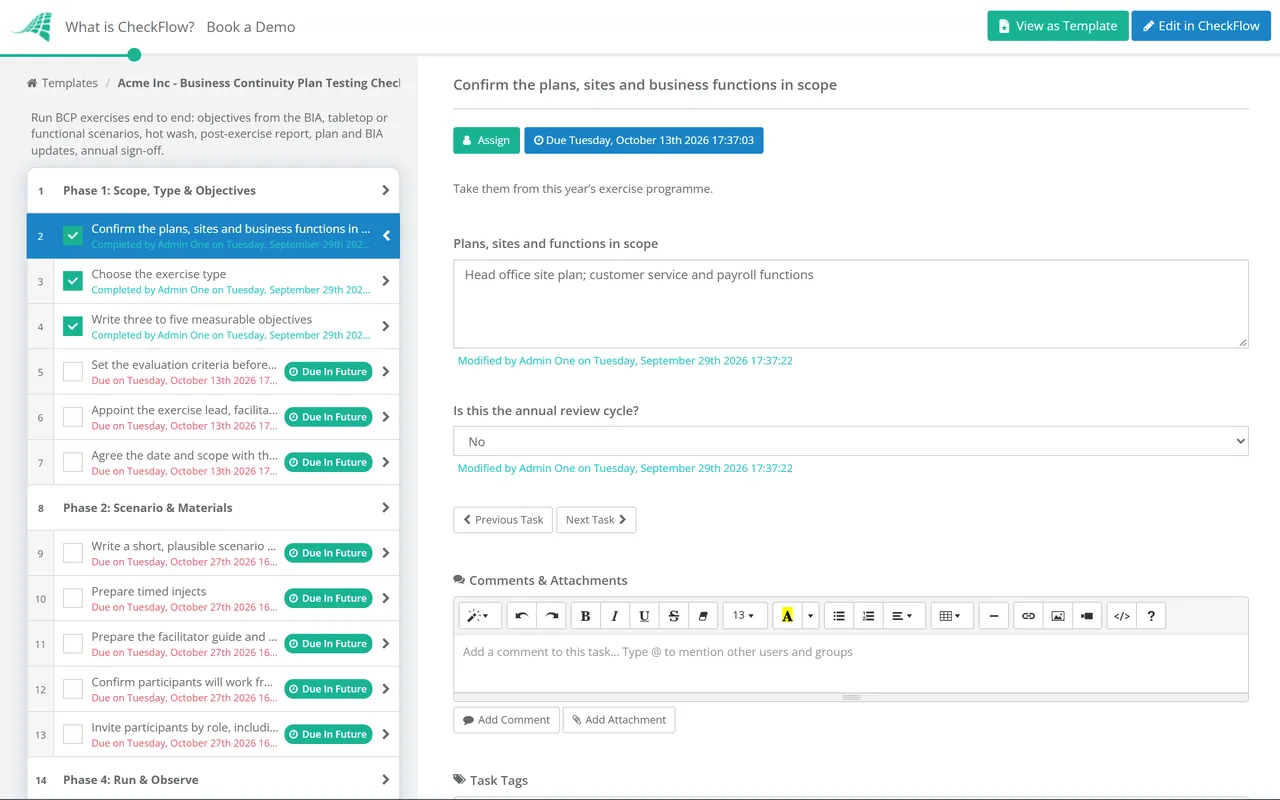
  • Confirm the plans, sites and business functions in scope — take them from this year’s exercise programme
  • Choose the exercise type — walkthrough, tabletop, functional or full-scale, matched to how mature the plan is and what it needs to prove
  • Write three to five measurable objectives — for example “customer service answers calls from the alternate location within four hours”, tied to the BIA recovery time for that activity
  • Set the evaluation criteria before the exercise — so observers know exactly what to time and record
  • Appoint the exercise lead, facilitator and observers — observers take no part in the play
  • Agree the date and scope with the executive sponsor
Phase 2

Phase 2: Scenario & Materials

  • Write a short, plausible scenario from the risk assessment — loss of a building, a key supplier failing, a cyber attack that takes systems offline, or loss of key staff
  • Prepare timed injects — developments that force decisions, such as a journalist calling at 45 minutes or a supplier quoting five days to recover
  • Prepare the facilitator guide and participant briefing — purpose, scope, objectives, scenario and ground rules
  • Confirm participants will work from the current plan — the approved version, contact lists and call trees, available offline
  • Invite participants by role, including deputies — a plan that only works when the primary role holder is present has a single point of failure
Phase 3 — Functional & Full-Scale Only

Phase 3: Live Exercise Controls

Shown only when the exercise type is functional or full-scale. A tabletop touches nothing live, so it skips this phase.

  • Notify people who will see the exercise but are not playing — reception, security, the service desk and any customers or suppliers who might be contacted
  • Mark every exercise message clearly as an exercise — in the subject line and the first words of every call
  • Agree stop criteria and who can call a halt — a real incident during the exercise always takes priority
  • Confirm alternate site or remote working logistics — seats, building access, equipment, network and phones
  • Plan the return to normal operations — how teams move back, and who confirms normal service has resumed
Phase 4

Phase 4: Run & Observe

  • Brief participants on scope and ground rules — the plan is under test, not the people
  • Run the scenario and injects — record each decision, who made it and when, against the objectives
  • Test the notification cascade — record how long it took to reach each role and who could not be reached
  • Log where the plan was unclear, wrong or ignored — observers note the page or section reference
  • Hold the hot wash straight after — what went well, where people need training and which parts of the plan need changing
  • Collect participant feedback forms before people leave
Phase 5

Phase 5: Post-Exercise Report

  • Draft the post-exercise report — purpose, objectives, participants, scenario, observations and recommendations
  • Grade each objective — met, partly met or not met, with the evidence for each grade
  • Turn each recommendation into an action — one owner, one due date, one measurable outcome
  • Circulate the report to the sponsor and participants — agree the findings within two weeks, while memories are fresh
  • Note what the next exercise should test — objectives not met become candidates for the next scenario
Phase 6

Phase 6: Update the Plan, BIA & Training

  • Correct the plan — contact details, steps, workarounds and decision authorities the exercise showed were wrong
  • Revisit the BIA where the exercise challenged it — a recovery time, a dependency or a minimum staffing level that did not hold
  • Review supplier arrangements the exercise relied on — contacts, contractual recovery commitments and alternative sources
  • Schedule training for roles that struggled — and brief anyone newly appointed to a plan role
  • Reissue the plan under version control — confirm every role holder has the current copy, including offline
  • Close actions with evidence — carry open ones into the next exercise record
Phase 7 — Annual Only

Phase 7: Annual Programme Review & Sign-Off

Shown only when the exercise record is marked as the annual review. It looks across the whole year rather than at a single exercise.

  • Review the year’s exercises against the programme — every critical activity and plan exercised over the cycle, and any gaps explained
  • Refresh the business impact analysis and risk assessment — new products, sites, suppliers and threats since the last review
  • Check the plans against organisational change — restructures, office moves, outsourcing and new systems
  • Set next year’s exercise programme — vary the scenarios, the teams involved and the exercise types
  • Report results, open actions and resourcing to top management — as an input to management review
  • Obtain sign-off of the updated plans by the accountable executive

Choosing the Exercise Type

NIST SP 800-84 divides exercises into two families. Tabletop exercises are discussion only: a facilitator presents a scenario and participants talk through their roles and responses without deploying equipment. Functional exercises have people perform their duties in a simulated operational environment, and range from one aspect of a plan up to full-scale exercises that cover every element. FEMA’s Homeland Security Exercise and Evaluation Program (HSEEP) draws the same line between discussion-based and operations-based exercises.

Exercise type What happens What it can prove Effort
Plan walkthroughPlan owners step through the plan with a facilitator, section by sectionThe content is current and each role holder understands their partLow: an hour or two
Tabletop exerciseA scenario and timed injects are discussed; nothing is touched liveDecision-making, escalation, communications and gaps between teamsLow to moderate: half a day
Functional exercise or drillSelected teams carry out specific procedures, such as a call cascade or relocationIndividual procedures work in practice and within target timesModerate: needs live controls
Full-scale exerciseSeveral functions activate the plan together, with relocation and IT recoveryThe plan works end to end, including the handoffs between teamsHigh: weeks of planning and executive sponsorship

A good programme mixes the types over a cycle rather than repeating the same tabletop every year. A common pattern is a walkthrough whenever a plan changes, tabletops for each critical function through the year, and a functional or full-scale exercise for the most time-critical activities. For scenarios, CISA publishes free Tabletop Exercise Packages (CTEPs) covering threats such as ransomware, insider threats and natural disasters, each with template objectives, discussion questions and an after-action report template.

Why Run Your BCP Exercises in CheckFlow?

1

One template, every exercise type

A dropdown for the exercise type drives conditional logic: live exercise controls appear only for functional and full-scale exercises, and the annual review phase only when the record is marked annual. Template versioning keeps a history of how the exercise process itself has changed.

2

Observations captured as they happen

Observers record decisions and timings in a table inside the task, add comments, and attach photos of whiteboards and call logs. The activity trail shows who recorded what and when, so the post-exercise report is drawn from evidence rather than recollection.

3

Actions that outlive the meeting

Each action is assigned to a named person or group, with a due date calculated from the exercise date. Open actions stay visible until they are closed with evidence, and a recurring schedule starts the next exercise in the programme on time.

Continuity and disaster recovery share a business impact analysis but not a test. Our disaster recovery checklist guide sets out how the DR plan, the runbooks and the BCP fit together, and the Disaster Recovery Audit Checklist assesses the IT side once a year.

Exercises often expose weaknesses in the live response. The Incident Management Checklist covers how an incident is handled and escalated, and the ISO 27001 Compliance Checklist includes Annex A 5.30, which requires ICT readiness to be planned, implemented, maintained and tested against business continuity objectives.

Frequently Asked Questions

How often should a business continuity plan be tested?

+

ISO 22301 requires exercises at planned intervals, so your programme sets the frequency and auditors check you keep to it. NIST SP 800-34 recommends testing contingency plans annually and after significant organisational or system changes. In practice most organisations exercise each critical plan at least once a year, run shorter tabletops or walkthroughs more often, and add an exercise after a major change such as an office move or a new outsourcing arrangement.

What is the difference between a tabletop exercise and a functional exercise?

+

A tabletop exercise is discussion only. Participants talk through how they would respond to a scenario and nothing live is touched. A functional exercise has people actually perform their duties in a simulated environment: running the call cascade, relocating to the alternate site or working from the manual workaround. Tabletops are cheaper and good for testing decisions and coordination. Functional exercises prove the procedures work and how long they take.

What should a post-exercise report include?

+

The background (purpose, objectives, participants and scenario), what the observers saw, the points raised in the hot wash, a grade for each objective, and recommendations for improving the plan. NIST SP 800-84 describes the same contents for an after-action report. The report is only useful if every recommendation becomes an action with an owner and a due date, which is why Phase 5 converts them before the report is circulated.

Who should take part in a business continuity exercise?

+

The people named in the plan being exercised, and their deputies. For a crisis management tabletop that means senior decision-makers and communications. For a departmental exercise it means the function head and the staff who would run the workaround. Add a facilitator who knows the plan well and at least one observer who takes no part in the play and records what happens against the objectives.

Does ISO 22301 require business continuity exercises?

+

Yes. Clause 8.5 requires an exercise programme that validates the effectiveness of business continuity arrangements over time, and post-exercise reports are among the documents the standard requires you to keep. The business impact analysis sits in clause 8.2, which is why Phase 6 feeds exercise findings back into it.

Is CheckFlow free for this template?

+

14-day free trial, no card required. The Business plan is $10 per user per month after the trial. Full details at checkflow.io/pricing.

Find the Gaps in Your Continuity Plan in an Exercise, Not an Outage

Free trial — no credit card required.