Sales & Operations Planning (S&OP) Checklist Template

Run one month’s sales and operations planning cycle: last month’s results closed, demand and supply reviewed, the plans reconciled in money, and one plan approved by the executives and published.

Last reviewed: November 2026

Printed from checkflow.io/templates/procurement-supply-chain/sales-and-operations-planning-checklist

This free S&OP checklist runs one month’s sales and operations planning (S&OP) cycle for businesses that make or stock products, owned by the S&OP or supply chain lead. It is planned back from the executive S&OP meeting. It closes last month’s actual results and refreshes the baseline forecast, holds a product and portfolio review when there is one, then the demand review and its consensus demand plan and the supply review with capacity, materials and inventory targets. Finance values the plans and compares them with the business plan, the pre-S&OP meeting turns open issues into recommendations, and the executives decide and approve the plan. The approved plan is then published and handed to scheduling, purchasing, finance and sales, and the actions are carried into next month.

Planning the Month’s Demand and Supply, Not Scheduling the Shop Floor

Sales and operations planning (S&OP) is the monthly cycle in which sales, marketing, operations, supply chain and finance agree one plan that balances demand and supply, and the executives decide what the reviews cannot settle. This checklist runs one month’s cycle, owned by the S&OP or supply chain lead, from the data close to the plan published and the actions carried into next month. S&OP here means sales and operations planning, not a standard operating procedure (SOP); for those, see SOP software.

Turning the approved plan into a schedule for the shop floor is the Manufacturing Production Scheduling Checklist. Setting next year’s budget is the Annual Budget Planning Checklist, and the weekly cash view is the Weekly Cash Flow Forecast Checklist. Checking stock records against what is on the shelves is the Inventory Audit Process Checklist, and assessing risks across your suppliers is the Supply Chain Risk Assessment Checklist.

This checklist

One month’s S&OP cycle

Who runs it: the S&OP or supply chain lead, with sales, marketing, operations, finance and the executive team.

Covers: product families over a horizon of many months: the data close, the product, demand and supply reviews, the financial reconciliation, the pre-S&OP and executive meetings.

Output: one approved plan for demand, supply and money, with decisions and actions.

The shop floor

Production scheduling

Who runs it: production planners and schedulers.

Covers: orders, capacity and materials for the coming weeks, the master production schedule and the work orders released.

Output: a schedule that carries out the plan, in the Manufacturing Production Scheduling Checklist.

Finance

The annual budget

Who runs it: finance, with the budget holders.

Covers: next year’s targets for revenue, costs and investment, agreed once a year.

Output: the budget the monthly S&OP plan is compared with, in the Annual Budget Planning Checklist.

What the S&OP Checklist Covers

Nine phases take one month’s S&OP cycle from the data close to next month. The first task records the date of the executive S&OP meeting, which sets every due date in working days: the data close falls 14 working days before it, the demand review 8, the supply review 6 and the pre-S&OP meeting 3, and the plan is published 2 working days after it. It also asks whether this cycle has a product and portfolio review, which adds Phase 2 when it does. A supply review that cannot meet the demand plan adds a task to work out the alternatives, and a gap to the business plan adds a task to build scenarios. The chair’s approval is the gate: nothing after it can be completed until the chair completes it with Approved or Approved with changes, and Not approved shows a rework task above it and leaves it open.

  1. Phase 1

    Phase 1: Set Up the Cycle & Close the Data

    6 tasks

    Owned by the S&OP lead. Enter the date of this month’s executive S&OP meeting: every due date counts from it in working days. This template starts the cycle three working weeks before the meeting and closes it a week after. The data close comes first, because every review that follows works from last month’s actual results.

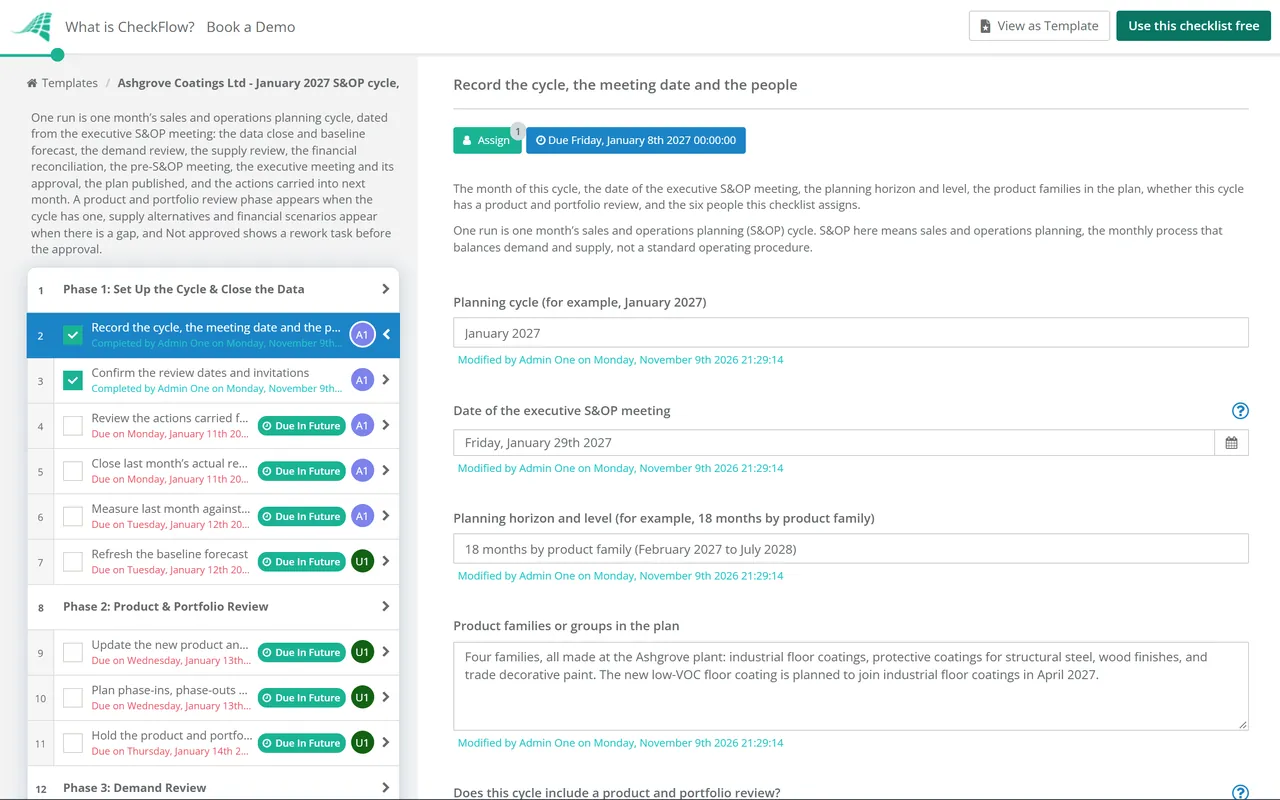
    • Record the cycle, the meeting date and the people — the month of this cycle, the date of the executive S&OP meeting, the planning horizon and level, the product families in the plan, whether this cycle has a product and portfolio review, and the six people this checklist assigns
    • Confirm the review dates and invitations — the dates of this cycle’s reviews and meetings set from the executive meeting date, the invitations sent, and anyone who cannot attend asked to send a deputy with authority to agree
    • Review the actions carried from last month — the actions and assumptions carried forward when last month’s cycle closed, with each action’s owner and status, so each review knows what was promised and what is still open
    • Close last month’s actual results — last month’s actual sales or shipments, orders and backlog, production and inventory for each product family, taken from your own systems once the month has closed, with any known data problem noted
    • Measure last month against the plan — actual demand against the forecast, production against the supply plan, inventory and backlog against their targets, and customer service, by product family, with the main reasons for each large miss
    • Refresh the baseline forecast — the statistical or baseline forecast rolled forward one month with the new actuals, for every product family over the planning horizon, ready for the demand review
  2. Phase 2

    Phase 2: Product & Portfolio Review

    3 tasks

    Applies only when the first task says this cycle has a product and portfolio review. The product review comes first so that the demand review plans with the launches and phase-outs it agrees.

    • Update the new product and launch plan — each product in development with its stage, launch date and the resources it needs, and any launch now at risk with its recovery plan
    • Plan phase-ins, phase-outs and end-of-life products — products to be introduced, replaced or withdrawn over the horizon, with the dates when old stock should run down and new stock start, so demand and supply plan the change-over together
    • Hold the product and portfolio review — the launch and portfolio changes agreed with product development, marketing and the S&OP lead, and passed to the demand review as an input
  3. Phase 3

    Phase 3: Demand Review

    4 tasks

    Sales, marketing and product management agree one demand plan for every family over the horizon. It is the demand you expect, before anyone limits it to what supply can make: the supply review tests it next.

    • Gather sales and customer input — account plans, customer forecasts, orders in hand, business won and lost, and changes the sales team expects, by product family
    • Add promotions, pricing and market events — planned promotions, price changes, launches, one-off events and market changes added to the baseline, each with the volume it is expected to add or take away
    • Record the demand assumptions — the assumptions behind the demand plan, such as market growth, a customer’s ramp-up, a price change or a competitor’s move, written down so next month’s review can see which ones held
    • Hold the demand review and agree the demand plan — the changes from last month’s demand plan reviewed family by family, risks and opportunities named, and one consensus demand plan agreed over the horizon, with issues that need a decision passed on
  4. Phase 4

    Phase 4: Supply Review

    6 tasks

    Operations and supply chain test whether the demand plan can be met with the capacity, materials and inventory available. Where it cannot, they work out the alternatives, and the executives choose between them.

    • Set inventory and backlog targets — the inventory or order backlog each product family should hold at the end of each period, reviewed against last month’s performance and the service the business wants
    • Check capacity with rough-cut capacity planning — the capacity the demand plan needs in each key work centre, line or site, month by month, compared with the capacity actually achieved and the most that can be made without new investment
    • Check materials and supplier constraints — key materials and components with long lead times, a single source or a known shortage, and suppliers’ ability to support the plan
    • Draft the supply plan for each family — production or purchasing by family and period over the horizon, built to meet the demand plan and the inventory targets within the constraints found, by levelling production, following demand, or a mix
    • Hold the supply review — the draft supply plan reviewed by operations, supply chain and purchasing, with the months and families where it cannot meet the demand plan named, and the supply plan agreed for the reconciliation
    • Work out the supply alternatives — each realistic way to close the gap, such as overtime, extra shifts, outsourcing, building ahead, more capacity, or meeting less demand, with its cost, effect on service and inventory, and lead time, for the executives to choose from
  5. Phase 5

    Phase 5: Financial Reconciliation

    5 tasks

    Finance puts the demand and supply plans into money and compares them with the business plan. This is a check of the operating plan against the business plan, not a new budget.

    • Value the plans in revenue, cost and margin — the demand and supply plans converted from units into revenue, cost of sales, margin, inventory value and the main operating costs, period by period over the horizon
    • Record the financial assumptions — prices, costs, exchange rates and any other assumption used to value the plans, written down so the numbers can be checked and compared next month
    • Check the financial view against recent actual results — the valued plan compared with recent actual results and last month’s view, so a sudden jump in revenue, margin or inventory is explained before anyone relies on it
    • Compare the plans with the business plan — revenue, margin, inventory and cash from the plans compared with the business plan or budget for the same periods, with each gap and its cause recorded
    • Build scenarios for each gap — two or three ways to close each gap, such as a price change, a promotion, a supply alternative or accepting the gap, each with its effect on revenue, margin, inventory and service
  6. Phase 6

    Phase 6: Pre-S&OP Meeting

    5 tasks

    The review leads meet to settle what they can between themselves and turn the rest into options and a recommendation. Only the decisions they cannot make go to the executives.

    • Gather the issues from each review — the issues, gaps and decisions needed from the product, demand and supply reviews and the financial reconciliation, in one list
    • Hold the pre-S&OP meeting — the S&OP lead and the product, demand, supply and finance leads settle the issues they have authority to settle, and agree options for the rest
    • Write the options and recommendations — for each open issue, the options, the effect of each on revenue, margin, inventory and service, and the recommendation, with who recommends it
    • Prepare the executive S&OP pack — last month’s performance, the demand, supply and financial plans by family against the business plan, the main assumptions, the gaps and scenarios, and the decisions needed, with the recommendations
    • Send the pack before the meeting — the pack sent to everyone attending at least one working day before the executive meeting, with the decisions needed listed first
  7. Phase 7

    Phase 7: Executive S&OP Meeting

    3 tasks

    The executives decide: they choose between the options, approve the plan and set the actions. Nothing after the approval can be completed until the chair completes it, with Approved or Approved with changes. Not approved shows a rework task above it and leaves the approval open.

    • Hold the executive S&OP meeting — last month’s performance, the plans and the gaps reviewed, a decision made on each recommendation, and the actions agreed with an owner and a date
    • Rework the plan for another decision — not approved only: each point the executives raised dealt with, such as a scenario costed again, a supply alternative confirmed or the demand plan changed, and a date agreed for the chair to decide again
    • Approve the plan for this cycle — Approved, Approved with changes or Not approved, with the changes or the reasons, recorded by the chair alone
  8. Phase 8

    Phase 8: Publish the Plan

    5 tasks

    One approved plan goes to everyone who works from it, so sales, operations and finance plan from the same numbers until the next cycle.

    • Update the plans with the executives’ decisions — the demand, supply and financial plans changed to match each decision, and a version recorded as this month’s approved plan
    • Publish the approved plan — the approved plan, the decisions and the main assumptions shared with sales, operations, purchasing and finance, with what changed since last month
    • Hand the supply plan to scheduling and purchasing — the approved supply plan by family given to whoever builds the master production schedule and places purchase orders, with any capacity or material decision they must act on
    • Give finance the updated outlook — the approved plan’s revenue, margin, inventory and cash used to update the financial forecast, with any gap to the business plan that the executives accepted
    • Tell sales and customer teams what changed — the decisions that affect customers, such as supply limits, allocations, launch dates or phase-outs, explained to the sales and customer teams with what they should tell customers
  9. Phase 9

    Phase 9: Actions & Measures

    5 tasks

    Close the cycle: every action has an owner and a date, the assumptions to watch are written down, and what is still open is carried into next month’s checklist.

    • Record each action with an owner and a date — every action from the reviews and the executive meeting entered with its owner, due date and status, so the next cycle can check them
    • Record the assumptions and risks to watch — the assumptions the plan depends on most and the early signs that would show one failing, such as orders below a level or a supplier’s lead time growing, each with who watches it
    • Note what to improve in the cycle — what worked and what did not in this cycle, such as late data, a review without a decision maker or a pack sent late, and one change to try next month
    • Carry open actions into next month’s cycle — next month’s checklist started with its executive meeting date, and the open actions and assumptions to watch carried into it
    • File the cycle’s record — the data, the plans, the pack, the minutes, the decisions and the approved plan kept together for as long as your records policy says

The Steps of the Monthly S&OP Cycle

What each step does in this template

Who takes part, what each step needs and produces, and when it falls, counted from the executive S&OP meeting.

Step Who takes part What goes in What comes out When, in this template
Data close and baseline forecastThe S&OP lead and the demand leadLast month’s actual sales, orders, production and inventoryPerformance against last month’s plan, and a refreshed baseline forecast14 to 13 working days before the executive meeting
Product and portfolio review (when held)Product development, marketing and the S&OP leadDevelopment plans, launch dates and products to withdrawLaunches and portfolio changes for the demand review12 to 11 working days before
Demand reviewSales, marketing and product managementThe baseline forecast, customer and sales input, promotions and portfolio changesOne consensus demand plan, before any limit from supply, with its assumptions10 to 8 working days before
Supply reviewOperations, supply chain and purchasingThe demand plan, inventory targets, capacity and materialsAn agreed supply plan, and alternatives where it falls short7 to 5 working days before
Financial reconciliationFinanceThe demand and supply plans, prices and costsThe plans in revenue, margin and inventory, the gaps to the business plan, and scenarios5 to 4 working days before
Pre-S&OP meetingThe S&OP lead and the review leadsThe issues and gaps from every reviewIssues settled, options and recommendations, and the executive pack3 to 1 working days before
Executive S&OP meetingThe executive team, chaired by its leaderThe packDecisions, actions and the approved planThe meeting day, and the approval the working day after
Publish and follow upThe S&OP lead and the review leadsThe approved planOne published plan, and actions and risks carried into next month2 to 5 working days after

How published sources name the steps

Sources describe the same monthly cycle with different numbers of steps.

Source The steps it names What else it says
Oliver Wight, Integrated Business Planning (Advanced S&OP) course descriptionProduct Management Review, Demand Review, Supply Review, Integrated Reconciliation, Financial Review, Management Business ReviewSays Integrated Business Planning is often referred to as advanced S&OP, and plans over a 24 to 36 month horizon
John Schorr of Oliver Wight, “Integrated business management” series in Business Excellence magazine (2007)Product management review, demand review, supply review, integrated reconciliation, senior management business reviewA monthly plan for the next 18 to 24 months at product family level; the demand review produces an unconstrained demand plan; the supply review follows it “by a couple of days”; the pack reaches each senior manager at least 24 hours before the management review
TechTarget, “sales and operations planning (S&OP)”, January 2024Data gathering, demand planning, production (supply) planning, reconciliation, executive meetingStep names and numbers vary from company to company; reconciliation includes making sure the plans meet financial requirements
ASCM conference presentation, 2019Names the pre-executive S&OP meeting step 4 and the executive S&OP meeting step 5 of the five-step process

Where this comes from. Oliver Wight’s Integrated Business Planning course description; John Schorr’s six-part series on integrated business management in Business Excellence magazine (from June 2007); and TechTarget’s definition by David Essex (11 January 2024); the ASCM presentation “Demand Plan? Check. Supply Plan? Check. Now What?” (2019). All read on 9 November 2026. The sources agree on the core order: demand, then supply, then reconciliation, then the executive decision. They differ on whether data gathering and a product review are steps of their own, and on whether financial reconciliation and the pre-S&OP meeting are one step or two. This template keeps all of them, makes the product review optional, and splits finance’s work from the meeting. Thomas F. Wallace’s Sales & Operations Planning: The How-To Handbook (paid) is a practitioner’s guide to setting up S&OP; this page does not draw on it. No law requires S&OP: the steps, owners and working-day offsets above are this template’s choices.

Why Run Your S&OP Cycle in CheckFlow?

1

No plan published before the executives approve it

The approval is assigned to the executive who chairs the meeting, and the checklist halts there: the plan cannot be marked published or handed on until the chair completes the approval with Approved or Approved with changes. Not approved shows a rework task above the approval and leaves it open. See how approvals that halt a checklist work.

2

Only the steps this month needs

Say whether the cycle has a product and portfolio review, and Phase 2 appears or stays hidden. A supply review that cannot meet the demand plan adds a task to work out the alternatives, and a gap to the business plan adds a task to build scenarios, so the executives see options when there is something to decide.

3

Every review on time, every month

Name the S&OP lead, the product, demand, supply and finance leads and the chair on the first task, and every step is assigned from those fields and dated from the executive meeting, so each review’s inputs are due before it. The Reports Grid lists each month’s cycle with its answers, while Analytics shows where tasks are waiting.

CheckFlow does not forecast demand, plan capacity or value a plan: those stay with your planning system, ERP or spreadsheets. CheckFlow makes sure every month’s cycle runs the same steps in the same order, with an owner and a due date for each, an approval before the plan is published, and a record of what was decided and by whom. See how a checklist runs, or set the cycle up as a recurring checklist.

Schedule production from the approved plan with the Manufacturing Production Scheduling Checklist, keep stock in line with the Inventory Management for Manufacturing Checklist, review suppliers’ risks with the Supply Chain Risk Assessment Checklist, and prepare the month’s financial report with the Monthly Management Reporting Pack Checklist.

AI generator

Didn’t find what you need? Describe it.

Describe the process in a sentence and the AI checklist generator drafts the phases and tasks for you.

Frequently Asked Questions

What should an S&OP checklist include?

Last month’s actual results and a refreshed baseline forecast; a product and portfolio review when there are launches or withdrawals; the demand review and its consensus demand plan; the supply review with capacity, materials and inventory targets; the plans valued in money and compared with the business plan; a pre-S&OP meeting that turns open issues into recommendations; the executive meeting and its approval; the plan published; and the actions carried into next month. This template covers each of those for one month’s cycle.

What are the steps of the S&OP process?

Sources differ on the count. John Schorr of Oliver Wight names five steps: the product management review, the demand review, the supply review, integrated reconciliation and the senior management business review. TechTarget lists data gathering, demand planning, supply planning, reconciliation and the executive meeting, and says step names and numbers vary by company. All agree on the order: demand, then supply, then reconciliation, then the executive decision. This template keeps data gathering as its first phase and makes the product review optional.

What happens in an S&OP demand review?

Sales, marketing and product management review the changes from last month’s demand plan, add customer input, promotions, price changes and launches to the baseline forecast, write down their assumptions, and agree one demand plan by product family over the horizon. John Schorr of Oliver Wight describes its output as an unconstrained demand plan: the demand expected before any limit from supply. In this template it falls 8 working days before the executive meeting.

What happens in an S&OP supply review?

Operations, supply chain and purchasing test whether the demand plan can be met. They set inventory or backlog targets, check capacity with rough-cut capacity planning, check materials and suppliers, and agree a supply plan by family. Where supply falls short, they work out the alternatives, such as overtime, outsourcing or building ahead, and the executives choose. In this template it falls 2 working days after the demand review, as Oliver Wight’s Schorr describes.

What is a pre-S&OP meeting?

It is the meeting before the executive meeting, where the S&OP lead and the leads of each review bring the demand, supply and financial plans together, settle the issues they have authority to settle, and turn the rest into options and recommendations. Some sources call this step reconciliation or integrated reconciliation. In this template the meeting falls 3 working days before the executive meeting, and the pack goes out at least one working day before it.

Who attends the executive S&OP meeting?

The executive team, chaired by its leader, with the S&OP lead. John Schorr of Oliver Wight adds that people such as the demand manager and the new product coordinator may attend to answer questions, and describes it as a decision-making meeting, not a discovery meeting, whose output is the approved plan, the decisions and the actions. In this template the chair records the approval the working day after the meeting, and nothing is published until then.

How far ahead should an S&OP plan look?

Sources give different horizons. John Schorr of Oliver Wight describes a plan for the next 18 to 24 months at product family level, and Oliver Wight’s integrated business planning course describes 24 to 36 months for the wider process. Choose a horizon that covers your longest lead times and capacity decisions, and record it on the first task so every review plans over the same months.

What is the difference between S&OP and integrated business planning?

Oliver Wight says integrated business planning is often referred to as advanced S&OP, and describes it as the move of sales and operations planning from its production planning roots to a process that also covers strategy and financial planning, over 24 to 36 months. TechTarget describes it as covering more than S&OP and planning further ahead. This template runs the monthly S&OP cycle with a financial reconciliation, and you can widen each review if your organisation plans the whole business this way.

How is S&OP different from production scheduling?

In this template, S&OP plans demand and supply by product family, month by month, over many months, and the executives approve it. Production scheduling turns the approved supply plan into a master production schedule and work orders for particular products in the coming weeks, which is the Manufacturing Production Scheduling Checklist. The S&OP checklist hands its approved supply plan to scheduling and purchasing in Phase 8.

Is CheckFlow free for this template?

14-day free trial, no card required. The Business plan is $10 per user per month after the trial. Full details at checkflow.io/pricing.

Agree One Plan for Demand and Supply Every Month

Free trial — no credit card required.

14-day free trial, no credit cardFull refund in your first 30 daysUS hosting, EU on request