Modern Slavery Statement Checklist Template

The statement is drafted in July, the board last met in May, and the training figures in it are from two years ago. A modern slavery statement is a short public document, but it needs a year’s evidence, the board’s approval, a director’s signature and a link on the homepage.

Last reviewed: October 2026

This free modern slavery statement checklist is for compliance, legal, procurement and sustainability teams who prepare their organisation’s annual slavery and human trafficking statement under section 54 of the UK Modern Slavery Act 2015. One run prepares one statement for one financial year, from planning about two months before the year end to publication and next year’s actions. It confirms whether the duty applies and what the statement covers, describes the structure, supply chains and policies, collects the year’s due diligence, audits, training and progress against KPIs, and reviews where the risk to workers is highest. It drafts the statement against the six areas the Act suggests, sends it to the board (or equivalent) for approval and to a director (or equivalent) to sign, publishes it with a prominent homepage link and submits it to the government’s registry. Indicators or a suspected case found in the supply chains add the response tasks, kept apart from publishing, and a group statement, a first statement, an update and Australian or Canadian reporting each add the tasks they need.

A Modern Slavery Statement Reports on a Year, Not on One Supplier

A modern slavery statement, also called a section 54 statement or a slavery and human trafficking statement, is a public report on the steps an organisation took during one financial year to make sure slavery and human trafficking are not taking place in its business or its supply chains. Section 54 requires one from every commercial organisation that supplies goods or services, carries on business in the UK and has a total turnover of at least £36 million. A statement that the organisation took no steps also complies, but it still has to be published.

The statement draws on work other checklists run: auditing a supplier, assessing a vendor, collecting ESG data and reviewing anti-bribery controls. This checklist gathers the year’s evidence from that work, adds a supply chain risk review, and takes the statement through the board’s approval, a director’s signature, the website and the registry. It is a planning aid, not legal advice: take advice where the rules are unclear for your organisation.

This checklist

The annual modern slavery statement

Covers: the organisation’s own business and all its supply chains, for one financial year.

Planned around: the year end, the year’s evidence, the board’s approval and publication.

Output: a signed statement on the website, linked from the homepage and added to the registry.

Each supplier

Supplier audits and vendor risk

Covers: one supplier or vendor at a time: its quality system, or the risk it brings.

Planned around: onboarding, an audit visit or a periodic review.

Output: an audit report or a risk rating, in the Supplier Audit Checklist and the Vendor Risk Assessment Checklist. Their findings feed this statement’s due diligence.

What the Modern Slavery Statement Checklist Covers

Nine phases take one statement from planning about two months before the financial year ends to publication and next year’s actions. The first task records the kind of organisation, whether the statement covers a group, whether it is the first statement or an update, and whether another country’s law also applies, and each answer adds the tasks or notes it needs. Indicators or a suspected case found in the risk review add a response phase that runs alongside the statement. Nothing after the board’s approval and the director’s signature can be completed until they are recorded.

  1. Phase 1

    Phase 1: Duty, Scope & Owners

    8 tasks

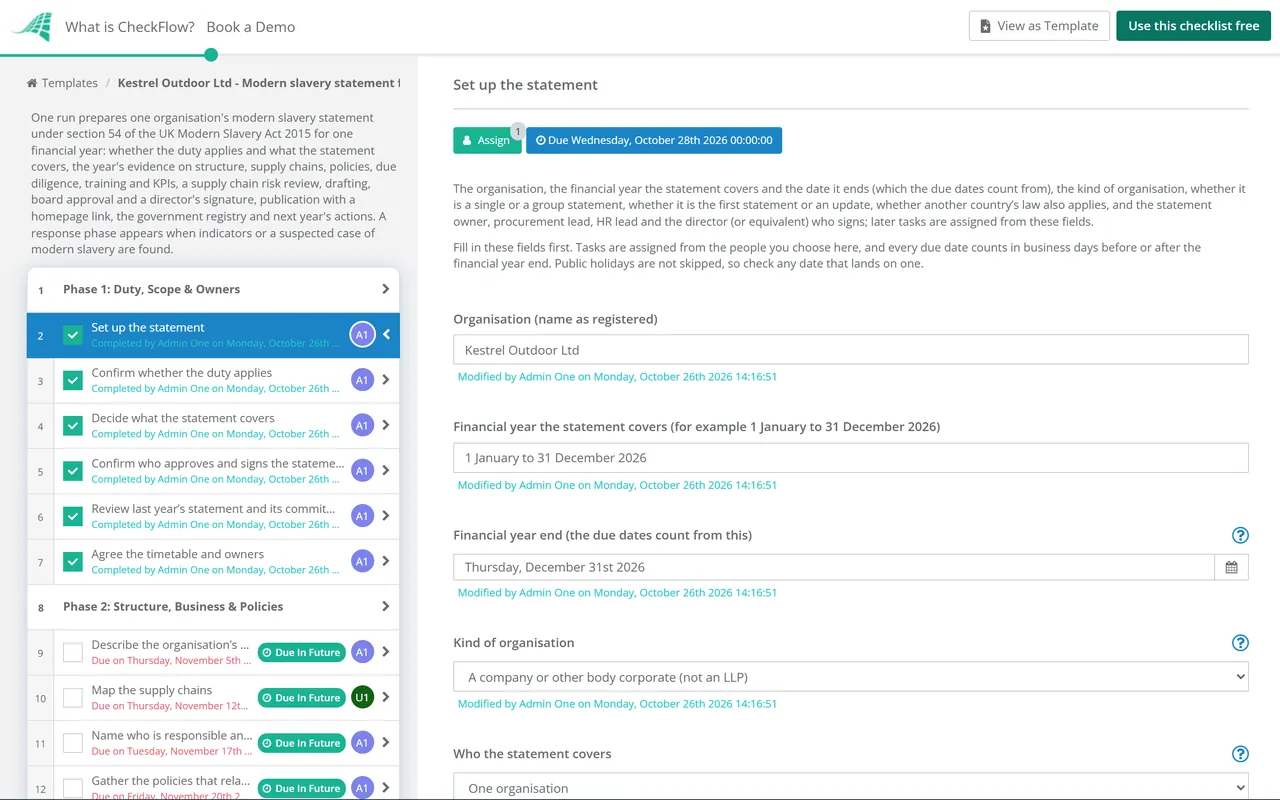
    Start about two months before the financial year ends. Answer the questions in the first task first: the kind of organisation shows who approves and signs, and the other answers add the tasks for a group statement, a first statement or an update, and another country’s law. Due dates count back from the year end for the planning and forward from it for the rest.

    • Set up the statement — the organisation, the financial year the statement covers and the date it ends (which the due dates count from), the kind of organisation, whether it is a single or a group statement, whether it is the first statement or an update, whether another country’s law also applies, and the statement owner, procurement lead, HR lead and the director (or equivalent) who signs; later tasks are assigned from these fields
    • Confirm whether the duty applies — the four tests in section 54: a body corporate or a partnership, carrying on a business or part of a business in the UK, supplying goods or services, and a total turnover of at least £36 million including subsidiaries, with the answer recorded
    • Take advice on whether the duty applies — shown when the answer is not yet known: the facts that decide it, such as income from business activities for a charity or the UK presence of an overseas company, taken to a lawyer, with the advice recorded
    • Decide what the statement covers — the organisation’s own business and all its supply chains, any subsidiaries whose activities form part of its business or supply chains, and, for a group, which organisations the statement covers
    • List each organisation the group statement covers — shown for a group statement: each parent and subsidiary that meets the tests, named in the statement, with its company number and UK website
    • Confirm who approves and signs the statement — the board of directors (or equivalent management body) and a director for a company, the members and a designated member for an LLP, a general partner for a limited partnership or a partner for any other partnership, and a meeting date that fits the timetable
    • Review last year’s statement and its commitments — shown for an update: last year’s statement, the goals and actions it promised, and any feedback from customers, investors or campaigners, so this year’s statement reports progress against them
    • Agree the timetable and owners — the dates for the year’s evidence, the approval meeting, publication and the registry submission, aiming to publish within six months of the year end as the guidance asks, with an owner for each area of the statement
  2. Phase 2

    Phase 2: Structure, Business & Policies

    6 tasks

    Describe the organisation and its supply chains and gather the policies before the year ends, while the people who know them are easy to reach. These are the first two areas section 54(5) says a statement may cover.

    • Describe the organisation’s structure and business — its size, the countries it operates in, its trading entities, its main products and services and the sectors it works in
    • Map the supply chains — how goods and services are sourced, produced and distributed, the countries and tiers known, support services such as cleaning and catering, how workers are recruited, and what is not yet known below the first tier
    • Name who is responsible and how senior managers oversee it — who identifies, assesses and responds to modern slavery risks, and the governance that gives the board or senior management oversight of them
    • Gather the policies that relate to modern slavery — the employee and supplier codes of conduct, recruitment (including a ban on fees paid by workers), responsible purchasing, whistleblowing and any others, with links to those that are public
    • Check supplier contracts and onboarding terms — whether contracts and onboarding terms include the supplier code of conduct, modern slavery terms, the right to audit and what happens on a breach
    • Confirm the grievance and whistleblowing channels — the channels staff, agency workers and suppliers’ workers can use to raise concerns, anonymously and in a language they understand, and how reports reach the statement owner
  3. Phase 3

    Phase 3: The Year’s Due Diligence, Training & Progress

    6 tasks

    Once the year has ended, collect what was done during it. The statement reports the steps taken in the financial year, so every figure here should come from that year.

    • Collect the due diligence carried out in the year — supplier questionnaires, onboarding checks, engagement with suppliers and workers, and work with industry groups, NGOs or trade unions, with what each found
    • Collect the audits and site visits and what they found — each audit or visit in the year, whether it was announced, whether the auditors were trained in the ILO indicators of forced labour and spoke the workers’ language, and the findings
    • Collect the training figures — the training given to the whole organisation, frontline, HR, procurement and executive staff, and suppliers, with its content and the numbers trained
    • Measure progress against goals and KPIs — each goal the organisation set and the indicator that measures it, with this year’s figure and what it shows about whether the steps are working
    • Report progress on last year’s commitments — shown for an update: each commitment last year’s statement made, whether it was done, and what changed as a result
    • Collect each covered organisation’s steps — shown for a group statement: the steps each organisation the statement covers took during the year, since a group statement must cover them all
  4. Phase 4

    Phase 4: Supply Chain Risk Review

    4 tasks

    Assess where the risk of modern slavery to workers is highest, using the year’s evidence, and record any indicators or cases found. The guidance says the risk assessment should focus on risk to workers, not to the organisation. Indicators or a suspected case add the response phase that follows.

    • Identify the risks across the supply chains — each supplier category assessed for its industry, the nature of its workforce, its location, the context it works in, the commodity and the business model, including services such as cleaning and facilities
    • Assess and prioritise the risks — likelihood and severity of harm to workers for each risk, the most salient ones ranked first, and how much influence the organisation has over the suppliers concerned
    • Agree actions on the highest risks — the prevention and mitigation steps for each priority risk, such as working with the supplier, changing purchasing or recruitment practices or joining an industry initiative, each with an owner and a date
    • Record any indicators or cases of modern slavery found — whether the year’s work found indicators of modern slavery, or a suspected case, in the business or its supply chains; either answer adds the response tasks
  5. Phase 5

    Phase 5: Responding to Indicators or Cases

    5 tasks

    Applies only when indicators or a suspected case were found. Act on them straight away rather than at the due dates, and keep this work apart from publishing: the statement can be approved and published while the response continues.

    • Report the suspected case and protect the people affected — shown for a suspected case: in the UK, report it to the Gangmasters and Labour Abuse Authority or the police straight away, call 999 if anyone is in immediate danger, and contact the local authority as well if the person may be under 18
    • Investigate and verify what was found — shown when indicators or a case were found: what happened, the workers affected and the supplier’s part in it, putting the safety of the people affected first
    • Agree remediation for the workers affected — shown when indicators or a case were found: the remedy agreed with the workers affected or their representatives, such as repaying recruitment fees, and the supplier’s corrective actions
    • Decide whether to stay engaged with the supplier — shown when indicators or a case were found: whether to continue with corrective actions or to disengage responsibly as a last resort, considering the effect on the workers
    • Track the actions to an outcome — shown when indicators or a case were found: each action followed up until it is closed, with the outcome for the workers and what the statement will say about it
  6. Phase 6

    Phase 6: Drafting the Statement

    5 tasks

    Write the statement in plain English against the areas section 54(5) suggests, using the evidence gathered. The law requires a statement of the steps taken in the year, or that none were taken; the guidance expects the six areas to be covered and to improve each year.

    • Decide the level of detail for a first statement — shown for a first statement: the guidance suggests starting with its level 1 disclosures in each area and adding level 2 detail in later years
    • Draft the statement against the six areas — structure and supply chains, policies, risk assessment and management, due diligence (including remediation), training, and effectiveness measured against KPIs, using the year’s evidence and naming every organisation it covers
    • Set goals and actions for the coming year — what the organisation will do next year in each area, with measures, so next year’s statement can report progress
    • Check the draft against section 54 — the financial year it covers, the steps taken in that year (or a statement that none were taken), every organisation covered named, plain language, links to policies, and space for the approval date and the signatory
    • Review the draft with procurement, HR and legal — comments from the people who supplied the evidence and a legal check that every statement of fact is accurate, with the final draft ready for approval
  7. Phase 7

    Phase 7: Approval & Signature

    4 tasks

    Send the final statement to the board (or equivalent) for approval and to the director (or equivalent) to sign. Approval and signature halt the checklist: nothing in the later phases can be completed until they are recorded.

    • Send the statement to the board for approval — the final statement with a short paper covering what changed since last year, the main risks, any cases found and what was done, and the goals for next year
    • Board approves the statement and a director signs it — the board (or equivalent body, or the members of an LLP) approves the statement and the director, designated member or partner signs it, recorded with the date of approval and the signatory’s name and job title; nothing is published until this is recorded
    • Record how each covered organisation approved the group statement — shown for a group statement: how and when each organisation the statement covers approved it; neither the Act nor the guidance says how each organisation in a group approves a shared statement, so take advice where it is unclear
    • Add the approval date and the signatory to the statement — the date of approval and the name, job title and date of the person who signed, as the gov.uk guidance asks; a physical signature is not needed, but the statement should say it has been signed
  8. Phase 8

    Phase 8: Publishing & the Registry

    9 tasks

    Publish the statement on the website with a prominent homepage link, then add it to the government registry. A group statement goes on each covered organisation’s UK website, and Australia, Canada or another law adds its own filing.

    • Publish the statement on the website — the signed statement on the organisation’s website or, if it has no website, a copy sent within 30 days to anyone who asks for one in writing
    • Add a prominent link on the homepage — a clearly named link, such as Modern Slavery Act Transparency Statement, directly on the homepage or in an obvious drop-down menu
    • Publish it on each covered organisation’s UK website — shown for a group statement: the statement, or a link to it, on the UK website of every organisation it covers, each with its own homepage link
    • Keep previous years’ statements online — shown for an update: last year’s and earlier statements left available so readers can compare progress, as the guidance recommends
    • Register the organisation on the statement registry — shown for a first statement: an account for the organisation on the government’s modern slavery statement registry, found by name or company number
    • Submit the statement to the government registry — the link, a PDF copy, the period covered, the signatory, the approval date, the areas covered, sector and turnover, and the optional summary questions; submission is voluntary, and the government encourages it
    • Prepare and give the Australian statement — shown when Australia’s Act applies: a statement meeting the mandatory criteria in section 16, approved by the principal governing body, signed by a responsible member and given to the Minister within six months after the end of the reporting period
    • Prepare and file the Canadian report — shown when Canada’s Act applies: a report on the steps taken in the previous financial year, approved by the governing body, signed by one or more of its members, given to the Minister by 31 May and published prominently on the website
    • Check the other reporting law and its deadline — shown when another country’s or state’s law applies: what it requires, who must approve the report and by when, checked with local advice
  9. Phase 9

    Phase 9: Sharing & Next Year

    4 tasks

    Tell people where the statement is, turn the goals into actions with owners, and set up next year’s run so the evidence is collected as the year goes.

    • Tell staff, suppliers and customers where the statement is — a link sent to staff, key suppliers and the customers or investors who ask for it, and the statement used in tender and supplier questionnaires
    • Assign the actions for next year — each goal and action from the statement given an owner and a date, with the open actions from the risk review and any response carried into them
    • Review how this year’s statement went — what was hard to find, what took too long and what to collect during the year next time
    • Set up next year’s statement — next year’s financial year end entered in a new run, or on a recurring schedule, so the planning starts about two months before it

What Section 54 Requires, and What the Guidance Adds

Section 54 sets a short list of legal duties. The Home Office statutory guidance, “Transparency in supply chains: a practical guide” (the updated version published on 24 March 2025), explains how to meet them and what a good statement contains. The table separates the two. It is a summary, not a substitute for the Act or legal advice.

Topic What applies Law or guidance Where
Who must publishA body corporate or a partnership, wherever formed, that carries on a business or part of a business in the UK and supplies goods or servicesLaws.54(2), (12)
Turnover thresholdTotal turnover of at least £36 million, including subsidiaries, after trade discounts, VAT and other taxes based on itLawSI 2015/1833 regs 2 and 3
How oftenA statement for each financial yearLaws.54(1)
What it must sayThe steps taken during the year to ensure slavery and human trafficking are not taking place in any supply chain or any part of the business, or that no such steps were takenLaws.54(4)
What it may includeStructure, business and supply chains; policies; due diligence; risk assessment and management; effectiveness measured against KPIs; trainingLaw says “may”; the guidance expects all sixs.54(5)
Approval and signatureCompany: the board approves and a director signs. LLP: the members approve and a designated member signs. Limited partnership: a general partner signs. Other partnership: a partner signsLaws.54(6)
PublicationOn the website, with a link in a prominent place on the homepage; with no website, a copy within 30 days of a written requestLaws.54(7), (8)
When to publishAs soon as possible after the year end, and at most within six months of itGuidance (the Act sets no date)Guidance 5.4
Government registryVoluntary: any organisation can add its statement, and the government encourages itGuidanceGuidance 5.3.2
EnforcementThe Secretary of State can seek an injunction in the High Court, or specific performance in ScotlandLaws.54(11)

Changes announced but not in force. In September 2020 the government said it would set the topics a statement must cover, extend the duty to public bodies with a budget of £36 million or more and require statements to be published on a government reporting service. The gov.uk page on publishing a statement says these changes have not yet come into effect, and legislation.gov.uk shows section 54 up to date to 26 October 2026 without them. Report under the current rules.

Australia and Canada. Australia’s Modern Slavery Act 2018 applies to entities with consolidated revenue of at least A$100 million that are Australian or carry on business in Australia. They give the Minister a statement within six months after the end of each reporting period, approved by the principal governing body, signed by a responsible member and covering the mandatory criteria in section 16. Canada’s Fighting Against Forced Labour and Child Labour in Supply Chains Act applies to entities listed on a Canadian stock exchange, and to entities with a place of business, business or assets in Canada that meet two of three size tests (C$20 million in assets, C$40 million in revenue, an average of 250 employees). They report by 31 May on the previous financial year, with the report approved by the governing body, signed by one or more of its members and published prominently on their website. The Home Office publishes an optional international reporting template that supports one report for all three countries. The first task’s answer adds the filing task for each.

Why Prepare Your Modern Slavery Statement in CheckFlow?

1

A year’s work, timed from the year end

Enter the financial year end and each task falls due a set number of working days before or after it, from planning about two months before to publication about three months after, inside the six months the guidance allows. Tasks are assigned from the four people named in the first task, and the Tasks Grid shows each of them what is due. Run it on a recurring schedule so next year’s statement starts on time.

2

Only the tasks this statement needs

The kind of organisation shows who approves and signs. A group statement adds the organisations it covers, their evidence, their approvals and their websites; a first statement adds the registry account; an update adds last year’s commitments; Australia or Canada adds its filing. Indicators or a suspected case found in the risk review add the response tasks, which carry on while the statement is published.

3

Nothing is published before the board approves it

The approval and the director’s signature halt the checklist, so the statement cannot be marked published or submitted to the registry in the checklist until the approval date and the signatory are recorded. See how approvals that halt a checklist work.

CheckFlow does not write or publish the statement for you, and it does not check suppliers. It keeps the year’s work in one place: who does what and by when, the evidence on the tasks it came from, the risk register, the approval and the published link, with a record of what was done. The Reports Grid lists every statement run with its answers, so next year starts from this one.

Checking suppliers during the year? Use the Supplier Audit Checklist for on-site audits and the Vendor Risk Assessment Checklist for each vendor’s risk. The Whistleblowing Report Handling Checklist handles a concern raised through a speak-up channel, and the ESG & CSRD Reporting Checklist and the Anti-Bribery & Corruption Compliance Checklist cover two other annual reviews.

AI generator

Didn’t find what you need? Describe it.

Describe the process in a sentence and the AI checklist generator drafts the phases and tasks for you.

Frequently Asked Questions

What should a modern slavery statement checklist include?

Whether the duty applies and what the statement covers; the organisation’s structure, supply chains and policies; the year’s due diligence, audits, training and progress against KPIs; a risk review that puts the risk to workers first; any indicators or cases found and the response; a draft against the six areas in section 54(5); the board’s approval and a director’s signature; publication on the website with a prominent homepage link; submission to the government registry; and the actions for next year.

Which organisations must publish a modern slavery statement?

Under section 54 of the Modern Slavery Act 2015, a body corporate or partnership, wherever it was formed, that carries on a business or part of a business in the UK, supplies goods or services and has a total turnover of at least £36 million. Turnover includes its subsidiaries’ turnover, including subsidiaries outside the UK. Charities and investment trusts are covered when they meet the tests, counting income from goods and services. Organisations decide for themselves whether the duty applies, so take advice if you are unsure.

What must a modern slavery statement contain?

By law, the steps the organisation took during the financial year to ensure slavery and human trafficking are not taking place in any of its supply chains or any part of its own business, or a statement that it took no such steps (section 54(4)). Section 54(5) lists six areas it may include: structure and supply chains, policies, due diligence, risk, effectiveness measured by KPIs, and training. The Home Office guidance expects statements to cover them and improve each year.

Who must approve and sign a modern slavery statement?

It depends on the kind of organisation (section 54(6)). A company or other body corporate needs approval by its board of directors, or equivalent management body, and a director’s signature. An LLP needs approval by its members and a designated member’s signature. A limited partnership needs a general partner’s signature, and any other partnership a partner’s. Gov.uk guidance asks the statement to give the approval date and the signatory’s name, job title and date; a physical signature is not needed, but the statement should say that it has been signed.

Where must the statement be published?

On the organisation’s website, with a link in a prominent place on the homepage (section 54(7)). The guidance says a prominent place may mean a link visible on the homepage or in an obvious drop-down menu, clearly named, for example “Modern Slavery Act Transparency Statement”. A group statement should go on the UK websites of every organisation it covers. An organisation without a website must send a copy to anyone who asks in writing within 30 days (section 54(8)).

When must a modern slavery statement be published?

Section 54 requires a statement for each financial year but sets no date. The Home Office statutory guidance says organisations should publish as soon as possible after the financial year end and at most within six months of it, perhaps alongside the annual accounts, and should keep earlier statements online. This checklist starts about two months before the year end and plans publication about three months after it, leaving time before the six months run out.

Do we have to submit our statement to the government registry?

No. The registry is voluntary: the gov.uk guidance encourages every organisation, in scope or not, to add its statement, giving the link, a PDF copy, the period covered, the signatory, the approval date and the areas covered, plus optional summary questions. In 2020 the government said it would require publication on a government service, but gov.uk says those changes have not yet come into effect, so publishing on your own website remains the legal duty.

Can a group publish one statement for all its subsidiaries?

Yes. Where a parent and one or more subsidiaries each meet the tests, the guidance says the parent may produce one statement they can use, provided it covers the steps each of them took. It should name the parent and each subsidiary covered and be published on each one’s UK website. Where group companies work in different sectors, the guidance calls separate statements best practice. A parent’s statement should also cover subsidiaries that form part of its business or supply chains.

What happens if a company does not publish a statement?

The Secretary of State can bring civil proceedings in the High Court for an injunction requiring the organisation to comply, or for specific performance in Scotland (section 54(11)). The guidance notes that failing to comply with an injunction is contempt of court, punishable by an unlimited fine. Legal compliance does not depend on how well the statement is written, but the guidance warns that a failure to comply, or a statement that no steps were taken, may damage the organisation’s reputation.

Is CheckFlow free for this template?

14-day free trial, no card required. The Business plan is $10 per user per month after the trial. Full details at checkflow.io/pricing.

Publish Every Modern Slavery Statement Approved, Signed and on Time

Free trial — no credit card required.

14-day free trial, no credit cardFull refund in your first 30 daysUS hosting, EU on request