The right time to discover that a supplier cannot reliably deliver to specification, on time, at the agreed price, is before they enter your supply chain — not six months later when they are critical to a production schedule you cannot change.
Supplier failures rarely announce themselves before they are operational. The supplier that looks capable in an initial meeting, offers competitive pricing, and passes a basic documentation check sometimes turns out to have insufficient production capacity for peak demand, inadequate quality management systems, or financial fragility that surfaces under the pressure of actual orders. The cost of discovering this after a strategic supplier is embedded in the supply chain — when switching is operationally disruptive and contractually complex — is far higher than the cost of discovering it during a structured qualification process. Procurement teams that run structured supplier onboarding qualify suppliers against capability, capacity, quality, financial health, compliance, and ESG standards before they receive their first purchase order. They negotiate and document commercial terms before the relationship begins. They set up performance measurement frameworks from day one. And they create a supplier record that supports the ongoing management, performance review, and contractual renewal that follows. This free checklist gives procurement managers, supply chain managers, and category managers a structured framework for the full supplier onboarding lifecycle.
Strategic, Preferred, Approved, and Transactional Suppliers — Why the Tier Determines the Onboarding Intensity
Strategic Suppliers
Definition
A small number of suppliers critical to the organisation’s ability to operate — where disruption would have severe and rapid impact, and where the supplier relationship is a source of competitive advantage.
Onboarding intensity
Maximum. Full capability assessment, site visit, financial health review, executive relationship establishment, detailed contractual framework, joint risk planning.
Preferred Suppliers
Definition
Qualified suppliers with established commercial terms for a specific category; go-to source for that category within the approved supplier list.
Qualified suppliers on the approved list; available for competitive quotation within their category; no preferred status.
Onboarding intensity
Standard. Documented qualification, insurance and compliance checks, standard terms and conditions, approved supplier list registration.
Transactional Suppliers
Definition
One-off or infrequent purchases of low strategic significance; low spend and low risk.
Onboarding intensity
Minimal. Basic verification (legal entity, tax documentation, bank details), standard terms, fast setup.
What the Supplier Onboarding Checklist Covers
Seven phases covering the complete supplier onboarding lifecycle — from business need assessment through market sourcing, qualification, compliance, commercial negotiation, contract execution, system setup, and relationship kickoff.
Phase 1
Business Need & Market Assessment
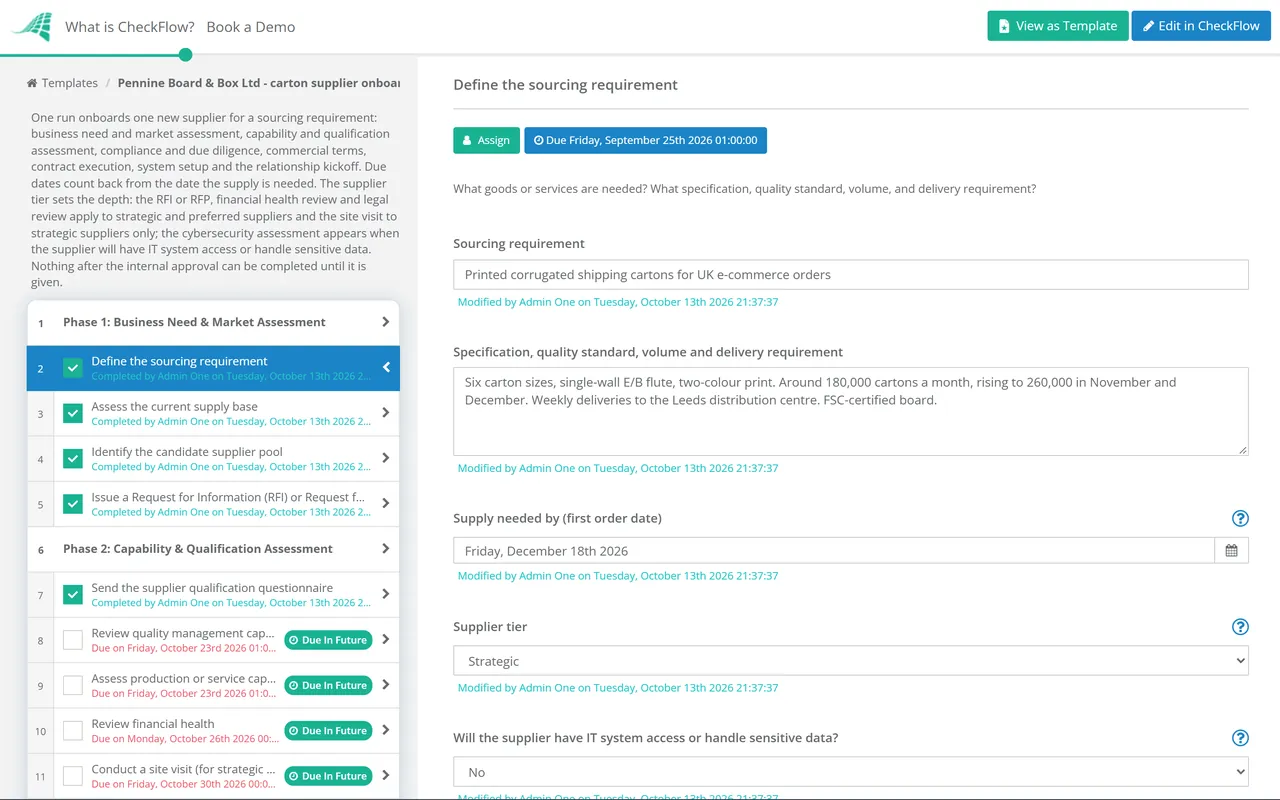
Define the sourcing requirement — what goods or services are needed? What specification, quality standard, volume, and delivery requirement?
Assess the current supply base — can an existing approved supplier meet this requirement? Is a new supplier genuinely needed or is this a category where the base can be consolidated?
Identify the candidate supplier pool — through market research, trade databases, industry contacts, and referrals; for significant categories, a minimum of 3–5 candidates
Issue a Request for Information (RFI) or Request for Proposal (RFP) — for strategic and preferred tier sourcing; define selection criteria before receiving responses
Phase 2
Capability & Qualification Assessment
Send the supplier qualification questionnaire — covering: company background, financial information, production/service capacity, quality management systems (ISO 9001 or equivalent), compliance and regulatory certifications, ESG and sustainability practices, and key customers/references
Review quality management capability — documented QMS; relevant certifications (ISO 9001, IATF 16949, AS9100, or sector-relevant standards); defect rate history; corrective action process
Assess production or service capacity — can the supplier meet the required volumes? What is their current capacity utilisation? What is their peak capacity?
Review financial health — for strategic and preferred suppliers; financial statements or credit check; a financially fragile supplier is a supply continuity risk regardless of technical capability
Conduct a site visit (for strategic suppliers) — to verify the capability presented in the questionnaire; assess the facility, quality controls, and management team in person
Check references — from 2–3 existing customers; on-time delivery, quality performance, and relationship quality
Phase 3
Compliance & Due Diligence
Verify legal entity and registration — registered company name, registration number, and country of incorporation
Conduct sanctions screening — vendor and key principals against OFAC, HM Treasury, and EU sanctions lists
Confirm insurance certificates — current, adequate coverage levels, and the correct policy types for the category
ESG and supply chain due diligence — for organisations with obligations under CSDDD, LkSG, or internal ESG policies; evidence of labour standards, environmental management, and ethical trading practices
Cybersecurity assessment — for suppliers with IT system access or who handle sensitive data; SOC 2 or equivalent certification; data protection provisions
Phase 4
Commercial Terms Negotiation
Define the commercial framework — pricing structure, volume commitments, price escalation provisions, payment terms, and delivery terms (Incoterms)
Negotiate pricing — based on market benchmarking, volume commitment, and payment terms; document the negotiation and agreed rationale
Define quality and service requirements — specification, acceptable quality level (AQL), defect return process, and CAPA obligation
Define performance KPIs — on-time delivery rate, quality defect rate, order accuracy; the metrics against which the supplier will be evaluated in the periodic review
Agree escalation and dispute resolution — how are issues escalated? What happens if KPIs are not met? What is the dispute resolution process?
Phase 5
Contract Execution
Draft or issue the appropriate contract — Master Supply Agreement (MSA) or Purchase Agreement for strategic/preferred suppliers; standard terms for approved; purchase order terms for transactional
Legal review — for strategic and preferred tier contracts; key terms confirmed as per Phase 4 negotiation
Obtain required internal approvals — per the spending authority matrix for the total committed value
Execute the contract — both parties sign before any first order is placed
File the executed contract — in the contract register; renewal alert set; key terms summarised in the supplier record
Phase 6
System Setup & Approved Supplier List Registration
Add to the approved supplier list — with tier classification, category, and any restrictions on use
Create the supplier record — in the ERP or procurement system; legal name, address, tax reference, bank details (verified), payment terms, and key contacts
Verify bank details — by phone to an independently sourced number; before any payment is made (fraud prevention)
Configure purchasing parameters — in the ERP; approved categories, contracted pricing if applicable, currency, and delivery site
Set performance monitoring cadence — when will the first performance review occur? Who owns the supplier relationship?
Phase 7
Supplier Relationship Kickoff
Issue the welcome communication — introducing key contacts on both sides; ordering process, invoicing instructions, and escalation contacts
Confirm performance expectations — the KPIs and reporting requirements from Phase 4; the supplier knows what success looks like
Place the first order — or confirm when the first order will be placed; suppliers who have been through a lengthy onboarding and then receive no orders are a relationship and reputation risk
Monitor the first delivery closely — quality, delivery date, and documentation; the first delivery reveals whether the qualification assessment was accurate
A structured qualification process proportionate to supplier tier
Applying full strategic supplier qualification to a transactional stationery supplier wastes procurement capacity. Applying transactional onboarding to a critical production material supplier creates unacceptable supply risk. CheckFlow’s tiered onboarding checklist applies the right qualification depth to each tier — automated by the tier assigned at intake.

2
Compliance and due diligence before the first order
The compliance check that happens after the first order has been placed has no leverage. CheckFlow makes sanctions screening, insurance verification, and ESG due diligence required steps before contract execution can begin — maintaining the leverage to require remediation or decline the supplier while it still exists.
3
A supplier database that drives ongoing management
The supplier record created through CheckFlow’s onboarding process — capability assessment, qualifications, commercial terms, performance KPIs, contract expiry, and review cadence — becomes the foundation for the supplier performance reviews, contract renewals, and risk monitoring that follow. The onboarding record is the ongoing management record.
Once a supplier is onboarded, their performance must be measured against the KPIs established at onboarding. CheckFlow’s Supplier Performance Evaluation Checklist covers the structured periodic review process. See the Supplier Performance Evaluation →
Supplier onboarding connects to the broader procurement compliance framework — approved supplier list management is a key compliance control. CheckFlow’s Procurement Compliance Review covers the audit of supplier qualification compliance. See the Procurement Compliance Review →
Supplier onboarding involves seven phases: business need and market assessment (defining the sourcing requirement, checking the existing supply base, identifying candidates, and issuing RFI/RFP for significant categories), capability and qualification assessment (supplier questionnaire, quality management review, capacity assessment, financial health check, site visit for strategic suppliers, reference checks), compliance and due diligence (legal entity verification, sanctions screening, insurance certificates, ESG due diligence, cybersecurity for data-handling suppliers), commercial terms negotiation (pricing, volume commitments, payment terms, quality requirements, performance KPIs), contract execution (appropriate contract type by tier, legal review, approval, and execution), system setup (approved supplier list registration, ERP record, verified bank details), and supplier relationship kickoff (welcome communication, performance expectations, first order placement, first delivery monitoring).
How is supplier onboarding different from vendor onboarding?
+
Supplier onboarding and vendor onboarding overlap but are distinct processes. Supplier onboarding is primarily a procurement and supply chain function focused on qualifying whether a supplier can reliably deliver the goods or services required — it includes capability assessment, quality management evaluation, capacity assessment, financial health review, and commercial terms negotiation, in addition to the compliance documentation and system setup that vendor onboarding also covers. Vendor onboarding (as an operations and facilities management function) primarily focuses on the administrative setup of an already-selected vendor — collecting documentation, running compliance checks, executing the contract, and setting up the AP system. For strategic and preferred supply chain suppliers, both processes are relevant and should be run in sequence.
What is a supplier qualification questionnaire and what should it cover?
+
A supplier qualification questionnaire (SQQ) is a structured information request sent to candidate suppliers to assess their suitability before selection. A comprehensive SQQ covers: company profile (size, age, ownership structure, key customers), financial information (turnover, profitability, credit rating or financial statements), production or service capacity (current capacity, peak capacity, flexibility), quality management (certification to relevant standards, QMS documentation, defect history, CAPA process), regulatory compliance (sector-specific certifications, legal compliance confirmation), ESG and sustainability (environmental policy, labour standards, ethical trading certifications), key contacts and account management, and references from existing customers. The depth of the questionnaire should be proportionate to the tier of the supplier being assessed.
Why is financial health assessment important in supplier qualification?
+
A supplier’s financial health is a supply continuity risk that is independent of their technical capability. A technically excellent supplier that is financially distressed may be unable to purchase raw materials for your orders, may delay production to preserve cash, or may enter insolvency at a critical moment — leaving the buyer without a key source and unable to recover prepayments or work-in-progress value. For strategic and preferred suppliers where disruption would have severe operational impact, financial health assessment is as important as capability assessment. Indicators to review include current ratio, debtor days, net debt position, and any publicly available credit information.
Is CheckFlow free for this template?
+
14-day free trial, no card required. The Business plan is $10 per user per month after the trial. Full details at checkflow.io/pricing.
Qualify Every Supplier Before They Enter Your Supply Chain — Not After They Cause a Disruption
Free trial — no credit card required.
Do you like cookies? 🍪 We use cookies to ensure you get the best experience on our website. Learn more