Deadlines from the right date
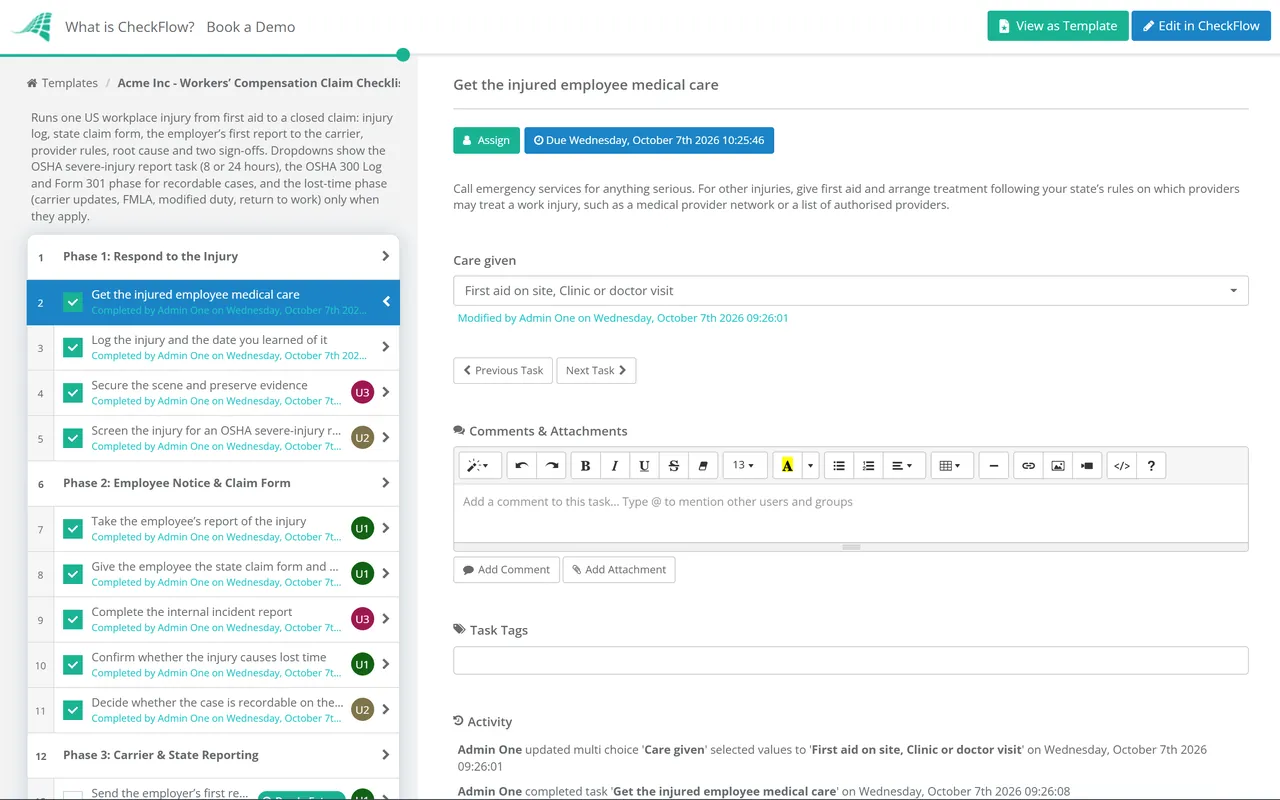
Enter the date you learned of the injury and the claim form, carrier report and OSHA log entry are dated from it. A severe injury puts the OSHA report on the list with a due time in hours, so it cannot wait for Monday.
This free workers’ compensation claim checklist takes one workplace injury from first aid to a closed claim. It records the date you learned of the injury, dates every report from it, and assigns each step to HR, the supervisor or the safety lead. Three questions switch on the extra steps: whether the injury must be reported to OSHA, whether it is recordable on the OSHA 300 Log, and whether it causes lost time.
This checklist is for US employers. Workers’ compensation is run by each state, through its own agency, forms and deadlines. The Department of Labor lists a separate workers’ compensation office for every state and territory, and runs federal programmes for groups such as federal employees, coal miners and longshore workers. Even whether you must carry cover depends on the state: in Texas, most private employers may choose not to.
OSHA sits alongside the claim, not inside it. The insurer decides whether benefits are paid. OSHA’s recordkeeping rule, 29 CFR Part 1904, decides what goes on your injury log, and its reporting rule decides when you must call OSHA. A case can be a valid claim but not recordable, or recordable with no lost time. The template keeps the two decisions apart so neither is made by default.
Most problems are missed dates and quiet pressure. A first report sent after the deadline, a claim form that was never handed over, or a supervisor who hints that reporting will cost the team its safety bonus. OSHA’s rule says your reporting procedure must not deter a reasonable employee from reporting, and state laws prohibit discrimination for filing a claim.
Employing people in the United Kingdom? The UK has no workers’ compensation system of this kind. Most employers must hold employers’ liability insurance with cover of at least £5 million, and certain injuries are reported to the Health and Safety Executive under RIDDOR, including injuries that keep a worker off normal duties for more than seven consecutive days. UK readers follow that system, not this checklist.
This template turns state and federal requirements into process steps; it is not legal advice. If a claim is denied, disputed or followed by a dismissal, take advice from an employment lawyer in the state concerned.
Six phases for each injury. The OSHA report appears only for severe injuries, the recordkeeping phase only for recordable cases, and the lost-time phase only when the employee misses work or cannot do their normal job.
The OSHA report task appears only when the injury is reportable. The duty binds employers that are exempt from keeping injury logs too.
Shown when the case is recordable. Employers partially exempt from Part 1904 answer No.
Shown when the injury keeps the employee away from work or off their normal duties.
The federal clocks are the same everywhere. OSHA’s run from the incident or from when you learned of the case; the state clocks below run from the employer’s knowledge of the injury or, in Texas, from the employee’s absence.
Report it to OSHA if the death occurs within 30 days of the incident. Call the Area Office, phone 1-800-321-6742 or report online. If the Area Office is closed, a voicemail does not count. Some State Plans go further: California expects a report to Cal/OSHA within 8 hours of any serious injury or illness.
Report it if it happens within 24 hours of the incident. In-patient hospitalisation means a formal admission for care or treatment; observation or diagnostic tests alone do not count.
Not every state sets this duty, but where it exists it can be short. California gives the employer one working day to provide the DWC 1 when the injury causes lost time beyond the shift or treatment beyond first aid.
Seven calendar days from receiving information that a recordable case has occurred. Many employers attach an insurance form instead of a Form 301, adding any information OSHA asks for that the insurer’s form lacks.
State deadlines differ in length, trigger and form. Three examples, as published by each state:
| Step | California | New York | Texas |
|---|---|---|---|
| Employee notifies the employer | Within 30 days, or benefits may be lost | Within 30 days | Not later than the 30th day after the injury |
| Employer to employee | DWC 1 claim form within one working day; dated copy once completed | Employee files Form C-3 with the Board within two years | Copy of DWC Form-001 when it goes to the carrier |
| Employer to carrier | Form 5020 within five days of knowledge | Within 10 days of the accident for most injuries | DWC Form-001 within eight days of an absence of more than one day |
| Treating provider | MPN or HCO if used, unless the employee predesignated a doctor | Board-authorised providers; any eligible licensed provider from 1 January 2028 | Employer may elect a certified network but need not |
The year-end step matters too. Establishments with 20 to 249 employees in designated industries, or 250 or more in any industry that keeps records, enter their Form 300A data in OSHA’s Injury Tracking Application by 2 March; those with 100 or more in the higher-hazard industries also submit their 300 and 301 case data. Cases from 2026 are due by 2 March 2027. Part 1904 was not amended in 2025 or 2026; in July 2025 OSHA withdrew an old proposal to add a musculoskeletal disorder column to the 300 Log.
Enter the date you learned of the injury and the claim form, carrier report and OSHA log entry are dated from it. A severe injury puts the OSHA report on the list with a due time in hours, so it cannot wait for Monday.
Three dropdowns decide the shape of each claim. A cut finger treated on site stays short; a fracture with time off brings in the OSHA log, the leave designation and the return-to-work steps.
The safety lead approves the corrective actions and the HR approver signs off the closed file; the checklist halts until each approval is given. Uploads, comments and the audit trail show who did what and when, if the claim is ever disputed.
A claim touches leave, payroll and health and safety. CheckFlow’s HR checklist software runs those processes from templates, with assignments, due dates and approvals shared between HR, managers and the safety team.
Use the Return-to-Work Checklist when the employee is ready to come back, and the Safety Audit Checklist to check the fix held. The OSHA Recordkeeping Checklist runs the full year of logs, the 300A and electronic filing.
No. Recording and reporting are different duties. Recordable cases, such as those needing medical treatment beyond first aid or causing days away, go on your own OSHA 300 Log within seven calendar days. Only a death, an in-patient hospitalisation, an amputation or the loss of an eye must be reported to OSHA directly, within 8 or 24 hours. Employers with ten or fewer employees all last year, and some low-hazard industries, need not keep the log, but they must still make those severe-injury reports.
It depends on the state, so check with your state workers’ compensation agency. In California, the employer’s report goes to the claims administrator within five days of learning of the injury. In New York, most injuries are reported to the carrier within 10 days of the accident. In Texas, DWC Form-001 is due within eight days after the employee has been absent for more than one day. Report even when you doubt the claim; the carrier investigates.
Sometimes. Medical provider rules are set by each state. In California, an employer using a medical provider network usually has the employee treated inside it unless they predesignated their own doctor. New York currently requires Board-authorised providers and will open treatment to any eligible licensed provider from 1 January 2028. In Texas, employers may choose a certified network but are not required to. Tell the employee the rules at the start.
It can. If the injury is also a serious health condition and the employee is eligible, the absence may count against their 12-week FMLA entitlement, provided you designate it and give notice within five business days of having enough information. If the doctor clears light duty, the employee may decline it and stay on unpaid FMLA leave, though their workers’ compensation payments may stop. FMLA covers private employers with 50 or more employees, and the ADA may also apply.
Not because of the claim or the injury report. State laws such as New York’s Workers’ Compensation Law section 120 and California Labor Code section 132a prohibit discrimination for claiming. OSHA’s section 11(c) protects employees who report a work-related injury or raise safety concerns, and a complaint to OSHA must be filed within 30 days of the adverse action. Unrelated conduct can still be handled, but document the reasons carefully and take advice before acting.
14-day free trial, no card required. The Business plan is $10 per user per month after the trial. Full details at checkflow.io/pricing.