Vehicle Accident Reporting Checklist Template

A company vehicle has been in a collision? Take the driver through the scene, report to the police and the insurer where required, check what the regulator and the FMCSA rules need, then repair the vehicle, find out why it happened and close the file.

Last reviewed: November 2026

Printed from checkflow.io/templates/transport-logistics/vehicle-accident-reporting-checklist

This free vehicle accident reporting checklist is for fleet managers, drivers and the people who handle one collision involving a vehicle driven for work, in the US or the UK. One run starts from the date and time of the collision. The driver makes the scene safe, checks for injuries, exchanges details, takes photos and witness details and says what happened without admitting fault. In the first hours the vehicle is recovered if it cannot be driven, the collision is reported to the police where the law requires it, and the driver is looked after. The driver’s written report, the insurer told within the policy’s notice period and the check on the health and safety regulator follow, with a check of the state’s own rules and the FMCSA accident register in the US, and post-accident drug and alcohol testing for a CDL driver. The vehicle is inspected, repaired and returned to service. The collision is investigated through the journey, the driver and the vehicle, and a named person signs off the findings before the driver review, the lessons shared, the costs and the closed file.

Vehicle Accident Reporting, Workplace Accident Investigation or Fleet Vehicle Inspection?

This checklist runs one road collision involving a vehicle driven for work, from the scene to the closed file: the driver’s steps at the scene, the police, insurer and regulator reports, the vehicle’s repair, the investigation, the driver review and the lessons. Its first tasks fall due within the hour.

An injury on your own site, away from the public road, runs in the Workplace Accident Investigation Checklist, which covers RIDDOR and OSHA reporting for workplace injuries. Daily checks, defects and the return to service after any repair are in the Fleet Vehicle Inspection Checklist. A US motor carrier checks its accident register, with the rest of its FMCSA records, in the DOT Compliance Audit Checklist, and sets up a new CDL driver’s qualification file and drug testing with the Commercial Driver Onboarding Checklist. An employee hurt in the collision may need the Workers’ Compensation Claim Checklist in the US.

This checklist

One road collision

Covers: the scene, the first hours, the police, the insurer, the regulator, the US state and FMCSA checks, recovery, inspection and repair, the investigation, the driver review, the lessons and the costs.

Planned around: the date and time of the collision.

Output: every report made on time, a repaired vehicle, signed-off findings and a closed file.
On your own site

Workplace accident investigation

Covers: an injury or near miss at work away from the public road, the evidence, the causes, and RIDDOR or OSHA reporting.

Planned around: the date of the accident.

Output: a report on the causes and the actions. A collision on a private site road can belong there.

The vehicle

Fleet vehicle inspection

Covers: the daily walkaround, periodic inspections, defect reporting and the return to service.

Planned around: each shift and the inspection interval.

Output: safe vehicles with the records kept. This checklist relies on it after the repair.

What the Vehicle Accident Reporting Checklist Covers

Seven phases take one collision from the scene to the closed file, about four weeks later. The first task records when the collision happened: the scene and first-hours tasks fall due within hours of it, counted in calendar hours so they fall at weekends too, and the rest in working days. One answer on the first task says where it happened and what kind of vehicle it is, and sets the police and regulator notes for Great Britain, Northern Ireland or the US, with the state report, the FMCSA accident register and CDL post-accident testing where they apply. Other answers add the details exchange, the injury record, the vehicle’s recovery and the driver’s training. The investigation sign-off in Phase 5 is assigned to one person, and nothing after it can be completed until they do.

  1. Phase 1

    Phase 1: At the Scene

    7 tasks

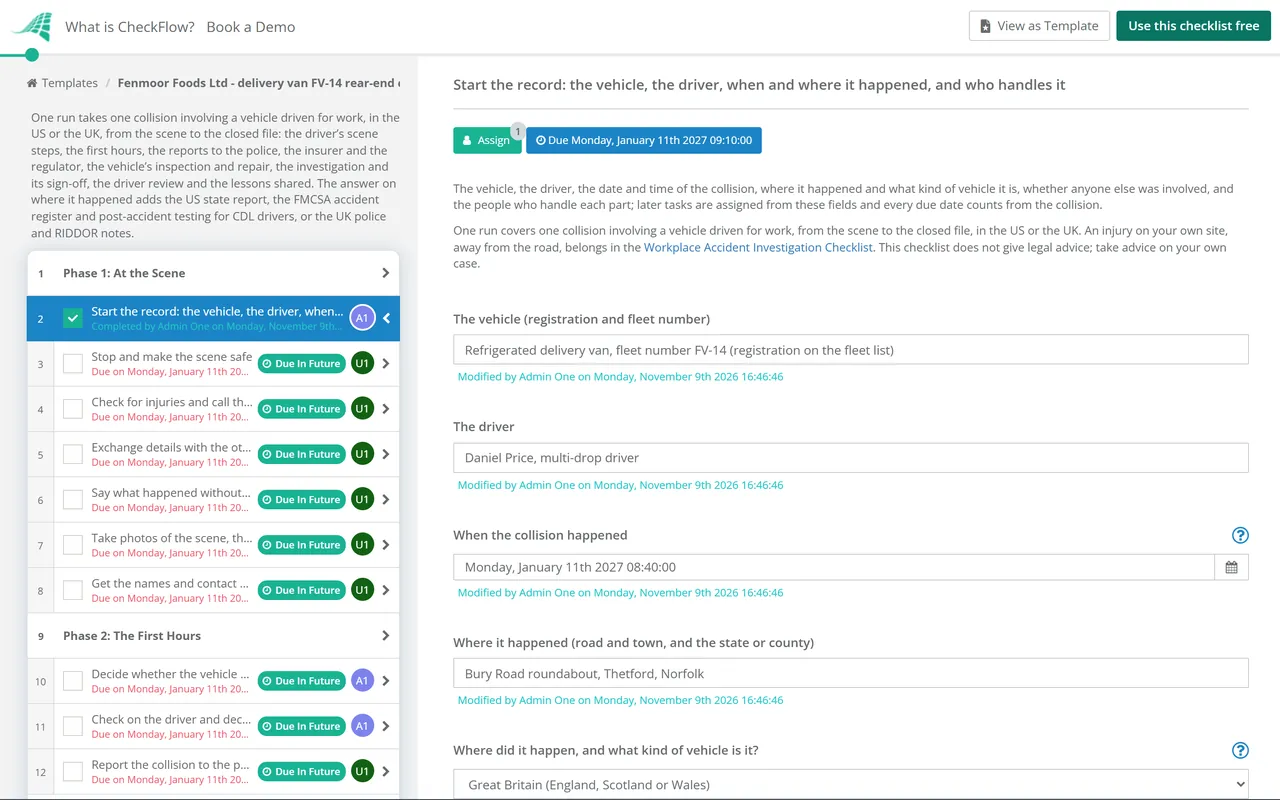
    The driver’s first hour. The fleet manager starts the checklist when the driver calls in and fills in the first task: when the collision happened, where, the vehicle and who handles each part. The scene tasks are the driver’s, done at the scene or ticked as soon as they safely can be. In Great Britain and Northern Ireland the duty to stop and give details is the driver’s own, by law.

    • Start the record: the vehicle, the driver, when and where it happened, and who handles it — the vehicle, the driver, the date and time of the collision, where it happened and what kind of vehicle it is, whether anyone else was involved, and the people who handle each part; later tasks are assigned from these fields and every due date counts from the collision
    • Stop and make the scene safe — stop as soon as it is safe, hazard lights on and engine off, get out away from the traffic where you can, and keep yourself and others off the carriageway; move the vehicle only where it is safe and the law allows
    • Check for injuries and call the emergency services if anyone is hurt or the road is blocked — whether anyone is hurt, including the driver, and whether the emergency services were called; give first aid only if you are trained and it is safe
    • Exchange details with the other drivers and owners — your name and address, the vehicle owner’s name and address and the registration, given to anyone with reasonable grounds to ask, and the same details, the insurer and the vehicle registration taken from each other driver
    • Say what happened without admitting fault or blame — describe what happened to the police and the other people involved, without admitting fault, blaming anyone, offering to pay or signing anything except a police form
    • Take photos of the scene, the vehicles and the damage — wide shots of the scene and the road layout, each vehicle and its registration, the damage, the road surface, signs and the weather, and the dashcam footage marked to keep
    • Get the names and contact details of witnesses — each independent witness’s name, phone number or email, and what they saw, before they leave the scene
  2. Phase 2

    Phase 2: The First Hours

    6 tasks

    Get the vehicle moved, report to the police where the law requires it, and look after the driver. For a US driver who needs a CDL, the post-accident testing decision and the tests come in this phase, because the rule sets limits of 8 hours for alcohol and 32 hours for drugs.

    • Decide whether the vehicle can be driven from the scene — whether the vehicle is safe and legal to drive on, judged by the driver with the fleet manager: lights, tyres, steering, brakes, mirrors, leaks and anything hanging loose
    • Decide whether post-accident drug and alcohol tests are required — whether 49 CFR 382.303 requires the driver to be tested: always after a death, and after an injury treated away from the scene or a vehicle towed away with disabling damage if the driver is cited for a moving violation (within 8 hours for alcohol, 32 hours for drugs)
    • Arrange recovery of the vehicle — the recovery firm, where the vehicle is taken, what happens to the load or equipment on board, and how the driver gets back
    • Check on the driver and decide whether they drive again today — how the driver is, whether they need medical advice or time off, and whether they finish the shift, take another vehicle or go home
    • Report the collision to the police where the law requires it — a report to the police where the law of the place requires one, with the reference kept for the insurer and the file
    • Get the tests done in time, or record why they were not — the alcohol test within 2 hours if possible and never after 8 hours, the drug test within 32 hours, and a record of the reasons for any test given late or not given
  3. Phase 3

    Phase 3: Report & Notify

    9 tasks

    The driver’s written report, the evidence kept before it is lost, the insurer told within the policy’s notice period, and the checks on what the health and safety regulator and, in the US, the state and the FMCSA rules need. The first answers set which of these appear.

    • Send the driver’s written report to the fleet manager — the driver’s own account of the collision, a sketch of the positions, and the details from the scene, sent within the deadline your fleet policy sets; this template sets the next working day
    • Save the dashcam, telematics and tachograph data before it is overwritten — the dashcam footage, the telematics trip and speed data, and for a vehicle that has one the tachograph or ELD records for the day, downloaded and saved with the file
    • Notify the insurer within the policy’s notice period — the collision reported to the motor insurer or the fleet’s claims handler within the notice period your policy sets, with the policy number and the claim reference recorded; this template sets one working day
    • Record who was hurt and the treatment they had — each person hurt, whether they work for you, the injury, and the treatment: first aid at the scene, treatment away from the scene or a stay in hospital
    • Tell the people who need to know inside the organisation — the driver’s line manager, health and safety, finance for the costs, and the customer or site whose delivery or visit was affected
    • Check whether the health and safety regulator must be told — whether the collision must be reported to the health and safety regulator where it happened, or recorded, with the reference of any report made
    • Check the state’s crash report rules and file any report due — the rules of the state where the crash happened on reports to the state motor vehicle agency, and any report filed, with its date and a copy kept
    • Decide whether it is an FMCSA accident and enter it in the accident register — whether the collision is an accident as 49 CFR 390.5T defines it (a death, an injury treated away from the scene straight away, or a vehicle towed away with disabling damage) and, if it is, the entry in the accident register
    • Pass any contact or claim from the other party to the insurer — any call, letter or claim from the other driver, owner or their insurer or solicitor passed to your insurer unanswered, with the date it arrived
  4. Phase 4

    Phase 4: Vehicle Inspection & Repair

    5 tasks

    The vehicle is inspected before it is used again, repaired with the insurer’s agreement and returned to service with the defects cleared. A replacement keeps the work moving in the meantime.

    • Inspect the vehicle before it is used again — a full inspection by a competent person of the damage and anything that affects safety, with the result recorded and the vehicle kept off the road until it is safe
    • Arrange a replacement vehicle if one is needed — a spare, hire or courtesy vehicle for the work while this one is off the road, and who pays for it under the policy
    • Get the repair estimate and the insurer’s agreement — the repairer’s estimate, the insurer’s agreement or its engineer’s visit, and the excess or cost you will pay
    • Repair the vehicle and check the work — the repair done, the vehicle checked on its return from the repairer against the estimate and the defects found, and anything not put right sent back
    • Return the vehicle to service — the vehicle passed as safe to use, every defect from the collision cleared, and the fleet records updated
  5. Phase 5

    Phase 5: Investigate the Collision

    9 tasks

    Find out why it happened, looking at the journey, the driver and the vehicle, as HSE’s guidance on driving for work does, and agree actions to stop it happening again. The investigation sign-off at the end is assigned to one person, and nothing after it can be completed until they do.

    • Gather the evidence — the driver’s report, the scene photos, witness details, the police reference, the dashcam and telematics data, the inspection report and the day’s schedule, in one place
    • Talk to the driver and any witnesses — the driver’s account in their own words, without blame, and what any witnesses saw, with any differences from the written report noted
    • Check the journey: the route, the schedule and the conditions — the planned route and times, whether the schedule left time for breaks and traffic, the weather and light, and the road layout
    • Check the driver’s records: licence, training, hours and past incidents — the driving licence check, the training and any assessments, the hours driven and worked that day and the week before, and any earlier collisions or near misses
    • Check the vehicle’s maintenance and defect records — the last safety inspection and service, any defects reported and whether they were fixed, and the condition found at the post-collision inspection
    • Find the immediate and underlying causes — what happened in the moments before the collision, and the reasons behind it in the journey, the driver, the vehicle, other road users or the road
    • Agree the actions to stop it happening again — each action with an owner and a date: changes to routes or schedules, training, vehicle equipment, policy or checks
    • Finish the investigation before sign-off — the questions raised at the sign-off answered and the findings or actions changed; then change the sign-off’s decision to Approved and complete it
    • Sign off the investigation findings and actions — the evidence, the causes and the actions reviewed, and the findings agreed before the driver review and the lessons are shared
  6. Phase 6

    Phase 6: Driver Review

    4 tasks

    The driver’s line manager goes through the findings with the driver and agrees what happens next: nothing further, coaching, training or a driving assessment, or a referral to HR under your own policy.

    • Hold the review with the driver — the findings and the actions talked through with the driver, their view heard, and the outcome agreed and explained
    • Record the review on the driver’s file — the collision, the findings that concern the driver and the outcome of the review, recorded where driver records are kept
    • Hand the findings to HR — the investigation findings and the review notes passed to HR to handle under your own policy, and the driver told
    • Arrange the training or driving assessment — the training or assessment booked and done, and its result recorded on the driver’s file
  7. Phase 7

    Phase 7: Lessons & Close

    5 tasks

    Share what was learned, update the risk assessment or policy if it needs it, record the costs and the claim, and close the file with the records kept.

    • Share the lessons with drivers and managers — what happened and what changes, shared with the other drivers and managers without naming or blaming the driver
    • Update the driving risk assessment, policy or routes if needed — the driving at work risk assessment, the fleet policy, routes, schedules or vehicle checks changed where the investigation showed a gap
    • Record the costs of the collision — the repair, the hire vehicle, the excess, recovery, the time the vehicle was off the road and any other costs
    • Record where the insurance claims stand — your own claim and any claim against you: settled, open or closed, with the amounts and anything still to do
    • Close the file and keep the records — the report, photos, statements, data, references, investigation and review filed together and kept for as long as the law and your retention policy say

Reporting Rules After a Collision, in the UK and the US

The police and the health and safety regulator

The first task’s answer on where the collision happened shows the matching note on the police task in Phase 2 and the regulator task in Phase 3.

Where At the scene Reporting to the police Health and safety reporting Source
Great BritainWhere someone else is injured, or another vehicle, a listed animal (horse, cattle, ass, mule, sheep, pig, goat or dog) or roadside property is damaged: stop, and give your name and address, the owner’s name and address and the registration to anyone with reasonable grounds to ask.If those details were not given: at a police station or to a constable, as soon as reasonably practicable and within 24 hours. If someone else was injured and the insurance certificate was not produced: report it and produce the certificate.RIDDOR does not apply to deaths and injuries connected with the movement of a vehicle on a road, unless caused by a train, a substance the vehicle carried, loading or unloading, or work on or alongside the road.Road Traffic Act 1988 s170; RIDDOR 2013 reg 14(3)
Northern IrelandWhere someone else, or a listed animal (horse, cattle, ass, mule, hinny, sheep, pig, goat or dog), is injured, or other property is damaged (not the vehicle’s own, the driver’s or the owner’s): stop, keep the vehicle at or near the place for a reasonable time, and give your particulars to a police officer on demand and to anyone with reasonable grounds to ask.Forthwith (straight away), at a police station or to a police officer, if the particulars were not given or anyone other than the driver was injured, producing the insurance certificate.The 1997 regulations apply to a road vehicle accident only where the harm came from a substance the vehicle carried, loading or unloading, or work on or alongside the road.Road Traffic (Northern Ireland) Order 1981 art 175; RIDDOR (NI) 1997 reg 10(2)
United StatesSet by the law of the state where it happened.Set by state law, which decides which crashes must be reported to the police or the state, and by when.Federal OSHA: a death, in-patient hospitalisation, amputation or loss of an eye from a motor vehicle accident on a public street or highway is not reported unless it was in a construction work zone (then within 8 hours for a death, and 24 hours for an in-patient hospitalisation, amputation or loss of an eye), but is recorded if you must keep OSHA records.State law; 29 CFR 1904.39(b)(3)

FMCSA rules for US commercial motor vehicles

The accident register task appears for a commercial motor vehicle under the FMCSA rules, and the two testing tasks for a vehicle whose driver needs a CDL. The test limits are 8 hours for alcohol and 32 hours for drugs: a citation must come within those times, and attempts to test stop at them.

Accident (49 CFR 390.5T) Driver cited for a moving violation? Post-accident test (CDL drivers) Accident register
A deathEitherRequired for each surviving driver who was performing safety-sensitive functionsEntered
An injury treated away from the scene straight awayYesRequiredEntered
An injury treated away from the scene straight awayNoNot requiredEntered
Disabling damage, with a vehicle towed awayYesRequiredEntered
Disabling damage, with a vehicle towed awayNoNot requiredEntered
None of these (for example minor damage, no tow, no one treated away from the scene)EitherNot requiredNot an accident under 390.5T: not entered

Where this comes from. Section 170 of the Road Traffic Act 1988 (England, Wales and Scotland) and Article 175 of the Road Traffic (Northern Ireland) Order 1981; regulation 14(3) of RIDDOR 2013 and HSE’s examples of reportable incidents, which add that a site road the public do not normally use is not a road for the exemption; regulation 10(2) of RIDDOR (Northern Ireland) 1997; 29 CFR 1904.39; 49 CFR 390.5T for the definition of an accident (390.5 is suspended; 390.15 still refers to it, and the definition reads the same), which leaves out occurrences involving only boarding or alighting from a stationary vehicle or only loading or unloading cargo; 49 CFR 390.15(b) for the register, kept for 3 years, which applies to motor carriers in interstate commerce (390.3T; for a vehicle used only within one state, check your state’s rules); and 49 CFR 382.303 for post-accident testing, which applies to drivers who must hold a CDL (382.103) and not to a passenger car or multipurpose passenger vehicle unless it carries passengers for hire or placarded hazardous materials. All read on 9 November 2026. This checklist does not give legal advice; take advice on your own case.

Why Run Vehicle Accident Reports in CheckFlow?

1

The first hour, step by step

The driver’s scene tasks, from making it safe to taking witness details, fall due within the hour, and the police report, the recovery and the driver’s welfare within the first hours, counted in calendar hours so a collision at the weekend is covered. Every task is assigned from the people named on the first task, so each step has an owner from the start.

2

The right reports for where it happened

One answer on the first task says where the collision happened and what kind of vehicle it is. Great Britain and Northern Ireland get their own police and RIDDOR notes; the US gets the state report check and the OSHA note, plus the FMCSA accident register for a commercial motor vehicle and post-accident testing for a CDL driver. The insurer is told within the period your own policy sets.

3

From the repair to the lessons

The vehicle is inspected, repaired and returned to service while the collision is investigated through the journey, the driver and the vehicle. A named person signs off the findings before the driver review and the lessons shared, and the costs and claims are recorded before the file is closed. Track every open collision in the Reports Grid.

CheckFlow does not report a collision to the police, an insurer or a regulator, or decide who was at fault: those stay with your drivers, your fleet manager and your insurer. CheckFlow makes sure every step is done in order, by the right person, with the record kept.

Run on-site injuries with the Workplace Accident Investigation Checklist, vehicle checks with the Fleet Vehicle Inspection Checklist, and a motor carrier’s self-audit with the DOT Compliance Audit Checklist.

AI generator

Didn’t find what you need? Describe it.

Describe the process in a sentence and the AI checklist generator drafts the phases and tasks for you.

Frequently Asked Questions

What should a vehicle accident reporting checklist include?

The driver’s steps at the scene (make it safe, check for injuries, exchange details, take photos and witness details, and say what happened without admitting fault), the report to the police where the law requires it, the driver’s written report, the insurer told within the policy’s notice period, any health and safety, state or FMCSA reporting, the vehicle’s inspection and repair, an investigation of the causes with a sign-off, a review with the driver and the lessons shared. This template covers those steps for one collision.

What should a driver do after an accident in a company vehicle?

Stop and make the scene safe, check for injuries and call 999 or 911 if anyone is hurt or the road is blocked, give and take details, photograph the scene and the damage, take witness details, and describe what happened without admitting fault. Then call the fleet manager, who starts this checklist. In Great Britain the duty to stop and give details is the driver’s own, under section 170 of the Road Traffic Act 1988.

Do you have to report a road accident to the police in the UK?

Not always. In Great Britain, a driver whose vehicle injures someone else, or damages another vehicle, roadside property or certain animals (a horse, cattle, ass, mule, sheep, pig, goat or dog), must stop and give their details to anyone with reasonable grounds to ask. If they do not, they must report it to the police as soon as reasonably practicable and within 24 hours, as must a driver who did not produce the insurance certificate after injuring someone (section 170). Northern Ireland’s rule is Article 175 of the 1981 Order.

Is a road traffic accident at work reportable under RIDDOR?

Not unless one of its exceptions applies. Regulation 14(3) of RIDDOR 2013 takes out deaths and injuries connected with the movement of a vehicle on a road, unless the person was hurt by a train, by a substance the vehicle carried, while loading or unloading it, or in work on or alongside the road. HSE’s examples point to the police, who have primary responsibility for enforcing road traffic law, and say a private site road the public do not normally use is not a road for this exemption.

When is a post-accident drug and alcohol test required for a CDL driver?

Under 49 CFR 382.303, after an accident involving a death, for each surviving driver who was performing safety-sensitive functions. After an accident where someone was treated away from the scene straight away, or a vehicle was towed away with disabling damage, only if the driver is cited for a moving traffic violation within 8 hours (for the alcohol test) or 32 hours (for the drug test). Attempts to test stop at those limits. The rule covers drivers who must hold a CDL.

What goes in an FMCSA accident register?

49 CFR 390.15 says a motor carrier keeps an accident register for 3 years after each accident: the date, the city or town and state, the driver’s name, the injuries and fatalities, and whether hazardous materials other than fuel from the vehicles’ tanks were released, with copies of the accident reports required by states, other governmental entities or insurers. It covers interstate carriers, and only accidents as 390.5T defines them: a death, an injury treated away from the scene straight away, or a tow-away with disabling damage.

Should a driver admit fault at the scene of an accident?

This template tells drivers to describe what happened to the police and the other people involved without admitting fault, blaming anyone, offering to pay or signing anything except a police form. Who was at fault is settled later, by the insurers or the courts, not at the roadside. Your motor insurance policy may say what a driver must not say or agree to: check it, and tell your drivers.

How soon should a fleet accident be reported to the insurer?

Within the notice period in your own motor or fleet policy, which this template asks you to read and record rather than assume. The template sets one working day after the collision and says to move the date if the policy’s period is shorter. Pass any letter or claim from the other party to the insurer unanswered, and keep the police reference for it.

Is CheckFlow free for this template?

14-day free trial, no card required. The Business plan is $10 per user per month after the trial. Full details at checkflow.io/pricing.

Handle Every Vehicle Accident the Same Way

Free trial — no credit card required.

14-day free trial, no credit cardFull refund in your first 30 daysUS hosting, EU on request