
A forklift driver gets three stitches in March and nobody decides whether it is recordable. In January a plant manager signs a 300A summary built on a log that never mentions it.
This free OSHA recordkeeping checklist is for EHS managers, HR teams and site leaders at US establishments covered by 29 CFR Part 1904. It runs one calendar year of the injury and illness log cycle: who must keep records, the recording decision for each case, Forms 300 and 301 within seven days, severe-injury reports, the year-end review, the executive’s certification of Form 300A, posting from 1 February to 30 April, electronic submission by 2 March and five-year retention. The output is a complete log per establishment and a dated record of every decision.
Record, Report, Submit: Three Duties on Three Clocks
Part 1904 is a records rule, not a hazard rule. A site can pass every walkround and still fail it, because the errors sit in judgement calls made after an incident: first aid or medical treatment, a new case or a recurrence, a restricted day or a normal one.
Inspections of the workplace itself belong in the Safety Audit Checklist. This template starts where an incident report ends and follows the paperwork through to the year’s archive.
Record (1904.4 to 1904.33)
Your own log, kept for every establishment
Trigger: a work-related new case that meets the general recording criteria, such as days away, restricted work or treatment beyond first aid.
Clock: Form 300 entry and Form 301 report within seven calendar days of learning of it.
Output: the 300 Log, 301 reports, a privacy case list and the annual 300A summary.
Report (1904.39)
A call or online report to OSHA, within hours
Trigger: a work-related fatality, or an in-patient hospitalisation, amputation or loss of an eye.
Clock: 8 hours for a death, 24 hours for the others. It applies to every employer, including those exempt from keeping a log.
Output: a report reference, plus the case on the log if you keep one.
Submit (1904.41)
Annual data to OSHA’s Injury Tracking Application
Establishments that had 20 to 249 employees in a designated industry, or 250 or more in any industry that must keep records, file their 300A data by 2 March. Those with 100 or more employees in the higher-hazard industries of Appendix B to Subpart E also file their 300 and 301 case data, without names or addresses. OSHA has said it will publish some of what it collects.
State Plans run their own programmes. There are 29, of which 22 cover private employers, and each must be at least as effective as federal OSHA. Most mirror Part 1904, but not all: California requires a report within eight hours of any serious injury or illness under 8 CCR 342, and Minnesota asks for submissions beyond the federal ones. Federal ITA filing still applies in State Plan states.
What the OSHA Recordkeeping Checklist Covers
Seven phases, one checklist per recording year, opened every January. Your answers decide which steps appear.
Phase 1
Phase 1: Applicability & Set-Up
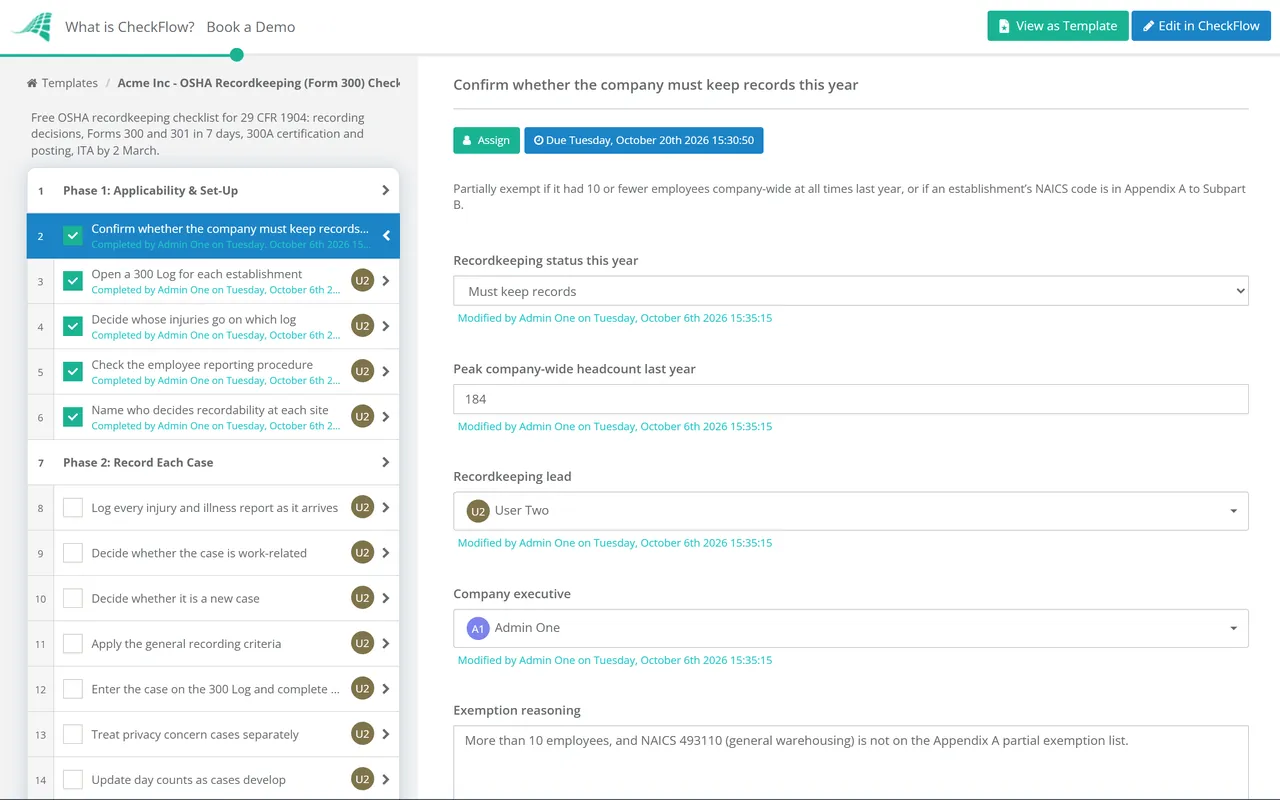
The first task names the recordkeeping lead and the company executive, and its applicability answer decides whether the recording phases appear.
Confirm whether the company must keep records this year — partially exempt if it had 10 or fewer employees company-wide at all times last year, or if an establishment’s NAICS code is in Appendix A to Subpart B
Open a 300 Log for each establishment — a separate log for every site expected to operate a year or longer; short-term sites may share one
Decide whose injuries go on which log — everyone on payroll, plus temporary or leased workers you supervise day to day; the staffing agency does not record those
Check the employee reporting procedure — it must not deter prompt, accurate reporting; tell every employee how to report and that retaliation is prohibited
Name who decides recordability at each site — and who can hand over the records within four business hours if OSHA asks
Phase 2
Phase 2: Record Each Case
Shown when the company must keep records. Each case is a row in a case table on the first task, with its own seven-day date.
Log every injury and illness report as it arrives — record the date you learned of it, because the seven-day clock runs from there
Decide whether the case is work-related — an event or exposure at work is presumed to be the cause unless a 1904.5(b)(2) exception applies, such as commuting or a common cold
Decide whether it is a new case — the same type of injury to the same body part is new only if the employee had fully recovered and a workplace event brought it back
Apply the general recording criteria — death, days away, restricted work or transfer, medical treatment beyond first aid, loss of consciousness or a significant diagnosis
Enter the case on the 300 Log and complete a Form 301 within seven days — an insurer’s first report can stand in for the 301 if it holds the same information
Treat privacy concern cases separately — write ‘privacy case’ instead of the name and keep the case-number list apart from the log
Update day counts as cases develop — calendar days from the day after the injury, capped at 180; a new diagnosis can change a case’s classification
Phase 3
Phase 3: Severe Injury Reports
Always shown, because the reporting duty binds exempt employers too. The answer on the first task shows the right report task with an 8-hour or 24-hour due time.
Screen every serious incident for a report to OSHA — count deaths within 30 days of the incident and admissions, amputations or eye loss within 24 hours
Report a work-related death within 8 hours — by phone to the Area Office, on 1-800-321-OSHA or online; a voicemail does not count
Report a hospitalisation, amputation or loss of an eye within 24 hours — formal in-patient admission only; observation or diagnostic tests alone are not reportable
Check the State Plan’s own reporting rule — some set a shorter clock or a wider trigger than the federal one
Record the event on the log as well — a crash on a public road needs no report outside a construction zone, but still goes on the log
Phase 4
Phase 4: Year-End Review & Form 300A
Due in January of the following year. The electronic submission answer here decides whether Phase 6 appears.
Review each 300 Log for completeness and accuracy — reconcile it against first-aid logs, workers’ compensation claims and absence records
Update earlier years’ logs still in retention — late diagnoses and changed outcomes belong on the log of the year the case occurred
Work out the average number of employees and the total hours worked — both go on the 300A; use payroll hours, not estimates, where you have them
Confirm the electronic submission duty from peak employment — count everyone employed at any time in the year, including part-time, seasonal and temporary staff
Complete Form 300A for each establishment — column totals, zeros if there were no cases, company and establishment name and address
Phase 5
Phase 5: Certify, Post & Give Access
The first task is an approval assigned to the company executive named in Phase 1; nothing is posted until it is answered.
Company executive certifies each 300A — an owner, a corporate officer, the highest-ranking official at the site or that person’s supervisor confirms it is correct and complete
Post the signed 300A by 1 February — wherever notices to employees are usually posted, at every establishment
Keep it posted, legible and uncovered until 30 April — check it in mid-March and replace a defaced copy
Answer employee requests for records by the end of the next business day — current and stored 300 Logs, and the employee’s own 301
Phase 6
Phase 6: Electronic Submission (ITA)
Shown only when an establishment must submit. The case-data task appears only for 100 or more employees in an Appendix B industry.
Check access to the Injury Tracking Application — the ITA account email must match a Login.gov account; have each establishment’s EIN ready
Submit the 300A data by 2 March — include the legal company name even if sites are named by code; an enterprise office can file for several sites
Submit the 300 and 301 case data by 2 March — names, addresses and treating providers are excluded; strip identifying detail from the descriptions too
Save the submission confirmation — file it with the signed 300A as proof of what was sent and when
Phase 7
Phase 7: Retention & Close
File the year’s records for five years — 300 Logs, the privacy case list, the 300A and every 301, kept until 31 December five years after the year covered
Transfer the records if an establishment is sold — the new owner keeps the old records; you record only the part of the year you owned it
Compare the year’s cases with the last — by site, body part, event and days lost, so the safety programme works on causes rather than counts
Close the year and confirm the next checklist is open — the following year’s log started on 1 January
Each row links a federal requirement to the phase that leaves the evidence. State Plans and some industries add their own rules, so treat the table as a starting point, not legal advice.
Requirement
29 CFR
Deadline or test
Evidenced in
Partial exemptions
1904.1, 1904.2
10 or fewer employees at all times last year; Appendix A to Subpart B industries
Phase 1
Logs and covered employees
1904.30, 1904.31
One log per establishment; temporary workers you supervise day to day
Phase 1
Recording decision
1904.4 to 1904.7
Work-related, new case, general recording criteria
Phase 2
Specific cases
1904.8 to 1904.11
Needlesticks, medical removal, hearing loss, tuberculosis
Part 1904 itself was unchanged at the time of review. OSHA’s July 2025 deregulatory package withdrew an old proposal to add a musculoskeletal disorder column to the 300 Log, and a new enforcement directive, CPL 02-00-172, replaced the 2004 version in January 2025. Data for 2026 is due in the ITA by 2 March 2027. Check your State Plan and OSHA’s site before each cycle, because rulemaking can move. Nothing on this page is legal advice.
Why Run the Recordkeeping Year in CheckFlow?
1
The year opens itself on 1 January
An annual recurring schedule starts each recording year’s checklist with its dates already set: the year-end review in January, posting by 1 February, the ITA filing by 2 March and the posting check before 30 April.
2
Severe events get a clock in hours
When someone answers the severe-event question, conditional logic shows the matching report task, due 8 or 24 hours from the time you recorded. Exempt sites see the reporting phase but not the recording ones.
3
The certification has a name and a date
The 300A sign-off is an approval assigned to the executive picked in Phase 1, and the checklist waits for it. Each recording decision, case table row and upload carries who did it and when.
CheckFlow is not OSHA’s Injury Tracking Application, an incident management system or a claims tool, and it does not decide whether a case is recordable. It schedules the cycle, holds the decisions and stores the signed forms as evidence. Plants that run inspections and maintenance rounds in CheckFlow for manufacturing can keep this cycle beside them.
Most employers with more than 10 employees. You are partially exempt if the whole company had 10 or fewer employees at all times during the last calendar year, or for any establishment classified in a low-hazard industry listed in Appendix A to Subpart B, such as offices of physicians, legal services or full-service restaurants. The industry test applies site by site. Exempt employers must still report severe injuries, and must keep records if OSHA or the Bureau of Labor Statistics asks in writing.
What makes an injury recordable rather than first aid?
+
A work-related new case is recordable if it leads to death, days away, restricted work or a job transfer, loss of consciousness, or medical treatment beyond first aid, or if a clinician diagnoses a significant injury or illness. First aid is a closed list in 1904.7: non-prescription medicine at non-prescription strength, wound cleaning and bandages, hot or cold therapy, a tetanus shot and similar items. Stitches, staples, rigid braces and physical therapy fall outside it, so a sutured cut is recordable even if the employee is back at work the same day.
When must the OSHA 300A be posted, and who signs it?
+
Post it by 1 February and leave it up until 30 April, at every establishment, even if every total is zero. A company executive certifies it first: an owner of a sole proprietorship or partnership, an officer of the corporation, the highest-ranking company official at the establishment, or that person’s immediate supervisor. A safety coordinator cannot sign in their place.
Do we have to submit our injury data to OSHA electronically?
+
Only in three cases, judged on each establishment’s peak headcount in the year covered: 20 to 249 employees in an industry listed in Appendix A to Subpart E, 250 or more in any industry required to keep records, or 100 or more in an Appendix B industry, which adds the 300 and 301 case data. Every part-time, seasonal and temporary worker counts as one employee. The deadline is 2 March, and late submissions are accepted until 31 December, but a late filing is still late.
How long must OSHA injury records be kept?
+
Five years following the end of the calendar year they cover, so the 2026 records are kept until the end of 2031. That covers the 300 Log, the privacy case list, the 300A and the 301 reports. During those five years you must keep the 300 Log up to date with newly discovered cases and changed outcomes; the 300A and 301 need not be updated.
Is CheckFlow free for this template?
+
14-day free trial, no card required. The Business plan is $10 per user per month after the trial. Full details at checkflow.io/pricing.
Close Every Recording Year With a Log You Can Sign
Free trial — no credit card required.
Do you like cookies? 🍪 We use cookies to ensure you get the best experience on our website. Learn more