Workplace Investigation Checklist

Whoever decides a grievance or a disciplinary case can only be as fair as the facts in front of them. Most weak decisions trace back to an investigation that was rushed, one-sided or run by someone too close to the people involved.

This free workplace investigation checklist covers the fact-finding stage that sits in the middle of both procedures. It starts when a complaint or concern lands, fixes the scope in written terms of reference, puts any interim measures in place, secures the evidence before it disappears, runs the interviews and ends with a findings report that the decision-maker signs off. The result then goes back to the Grievance Procedure Checklist or the Disciplinary Procedure Checklist, whichever started it. The investigator finds facts; someone else decides what happens next.

Use This Template Free See Live Example
No Credit Card Required

Last reviewed: October 2026

Why Investigations Go Wrong

The scope drifts. An investigation that starts with one complaint about a manager’s comments ends up reviewing three years of team history, and nobody can say when it is finished. Written terms of reference fix the allegations, the policies in play and the deadline before the first interview.

The investigator is too close. A line manager investigating their own team member, or a colleague who sat in on the original argument, will be accused of bias whatever they conclude. Check for conflicts before you appoint anyone, and bring in an outside investigator when the people involved are senior or the allegation is serious.

The evidence goes missing. CCTV systems overwrite footage on a cycle, chat messages get deleted and people’s memories blur within days. Securing records comes before interviews, not after.

The report decides instead of finding. The investigator’s job is to say which facts were established, which were not and why. Choosing the sanction or the remedy belongs to the person who hears the case.

United Kingdom

A reasonable investigation is expected

Accompaniment: the Acas Code says there is no statutory right to be accompanied at an investigatory meeting, though your own procedure can allow it. The statutory right applies at disciplinary and grievance hearings.

Harassment: since 26 October 2024 employers must take reasonable steps to prevent sexual harassment of employees. From 30 October 2026 the duty becomes “all reasonable steps”, and employers must not permit harassment by third parties such as customers. Since 6 April 2026 a disclosure about sexual harassment can qualify for whistleblowing protection.

Records: witness statements and notes are personal data under UK GDPR, and the people in them can ask for copies. For events from 1 October 2026, most tribunal claims can be brought within six months rather than three, so keep the file accordingly.
United States

The investigation is the defence

Corrective action: the EEOC says an employer is liable for harassment by a co-worker or non-employee if it knew or should have known and failed to take prompt and appropriate corrective action. A documented investigation is how you show you acted.

Guidance: a federal court vacated parts of the EEOC’s 2024 harassment guidance in May 2025, and in January 2026 the Commission voted to rescind it entirely. The statutes and Supreme Court case law are unchanged.

Unions and counsel: under the NLRB’s Weingarten rule, a union member who reasonably fears discipline may ask for a steward at the interview. An investigation run by or for outside counsel may be protected by attorney-client privilege.

None of this is legal advice: the template puts the rules into a working order. Where the allegation involves senior people, possible criminal conduct or a likely tribunal or EEOC claim, ask an employment lawyer how to structure the investigation before it begins.

What the Workplace Investigation Checklist Covers

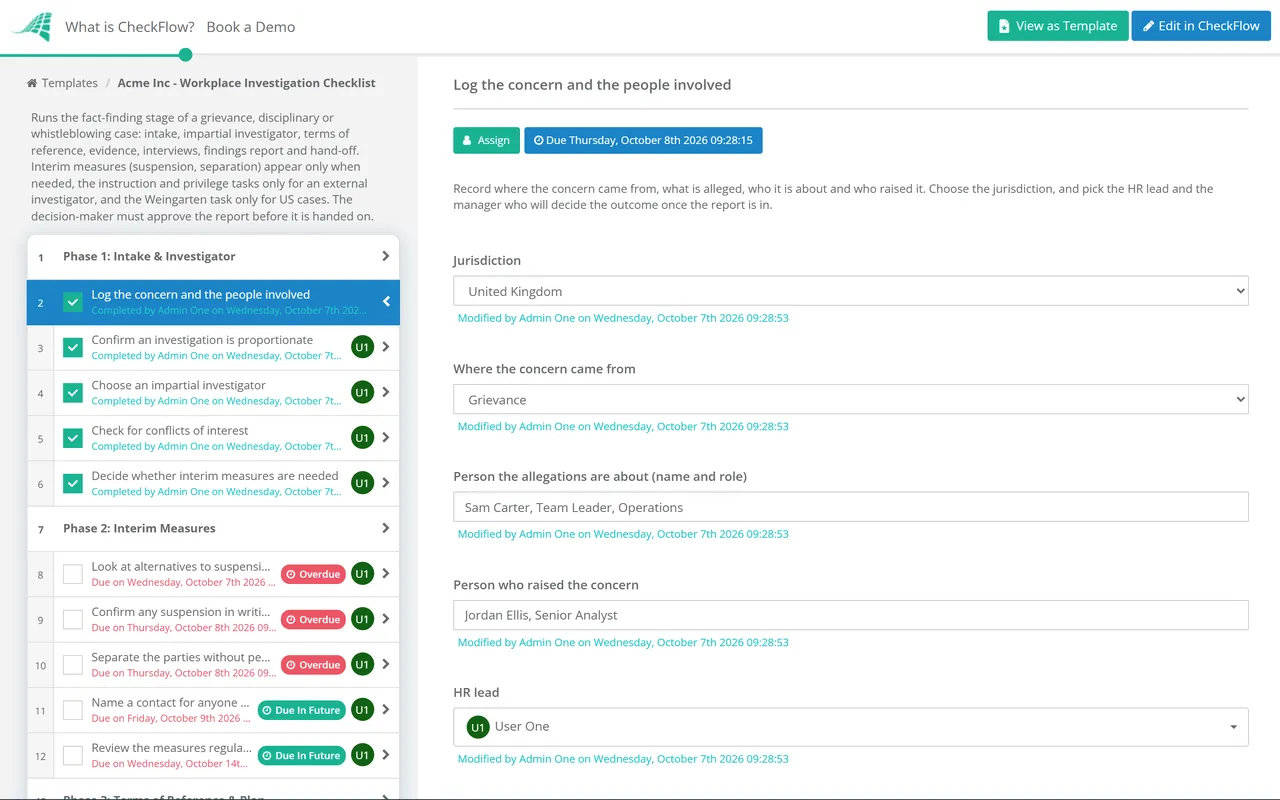
The template runs in seven phases and ends with the hand-off. Interim measures appear only when they are needed, the external investigator steps only when you bring one in, and the union step only for US cases.

Phase 1

Phase 1: Intake & Investigator

  • Log the concern and the people involved — source, allegations, jurisdiction and who will decide the outcome
  • Confirm an investigation is proportionate — a factual dispute needs one; an agreed fact may not
  • Choose an impartial investigator — internal or external, with the time and training to do it
  • Check for conflicts of interest — no reporting line, friendship or earlier role in the matter
  • Decide whether interim measures are needed — to protect people or the evidence
Phase 2 — If Needed

Phase 2: Interim Measures

Shown when interim measures are needed.

  • Look at alternatives to suspension first — a different shift, site, reporting line or home working
  • Confirm any suspension in writing as a neutral act — pay and benefits continue, and nothing has been decided
  • Separate the parties without penalising the complainant
  • Name a contact for anyone suspended or moved — with an agreed pattern of updates
  • Review the measures regularly — and end them as soon as they are no longer needed
Phase 3

Phase 3: Terms of Reference & Plan

The instruction and privilege tasks show only when an external investigator is used; the Weingarten task only for US cases.

  • Write the terms of reference — allegations, policies, scope, deliverables and deadline
  • Instruct the external investigator — engagement letter, data-sharing terms and reporting line
  • Agree with counsel whether the work is privileged — and who may see drafts
  • Plan the interviews and evidence — who, in what order, which records and by when
  • Tell the parties an investigation is under way — process, confidentiality, support and any companion allowed by policy
  • Check Weingarten rights for union members (US)
Phase 4

Phase 4: Secure the Evidence

  • Preserve emails, chat and system records — suspend routine deletion for the accounts in scope
  • Request CCTV before it is overwritten — the exact cameras, dates and times
  • Check monitoring rules before using any data — privacy notice, policy and proportionality
  • Record how and why each item was obtained — in an evidence log
Phase 5

Phase 5: Interviews

  • Interview the complainant — a full account, dates, witnesses and what they hope will happen
  • Interview witnesses one at a time — open questions, no sharing of other accounts
  • Interview the person the allegations are about — put every allegation and the key evidence
  • Send each person their statement to check and sign
  • Follow up new points — further records or a second interview
Phase 6

Phase 6: Findings & Report

  • Make a finding on each allegation — upheld, not upheld, partly upheld or unable to determine, with reasons
  • Write the findings report — facts established and not established, mitigation and any delay
  • Add recommendations if the terms of reference ask for them
  • Decision-maker accepts the report — or sends it back for more work
Phase 7

Phase 7: Hand-Off & Close

The interim measures task shows only if Phase 2 was used.

  • Hand the report to the procedure that started it — disciplinary, grievance or no further action
  • Tell each party what happens next — without disclosing more than they need
  • End or confirm the interim measures
  • Answer any subject access request on time — redacting other people’s data where needed
  • Watch for retaliation and file the record — under your retention policy

Evidence to Secure, and the Two Documents That Frame It

Acas suggests a simple case might take a day to investigate and a complicated one several weeks. Either way, the records below are at risk from the first day, so they are secured in Phase 4 before most interviews happen. There is no legal retention period for CCTV in the UK: the ICO expects footage to be kept only as long as its purpose needs, which is why many systems delete it automatically. Ask early.

Source Why it matters Secure it by Watch out for
CCTVIndependent record of who was whereAsking the system owner the same day for named cameras and time windowsAutomatic overwrite; third parties in frame who may need redacting later
Email and chatTone, timing and who knew whatPausing deletion rules for the accounts in scope and exporting the relevant threadsReading private messages beyond the allegations; keep searches targeted
System and access logsLogins, door entries, file changes, vehicle trackersAsking IT or facilities for an export with the date rangeLogs that roll over after a short period
Company devicesMessages and files that exist nowhere elseCollecting or imaging the device under your IT policyPersonal devices: get advice before asking for them
Rotas, expenses and paperworkCorroborates or contradicts accountsCopying the originals and noting where they came fromDocuments edited after the complaint was made
Witness recollectionOften the only evidence of what was saidInterviewing promptly and sending notes back for checkingWitnesses comparing accounts before they are interviewed

Covert monitoring is a separate question. The ICO says it should be exceptional, for example where criminal activity or gross misconduct is suspected and telling people would defeat the purpose. It should be authorised by senior management after a data protection impact assessment, kept tightly targeted and stopped when the investigation ends.

Before the first interview

Terms of reference

  • Each allegation, worded as a question the investigation will answer
  • The policies and standards the conduct will be measured against
  • What is out of scope, and who can widen it
  • Who investigates, who the report goes to and who decides
  • Whether the investigator may make recommendations
  • The target date, and how delays are reported
  • Confidentiality and data handling rules
At the end

Findings report

  • The terms of reference and any changes to them
  • Who was interviewed and what records were reviewed
  • A finding on each allegation, with the evidence for and against
  • Why one account was preferred, where accounts conflict
  • Facts that could not be established, and why
  • Any mitigating circumstances raised
  • Recommendations, only if the terms of reference allow them

Why Run Investigations in CheckFlow?

1

Only the steps this case needs

Three dropdown answers shape the checklist. Interim measures appear only when someone says they are needed, the instruction and privilege tasks only when an external investigator is used, and the union representation step only for US cases.

2

A sign-off before the hand-off

Accepting the report is set up as an approval task for the decision-maker named at intake. The checklist halts until they approve it, so an incomplete report cannot slip through to a hearing.

3

Evidence with a history

Statements, CCTV requests and the evidence log sit on the task they belong to, with due dates set from the day the concern was logged. The audit trail records who completed each step and when, which is what a tribunal or the EEOC will ask about.

Investigations rarely stand alone. CheckFlow’s HR checklist software runs the grievance, disciplinary and investigation templates side by side, with assignments, approvals and reports shared between HR, investigators and decision-makers.

If the concern came in as a report of wrongdoing rather than a personal complaint, the Whistleblowing Report Handling Checklist covers receipt, protecting the whistleblower and feedback, and can hand the fact-finding to this template.

Frequently Asked Questions

What is a workplace investigation?

+

It is the fact-finding stage an employer runs before deciding a grievance, a disciplinary case or a report of wrongdoing. An impartial investigator gathers documents, interviews the people involved and writes a report saying which facts were established. The investigator does not choose the outcome. That decision belongs to a separate manager, who uses the report at a hearing or grievance meeting.

Can an employee bring someone to an investigation meeting?

+

In the UK there is no statutory right to be accompanied at an investigation meeting. The right under section 10 of the Employment Relations Act 1999 applies to disciplinary and grievance hearings. Acas says allowing a companion at an investigation meeting is good practice, and your own policy may give the right. A disabled employee may need a support worker as a reasonable adjustment. In the US, the NLRB’s Weingarten rule lets a unionised employee request a steward or other union representative where they reasonably believe the interview could lead to discipline. You can then wait for the representative, end the interview, or let the employee choose.

Should we suspend the employee while we investigate?

+

Only if there is no workable alternative, such as moving shift or site. The Acas Code says suspension with pay should be as brief as possible, kept under review and made clear that it is not a disciplinary action. Acas guidance adds that pay and benefits should continue and that you should agree how often you will be in touch. Acas’s draft revised Code, consulted on in 2026, would limit suspension further, to cases where it meets a legal requirement or is reasonably believed to protect the investigation, the organisation or the people involved.

What standard of proof should the investigator use?

+

Set the civil standard, the balance of probabilities, in your terms of reference: is it more likely than not that this happened? The investigator does not need the certainty of the criminal standard, beyond reasonable doubt. In a UK unfair dismissal claim, the tribunal does not retry the facts. It asks whether the employer genuinely believed the misconduct happened, on reasonable grounds, after a reasonable investigation. The Acas guide on discipline makes the same point: no penalty until there is a reasonably held belief. Give reasons for every finding.

Can the employee see the witness statements?

+

If the case goes to a disciplinary hearing, the employee should get copies of the evidence, including witness statements. Outside that, they can make a subject access request under UK GDPR, which you must answer within one month, extendable by two months for complex requests. The ICO says you cannot refuse just because a grievance or claim is under way, but you can withhold or redact another person’s information unless they consent or disclosure is reasonable without consent. Acas says anonymous statements should be used only in exceptional cases.

Is the EEOC’s 2024 harassment guidance still in force?

+

No. A federal court in Texas vacated its sections on gender identity nationwide in May 2025, and on 22 January 2026 the Commission voted 2–1 to rescind the whole document. Title VII and the other federal laws, and the Supreme Court decisions interpreting them, still apply. Employees still have 180 days to file a charge, extended to 300 days where a state or local agency enforces a similar law, and an employer that knew of harassment by co-workers and failed to act promptly can still be liable. Check state law too, which often goes further.

Is CheckFlow free for this template?

+

14-day free trial, no card required. The Business plan is $10 per user per month after the trial. Full details at checkflow.io/pricing.

Get the Facts Right Before Anyone Decides

Free trial — no credit card required.