
Walkaround and defect report
- Before the first journey of the shift
- Tyres, lights, mirrors, leaks, brakes, warning lamps, load
- Defects reported in writing the same day
- End-of-day report on anything that developed
Last reviewed: October 2026
No Credit Card Required
Printed from checkflow.io/templates/operations-facilities-management/fleet-vehicle-inspection-checklist
Most fleets already have a check sheet. The trouble is what happens to it: carbon copies in the cab, identical ticks every day, and defects that reach the workshop late or not at all. This free fleet vehicle inspection checklist gives fleet managers, transport managers and operations managers running vans, trucks and company cars one digital record of the daily check, the defect and its repair. It covers driver and vehicle details, the walkaround outside the vehicle, cab checks, extra checks for trucks, trailers and passenger vehicles, defect reporting with a return-to-service approval, the periodic safety inspection and the end-of-shift report. The heavy vehicle, defect and inspection phases appear only when they apply.
Vehicle safety rests on two kinds of check, done by different people. The driver’s daily check covers what changes from day to day: tyres, lights, mirrors, leaks, warning lamps, the load. The periodic safety inspection is a workshop job, over a pit or on a lift, by someone qualified to judge brakes, steering, suspension and the chassis. Neither replaces the other. A driver cannot see a cracked spring hanger, and a six-weekly inspection will not catch a tyre cut on Tuesday.
Between them sits the step that most often fails: the defect report. A defect only helps if it reaches whoever decides whether the vehicle goes out, and is repaired and signed off before the next driver takes the keys. That chain is what an auditor will follow, so it gets its own phase with a named approver.
Mixed fleets add a complication: heavy vehicles come with detailed rules, while vans and cars mostly fall under general health and safety duties. One checklist with a vehicle-type question handles both without making a car driver tick through coupling checks. Fleet vehicles are one asset class in the wider Preventive Maintenance Checklist, which tracks service and inspection compliance across everything you own.
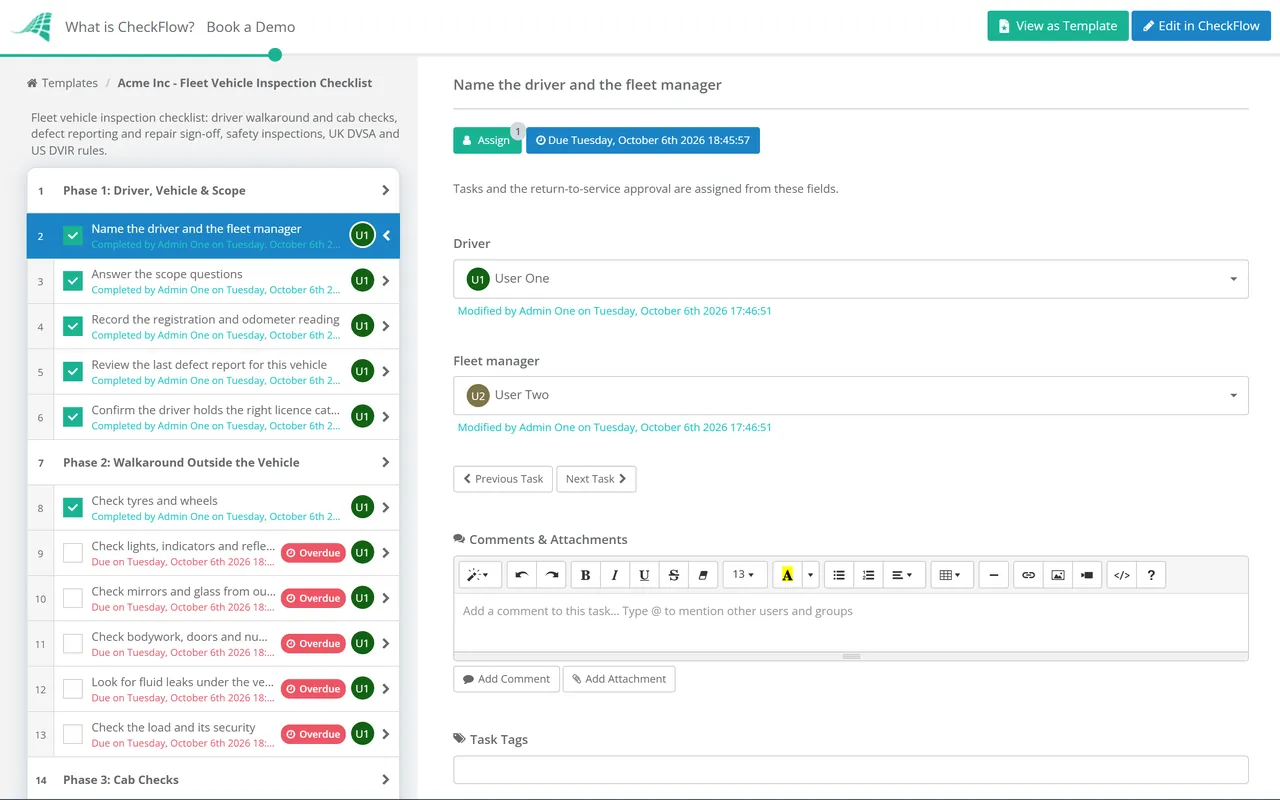
Seven phases follow a vehicle through the working day. Phase 4 appears only for trucks, trailers and passenger vehicles, most of Phase 5 only when a defect is reported, and Phase 6 only on the day a periodic safety inspection is due.
The scope questions decide whether the heavy vehicle and safety inspection phases appear.
Shown only when the vehicle is a truck, a trailer combination, a bus or a minibus.
Every task after the first is shown only when a defect is reported.
Shown only on the day a periodic safety inspection or annual inspection is due.
Both countries put the daily check on the driver and the maintenance system on the operator. The UK expects a record of every check; the US requires a written report only when there is a defect. Cars and light vans follow the table.
| Requirement | United Kingdom (Great Britain) | United States (FMCSA) |
|---|---|---|
| Which vehicles | An operator licence is needed for goods vehicles over 3,500 kg gross plated weight, and since 21 May 2022 for vans over 2,500 kg used internationally for hire or reward | Part 396 applies to commercial motor vehicles in interstate commerce, which includes vehicles rated at 10,001 lb or more |
| Daily check | The driver carries out a walkaround check before the journey; results are recorded and safety defects fixed before the vehicle is driven. Daily checks are among the commitments operators make to get the licence | 49 CFR 396.13: before driving, the driver must be satisfied the vehicle is safe, review the last inspection report and sign it to acknowledge any repairs |
| Defect report | Drivers report defects in writing to the person responsible for repairs; operators keep a system for recording defects and the rectification work | 49 CFR 396.11: a written report at the end of each day’s work listing defects that would affect safety, covering at least brakes, steering, lights, tyres, horn, wipers, mirrors, coupling devices, wheels and rims, and emergency equipment. No report is needed when there is no defect: property carriers since the 2014 rule, passenger carriers since 2020 |
| Repair sign-off | The defect record shows who it was reported to, what was done and who resolved it | The carrier certifies the repair, or that none is needed, before the vehicle is used again; the next driver signs to acknowledge it |
| Periodic inspection | Safety inspections at the intervals declared on the licence, planned by ISO week; DVSA recommends no more than six weeks for vehicles and trailers aged 12 years or more, and since April 2025 expects a laden brake performance assessment at every inspection. Lorries also need an annual test from 12 months after first registration | 49 CFR 396.17: a periodic inspection at least once every 12 months, with the report or a decal carried on the vehicle |
| Record retention | Maintenance records, including driver defect reports, kept for at least 15 months | Inspection reports and repair certifications for 3 months; annual inspection reports for 14 months; maintenance records for 1 year, and 6 months after the vehicle leaves your control |
Digital records are fine. In February 2026 FMCSA added wording to 396.11 and 396.13 confirming that driver vehicle inspection reports may be completed and signed electronically, effective 23 March 2026; paper remains legal. In the UK, DVSA’s Guide to Maintaining Roadworthiness describes what a good maintenance system looks like and is the reference to check your own records against.
Cars and vans are not exempt from care. In Great Britain, HSE expects employers to manage the risks of driving for work through a risk assessment covering the journey, the driver and the vehicle, and that includes employees’ own cars used on business, the “grey fleet”. Those vehicles should be checked, serviced, insured and hold a valid MOT, needed from three years old and yearly after, though HSE notes an MOT covers only basic defects. In the US, vehicles under 10,001 lb fall outside Part 396, so their checks are set by your own fleet policy, your insurer and any state inspection programme. The same walkaround and defect route closes the gap.
A daily schedule creates the checklist for each vehicle before the shift starts, assigned to the driver, so a missed check shows as an open task.
The vehicle-type answer shows coupling and passenger checks only where they belong, and a “no defects” answer hides the defect tasks. Drivers complete it on a phone browser with photos from the camera.
A vehicle taken off the road waits on the fleet manager’s approval, and the checklist stops until they answer. Every report, photo and repair note is kept with who did what and when, ready to export for an audit.
Workshop repairs that come out of a defect report can run through the Equipment Servicing Workflow Checklist, and the Preventive Maintenance Checklist keeps service and inspection compliance for the fleet alongside the rest of your assets.
Depots and yards need their own checks: the Facility Inspection Checklist covers the buildings, and the Fire Risk Assessment Checklist covers fuel stores, charging areas and workshops. See how recurring checklists run daily checks across every vehicle and site.

Forklift Pre-Use Inspection Checklist
Preventive Maintenance Checklist

Equipment Servicing Workflow Checklist

DOT Compliance Audit Checklist

Commercial Driver Onboarding Checklist
Describe the process in a sentence and the AI checklist generator drafts the phases and tasks for you.
For lorries and other vehicles run under a UK operator licence, yes: drivers must check the vehicle is safe before the journey, and daily checks are part of the operator’s licence commitments. In the US, 49 CFR 396.13 requires the driver of a commercial motor vehicle to be satisfied it is safe before driving. For cars and light vans the employer’s duty is more general.
Not under federal rules. FMCSA dropped the no-defect report requirement for property-carrying vehicles in December 2014 and for passenger-carrying vehicles in August 2020. A written report is still required whenever a defect is found or reported, and carriers may still require no-defect reports, which makes a missed check easier to spot.
In the UK, at the interval declared on the operator licence; DVSA recommends no more than six weeks for vehicles and trailers aged 12 or more. In the US, commercial motor vehicles need a periodic inspection at least every 12 months. Cars and vans should follow the manufacturer’s service schedule plus the MOT or any state inspection.
UK operators should keep maintenance records, including driver defect reports, for at least 15 months. In the US, driver vehicle inspection reports and repair certifications must be kept for three months, annual inspection reports for 14 months, and maintenance records for a year and for six months after the vehicle leaves your control.
The driver records it in writing with a photo and reports it to whoever decides on repairs. If it affects safety, the vehicle stays off the road until repaired. The repair, or the decision that none is needed, is signed off, and the next driver reviews it before setting off.
14-day free trial, no card required. The Business plan is $10 per user per month after the trial. Full details at checkflow.io/pricing.
14-day free trial, no credit cardFull refund in your first 30 daysUS hosting, EU on request