Commercial Driver Onboarding Checklist Template

A new driver is booked to start on Monday, but the Clearinghouse query was never run, the road test certificate is missing from the file, and nobody knows when the 30 days for the previous employer replies run out.

Last reviewed: October 2026

This free commercial driver onboarding checklist is for safety managers, recruiters and driver trainers at US motor carriers hiring CDL drivers. It follows the FMCSA rules for carriers in interstate commerce; a carrier that operates only within one state follows the rules its state has adopted, which can differ. One run covers one new driver, from the employment application to the first unsupervised trip. It builds the driver qualification file under 49 CFR Part 391, runs the Clearinghouse pre-employment query and the drug test under Part 382, verifies the medical certification and the road test or an accepted equivalent, and covers hours of service, the ELD and vehicle inspection reports during orientation. A trainer rides along on the first trip, and the safety manager signs the driver off before they work alone. Answers on the first task add the previous employer checks, the hazardous materials phase and the steps for a drug and alcohol violation when they apply. For the walkaround and defect reports once the driver is on the road, use the Fleet Vehicle Inspection Checklist.

Three Sets of Rules Before One Solo Trip

Before a new driver can drive a commercial motor vehicle for you, three sets of federal rules have to be met. Part 391 of the Federal Motor Carrier Safety Regulations sets who is qualified to drive and what goes in the driver qualification (DQ) file: the application, the motor vehicle records, the road test or an accepted equivalent and the medical certification. Part 382 sets the drug and alcohol checks: a Clearinghouse full query and a verified negative pre-employment drug test before any safety-sensitive function. Parts 395 and 396 set the hours of service, the ELD and the vehicle inspection reports the driver is checked against at the roadside.

Some of it must be done before the driver drives, and some can follow. The previous employer replies and the motor vehicle records have 30 days from the start date; the Clearinghouse query, the drug test result, the medical certification and the road test do not. Keeping those two clocks apart is what stops a driver being dispatched with a gap in the file.

This checklist covers the regulated steps for one CDL driver. General hiring checks such as identity, references and criminal records belong in the Pre-Employment Background Check Checklist, the Form I-9 in the Form I-9 & E-Verify Checklist, and payroll and benefits in the Employee Onboarding Checklist.

Part 391

Qualify the driver

Covers: the application, motor vehicle records, previous employer history, the road test or equivalent and the medical certification.

Owned by: the safety manager and the recruiter.

Output: a complete DQ file and a driver investigation history file.

Part 382

Clear drug and alcohol

Covers: the policy materials, Clearinghouse consent and full query, the pre-employment drug test and the random pool.

Owned by: the safety manager.

Output: a verified negative result and no prohibition before any safety-sensitive function.

Parts 395 and 396

Induct and sign off

Covers: the 7-day duty statement, hours of service, the ELD account and packet, inspection reports, company policies and a supervised first trip.

Owned by: the driver trainer and the fleet manager, with the safety manager’s sign-off.

Output: a driver released to dispatch, with renewal dates set.

What the Commercial Driver Onboarding Checklist Covers

Eight phases take one new driver from the application to the first unsupervised trip. The answers on the first task decide which employer checks appear and whether the hazardous materials phase is added. Phase 4 appears only when a drug and alcohol violation is found, the road test tasks only when you give the test yourself, and nothing after the safety manager’s sign-off can be completed until it is given.

  1. Phase 1 — Before Hire

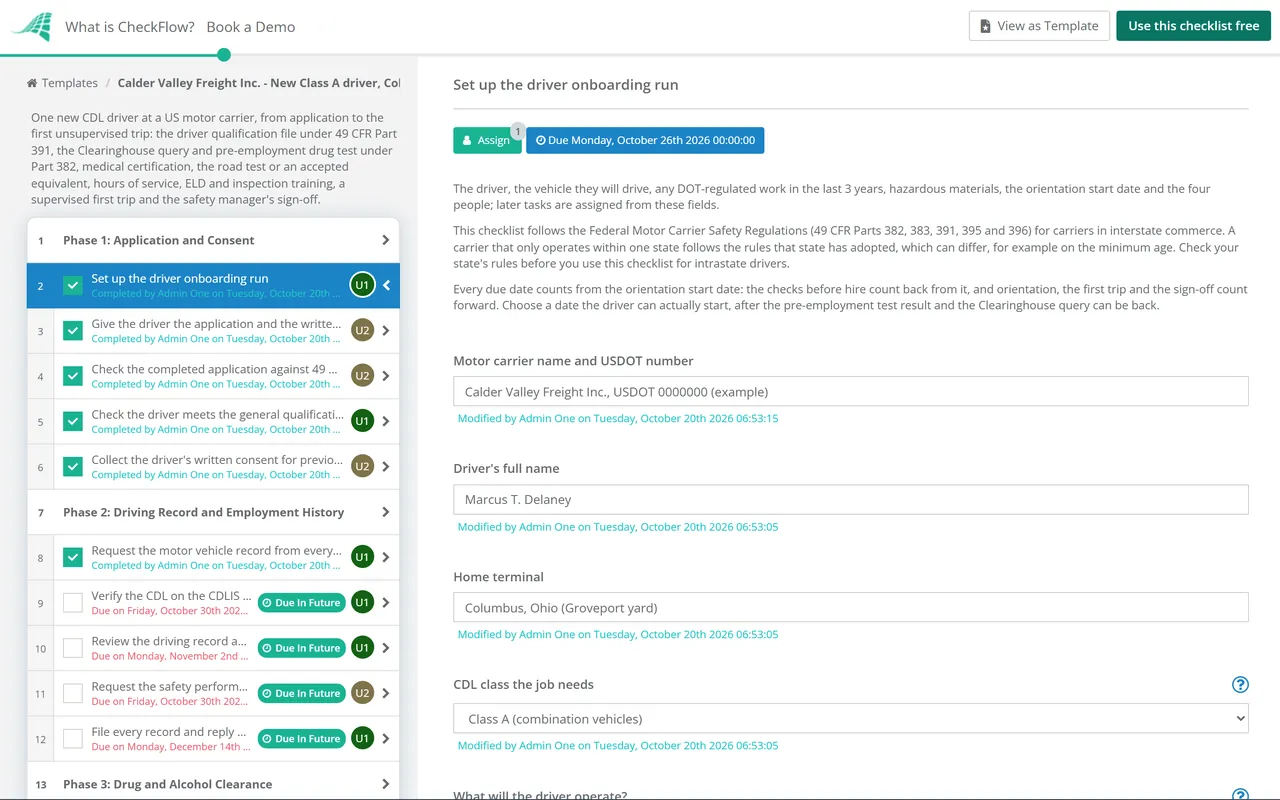
    Phase 1: Application and Consent

    5 tasks

    Part 391 starts with paperwork the driver completes and signs. Give the application and the notices before the driver fills it in, and collect the consents the later checks depend on. The answers on the first task decide which tasks appear.

    • Set up the driver onboarding run — the driver, the vehicle they will drive, any DOT-regulated work in the last 3 years, hazardous materials, the orientation start date and the four people; later tasks are assigned from these fields
    • Give the driver the application and the written notices — your employment application form, the notice that previous employers will be contacted to investigate their safety performance history, and written notice of their rights to review, correct and rebut what those employers send
    • Check the completed application against 49 CFR 391.21 — every item is filled in and the driver has signed the certification at the end; send back anything incomplete before you rely on it
    • Check the driver meets the general qualifications — at least 21 years old, reads and speaks English well enough for the job, can safely operate the vehicle by experience or training, holds one valid CDL from one state, and is not disqualified
    • Collect the driver’s written consent for previous employers — specific written consent for each previous employer to release the driver’s drug and alcohol history to you; a driver who refuses must not operate a commercial motor vehicle for you
  2. Phase 2 — Before Hire

    Phase 2: Driving Record and Employment History

    7 tasks

    Check the license and driving record first, because a driver without the right CDL class or endorsements cannot be used at all. Then ask the previous employers. The motor vehicle records and the employer replies, or proof of your good-faith efforts, must be on file within 30 days of the start date.

    • Request the motor vehicle record from every state that licensed the driver — each state where the driver held a license or permit in the last 3 years, covering 3 years of driving; from the current licensing state, get the CDLIS motor vehicle record
    • Verify the CDL on the CDLIS record — the class, endorsements and restrictions fit the vehicle and loads you will assign, the license is current and not disqualified, the driver holds only one, and the type of operation the driver self-certified is recorded
    • Review the driving record against your hiring standard — accidents and convictions in the last 3 years, giving great weight to speeding, reckless driving and driving under the influence, which show a disregard for public safety
    • Request the safety performance history from previous DOT-regulated employers — employment verification and accidents from every employer that had the driver operate a CMV in the last 3 years, with a written record of each contact
    • Request drug and alcohol history from employers regulated by another DOT agency — the Clearinghouse holds only FMCSA records, so ask each FAA, FRA, FTA, PHMSA or USCG-regulated employer from the last 3 years directly, with the driver’s written consent
    • Record that no previous employer investigation was possible — a dated note in the driver investigation history file that the driver had no DOT-regulated employment in the last 3 years
    • File every record and reply within 30 days of the start date — the motor vehicle records in the DQ file, and each previous employer reply or your documented good-faith efforts in the driver investigation history file
  3. Phase 3 — Before Any Safety-Sensitive Work

    Phase 3: Drug and Alcohol Clearance

    6 tasks

    Two results must be in hand before the driver performs any safety-sensitive function, which includes inspecting, loading and waiting to be dispatched as well as driving: a Clearinghouse full query with no prohibition and a verified negative pre-employment drug test.

    • Give the driver your drug and alcohol policy materials — the educational materials on Part 382 and your own policies, with the person who answers questions about them, and a signed certificate that the driver received them
    • Get the driver’s consent for the Clearinghouse full query — the driver’s written or electronic consent to the query, then their electronic consent given through the Clearinghouse itself before it releases their record to you
    • Run the Clearinghouse pre-employment full query — a full query, which tells you whether the driver has a positive, adulterated or substituted drug test, an alcohol test of 0.04 or higher, a refusal or a reported violation, and whether return-to-duty is complete
    • Send the driver for the pre-employment drug test — a DOT controlled substances test under 49 CFR Part 40 at a collection site, plus an alcohol test only if your policy tests every new driver
    • Receive the verified result from the medical review officer — the driver cannot perform any safety-sensitive function until you have received a verified negative result from the MRO or your consortium or third-party administrator
    • Record the drug and alcohol outcome — cleared only when the Clearinghouse query shows no prohibition, the pre-employment test is a verified negative and no previous employer reported a violation without completed return-to-duty
  4. Phase 4 — If a Violation Is Found

    Phase 4: If a Violation Is Found

    4 tasks

    Applies only when the drug and alcohol outcome records a violation; otherwise its tasks stay hidden. The driver must not perform any safety-sensitive function until the return-to-duty process in 49 CFR Part 40, subpart O, is complete, and you are not required to hire them once it is.

    • Keep the driver away from every safety-sensitive function — no driving, inspecting, loading, waiting to be dispatched or riding in the vehicle on duty, and tell dispatch and the trainer today
    • Give the driver a list of substance abuse professionals — names, addresses and phone numbers of SAPs readily available to the driver and acceptable to you, free of charge, including when the driver is only an applicant
    • Decide whether to continue with the hire — withdraw the offer, or continue once the driver has completed the SAP process and a negative return-to-duty test
    • Confirm return-to-duty is complete before any safety-sensitive work — the SAP’s report of successful compliance, a negative return-to-duty test and the follow-up testing plan, all shown in a new Clearinghouse full query
  5. Phase 5 — Before Driving

    Phase 5: Medical Certification and Road Test

    4 tasks

    The driver must be medically certified and have passed a road test, or shown an accepted equivalent, before driving for you. The road test tasks appear only when you give the test yourself.

    • Verify the medical certification on the CDLIS record — a valid medical certification and any medical variance, shown on the CDLIS motor vehicle record from the current licensing state, before the driver operates a CMV
    • Decide on the road test or an accepted equivalent — give a road test in the vehicle you will assign, or accept a valid CDL earned with a road test in that type of vehicle, or a road test certificate issued in the last 3 years
    • Give the road test in the vehicle you will assign — by a person competent to judge the driver, long enough to judge their skill, covering the eight operations in 49 CFR 391.31(c), each rated on your road test form
    • Issue the certificate of road test — in substantially the form in 49 CFR 391.31(f), signed by the examiner; give the driver a copy and keep the signed form and the certificate in the DQ file
  6. Phase 6 — If Hazmat

    Phase 6: If Hauling Hazardous Materials

    3 tasks

    Applies only when the driver will haul hazardous materials that require placards; otherwise its tasks stay hidden. The driver needs the H endorsement before the first hazmat load, and hazmat training within 90 days of starting, working under direct supervision until it is done.

    • Confirm the hazardous materials (H) endorsement — the H endorsement is on the CDLIS record, and its expiry date is recorded so it can be renewed in time
    • Give the driver hazmat training — general awareness, function-specific, safety and security awareness training, within 90 days of the start date, with direct supervision by a trained hazmat employee until it is complete
    • Record the hazmat training and set the recurrent date — the driver’s name, the date of the most recent training, the training materials used, the trainer’s name and address and a certification that the driver was trained and tested; recurrent training is due at least every 3 years
  7. Phase 7 — Orientation

    Phase 7: Hours of Service, ELD and Inspections

    7 tasks

    Orientation starts on the anchor date. It covers the rules the driver is checked against at roadside: hours of service, the ELD and its information packet, the pre-trip inspection and the driver vehicle inspection report.

    • Get the driver’s signed statement of the last 7 days on duty — the total time on duty in the 7 days before they start with you and the time they were last relieved from duty
    • Train the driver on the hours-of-service limits that apply — the driving limit, the on-duty window, the 30-minute break where it applies and the 60- or 70-hour limit, with your own scheduling rules
    • Create the driver’s ELD account — on an ELD listed on FMCSA’s registered ELD list, with the driver’s name as on the license, the license number and issuing state, and a unique username that is not the license or Social Security number
    • Train the driver on the ELD and its information packet — logging in, recording duty status, sending records to an officer and what to do when the ELD malfunctions; the packet in the cab holds both instruction sheets and blank duty-status grids for at least 8 days
    • Train the driver on the pre-trip inspection and the inspection report — check the parts in 49 CFR 392.7 before driving, review and sign the last inspection report, and at the end of each day write a signed report of any defect found on each vehicle driven
    • Walk the driver through company policies and their reporting duties — your safety and accident procedures, and the driver’s duty to tell you of a license suspension by the end of the next business day and of any traffic conviction within 30 days
    • Enroll the driver in the random testing pool — every covered driver must be in the random pool, where each driver has an equal chance of selection every time and tests are unannounced
  8. Phase 8 — First Trip

    Phase 8: Supervised First Trip and Sign-Off

    8 tasks

    A trainer rides along on the first trip before the safety manager signs the driver off for unsupervised work. Nothing after that sign-off can be completed until it is given.

    • Confirm every requirement for driving is in the file — the signed application, consent, a clear Clearinghouse query, a verified negative test, medical certification, the road test or equivalent, and a CDL that fits the job
    • Plan the supervised first trip — a route, load and vehicle typical of the work the driver will do, and the trainer who rides along
    • Ride along on the first trip — the trainer watches the pre-trip inspection, ELD use, driving, any coupling, delivery and the end-of-day inspection report
    • Debrief the driver and recommend a decision — what went well, what needs practice and the trainer’s recommendation to the safety manager
    • Safety manager signs the driver off for unsupervised trips — the DQ file, the drug and alcohol clearance and the first trip together; nothing after this can be completed until the decision is recorded
    • Release the driver to dispatch — add the driver to the dispatch schedule with any conditions from the sign-off
    • Set the renewal dates for this driver — the medical certification expiry, the annual motor vehicle record inquiry and review, the annual Clearinghouse query and the CDL expiry
    • Close the onboarding file — the DQ file holds everything 49 CFR 391.51(b) lists, and it is kept for as long as the driver works for you and three years after

What Must Be Done Before the First Drive, and What Can Follow

Every item below is taken from the current eCFR text of 49 CFR Parts 172, 382, 391 and 395 and the Part 40 testing procedures. The first rows must be in place before the driver drives or performs any safety-sensitive function; the later rows have their own clocks.

Requirement Rule (49 CFR) When
Signed employment application391.21Before the driver drives
Driver’s written consent for previous employers to release drug and alcohol information391.23(f)(1)Before the driver drives; without it, the driver must not operate a CMV for you
Clearinghouse pre-employment full query, with the driver’s consent given in the Clearinghouse382.701(a), 382.703Before any safety-sensitive function
Verified negative pre-employment drug test382.301(a)Before any safety-sensitive function, unless the exception in 382.301(b) applies
Medical certification verified and placed in the DQ file391.23(m), 391.51(b)(6)Before the driver operates a CMV
Self-certified type of operation verified from the CDLIS record391.23(m)(2)(i)Before the driver operates a CMV
Road test certificate, or a CDL or certificate accepted as its equivalent391.31, 391.33Before the driver drives
Drug and alcohol policy materials and a signed certificate of receipt382.601Given to every driver hired
Signed statement of time on duty in the previous 7 days395.8(j)(2)When the driver is used for the first time
Motor vehicle record from each state that licensed the driver in the last 3 years391.23(a)(1), (b)In the DQ file within 30 days of the start date
Safety performance history from previous DOT-regulated employers, or documented good-faith efforts391.23(a)(2), (c), (d)In the investigation history file within 30 days of the start date
Drug and alcohol history from employers regulated by another DOT agency382.413(c), and 40.25(d) in Part 40Before safety-sensitive functions if feasible; no safety-sensitive functions after 30 days without it or a documented good-faith effort
Hazmat training, for drivers who haul placarded hazardous materials172.704(c)(1)Within 90 days of starting, under direct supervision until it is done

Medical certification since June 23, 2025. A medical examiner now gives a paper certificate only to a driver who does not need a CDL or permit. For a CDL holder, the carrier reads the medical certification status on the CDLIS motor vehicle record from the current licensing state, and an interstate CDL holder with no status on that record is not certified for interstate driving.

Every year after. Get and review a new motor vehicle record at least once every 12 months (391.25), query the Clearinghouse at least once a year (382.701(b)), and keep the DQ file for as long as the driver works for you and three years after (391.51(c)).

Why Run Commercial Driver Onboarding in CheckFlow?

1

No solo trip without the safety manager

The safety manager’s sign-off is assigned to them, and the checklist halts there: the release to dispatch and everything after it cannot be completed until the decision is recorded. See how approvals that halt a checklist work.

2

Only the checks this driver needs

Four answers on the first task decide what appears: the previous employer requests for drivers with DOT-regulated work in the last 3 years, the hazardous materials phase, the passenger or property hours-of-service limits, and a road test note for doubles, triples and tank vehicles. A drug and alcohol violation adds the return-to-duty steps. Change any of it with conditional rules.

3

Two clocks, one start date

The checks before hire count back from the orientation start date and the 30-day filing task counts forward from it, so the 391.23 deadlines land on the right day. The Reports Grid shows every driver being onboarded and what is still open, and the annual reviews can run as a recurring checklist.

CheckFlow does not decide whether a driver is qualified, and it is not legal advice, a Clearinghouse account or an ELD. It runs the onboarding steps in the same order for every driver, with a record of who did what and when.

This template covers one new driver. Check the vehicle before each trip with the Fleet Vehicle Inspection Checklist, run general hiring checks with the Pre-Employment Background Check Checklist, and onboard the warehouse staff who load the trucks with the Warehouse Employee Onboarding Checklist. Onboarding drivers at several terminals? CheckFlow’s HR checklist software keeps owners, evidence and sign-offs in one place.

AI generator

Didn’t find what you need? Describe it.

Describe the process in a sentence and the AI checklist generator drafts the phases and tasks for you.

Frequently Asked Questions

What goes in a driver qualification file?

Under 49 CFR 391.51(b), the driver qualification (DQ) file holds the employment application, the motor vehicle record from each state that licensed the driver in the last 3 years, the road test certificate or the license or certificate accepted as its equivalent, each annual motor vehicle record with the note of its review, the medical certification (for a CDL holder, the CDLIS motor vehicle record that shows it) and any medical variance. Keep it for as long as the driver works for you and three years after. The previous employer replies go in a separate driver investigation history file (391.53).

How long do you have to check a new driver’s previous employers?

The motor vehicle records and the safety performance history from previous DOT-regulated employers, or documentation of your good-faith efforts to get them, must be on file within 30 days of the date the driver’s employment begins (49 CFR 391.23(b), (c)). Previous employers must answer within 30 days of receiving your request. If the driver had no DOT-regulated employment in the last 3 years, record that no investigation was possible. The Clearinghouse query and the drug test result are different: both must come before any safety-sensitive function.

What is a Clearinghouse pre-employment query?

A full query of FMCSA’s Drug and Alcohol Clearinghouse, which an employer must run before a CDL driver performs any safety-sensitive function for it (49 CFR 382.701(a)). It shows verified positive, adulterated or substituted drug tests, alcohol tests of 0.04 or higher, refusals and reported violations, and whether the return-to-duty process is complete. The driver must first give consent electronically in the Clearinghouse. Since January 6, 2023, the query is also how you get drug and alcohol history from FMCSA-regulated previous employers.

Does every new driver need a pre-employment drug test?

Yes, unless the exception in 49 CFR 382.301(b) applies: the driver took part in a Part 382 testing program in the last 30 days, was tested in the last 6 months or was in a random program for the last 12 months, and no prior employer you know of has a violation on record from the last 6 months. You must get and keep the program’s details to use it. The driver cannot perform safety-sensitive functions until you receive a verified negative result. Pre-employment alcohol testing is optional, but if you do it you must test every new driver.

Can a CDL replace the road test?

It can. Under 49 CFR 391.33 a carrier may accept, as the equivalent of its own road test, a valid CDL that the state issued after a road test in the type of vehicle the carrier will assign, or a road test certificate issued in the last 3 years. The CDL equivalent does not include the double or triple trailer or tank vehicle endorsements. Keep a legible copy in the DQ file. You may still require a road test from anyone who presents an equivalent.

How do I check a new CDL driver’s medical certification?

Since June 23, 2025, a medical examiner gives a paper certificate only to drivers who do not need a CDL or permit. For a CDL holder, get the CDLIS motor vehicle record from the current licensing state and check that it shows a valid medical certification and any variance before the driver operates a commercial motor vehicle (49 CFR 391.23(m), 391.51(b)(6)). An interstate CDL holder with no medical certification status on the record is not certified. A certification lasts up to 24 months, or less for some conditions.

What happens if a new driver fails the drug test or the query shows a violation?

The driver must not perform any safety-sensitive function, including driving, inspecting or loading a vehicle (49 CFR 382.501, 382.701(d)). Give them a list of substance abuse professionals, free of charge, even if they are only an applicant (49 CFR 40.287). They can return only after the SAP process and a negative return-to-duty test, and you are not required to hire them once they have (40.305). If they have completed return-to-duty but not their follow-up tests, you may hire them only if you take on that follow-up testing.

Is CheckFlow free for this template?

14-day free trial, no card required. The Business plan is $10 per user per month after the trial. Full details at checkflow.io/pricing.

Every New Driver Qualified Before the First Solo Trip

Free trial — no credit card required.

14-day free trial, no credit cardFull refund in your first 30 daysUS hosting, EU on request