Operator Licence Compliance Checklist (UK)

One review of a goods vehicle operator licence in Great Britain: the undertakings, the money, the transport manager, maintenance, drivers and tachographs checked against evidence, every change reported, and a director’s sign-off.

Last reviewed: November 2026

Printed from checkflow.io/templates/transport-logistics/operator-licence-compliance-checklist

This free operator licence compliance checklist is for transport managers and directors of goods vehicle operators in Great Britain. One run is one review of one licence, planned around the review date; the template plans one each quarter. It checks the licence on the Vehicle Operator Licensing service, its conditions and undertakings, the vehicles specified and the operating centres, then financial standing and the transport manager’s continuous and effective management. It samples the maintenance system against DVSA’s Guide to maintaining roadworthiness: safety inspections on time, brake tests, the planner, annual tests, walkaround checks and defect reports. It checks drivers’ licences and Driver CPC, tachograph downloads, infringements and calibrations, the Operator Compliance Risk Score and every DVSA encounter, and the changes the traffic commissioner must be told about within 28 days. A director signs the review off before the actions are closed and the next quarter’s run starts. Bus and coach operators and Northern Ireland have their own rules, named where they differ.

Operator Licence Compliance, Fleet Vehicle Inspection or DOT Compliance Audit?

An operator licence compliance checklist checks that a goods vehicle operator still meets the promises its licence was granted on: the conditions and undertakings, financial standing, the transport manager’s management, maintenance, drivers’ hours and the changes it must report. This one runs one review of one licence in Great Britain, planned in this template each quarter, from the records to a director’s sign-off and the actions that follow.

It is the licence-level review, and it links to the checklists that hold the daily work. The Fleet Vehicle Inspection Checklist is the driver’s walkaround check and the periodic inspection that this review samples. The DOT Compliance Audit Checklist is the US equivalent, for a motor carrier under FMCSA rules. A road collision involving a company vehicle runs on the Vehicle Accident Reporting Checklist, and the year’s fixed dates, such as the licence continuation and the earned recognition audit, can sit on the Annual Compliance Calendar Checklist.

This checklist

Operator licence review

Covers: the licence and its undertakings, financial standing, transport management, inspections and maintenance, walkaround checks, drivers and drivers’ hours, the OCRS, changes to report, findings and a director’s sign-off.

Planned around: the review date; this template plans one each quarter.

Output: a signed review with an action plan, and every change reported to the traffic commissioner.

The daily check

Fleet vehicle inspection

Covers: the driver’s walkaround check before a vehicle goes out, defects and the periodic safety inspection.

Planned around: each vehicle and each day it is used.

Output: a defect report and a vehicle fit to drive, in the Fleet Vehicle Inspection Checklist.

The US carrier

DOT compliance audit

Covers: a US motor carrier’s self-audit of driver files, hours of service, drug and alcohol testing and maintenance under FMCSA rules.

Planned around: the audit date.

Output: an audit report and corrective actions, in the DOT Compliance Audit Checklist.

What the Operator Licence Compliance Checklist Covers

Nine phases take one goods vehicle operator licence through one review. The first task records the review date, which sets every due date, and says which licence the operator holds, whether vehicles go abroad and whether the operator is in DVSA earned recognition. A standard licence adds the transport manager’s management and qualification checks; a restricted licence adds a task to record who manages transport instead. Journeys outside the UK add their records and documents, earned recognition adds its KPI reports, a prohibition or offence adds an investigation, and a change not yet reported adds the report to the traffic commissioner, before the sign-off. A director signs the review off: the checklist halts there, and Not approved keeps it halted and adds a task to put right what the director asked for.

  1. Phase 1

    Phase 1: Set Up the Review

    3 tasks

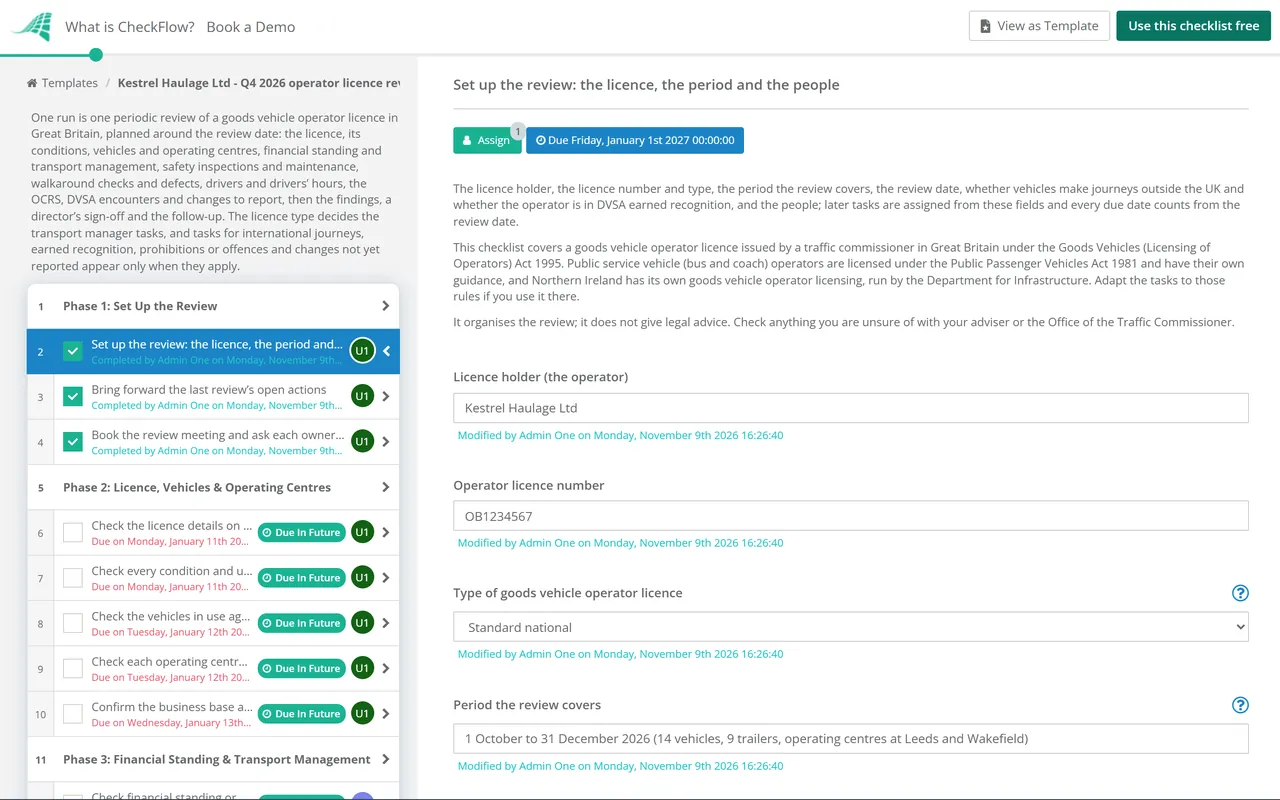
    Owned by the transport manager. Enter the review date on the first task: the day the transport manager and a director meet to go through the findings. The records are checked in the three weeks before it and the actions follow it. The first task also says which licence the operator holds, whether vehicles go abroad and whether the operator is in DVSA earned recognition, which decides the tasks that show.

    • Set up the review: the licence, the period and the people — the licence holder, the licence number and type, the period the review covers, the review date, whether vehicles make journeys outside the UK and whether the operator is in DVSA earned recognition, and the people; later tasks are assigned from these fields and every due date counts from the review date
    • Bring forward the last review’s open actions — every action from the last review that is not closed, with its owner and date, and anything the traffic commissioner or DVSA has asked for since
    • Book the review meeting and ask each owner for their records — the meeting booked with the director for the review date, and each person asked for the records they hold for the period: maintenance files, defect reports, tachograph analysis, driver licence checks, bank statements
  2. Phase 2

    Phase 2: Licence, Vehicles & Operating Centres

    5 tasks

    The licence itself: what it authorises, the conditions and undertakings it records, the vehicles specified on it and the operating centres where they are kept. A traffic commissioner can revoke, suspend or curtail a licence when a condition is broken or an undertaking is not kept, so each one is checked against evidence.

    • Check the licence details on the Vehicle Operator Licensing service — the licence type, the vehicles and trailers authorised, the operating centres, the transport managers named, the correspondence address and the date the licence must next be continued; anything out of date is a change to report in Phase 7
    • Check every condition and undertaking on the licence is kept — each condition and undertaking written on the licence, how it is kept and the evidence for the period: for example a maintenance contract, an inspection interval, an independent audit or the hours vehicles may leave an operating centre
    • Check the vehicles in use against the authorisation and the licence discs — every vehicle in use specified on the licence, none over the number authorised, vehicles that were sold or off-hired removed, and a current disc displayed in each one
    • Check each operating centre is used as authorised — vehicles and trailers kept only at the operating centres on the licence, the numbers at each within its authorisation, and any conditions on the site, such as hours or where vehicles park, kept
    • Confirm the business base and the address for service — for a standard licence, premises in Great Britain where the core business records are kept, not a PO box; for every licence, an address for official letters and emails that is current and checked
  3. Phase 3

    Phase 3: Financial Standing & Transport Management

    4 tasks

    A standard licence needs appropriate financial standing and a transport manager who manages the transport service effectively and continuously; a restricted licence needs sufficient financial resources. A director checks the money, and the transport manager records how the transport service was managed. The licence type on the first task decides which management task shows.

    • Check financial standing or financial resources for the vehicles authorised — the amount the licence needs for the number of vehicles authorised, against the average balance of the operator’s own accounts over the last three months, with any overdraft or facility agreed in writing
    • Confirm the transport manager’s continuous and effective management — the hours the transport manager worked each week against the hours declared, the work they did on maintenance, drivers, drivers’ hours and audits, and any time they could not do the job and told the operator in writing
    • Check the transport manager’s qualification and training — the Certificate of Professional Competence on file, the date it was issued, and the refresher training or continuing professional development done
    • Record who manages transport on the restricted licence — a restricted licence needs no transport manager, so record who looks after maintenance, drivers’ licences, drivers’ hours and the records, and the training they have had
  4. Phase 4

    Phase 4: Safety Inspections & Maintenance

    7 tasks

    Every licence holder promises satisfactory arrangements for keeping vehicles fit and serviceable. DVSA’s Guide to maintaining roadworthiness is the starting point traffic commissioners use, so each check here follows it: inspections on time and signed off, a brake assessment at each one, a planner six months ahead, annual tests, recalls and vehicles off the road.

    • Check every safety inspection was done within its interval — the inspection intervals for vehicles and trailers recorded on the licence, and each inspection due in the period against the date it was done; any late or missed inspection with the reason
    • Check each inspection record is complete and signed off — every inspection sheet showing the items checked, the defects found, the repairs and who repaired them, and a signature that the vehicle is roadworthy; records kept for at least 15 months
    • Check a brake performance assessment was done at every inspection — a laden roller brake test, an electronic braking performance monitoring report for a trailer, or a decelerometer test with temperature readings at each inspection, with a risk assessment where a laden test was not done
    • Check the maintenance planner runs at least six months ahead — safety inspection dates set at least six months ahead for every vehicle and trailer, with annual test dates, tachograph calibration dates and any other testing in the same planner
    • Check the annual test (MOT) results for every vehicle and trailer — each annual test in the period, whether it passed first time, the reasons for any failure, and every test date ahead in the planner; the results are on the MOT history service
    • Check safety recalls and vehicles off the road — every safety recall recorded and put right, and each vehicle declared off the road recorded with the date and reason; a vehicle that missed an inspection while off the road inspected before it returned to service
    • Check the maintenance contract and the inspection facilities — where inspections are contracted out, a written agreement with the provider that covers the intervals, the brake testing and the records; where they are done in house, the facilities and the inspectors’ training
  5. Phase 5

    Phase 5: Walkaround Checks & Defect Reporting

    4 tasks

    The daily walkaround check is the driver’s check before each use. This phase checks the system around it: a check every day a vehicle is used, every defect reported in writing, assessed and repaired before the vehicle goes out, and inspection findings compared with what drivers reported. The check itself runs on the Fleet Vehicle Inspection Checklist.

    • Check a walkaround check was recorded every day each vehicle was used — a sample of days for each vehicle against its defect reports or nil reports, with the time drivers spend on the check where tachograph data shows it
    • Check every reported defect was assessed and repaired before use — each defect report with the defect, who it was reported to, the assessment, the repair and the date, and no vehicle used with a safety defect outstanding
    • Compare inspection findings with drivers’ defect reports — defects found at safety inspections that a walkaround check should have found, and what was done about the drivers’ checks
    • Check height indicators and load information in the cabs — an overall height indicator in the cab of every vehicle over 3 metres high, showing the right height for the vehicle, trailer and load, and drivers told the vehicles’ payloads
  6. Phase 6

    Phase 6: Drivers, Drivers’ Hours & Tachographs

    9 tasks

    Drivers’ licences, Driver CPC and training, then the tachograph downloads, the infringements found and what was done about them. Rules for goods vehicles follow DVSA’s drivers’ hours guide (GV262), which covers the assimilated rules and the GB domestic rules. Journeys outside the UK add a task for their records and documents.

    • Check every driver’s licence entitlement and penalty points — each driver’s licence checked with DVLA with the driver’s permission, the categories they hold for the vehicles they drive, their penalty points and the date of the next check
    • Check each driver’s Driver CPC card and training deadline — a valid Driver CPC card for every professional driver, the 5-year deadline on each card, and the training each driver still needs before it
    • Check driver induction and training records — every driver, including agency drivers, trained on drivers’ hours, the tachograph, walkaround checks and defect reporting, with the dates on file
    • Check the records and documents for journeys outside the UK — drivers carrying the documents international journeys need, the licence’s UK Licence for the Community where it is required, any permits, and records kept for the days the rules ask
    • Check the vehicle units were downloaded at least every 90 days — each digital or smart tachograph vehicle unit downloaded at least every 90 calendar days, and before a vehicle was sold or off-hired
    • Check the driver cards were downloaded at least every 28 days — each driver card downloaded at least every 28 calendar days, and before a driver left, agency drivers included
    • Analyse the infringements and record the action taken with each driver — every drivers’ hours and tachograph infringement in the period from the analysis, its cause, and what was done: a talk with the driver, retraining, a change to the schedule or discipline
    • Check every tachograph calibration is in date — the calibration plaque and certificate for each vehicle: a digital or smart tachograph recalibrated every 2 years, an analogue one inspected every 2 years and recalibrated every 6
    • Check drivers’ hours and working time records are kept — drivers’ hours records kept for at least 12 months and working time records for at least 24 months, and the records can be produced when asked
  7. Phase 7

    Phase 7: OCRS, DVSA Encounters & Notifications

    6 tasks

    DVSA’s view of the operator: the Operator Compliance Risk Score, every roadside check, prohibition, offence and visit in the period, and earned recognition where the operator is in it. Then every change the traffic commissioner must be told about within 28 days. An encounter with a prohibition or offence adds an investigation task, and a change not yet reported adds the notification.

    • Check the Operator Compliance Risk Score — the roadworthiness, traffic and combined bands from the online report, any change since the last review and the events behind it
    • Record every roadside check, prohibition and DVSA contact in the period — each roadside inspection, prohibition, fixed penalty, offence, site visit or letter from DVSA or the traffic commissioner, with the vehicle or driver and the result
    • Investigate each prohibition or offence and put the cause right — for each one, why it happened, what has changed so it does not happen again, any reply DVSA or the traffic commissioner asked for, and whether it is a conviction or fixed penalty that must be reported
    • Check the earned recognition KPI reports and the next audit — the 4-weekly key performance indicator reports for the period, any KPI missed and the action agreed with DVSA, and the date of the next audit
    • Check for changes the traffic commissioner must be told about — each change in the period that must be reported within 28 days, and whether it was: the legal entity, directors or partners, the transport manager, the addresses or operating centres, convictions and fixed penalties, insolvency, or anything affecting good repute, financial standing or professional competence
    • Report each change to the traffic commissioner now — through the Vehicle Operator Licensing self service account or in writing to the Office of the Traffic Commissioner, with the date sent and the reference; do not wait for the sign-off, because the 28 days run from the change
  8. Phase 8

    Phase 8: Findings, Actions & Sign-Off

    4 tasks

    The transport manager writes up the findings and agrees an action for each gap with an owner and a date. A director then signs the review off: the checklist halts there, and Not approved keeps it halted and adds a task to put right what the director asked for. Reports to the traffic commissioner are made in Phase 7 whatever the decision.

    • Write up the findings and rate each area — each area of the review with what was found and a rating: compliant, action needed or serious, with the serious ones raised with the director straight away
    • Agree each action with an owner and a date — one action for each gap found, with the person who owns it and the date it will be closed, and the open actions brought forward from the last review
    • Put right what the director asked for — after a Not approved decision only: do what the director recorded, update the findings and the action plan, then ask the director to change the decision to Approved and complete the sign-off; reports to the traffic commissioner are made in Phase 7 and do not wait for this
    • Sign off the review and the action plan — Approved or Not approved, recorded by the director alone after going through the findings and the action plan with the transport manager
  9. Phase 9

    Phase 9: Follow-Up & Next Review

    3 tasks

    After the sign-off the findings go to drivers and staff, each action is closed by its date with evidence, and the next quarter’s review is started.

    • Brief drivers and staff on what the review found — the findings that affect them, such as walkaround checks, defect reports, card downloads or infringements, given at a briefing or a toolbox talk, with who attended
    • Close each action by its date and keep the evidence — each action in the plan closed with evidence, or moved to a new date with the reason; anything still open goes into the next review
    • File this review and start the next quarter’s run — the findings, action plan and sign-off kept with the operator’s records, and a new run started with the next review date, about three months after this one

The Rules Behind the Review, and the Figures It Checks

The rules behind the review

Each source as read on legislation.gov.uk and GOV.UK on 9 November 2026, with the date the page was last updated. The checklist’s task notes repeat the parts each task needs.

Source What it asks Where it shows
Goods Vehicles (Licensing of Operators) Act 1995, sections 13A and 13CA standard licence needs an effective and stable establishment in Great Britain, good repute, appropriate financial standing and professional competence; every licence needs satisfactory arrangements for drivers’ hours, against overloading and for maintenance, and a heavy goods vehicle licence an operating centrePhases 2 to 4
The same Act, Schedule 3, paragraph 14AA transport manager resident in the UK, of good repute, professionally competent and able to manage effectively and continuously the operator’s transport servicePhase 3
The same Act, sections 26 and 27A licence may be revoked, suspended or curtailed for a broken condition, an undertaking not kept, a material change and other grounds; a standard licence must be revoked if it no longer meets section 13A or its transport manager no longer qualifiesPhases 2 and 7
Goods vehicle operator licensing guide (GOV.UK, 2 October 2025)Changes reported within 28 days, vehicles specified on the licence, continuation every five years, and the transport manager’s duties, including licence checks usually every three months and the records keptPhases 2, 6 and 7
Senior Traffic Commissioner’s statutory document summaries (GOV.UK, 21 April 2026)Financial standing levels and evidence, the transport manager’s role and hours, external transport manager limits, reportable changes and periods of gracePhases 3 and 7
DVSA’s Guide to maintaining roadworthiness (28 April 2025)Walkaround checks and defect reports, inspection intervals, brake performance assessments, the maintenance planner, recalls and vehicles off the roadPhases 4 and 5
DVSA’s Drivers’ hours and tachographs: goods vehicles (GV262)The assimilated and GB domestic rules, downloads every 90 and 28 days, records produced for 12 months, calibration, and from 1 July 2026 light goods vehicles over 2.5 tonnes on international journeysPhase 6
Operator Compliance Risk Score and DVSA earned recognition (GOV.UK)The red, amber and green bands over a 3-year rolling period; earned recognition’s 4-weekly KPI reports, audits every 2 years and the blue bandPhase 7

Intervals and figures

The intervals and amounts the review checks, each as its source gives it. The operator’s own licence, with its conditions, undertakings and the inspection intervals it declared, comes first.

Item Interval or figure Source Where it shows
Report a change to the traffic commissionerWithin 28 daysGoods vehicle operator licensing guide; STC summariesPhase 7
Apply to add vehicles or an operating centreAt least 9 weeks before they are neededGoods vehicle operator licensing guidePhase 7
Continue the licenceEvery 5 years, with a feeGoods vehicle operator licensing guidePhase 2
Financial standing, standard licence (heavy goods vehicles)£8,000 for the first vehicle and £4,500 for each additional oneSTC summaries, 21 April 2026Phase 3
Financial standing, standard licence (light goods vehicles only)£1,600 for the first vehicle and £800 for each additional oneSTC summaries, 21 April 2026Phase 3
Financial resources, restricted licence£3,100 for the first vehicle and £1,700 for each additional oneSTC summaries, 21 April 2026Phase 3
Safety inspection intervalNormally 4 to 13 weeks; 6 weeks for a vehicle or trailer 12 years old or moreGuide to maintaining roadworthinessPhase 4
Laden brake tests without EBPMSAt least four a year, spread evenly, the annual test includedGuide to maintaining roadworthinessPhase 4
Maintenance and defect recordsKept at least 15 monthsGuide to maintaining roadworthiness; licensing guidePhases 4 and 5
Driving licence checksUsually every 3 monthsGoods vehicle operator licensing guidePhase 6
Driver CPC periodic training35 hours every 5 yearsGOV.UK Driver CPC trainingPhase 6
Tachograph downloadsVehicle unit at least every 90 days; driver card at least every 28 daysGV262, section 5Phase 6
Tachograph calibrationDigital and smart every 2 years; analogue inspected every 2 years and recalibrated every 6GV262, section 5Phase 6
Drivers’ hours and working time recordsKept at least 12 months and 24 monthsGoods vehicle operator licensing guidePhase 6
OCRSWorked out over a 3-year rolling periodGOV.UK OCRS guidancePhase 7

What has changed recently. The Senior Traffic Commissioner published plain-English summaries of the statutory documents on 21 April 2026; they do not replace the full documents. DVSA’s drivers’ hours guide was updated on 1 July 2026: from that date the assimilated drivers’ hours rules apply to light goods vehicles over 2.5 tonnes used on international journeys. The financial standing levels in the Goods vehicle operator licensing guide are headed “from 1 January 2021” and match the 2026 summaries.

Bus and coach operators, and Northern Ireland. Public service vehicle operators are licensed under the Public Passenger Vehicles Act 1981, with their own GOV.UK licensing guide and drivers’ hours guide. Northern Ireland has its own goods vehicle operator licensing, run by the Department for Infrastructure. Adapt the tasks to those rules.

Why Run Operator Licence Reviews in CheckFlow?

1

A director signs off every review

The director alone records the decision after going through the findings and the action plan with the transport manager. The checklist halts there, so the follow-up waits for the approval. Not approved keeps it halted and adds a task to put right what the director asked for, with the way back in its text. Reports to the traffic commissioner sit before the sign-off, because the 28 days run from the change.

2

Only the tasks this licence needs

The licence type adds the transport manager checks for a standard licence or a task to record who manages transport on a restricted one. Journeys abroad, earned recognition, a prohibition or offence, and a change not yet reported each add their own task only when they apply.

3

Every review assigned and dated

Name the transport manager, the fleet or maintenance controller and the director on the first task, and every task is assigned from those fields. Due dates count from the review date, so one date sets the whole review. The Reports Grid shows each quarter’s run with its answers, and Analytics shows overdue and late tasks by person and step.

CheckFlow does not give legal advice, inspect vehicles or analyse tachograph data: those stay with you, your advisers, your maintenance provider and your analysis software. It makes sure every part of the review is done in order, with an owner and a due date, a director’s sign-off and a record of who did what. CheckFlow’s compliance checklist software shows how the same approach runs other regular reviews.

Checking a vehicle before it goes out? The Fleet Vehicle Inspection Checklist covers the walkaround check. Running a US fleet? The DOT Compliance Audit Checklist covers FMCSA rules.

AI generator

Didn’t find what you need? Describe it.

Describe the process in a sentence and the AI checklist generator drafts the phases and tasks for you.

Frequently Asked Questions

What is an operator licence compliance checklist?

It is a list of checks that a goods vehicle operator still keeps the promises its licence was granted on: the conditions and undertakings, financial standing, the transport manager’s management, maintenance and inspections, walkaround checks, drivers’ licences and hours, and the changes it must report. In this template one run is one review of one licence in Great Britain, ending with a director’s sign-off and an action plan.

What must an operator tell the traffic commissioner, and how quickly?

Within 28 days, according to GOV.UK’s Goods vehicle operator licensing guide: a change of legal entity, name, directors, shareholding or partners; a change of transport manager; relevant convictions and accepted fixed penalties; bankruptcy, liquidation or a similar event; a death of someone named on the licence; and changes to the correspondence address or operating centres. A new legal entity needs its own licence before it operates.

What does continuous and effective management mean for a transport manager?

The 1995 Act requires a transport manager able to manage effectively and continuously the operator’s transport service. GOV.UK’s guide lists the duties: drivers’ licences and training, drivers’ hours and records, tachograph downloads, vehicles on the licence, inspections, brake tests and the maintenance planner, and defect reporting. The Senior Traffic Commissioner expects enough hours each week for the size of the fleet, and a change in those hours must be reported.

How much financial standing does a goods vehicle operator need?

The Senior Traffic Commissioner’s summaries (21 April 2026) give £8,000 for the first heavy goods vehicle and £4,500 for each additional one on a standard licence, £1,600 and £800 on a standard licence for light goods vehicles only, and £3,100 and £1,700 on a restricted licence. A traffic commissioner usually checks the average over three months, in the operator’s own name. It is money that must be available, not a fee.

How often must tachograph data be downloaded?

DVSA’s drivers’ hours guide says operators must download each digital or smart vehicle unit at least every 90 calendar days and each driver card at least every 28 calendar days, and also before a vehicle changes hands or a driver leaves. Operators must check the records regularly and be able to produce them for 12 months. This template checks the downloads and the infringements each quarter.

What is the OCRS and how does an operator lower it?

The Operator Compliance Risk Score is how DVSA decides which vehicles to inspect at the roadside. It is worked out over a 3-year rolling period from annual tests, roadside checks and visits, with red, amber and green bands. Clear encounters reduce it and events over 3 years old drop off. Operators in DVSA earned recognition show a blue band.

What happens if an operator licence undertaking is not kept?

Under section 26 of the Goods Vehicles (Licensing of Operators) Act 1995, a traffic commissioner may revoke, suspend or curtail a licence when an undertaking recorded in it is not fulfilled or a condition is broken. Section 27 requires a standard licence to be revoked when the holder no longer meets a requirement of section 13A, after notice and written representations. The notice may set a time limit to put it right: up to 6 months, or 9 months where a transport manager has died or is incapacitated.

How often should an operator licence audit be done?

No law sets a frequency for an operator’s own review. The Senior Traffic Commissioner’s summaries list compliance audits among their practical compliance measures, and operators in DVSA earned recognition are audited by a DVSA-authorised provider every 2 years. This template plans a review each quarter, a practice choice that fits the 90-day download cycle and gives the director a regular view. An independent audit can sit alongside it.

Does this checklist work for bus and coach operators or in Northern Ireland?

It is written for goods vehicle operator licences issued in Great Britain. Bus and coach operators hold a public service vehicle operator licence under the Public Passenger Vehicles Act 1981, with their own GOV.UK guidance, and Northern Ireland has its own goods vehicle operator licensing, run by the Department for Infrastructure. Many checks are similar, but adapt the tasks and figures to those rules.

Is CheckFlow free for this template?

14-day free trial, no card required. The Business plan is $10 per user per month after the trial. Full details at checkflow.io/pricing.

Keep Every Operator Licence Undertaking, One Review at a Time

Free trial — no credit card required.

14-day free trial, no credit cardFull refund in your first 30 daysUS hosting, EU on request