Facility Inspection Checklist Template

The facility issue found during a scheduled inspection costs a repair. The same issue found during a regulatory audit, a lease renewal, or a personal injury claim costs a multiple of that — in penalties, legal fees, or both.

Commercial facility management operates in a regulatory environment that is not forgiving of documented issues that were not addressed. Fire safety systems that have not been annually inspected by a certified contractor are a life safety risk and a licensing violation. Elevator certificates that have lapsed make every lift use a liability event. ADA accessibility deficiencies are actionable by any disabled person denied equal access — and the settlements in this area are significant. Building envelope defects that could have been caught in an annual inspection produce water ingress damage that compounds every season it is ignored. A structured facility inspection process does two things simultaneously: it identifies physical condition issues before they become expensive and ensures that every legally required inspection, certificate, and compliance verification is current. The shift from reactive to proactive facility management begins with a structured, documented inspection process. This free checklist gives facilities managers, property managers, and building owners a structured framework for the comprehensive facility inspection.

Use This Template Free See Live Example
No Credit Card Required

How Often Each Facility Area Should Be Inspected

Daily / Weekly (Visual)

Housekeeping and cleanliness, lobby and common areas, restrooms, car park, signage visibility, fire exit clearance. Any facilities team member can perform.

Purpose: Catch immediate issues before they become complaints or hazards.

Monthly / Quarterly (Operational)

Fire extinguisher visual check, emergency lighting test, HVAC filter visual, security system log review, water systems Legionella temperature checks, pest control service. Assigned to facilities team or specialist contractors.

Purpose: Ongoing operational compliance and early defect detection.

Annual (Comprehensive)

Full structural and systems inspection, fire alarm and sprinkler system certification, elevator annual inspection and certificate, HVAC comprehensive service, electrical installation condition report (EICR), plumbing and backflow prevention certification, ADA compliance review. Often requires specialist contractors.

Purpose: Compliance, capital planning, and risk identification.

The Facility Inspection Checklist

Eight phases covering the comprehensive facility inspection — from structural integrity and building envelope through HVAC, electrical, plumbing, fire and life safety, ADA compliance, security systems, and grounds.

Phase 1

Structural Integrity & Building Envelope

The building envelope — roof, walls, windows, and foundations — is the first line of defence against weather, water ingress, and structural deterioration. Defects caught early are repairs; defects left unaddressed become replacement projects.

  • Inspect the roof — visual inspection for damaged, missing, or deteriorated roofing materials; ponding water; blocked drains and gutters; flashing condition around roof penetrations
  • Inspect external walls — for cracks, spalling, efflorescence (white salt deposits indicating water ingress), failed sealants, and damaged render or cladding
  • Inspect windows and glazing — for cracked or broken panes, failed seals (condensation between panes), damaged frames, and inadequate weatherproofing
  • Inspect foundations and ground-floor areas — for cracks, movement, or signs of subsidence; rising damp at ground level
  • Inspect internal structures — any visible cracks in columns, beams, or slabs; evidence of recent movement or water damage
  • Document all findings — with photos; any structural concerns referred to a structural engineer
Phase 2

HVAC Systems Inspection

  • Confirm annual HVAC service certificate is current — service records showing a qualified contractor has performed the annual service
  • Inspect air handling units and fan coil units — for visible defects, unusual noise, and filter condition
  • Check cooling tower and chiller (where applicable) — operation and service records; Legionella risk assessment and water treatment records reviewed
  • Confirm HVAC controls are functioning — thermostats responding; no zones with persistent comfort complaints
  • Inspect ductwork where accessible — for visible damage, leakage at joints, or contamination
  • Review energy performance indicators — is consumption significantly higher than the prior year? May indicate efficiency degradation
Phase 3

Electrical Systems Inspection

  • Confirm Electrical Installation Condition Report (EICR) is current — (UK: every 5 years for commercial, more frequently for higher-risk; US: per NFPA 70B recommendations); on file
  • Inspect electrical distribution panels — for trip history, overloaded circuits, or evidence of overheating (scorching, burning smell)
  • Inspect all accessible wiring — for damage, improper alterations, or exposed conductors
  • Inspect outlets and switches — for damage, improper grounding, or non-working units
  • Confirm emergency power systems — UPS and generator tested and service records current
  • Confirm all electrical permits and certificates for recent work are on file
Phase 4

Plumbing & Water Systems

  • Test all fixtures and drains — sinks, toilets, and floor drains; proper flow and drainage; no drips or leaks
  • Inspect visible pipework — for corrosion, leaks, insulation condition, and evidence of previous leak damage
  • Confirm water heater condition and service records — age, temperature setting, and pressure relief valve condition
  • Confirm Legionella risk assessment and water hygiene records — (UK: Approved Code of Practice L8); temperature monitoring logs for hot and cold water systems; treatment records for cooling towers
  • Confirm backflow prevention devices are certified — current inspection tag from a certified tester
  • Locate and document main water shut-off valves — accessible and known to the facilities team
Phase 5

Fire & Life Safety Systems

Fire and life safety is the highest-stakes inspection area in any commercial facility. Legally required inspections are not optional — they are the minimum, not the ceiling. Annual certification by qualified contractors, combined with monthly visual checks, is the standard.

  • Confirm fire alarm system annual inspection — certified by a qualified contractor; certificate on file; any defects noted in the certificate addressed
  • Confirm sprinkler system annual inspection — (where applicable); certified by a qualified contractor; sprinkler heads unobstructed (18-inch clearance per NFPA 25)
  • Inspect all fire extinguishers — current annual service tag; in designated locations; pins and seals intact; unobstructed access
  • Test emergency lighting — all emergency luminaires tested; any non-functioning units replaced
  • Inspect fire exit routes — all exit doors open freely; exit signage illuminated; routes to exits clear; no materials stored in corridors
  • Confirm fire risk assessment is current — (UK: legally required for all non-domestic premises under the Regulatory Reform (Fire Safety) Order 2005); reviewed annually and after any significant changes
Phase 6

Accessibility Compliance (ADA / DDA)

  • Inspect accessible car park spaces — correct number and dimensions; properly signed; accessible route from parking to building entrance
  • Inspect building entrance — accessible route; automatic door openers functioning; ramp slopes within code; threshold heights compliant
  • Inspect elevators — braille call buttons; audio announcements functioning; door hold open timing appropriate
  • Inspect restrooms — accessible stalls with correct dimensions; grab bars installed; accessible sink heights
  • Inspect corridors and doors — minimum clear widths maintained; door hardware operable with a closed fist (lever, not knob); no protrusions into circulation paths
Phase 7

Security Systems & Access Control

  • Review access control system logs — any failed access events indicating compromised credentials or device failures
  • Test CCTV coverage — all cameras functioning; recording; no blind spots in critical areas; footage retention period compliant
  • Test intruder alarm — annual service and test records current; monitoring company confirmed
  • Inspect external lighting — all car park and perimeter lighting functioning; no dark areas that create security or personal safety risk
  • Review visitor management process — sign-in procedure followed; visitor badges issued; no unescorted visitors in secure areas
Phase 8

Grounds & Exterior

  • Inspect car park and access roads — surface condition; line markings visible; no trip hazards; drainage functioning
  • Inspect landscaping — overgrown vegetation near building envelope removed; no tree limbs overhanging roof or power lines
  • Inspect boundary fencing and gates — structural integrity; security gate functioning and locked where required
  • Confirm signage — directional signage, fire assembly points, and no-entry signs all visible and legible

The Certificates That Must Be on File in Every Commercial Facility

Certificate Frequency Who Issues Consequence of Lapse
Fire Alarm System Annual Certified fire alarm contractor Regulatory non-compliance; insurance invalidation
Sprinkler System Annual Certified contractor (NFPA 25) Regulatory non-compliance
Elevator / Lift Annual + periodic Licensed elevator contractor + authority Illegal operation; liability
Electrical (EICR) 5 years (commercial, UK) Qualified electrician Insurance and compliance risk
Fire Risk Assessment Annual review Responsible person / fire safety consultant Legal obligation (UK); insurance
Legionella Risk Assessment Annual review Qualified water hygiene specialist HSE enforcement (UK)
Generator Annual Licensed service engineer Business continuity risk

Why Run Your Facility Inspection in CheckFlow?

1

A structured annual inspection that covers every regulatory requirement

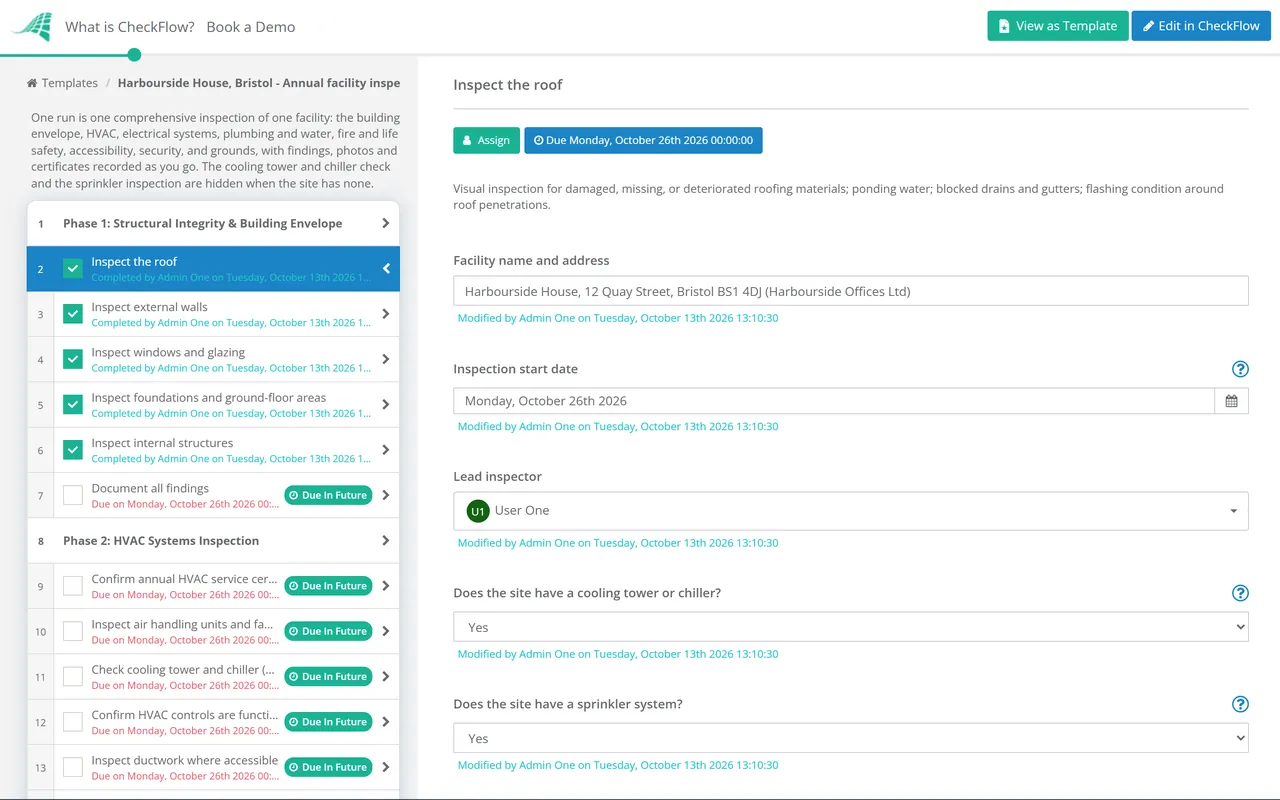
A facility inspection that proceeds from memory or an informal checklist produces incomplete coverage — a crucial certificate is overdue, the backflow prevention test was skipped, the ADA compliance walk was never done. CheckFlow’s facility inspection checklist ensures every regulatory requirement is assessed in the same structured process, with every finding logged and every follow-up action tracked to completion.

2

Recurring inspection schedules at every required frequency

Facility management requires inspections at daily, monthly, quarterly, and annual frequencies — all running simultaneously. CheckFlow’s recurring feature manages all of them: the monthly fire extinguisher visual, the quarterly HVAC filter check, and the annual comprehensive inspection all generated automatically at their required intervals.

3

An audit-ready inspection record

The regulatory body that arrives without notice is looking for documented evidence of systematic inspection and action on findings — not just confirmation that the building looks acceptable today. Every facility inspection conducted through CheckFlow is dated, attributed, and archived with all findings and follow-up actions recorded.

Facility inspection findings often identify equipment requiring servicing or replacement. CheckFlow’s Equipment Servicing Workflow covers the structured process for managing the service calls the inspection identifies. See the Equipment Servicing Workflow →

Regular scheduled maintenance prevents many of the issues that facility inspections identify. CheckFlow’s Office Maintenance Schedule covers the recurring maintenance tasks that keep facilities in inspection-ready condition. See the Office Maintenance Schedule →

Frequently Asked Questions

What should a facility inspection checklist cover?

+

A comprehensive facility inspection checklist covers eight areas: structural integrity and building envelope (roof, external walls, windows, foundations), HVAC systems (service certificates, controls, and energy performance), electrical systems (EICR currency, distribution panels, emergency power), plumbing and water systems (fixtures, visible pipework, Legionella risk, backflow prevention), fire and life safety (fire alarm, sprinkler, extinguishers, emergency lighting, exit routes, fire risk assessment), ADA/accessibility compliance (parking, entrance, elevators, restrooms, corridors), security systems (access control, CCTV, intruder alarm, external lighting), and grounds and exterior (car park, landscaping, boundary security, signage).

How often should a commercial facility be inspected?

+

Commercial facilities require inspection at multiple frequencies. Daily or weekly visual checks by the facilities team cover cleanliness, fire exit clearance, and obvious defects. Monthly checks cover fire extinguisher visual inspection, emergency lighting function, and basic HVAC filter condition. Quarterly checks cover more detailed equipment condition and operational system performance. Annual comprehensive inspections cover all structural, mechanical, electrical, and life safety systems — many of which also require annual certification by licensed contractors as a legal obligation.

What ADA requirements apply to commercial facilities?

+

The Americans with Disabilities Act (ADA) requires that commercial facilities open to the public or that employ people provide equal access to people with disabilities. Specific requirements include: accessible parking (minimum number, correct dimensions, accessible route to entrance), accessible building entrance (automatic doors or accessible handles, compliant ramp slopes, threshold heights), accessible vertical circulation (elevators in multi-story buildings), accessible restrooms (correct stall dimensions, grab bars, accessible fixtures), accessible routes throughout the facility (minimum corridor widths, compliant door hardware, no protrusions into circulation paths), and accessible signage. Non-compliance creates legal exposure to ADA lawsuits — settlements and legal costs in this area can be significant.

What is a Legionella risk assessment and who needs one?

+

Legionella bacteria can grow in water systems where temperatures are between 20°C and 45°C, and cause Legionnaires’ disease — a potentially fatal form of pneumonia — when contaminated water is inhaled as an aerosol. In the UK, the Approved Code of Practice L8 (Legionella) requires employers and building duty holders to assess and control Legionella risk in hot and cold water systems, cooling towers, and other relevant water systems. This requires a formal Legionella risk assessment, a written scheme of control, and documented ongoing monitoring and treatment. In the US, ASHRAE Guideline 12 and CDC guidelines recommend formal water management programmes for commercial buildings. Outbreaks have occurred in hotel cooling towers, hospital water systems, and office building HVAC systems.

Is CheckFlow free for this template?

+

You can start a free 14-day trial with no credit card required, giving you full access to all features including this template. The Business plan is $10 per user per month after the trial. Full details at checkflow.io/pricing.

Inspect Every System Before a Regulator, Insurer, or Plaintiff Does

Free trial — no credit card required.