DOT Compliance Audit Checklist Template

An investigator asks for driver files and six months of logs, two medical certifications lapsed in the spring, nobody checked last year’s random testing rate, and the roadside inspection reports were never signed off.

Last reviewed: October 2026

This free DOT compliance audit checklist is for safety directors, compliance managers and owners of US motor carriers who want to check their own records before FMCSA does. It follows the Federal Motor Carrier Safety Regulations for carriers in interstate commerce; a carrier that operates only within one state follows the rules its state has adopted, which can differ. One run covers one self-audit, yearly or before a compliance review or new entrant safety audit. It samples driver qualification files, the drug and alcohol program, hours of service and ELD records, vehicle maintenance and inspection files, the accident register, insurance and the MCS-150 update, then grades every finding as FMCSA does and works out an indicative rating for each factor. The safety director approves the corrective action plan, and the lead auditor checks the fixes worked. Answers on the first task add the passenger, hazmat, drug and alcohol and new entrant steps when they apply. Each driver’s file starts with the Commercial Driver Onboarding Checklist.

A Self-Audit Uses FMCSA’s Own Method

FMCSA checks a motor carrier’s records in two kinds of visit. A compliance review examines hours of service, maintenance and inspection, driver qualification, CDL requirements, financial responsibility, accidents, hazardous materials and other safety records, and ends with a safety rating of satisfactory, conditional or unsatisfactory (49 CFR 385.3, 385.9). A new entrant safety audit looks at a carrier in its first 18 months of interstate operation. It gives no rating, but any one of 16 listed violations fails it automatically (385.321).

A self-audit, sometimes called a mock DOT audit, runs the same checks on your own schedule. It samples the same records and grades what it finds the way Appendix B to Part 385 grades it, so a gap is closed before an investigator finds it. The driver qualification file it checks is the one your hiring process builds; the commercial driver onboarding checklist sets that file up for each new driver, and this audit checks it has stayed complete. For a quality management system audit, the ISO 9001 internal audit checklist shows that pattern.

Compliance review

FMCSA rates the carrier

Covers: driver qualification, drug and alcohol testing, hours of service, vehicles, accidents, insurance and hazardous materials.

Run by: an FMCSA or State investigator.

Output: a safety rating from the six factors in Appendix B to Part 385.

New entrant safety audit

FMCSA checks a new carrier

Covers: driver qualification, duty status, vehicle maintenance, the accident register and drug and alcohol testing.

Run by: a certified safety auditor, generally at your premises.

Output: pass, or fail with 60 days (45 for passenger and hazmat carriers) to show corrective action.

Your self-audit

You check yourself first

Covers: the same records, sampled the same way, with the findings graded as acute, critical or other.

Run by: your lead auditor, with the maintenance and drug and alcohol program owners.

Output: a corrective action plan approved by the safety director, and verified fixes.

What the DOT Compliance Audit Checklist Covers

Eight phases take one self-audit from planning to verified fixes. The first task decides what appears: the drug and alcohol phase for carriers with CDL drivers, the hazardous materials records, the passenger or property limits, and the new entrant check. Each audit area ends with a result: findings add that area’s corrective task, a serious finding adds an immediate-action task the same day, and nothing after the safety director’s approval of the plan can be completed until it is given.

  1. Phase 1 — Plan

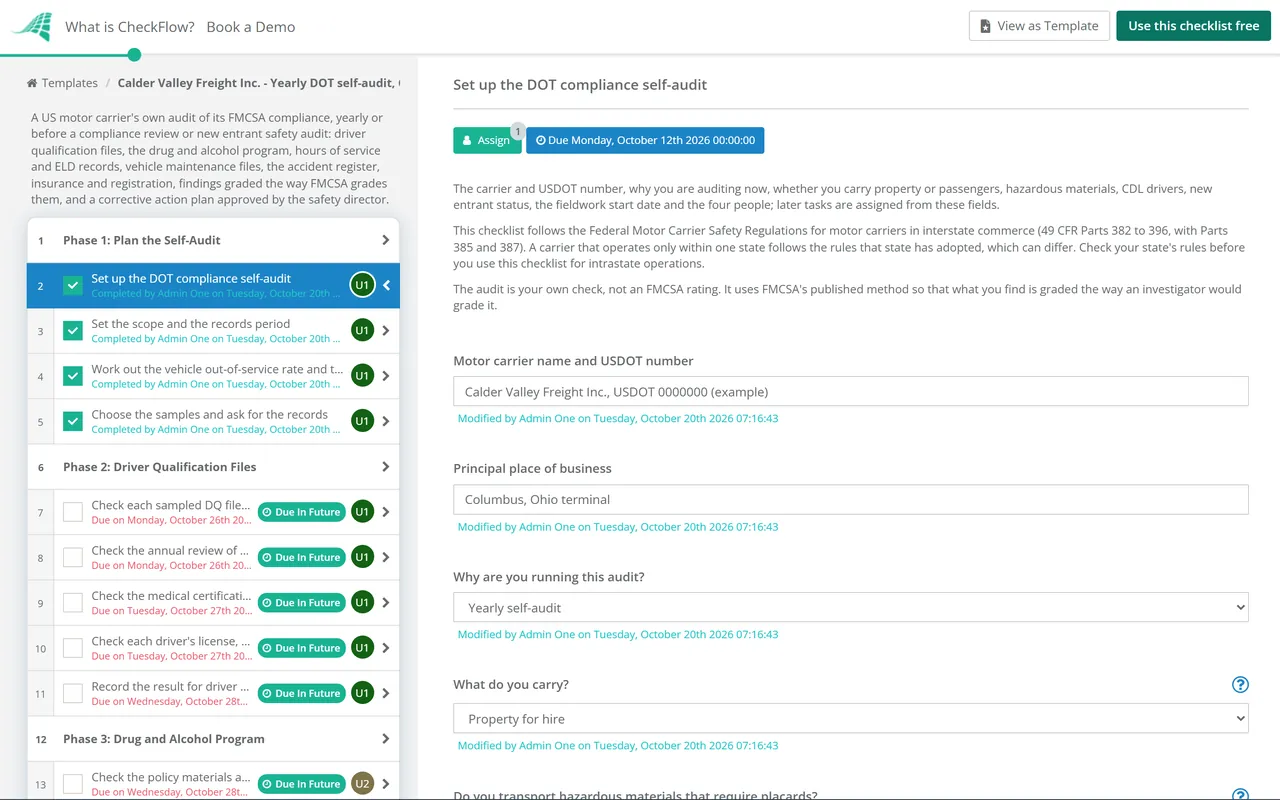
    Phase 1: Plan the Self-Audit

    4 tasks

    A self-audit looks at the same records FMCSA examines in a compliance review: driver qualification, drug and alcohol testing, hours of service, maintenance, accidents and insurance. The answers on the first task decide which tasks appear, and every due date counts from the first day of fieldwork.

    • Set up the DOT compliance self-audit — the carrier and USDOT number, why you are auditing now, whether you carry property or passengers, hazardous materials, CDL drivers, new entrant status, the fieldwork start date and the four people; later tasks are assigned from these fields
    • Set the scope and the records period — the terminals and operations in scope and the period you will sample, normally the last 12 months, which is the period FMCSA’s rating method looks back over
    • Work out the vehicle out-of-service rate and the accident rate — roadside vehicle inspections and out-of-service results in the last 12 months, and recordable accidents per million miles, the two numbers FMCSA’s rating method uses beside the records
    • Choose the samples and ask for the records — the drivers, vehicles and days you will check in each area, and when each record owner must have the files ready; sample enough records to see a pattern, which FMCSA counts as violations in at least 10 percent of the records examined
  2. Phase 2 — Drivers

    Phase 2: Driver Qualification Files

    6 tasks

    Every driver needs a driver qualification (DQ) file that stays complete for as long as they drive for you. Check what was put in at hiring and what must be renewed since. Unqualified, disqualified or medically uncertified drivers are among the most serious findings.

    • Check each sampled DQ file holds the hiring records — the signed application, the motor vehicle records from each state that licensed the driver in the 3 years before hire, and the road test certificate or the license or certificate accepted as its equivalent
    • Check the annual review of each driving record — a motor vehicle record from each licensing authority obtained at least every 12 months, and a note in the file naming who reviewed it and when
    • Check the medical certification of every sampled driver — a current certification and any medical variance in each file; for CDL holders, the CDLIS motor vehicle record from the current licensing state showing it, and for other drivers the certificate and a note that the examiner is on the National Registry
    • Check each driver’s license, CDL class and endorsements — one current license from one state, and for CDL drivers the class, endorsements and restrictions the work needs, with no disqualification
    • Record the result for driver qualification — no findings, findings to correct, or a serious finding such as a driver driving without valid medical certification, a valid license or the right CDL
    • Stop each unqualified driver from driving today — take the driver off the schedule until the gap is closed, tell dispatch, and record who was stopped, why and when
  3. Phase 3 — CDL Drivers

    Phase 3: Drug and Alcohol Program

    8 tasks

    Applies when any driver needs a CDL; otherwise its tasks are hidden. Part 382 and the testing procedures in Part 40 cover the policy, supervisor training, the random pool, Clearinghouse queries, the tests and their records. Using a driver after a positive test or a refusal is an acute finding.

    • Check the policy materials and the signed receipts — educational materials that explain Part 382 and your own policies, covering every topic 49 CFR 382.601(b) lists, and a certificate of receipt signed by each sampled driver
    • Check supervisor training for reasonable suspicion — at least 60 minutes on alcohol misuse and 60 minutes on controlled substances use for everyone who supervises drivers, with the records kept
    • Check the random testing pool and the rates achieved — every covered driver and only covered drivers in the pool, selected by a scientifically valid method, tested unannounced on dates spread through the year, at no less than the minimum annual rates
    • Check the Clearinghouse queries — a pre-employment full query for every driver hired in the period, and a query at least once a year for every covered driver
    • Check the test records against the rules for each test — a verified negative pre-employment result before each new driver’s first safety-sensitive function, post-accident tests where the accident register shows one was due, and return-to-duty and follow-up tests for any driver with a violation
    • Check how long the program records are kept — 5 years for positive results, refusals, alcohol results of 0.02 or more, evaluations and program records, 2 years for collection records and 1 year for negative results, in a secure place with controlled access
    • Record the result for the drug and alcohol program — no findings, findings to correct, or a serious finding such as a driver performing safety-sensitive functions after a positive test, a refusal or without a negative pre-employment result
    • Remove each affected driver from safety-sensitive functions today — no driving, inspecting, loading or waiting to be dispatched until the driver has completed return-to-duty or the missing result is in, and a record of who was removed and when
  4. Phase 4 — Hours of Service

    Phase 4: Hours of Service and ELD Records

    6 tasks

    Hours of service carry double weight in FMCSA’s rating method: each pattern of violations of a critical Part 395 regulation counts two points, not one. Check the records of duty status against the limits, then against the documents that show where the driver really was.

    • Sample records of duty status against the limits — the ELD records for the sampled drivers and days, checked against the driving limit, the on-duty window, the 30-minute break where it applies and the 60- or 70-hour limit
    • Match supporting documents to the records of duty status — bills of lading, dispatch records, expense receipts, fleet messages and payroll records for the same days, compared with the times and places on the ELD record
    • Check ELD edits, unidentified driving and malfunctions — edits annotated and confirmed by the driver, unidentified driving reviewed and assigned or explained, and every malfunction repaired within 8 days or covered by an extension
    • Check how long duty status records are kept — records of duty status and supporting documents kept for at least 6 months, and original ELD data never altered or erased
    • Record the result for hours of service — no findings, findings to correct, or a serious finding such as false logs or a tampered ELD
    • Stop the falsification and secure the records today — restore every affected ELD to working order, keep the original data and supporting documents, and decide what happens to each driver and dispatcher involved
  5. Phase 5 — Vehicles

    Phase 5: Vehicle Inspection, Repair and Maintenance

    6 tasks

    Part 396 asks for a maintenance file on every vehicle, a written report when a driver finds a defect, a yearly periodic inspection of every vehicle and trailer, and certified repairs after a roadside inspection. Operating a vehicle declared out of service is acute.

    • Check the maintenance file of each sampled vehicle — the vehicle’s identification, a way of showing the nature and due date of each inspection and maintenance operation, and a record of what was done and when
    • Check driver vehicle inspection reports and repair certifications — a signed report for each vehicle on each day a defect was found or reported, each defect repaired or certified as not needing repair before the vehicle was driven again, and reports kept for 3 months
    • Check the periodic inspection of every vehicle and trailer — each power unit, trailer and converter dolly passed an inspection to Appendix A of Part 396 in the last 12 months, with proof on the vehicle, the report kept 14 months and the inspector’s qualifications on file
    • Check each roadside inspection report was certified and kept — every violation corrected and the carrier official’s certification signed within 15 days of the inspection, a copy kept for 12 months, and no vehicle declared out of service driven before it was repaired
    • Record the result for vehicles — no findings, findings to correct, or a serious finding such as a vehicle driven while declared out of service or with an out-of-service defect not repaired
    • Take each unsafe vehicle out of service today — park the vehicle until the defect is repaired and the repair is recorded, tell dispatch, and list each unit and when it returned to service
  6. Phase 6 — General

    Phase 6: Accidents, Insurance and Registration

    6 tasks

    The general factor in FMCSA’s rating method covers Parts 387 and 390: the accident register, proof of insurance and accurate records. The USDOT registration update and, for hazmat carriers, the hazardous materials records complete the audit.

    • Check the accident register — every accident in the last 3 years with a fatality, an injury treated away from the scene or a vehicle towed away with disabling damage, listed with its date, city and state, driver, injuries, fatalities and any hazardous materials released, and the accident reports kept
    • Check proof of financial responsibility — the Form MCS-90 endorsement or Form MCS-82 surety bond (MCS-90B or MCS-82B for passenger carriers) at the principal place of business, for at least the minimum limits that apply to what you carry
    • Check the MCS-150 biennial update — the Form MCS-150 updated every 24 months, by the last day of the month set by the last digit of the USDOT number, in odd or even years by the next-to-last digit
    • Check the hazardous materials records — a training record for each hazmat employee covering the last 3 years, with recurrent training at least every 3 years, shipping papers kept for 1 year (3 years for hazardous waste), and a security plan or safety permit where your materials need one
    • Record the result for accidents, insurance and registration — no findings, findings to correct, or a serious finding such as operating without the required insurance in force
    • Put the required coverage in place before the next trip — no vehicle operates until the minimum financial responsibility is in effect and the proof is at the principal place of business
  7. Phase 7 — Report

    Phase 7: Grade the Findings and Report

    5 tasks

    Grade each finding the way FMCSA would, then work out an indicative rating for each factor. The new entrant check appears only for carriers still in the 18-month new entrant period.

    • Grade every finding against the acute and critical regulations — acute where noncompliance needs immediate correction whatever else the audit shows, critical where it shows a breakdown in management controls and counts only as a pattern, and other for everything else
    • Work out an indicative rating for each factor — one point for each acute violation or critical pattern, two for each hours-of-service critical pattern; 0 points is satisfactory, 1 conditional and 2 or more unsatisfactory for that factor
    • Check the findings against the new entrant automatic failures — any one of the 16 violations listed in 49 CFR 385.321 fails the new entrant safety audit, and a failed audit gives 60 days, or 45 for passenger and hazmat carriers, to show corrective action
    • Find the cause behind each finding — the control that failed, such as no renewal reminder, no one owning the task, a process nobody followed or a record kept in the wrong place, so the fix stops it happening again
    • Write the audit report and walk the record owners through it — scope, records period, samples, findings by area and grade, the indicative factor ratings, and any immediate action already taken
  8. Phase 8 — Correct

    Phase 8: Corrective Action and Follow-Up

    9 tasks

    The safety director or owner approves the corrective action plan, and nothing after that approval can be completed until it is given. Each area with findings gets its own corrective task, and the lead auditor checks the fixes on records made after them.

    • Write the corrective action plan — for each finding the action, an owner, a due date and the evidence that will show it worked, with acute findings first
    • Safety director approves the corrective action plan — the findings, the indicative ratings and the plan together; nothing after this can be completed until the decision is recorded
    • Correct the driver qualification findings — complete each file, get any missing motor vehicle records or medical certification, and set renewal dates for every driver so nothing lapses again
    • Correct the drug and alcohol program findings — fix the pool, the policy materials, missing queries or training, and make up any shortfall in random testing for the year
    • Correct the hours-of-service findings — retrain the drivers and dispatchers involved, fix how supporting documents are collected and matched, and change any schedule that cannot be run legally
    • Correct the vehicle findings — bring every maintenance file up to date, finish overdue periodic inspections, certify open repairs and change how defects reach the shop
    • Correct the accident, insurance and registration findings — complete the accident register and file the missing reports, put the proof of insurance on file and file the MCS-150 update if it is due
    • Check the corrective actions worked — re-sample records made after each fix, such as new annual reviews, logs or inspection reports, and record whether each finding is closed
    • Close the audit and schedule the next one — file the report, the plan and the evidence, and set the date of the next self-audit

How FMCSA Grades What an Audit Finds

FMCSA groups the regulations into six factors. Each acute violation, and each pattern of violations of a critical regulation, scores one point in its factor; a pattern of hours-of-service violations scores two. The table is drawn from Appendix B to 49 CFR Part 385, which lists every acute and critical regulation.

Factor Parts of 49 CFR What the audit samples Examples of acute and critical regulations
1 General387, 390Proof of insurance, the accident register and accident reportsOperating without the minimum insurance (acute); no accident reports on file (critical)
2 Driver382, 383, 391Driver qualification files, CDLs, drug and alcohol testing recordsUsing a disqualified driver (acute); no random testing program (acute); a driver not medically certified (critical)
3 Operational392, 395Records of duty status, supporting documents and ELD dataTampering with an ELD (acute); driving over the hours limits, false logs (critical)
4 Vehicle393, 396Maintenance files, inspection reports, periodic inspections; roadside out-of-service rateDriving a vehicle declared out of service (acute); no periodic inspection (critical)
5 Hazardous materials171, 177, 180, 397Training records, shipping papers, security plan, parking and attendanceNo required security plan (acute); no security awareness training (critical)
6 AccidentRecordable accident rateRecordable accidents per million miles in the last 12 monthsAbove 1.5, or 1.7 for carriers operating entirely within 100 air miles, with two or more accidents

From points to a rating. A factor with no points is satisfactory, one point conditional and two or more unsatisfactory. With three or more roadside vehicle inspections in the last 12 months, a vehicle out-of-service rate of 34 percent or more starts the vehicle factor at conditional. No unsatisfactory factor and two or fewer conditional ones rates the carrier satisfactory; two or more unsatisfactory factors, or one with more than two conditional, rates it unsatisfactory; anything between is conditional.

How long the records last. Records of duty status and supporting documents are kept 6 months, driver vehicle inspection reports 3 months, maintenance records 1 year, periodic inspection reports 14 months, the accident register 3 years, and a driver qualification file for the driver’s employment and 3 years after. Drug and alcohol records are kept for 1, 2 or 5 years depending on the record. Sample each area from the period you still hold.

Why Run DOT Compliance Audits in CheckFlow?

1

No plan goes ahead without the safety director

The approval of the corrective action plan is assigned to the safety director or owner, and the checklist halts there: the corrective tasks, the follow-up and the close cannot be completed until the decision is recorded. See how approvals that halt a checklist work.

2

Serious findings get acted on the same day

Each audit area ends with a result. Findings add that area’s corrective task; a serious finding, such as a driver without valid medical certification, also adds a task to stop the driver or park the vehicle that day. Carrier type, hazmat, CDL drivers and new entrant status decide which other tasks appear, all through conditional rules you can change.

3

One fieldwork date sets every deadline

Planning counts back from the first day of fieldwork and the report, plan and follow-up count forward, so every owner sees their date. The Reports Grid shows where each terminal’s audit stands, and the yearly audit can run as a recurring checklist.

CheckFlow does not tell you whether you comply with the Federal Motor Carrier Safety Regulations, and it is not legal advice, an FMCSA safety rating, a Clearinghouse account or an ELD. It runs the same audit steps every time, with a record of who checked what and when.

This template covers one self-audit. Build each driver’s file at hiring with the Commercial Driver Onboarding Checklist, run daily vehicle checks and defect reports with the Fleet Vehicle Inspection Checklist and the maintenance schedule with the Preventive Maintenance Checklist. US employers also keep injury logs with the OSHA Recordkeeping Checklist, and the Annual Compliance Calendar Checklist keeps yearly duties such as the MCS-150 update on a schedule. Running audits across several terminals? CheckFlow’s compliance checklist software keeps owners, evidence and sign-offs in one place.

AI generator

Didn’t find what you need? Describe it.

Describe the process in a sentence and the AI checklist generator drafts the phases and tasks for you.

Frequently Asked Questions

What is a DOT compliance audit?

Usually it means an FMCSA compliance review: an examination of a motor carrier’s hours of service, maintenance and inspection, driver qualification, CDL, financial responsibility, accident and hazardous materials records to decide whether it meets the safety fitness standard (49 CFR 385.3). It ends with a safety rating. New carriers get a new entrant safety audit instead, which gives no rating. A self-audit, or mock audit, is a carrier checking the same records itself before FMCSA does.

What does FMCSA look at in a compliance review?

Driver qualification files, records of duty status, vehicle maintenance records, drug and alcohol testing records, the accident register, proof of insurance and, for hazmat carriers, the hazardous materials records. The investigator samples documents and cites violations of the acute and critical regulations listed in Appendix B to Part 385. Roadside inspection results and the recordable accident rate for the last 12 months also count. The findings are grouped into six factors that produce the safety rating.

What is the difference between an acute and a critical violation?

An acute regulation is one where noncompliance is so severe that it needs immediate correction whatever else the review shows, such as using a driver with more than one CDL or operating without the required insurance. A critical regulation is one where noncompliance shows a breakdown in management controls, such as drivers going over the 11-hour driving limit. A single acute violation scores a point, while a critical regulation scores only as a pattern: more than one violation and at least 10 percent of the records examined.

How long do motor carriers have to keep DOT records?

It depends on the record. Records of duty status and supporting documents: 6 months. Driver vehicle inspection reports: 3 months. Vehicle maintenance records: 1 year, and 6 months after the vehicle leaves your control. Periodic inspection reports: 14 months. The accident register: 3 years. Clearinghouse query records: 3 years. A driver qualification file: as long as the driver works for you and 3 years after. Drug and alcohol records: 1, 2 or 5 years under 49 CFR 382.401.

What makes a new entrant fail the safety audit?

A new entrant fails automatically if the audit finds any one of 16 violations listed in 49 CFR 385.321. They include having no drug and alcohol testing program or no random program, using a driver who refused a test or tested positive, using a driver without a valid CDL or a disqualified or physically unqualified driver, operating without the required insurance, and operating a vehicle declared out of service. Missing records of duty status or periodic inspections fail it at 51 percent or more of the records examined.

How does FMCSA decide a safety rating?

Each acute violation and each pattern of critical violations scores a point in one of five regulatory factors, with two points for an hours-of-service pattern; a sixth factor rates the accident record. A factor with no points is satisfactory, one point conditional, two or more unsatisfactory. The factor ratings combine into the overall rating. A proposed conditional or unsatisfactory rating becomes final 45 days after notice, and a carrier can ask for a new rating once it has corrected the problems (49 CFR 385.17).

How often should a motor carrier run a DOT self-audit?

Part 385 does not set a schedule for your own audits, so it is a choice. Running one each year, and again before an expected compliance review or new entrant safety audit, keeps it in step with duties that come round each year: the annual driving record review, the annual Clearinghouse query, the periodic vehicle inspection and the random testing rates for the calendar year. The MCS-150 update falls every 24 months.

Is CheckFlow free for this template?

14-day free trial, no card required. The Business plan is $10 per user per month after the trial. Full details at checkflow.io/pricing.

Find the Gaps Before an Investigator Does

Free trial — no credit card required.

14-day free trial, no credit cardFull refund in your first 30 daysUS hosting, EU on request