Equipment Servicing Workflow Checklist Template

Office and commercial equipment that is not serviced on schedule does not fail on schedule — it fails at the worst possible time. A structured servicing workflow prevents this by making scheduled service automatic and reactive service fast.

Every office or commercial building depends on equipment that has to work reliably: HVAC systems that keep the building habitable, copiers that keep the office operational, elevators that provide access, kitchen equipment that serves the team, and backup generators that protect business continuity when the power fails. When any of this equipment fails unexpectedly, the business impact far exceeds the repair cost — in lost productivity, uncomfortable or inaccessible spaces, and emergency service premium rates. The research is consistent: planned, contract-managed servicing is dramatically cheaper than emergency repairs. A 25-year-old HVAC chiller operating at 40% efficiency costs an estimated $15,000 extra annually in electricity before it fails — and facilities teams that track equipment age, service history, and performance find these issues before they become crises. A structured equipment servicing workflow manages both modes: scheduled preventive servicing triggered automatically at the right interval, and reactive service calls managed consistently from the first call through to verified resolution and documented service record. This free checklist gives office managers, facilities managers, and operations managers a structured framework for the full equipment servicing cycle.

Use This Template Free See Live Example
No Credit Card Required

The Equipment Register — Why Every Piece of Serviced Equipment Needs a Single Record

An equipment servicing programme is only as good as the equipment register that underpins it. Without a register, the HVAC service date is in a spreadsheet that no one updates, the copier warranty expired three months ago and nobody noticed, and the generator last tested eighteen months ago. With a register, every asset has a record: what it is, who services it, when it was last serviced, when it is next due, what the service agreement number is, and whether the last service passed or identified issues.

What to include

Equipment name and model, serial number, location, purchase date and warranty expiry, service provider name and contact, service frequency, service agreement reference, and next service due date.

Who owns it

A named equipment owner — the person responsible for ensuring the equipment is serviced on schedule and that service records are maintained.

The service history

Every service event recorded: date, provider, work performed, pass/fail outcome, issues identified, follow-up actions, and next scheduled date.

Alert triggers

Calendar alerts at defined lead times before the next service due date and before the service agreement renewal date — so neither is missed.

The Equipment Servicing Workflow Checklist

Six phases covering the complete equipment servicing cycle — from register and agreement setup through planned service scheduling, execution, post-service documentation, reactive service management, and contract renewal review.

Phase 1

Equipment Register & Service Agreement Management

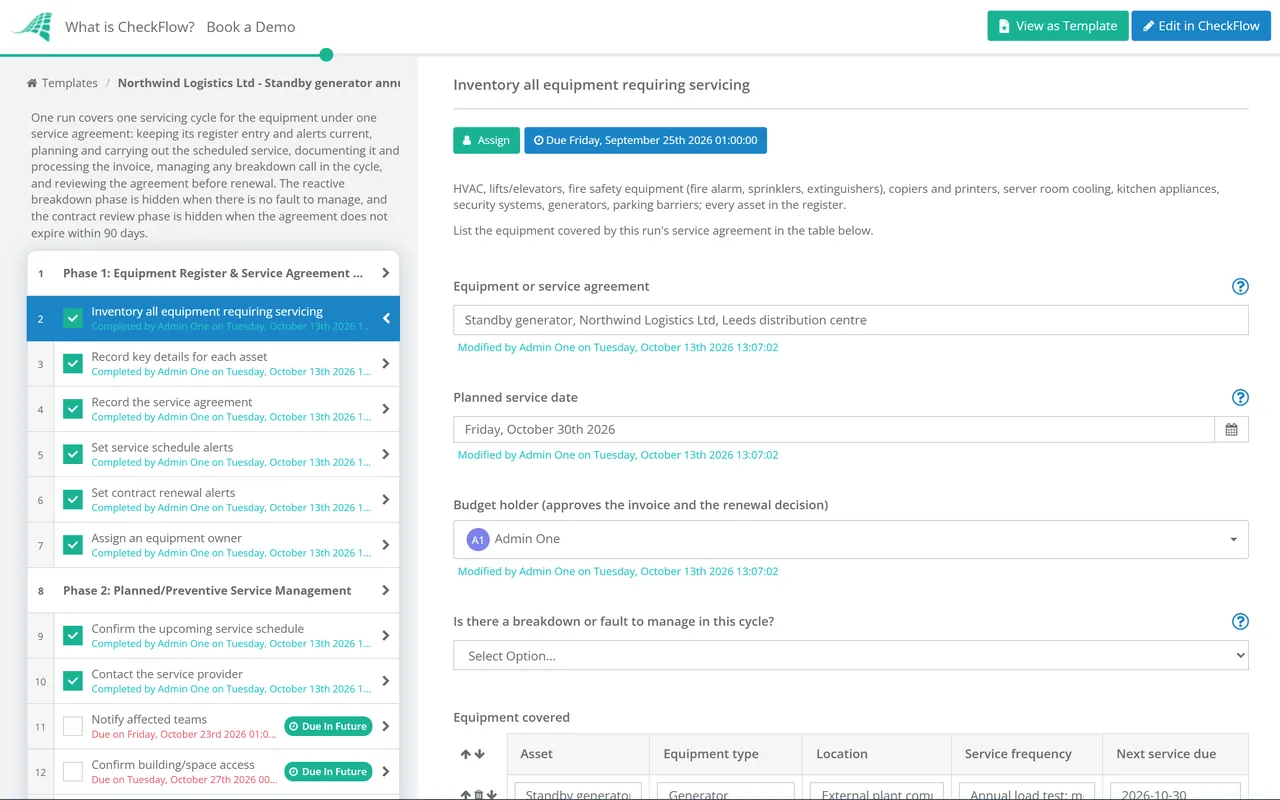
  • Inventory all equipment requiring servicing — HVAC, lifts/elevators, fire safety equipment (fire alarm, sprinklers, extinguishers), copiers and printers, server room cooling, kitchen appliances, security systems, generators, parking barriers; every asset in the register
  • Record key details for each asset — make, model, serial number, location, purchase date, warranty expiry, and expected service life
  • Record the service agreement — for each asset under a maintenance contract: provider name, contract number, covered services, response time SLAs, contract start and expiry dates
  • Set service schedule alerts — for every recurring service event (quarterly, annual, or usage-triggered); set 30-day advance alerts for all planned services
  • Set contract renewal alerts — at 90 days before expiry; service agreements that auto-renew without review are service agreements that may have better alternatives
  • Assign an equipment owner — a named person responsible for each asset’s servicing schedule and records
Phase 2

Planned/Preventive Service Management

  • Confirm the upcoming service schedule — from the equipment register; all services due in the next 30 days identified
  • Contact the service provider — to schedule the service date; confirm the specific work to be performed and any access requirements
  • Notify affected teams — of planned downtime for the equipment; HVAC servicing requires building access and may affect comfort; elevator servicing requires planned outage
  • Confirm building/space access — for the service engineer; key holder availability, parking, and any security access requirements
  • Confirm the work order or service notice — what work is scheduled; what parts or consumables will be used (confirm stock if applicable)
Phase 3

Service Execution Day

  • Meet the service engineer on arrival — confirm identity and the work order for the visit; do not leave contractors in sensitive areas unescorted
  • Confirm the scope of work — the engineer confirms what they will be doing; any additions to scope approved before work commences
  • Monitor the service where appropriate — for critical systems (generator test, fire system test) a member of the facilities team is present
  • Obtain the service report — before the engineer leaves; confirming work performed, system status (pass/fail/advisory), and any defects or recommendations
  • Confirm the engineer’s sign-out — all areas access cleared; no tools or materials left; systems back online where applicable
Phase 4

Post-Service Documentation & Follow-Up

  • File the service report — in the equipment register record; every service event has a service report on file
  • Update the equipment service history — date serviced, work performed, outcome, and next service due
  • Raise follow-up work orders — for any defects or recommended repairs identified in the service report; prioritised by urgency and safety impact
  • Approve and process the invoice — against the service agreement rate card; query any variance before payment
  • Update the contract record — if any out-of-contract work was performed; ensure it was pre-approved
Phase 5

Reactive/Breakdown Service Management

Reactive service calls cost more, take longer, and cause more disruption than planned services. But they happen. A structured reactive process minimises all three by moving from the problem to the engineer to the resolution without the delays that come from not knowing who to call, not having the contract reference, and not following up.

  • Log the fault — equipment, location, fault description, time first observed, and business impact; in the equipment register
  • Confirm the service provider — from the equipment register; call the contracted provider first unless the equipment is out of warranty
  • Log the call — time, person spoken to, reference number, and committed response time; chase if response time SLA is not met
  • Confirm the response time SLA — from the service agreement; if not met, escalate to the provider account manager
  • Follow up to verified resolution — the service call is not closed until the fault is confirmed resolved and the equipment is operational
Phase 6

Service Contract Review & Renewal

  • Review the contract 90 days before expiry — not at expiry; review includes: value for money assessment, provider performance review, and market comparison
  • Assess provider performance — against the service record; were all planned services delivered? Were response time SLAs met? Any unresolved issues?
  • Compare to market — are the contract rates still competitive? A quick market test at renewal is the most effective negotiating tool
  • Make the renewal/replacement decision — renew, renegotiate, or replace; with sufficient lead time to transition if replacing
  • File the new contract — in the equipment register; new expiry date and new renewal alert set immediately

Office and Commercial Equipment — Typical Service Frequencies

Equipment Type Typical Service Requirements
HVAC Systems Annual comprehensive service by licensed HVAC contractor; quarterly filter changes and basic checks; monthly visual inspection by facilities team.
Elevators / Lifts Monthly inspection and lubrication by licensed elevator maintenance contractor (required by law in most jurisdictions); annual comprehensive service and safety inspection; periodic certificate renewal.
Fire Safety Systems Annual comprehensive inspection of fire alarm, sprinkler system, emergency lighting, and extinguishers by certified fire safety contractor; monthly visual inspection and extinguisher check by facilities team.
Copiers and MFDs Typically covered by a pay-per-copy service agreement with the supplier; reactive service call as required; annual comprehensive service.
Generators Annual load test and service; monthly no-load test run; bi-annual transfer switch test (where applicable); fuel level check monthly.
Kitchen Equipment (commercial) Annual deep clean and service for commercial dishwashers, ovens, and refrigeration; quarterly filter cleaning for ventilation/extraction.
Server Room Cooling Monthly filter check; quarterly service by UPS and cooling system specialist; annual comprehensive service.

Why Run Your Equipment Servicing Process in CheckFlow?

1

Service schedules that trigger automatically — nothing missed

A service schedule that lives in a spreadsheet gets updated when someone remembers and missed when they are busy. CheckFlow’s recurring checklist feature generates each equipment service workflow automatically at its defined interval — the HVAC quarterly check, the annual generator test, the monthly fire extinguisher walk — assigned to the responsible person with all required steps and a reminder before the due date. Planned services happen because the process schedules them.
2

A complete service record for every asset

Without a documented service history, lease renewals, asset disposals, warranty claims, and insurance events all become disputes rather than settlements. Every service event logged through CheckFlow is archived against the asset record — the date, the work performed, the engineer, the outcome, and the next service date — automatically.

3

Contract renewal alerts that prevent auto-renewal traps

Service agreements that auto-renew lock organisations into another year at rates that may no longer be competitive and with providers whose performance has declined. CheckFlow’s contract renewal review task triggers 90 days before every service agreement expiry — enough time for a performance review, a market comparison, and a negotiation or transition.

Equipment servicing contracts are one of the largest recurring vendor relationships in facilities management. CheckFlow’s Vendor Onboarding Process covers the structured approach to setting up new service providers correctly from the start. See the Vendor Onboarding Checklist →

Equipment servicing is a key component of the broader facility inspection process. CheckFlow’s Facility Inspection Checklist covers the full facility condition assessment that identifies equipment requiring unscheduled service. See the Facility Inspection Checklist →

Frequently Asked Questions

What should an equipment servicing workflow include?

+

An equipment servicing workflow covers six phases: equipment register and service agreement setup (inventorying all serviced assets with make, model, service provider, service frequency, agreement reference, and renewal date), planned service scheduling (advance confirmation with providers, stakeholder notification, access arrangements), service execution (meet the engineer, confirm scope, obtain service report), post-service documentation (filing the service report, updating the service history, raising follow-up work orders), reactive service management (logging faults, contacting the contracted provider, tracking SLA compliance, verifying resolution), and contract review and renewal (90-day advance review, performance assessment, market comparison, renewal or replacement decision).

What office equipment typically requires a service agreement?

+

Commercial office equipment that typically requires a service agreement includes: HVAC systems (heating, ventilation, and air conditioning), lifts and elevators (which require legally mandated periodic inspection in most jurisdictions), fire safety systems (fire alarm, sprinklers, emergency lighting, and extinguishers — annual inspection by certified contractors is typically legally required), generators (monthly test run and annual full service), commercial kitchen equipment, server room cooling and UPS systems, access control and security systems, and copiers and multifunction devices (often covered by pay-per-click or pay-per-copy service agreements).

How should reactive service calls be managed?

+

Reactive service calls should be managed through a structured response rather than an ad hoc one: log the fault immediately (equipment, location, description, business impact), confirm the correct service provider from the equipment register, make the call and log the reference number and committed response time, monitor the response time SLA and escalate if it is not met, and do not close the fault call until resolution is confirmed and the service report is received. The most common reactive service failure is not the repair itself but the follow-up — the engineer visits, the fault is “resolved,” and then the same fault reappears two weeks later because the root cause was not addressed.

How often should HVAC systems be serviced?

+

HVAC systems typically require: annual comprehensive service by a licensed HVAC contractor (covering refrigerant levels, electrical checks, coil cleaning, bearing lubrication, and system controls testing); quarterly filter changes and basic performance checks; and monthly visual inspection by the facilities team. In some climates, a bi-annual service (pre-summer and pre-winter) is recommended to prepare the system for peak demand. An HVAC system operated without regular servicing can consume significantly more energy as efficiency degrades — research suggests that a poorly maintained commercial HVAC system can operate at 40% efficiency or below.

Is CheckFlow free for this template?

+

You can start a free 14-day trial with no credit card required, giving you full access to all features including this template. The Business plan is $10 per user per month after the trial. Full details at checkflow.io/pricing.

Manage Every Equipment Service Event Before It Manages You

Free trial — no credit card required.