Fire Safety Checklist Template (Weekly, Monthly & Annual Checks)

Fire precautions only protect people if they work on the day. A month of weekly alarm tests, monthly checks and servicing, recorded and signed off, shows that they do.

Last reviewed: November 2026

Printed from checkflow.io/templates/operations-facilities-management/fire-safety-checklist

This free fire safety checklist runs one month of the responsible person’s routine fire safety checks, started each month from a monthly CheckFlow schedule. It is for facilities and building managers, fire wardens and managing agents. One run covers the weekly fire alarm tests with a different call point each week, escape routes and exits, the monthly emergency lighting test, fire doors, extinguishers, the alarm panel and signs, the servicing that falls due that month, defects and their repair, the logbook record and the responsible person’s sign-off. Buildings in England with two or more homes add the duties of the Fire Safety (England) Regulations 2022.

The Routine That Keeps Fire Precautions Working

Fire precautions only protect people if they work on the day: an alarm that sounds everywhere, emergency lights that come on, fire doors that close and exits that open. The law asks the responsible person to keep them in efficient working order, and this template shows it with a routine of weekly, monthly and yearly checks and a record of each one.

This checklist runs that routine one month at a time. It sits beside three others: the Fire Risk Assessment Checklist decides which precautions the premises need, the Fire Drill & Evacuation Checklist runs the drills, and the Fire Extinguisher Inspection Checklist runs the full extinguisher round. Two sit closest to this one.

This checklist

One month of routine fire safety checks

Covers: the weekly fire alarm tests, escape routes and exits, the monthly emergency lighting test, fire doors, extinguishers, the alarm panel and signs, the servicing due that month, defects and repairs, and the logbook record.

Owned by: the fire safety coordinator, with the routine checks done by a fire warden or facilities assistant and the month signed off by the responsible person.

Output: a signed-off record of the month’s tests, checks and servicing.
The assessment

The Fire Risk Assessment Checklist

Covers: the hazards, the people at risk, means of escape, the precautions needed, the written record and action plan, and its review.

Use it: to decide what the premises need and to review it. This checklist keeps those precautions working between reviews and flags anything the assessment should look at again. Fire Risk Assessment Checklist.

Extinguishers

The Fire Extinguisher Inspection Checklist

Covers: the full round of every extinguisher: location, access and signs, condition, defects and replacements, the yearly service and longer-interval tests.

Use it: for the detailed round. This checklist keeps a quick monthly look and the yearly service in the month it falls. Fire Extinguisher Inspection Checklist.

What the Fire Safety Checklist Covers

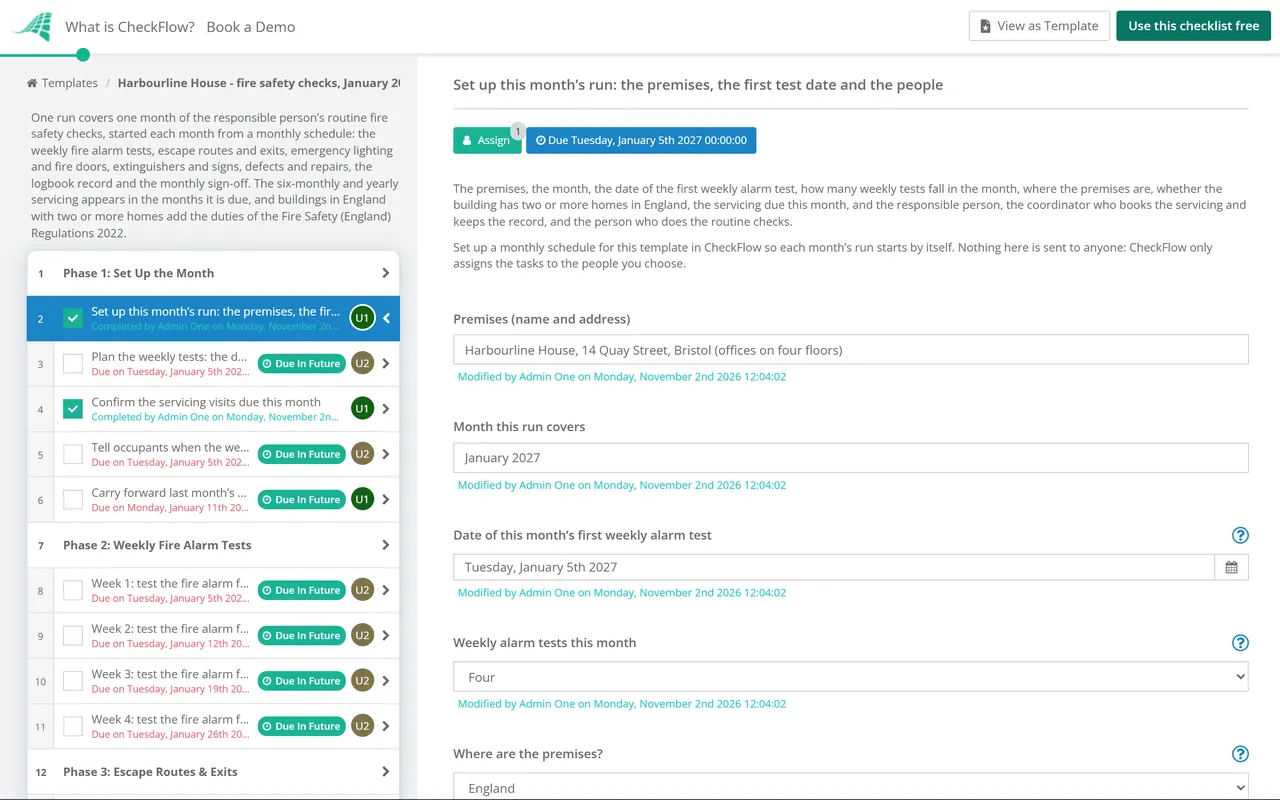
Eight phases take one month of fire safety checks from set-up to sign-off. The first task records the date of the month’s first weekly alarm test, which sets every due date, and asks how many weekly tests the month has, where the premises are, whether the building has two or more homes in England, and which servicing is due. Five tests add the fifth week’s test; each servicing item ticked adds its task; flats in England add the duties of the 2022 Regulations. Defects found add the interim measures, repairs and retest. The responsible person’s sign-off is the gate, and Not signed off adds a task to finish what is missing.

  1. Phase 1

    Phase 1: Set Up the Month

    5 tasks

    A monthly CheckFlow schedule starts this checklist for each month. Enter the date of the month’s first weekly alarm test on the first task: every due date counts from it, and the run stays open into the first days of the next month so the last test and any repairs are recorded before the sign-off. The first task also asks how many weekly tests the month has, where the premises are, whether the building has flats in England, and which servicing is due.

    • Set up this month’s run: the premises, the first test date and the people — the premises, the month, the date of the first weekly alarm test, how many weekly tests fall in the month, where the premises are, whether the building has two or more homes in England, the servicing due this month, and the responsible person, the coordinator who books the servicing and keeps the record, and the person who does the routine checks
    • Plan the weekly tests: the day, the time and the call points — keep a regular test day and time, and list which manual call point each week’s test will use, so a different one is tested each week and every call point is used in turn over the months
    • Confirm the servicing visits due this month — for each item ticked on the first task, confirm the date with the contractor or competent person, arrange access, and agree how the alarm will be handled during the visit if it is monitored by an alarm receiving centre
    • Tell occupants when the weekly test will happen — staff, visitors, residents or other occupiers of a shared building, so a test is not mistaken for a fire and an alarm at any other time is treated as real
    • Carry forward last month’s open defects and actions — once last month’s run is signed off: its open defects, interim measures still in place, repairs booked, and actions from the fire risk assessment that fall in this month
  2. Phase 2

    Phase 2: Weekly Fire Alarm Tests

    5 tasks

    Each week the fire alarm is tested from a different manual call point and the stairway fire doors are checked, as gov.uk’s guide for small non-domestic premises sets out. A month has four or five test days: the first task’s answer adds the fifth. If a test day falls on a day the building is closed, test on the next day it is open and say why.

    • Week 1: test the fire alarm from a call point — operate the call point on the rota for this week, check the alarm is heard throughout the premises and the panel resets, and check that fire-resisting doors on stairways close properly under their self-closers
    • Week 2: test the fire alarm from the next call point — use the next call point on the rota and make the same checks as in week 1: the alarm heard throughout, the panel reset and the stairway fire doors closed
    • Week 3: test the fire alarm from the next call point — the next call point on the rota, with the same checks of the alarm, the panel and the stairway fire doors
    • Week 4: test the fire alarm from the next call point — the next call point on the rota, with the same checks of the alarm, the panel and the stairway fire doors
    • Week 5: test the fire alarm from the next call point — only in a month with five test days: the next call point on the rota, with the same checks
  3. Phase 3

    Phase 3: Escape Routes & Exits

    4 tasks

    The Fire Safety Order requires routes to emergency exits, and the exits themselves, to be kept clear at all times where that is needed for safety (article 14). This is the month’s walk-round, on top of the daily checks at opening that are confirmed in Phase 8.

    • Walk every escape route and check it is clear — corridors, stairs and routes to the final exits free of storage, waste, furniture and trip hazards, and nothing stored in protected stairways
    • Check final exit doors open easily without a key — every final exit and escape door opens easily, push bars and pads work, nothing is locked, chained or blocked, and the way from each door to a place of safety is clear
    • Check exit and direction signs are in place and visible — signs where the way out is not obvious, none covered, faded, damaged or removed, and none blocked by new partitions, shelving or displays
    • Check the assembly point and the way to it — the route from each final exit to the assembly point is clear, and the assembly point is still usable, for example not taken over by parked vehicles, skips or building works
  4. Phase 4

    Phase 4: Emergency Lighting & Fire Doors

    4 tasks

    A monthly function test shows each emergency light comes on when its test switch is operated. Fire doors only hold back fire and smoke when they close fully, so this template checks them every month as its own practice, beyond the weekly stairway door check and the six-monthly condition check.

    • Function-test the emergency lighting — operate the test switch or key on each circuit, check every emergency light and lit exit sign comes on, then restore the normal supply and check the units show they are charging again
    • Test any domestic-type smoke alarms — battery or mains smoke alarms fitted in the premises, such as in a flat or staff accommodation, tested with their test button; mark this task not applicable if there are none
    • Check fire doors are shut, close fully and are undamaged — each fire door closes onto its latch from fully open under its self-closer, is not wedged or propped open, and has no obvious damage to the door, frame, seals or glazing
    • Check automatic door releases let their doors close — where doors are held open on releases linked to the fire alarm, check during this month’s alarm test that each one lets its door close; mark this task not applicable if there are none
  5. Phase 5

    Phase 5: Extinguishers, Signs & Building Duties

    6 tasks

    The monthly visual check of the extinguishers, the alarm panel, the notices and the housekeeping that keeps fires from starting. Buildings in England with two or more homes add the duties of the Fire Safety (England) Regulations 2022 that recur through the year.

    • Visually check every fire extinguisher — each one in its place, visible and easy to reach, with its pin and seal intact, the gauge in the green where it has one, no damage, and its service label in date
    • Check the fire alarm panel and the detectors — the panel shows normal with no fault or disabled zone left on, any fault is logged and reported, and no detector or call point is covered, painted over or blocked
    • Check the fire action notices and fire safety signs — fire action notices at call points and exits, extinguisher signs and fire door signs in place and readable, and the notices still match the emergency plan
    • Check waste and stored materials are kept clear of ignition sources — waste removed regularly, nothing combustible stored against heaters, electrical intake rooms or plant, and no storage in plant rooms or under stairs
    • Check the lifts for firefighters and the essential fire-fighting equipment — only in a high-rise residential building in England: the monthly routine checks of lifts for use by firefighters, evacuation lifts and essential fire-fighting equipment under regulation 7, with any fault not put right within 24 hours reported to the fire and rescue service
    • Give new residents the fire safety instructions and fire door information — only in a building in England with two or more homes and common parts residents would escape through: check the fire safety instructions are still displayed where residents will see them, and give anyone who moved in this month a copy with the fire door information as soon as reasonably practicable
  6. Phase 6

    Phase 6: Servicing Due This Month

    8 tasks

    Applies only when the first task says servicing is due this month: each item ticked there adds its task here. Gov.uk’s guide for small premises puts the fire alarm service and the fire door condition check every six months, and the emergency lighting test and the extinguisher service every year. Larger premises follow the standards their systems were designed to and the maker’s instructions, as their contractor advises.

    • Have the fire alarm serviced by a competent person — the six-monthly inspection and test; keep the contractor’s certificate or report and add any defects it lists to Phase 7
    • Check the condition of every fire door — the six-monthly check that each door is undamaged and still a good fit in its frame, with gaps no more than 4 mm except at the bottom, and its seals, closer, hinges and signs in order
    • Have the emergency lighting inspected and tested by a competent person — the yearly inspection and test, including a test for the full rated duration where the contractor’s standard or the maker’s instructions call for one; keep the certificate
    • Have the fire extinguishers serviced by a competent person — the yearly service, and any longer-interval tests the contractor says are due; keep the certificate
    • Have the sprinklers or other fixed system serviced — where a sprinkler, suppression or smoke control system is fitted, the service its maintenance schedule sets for this month; keep the report
    • Check the communal fire doors (flats above 11 metres in England) — at least every 3 months under regulation 10 of the Fire Safety (England) Regulations 2022, including that each door’s self-closing device works
    • Check the flat entrance doors (flats above 11 metres in England) — use best endeavours to check every flat entrance door at least every 12 months, including that its self-closing device works, and record the flats where access was not given and the steps taken to get in
    • Hold the fire drill due this month — run it with the Fire Drill & Evacuation Checklist and record the date, how long the building took to clear and anything to put right
  7. Phase 7

    Phase 7: Defects & Repairs

    5 tasks

    Report a defect on the day it is found: do not wait for this phase. Here the month’s defects are reviewed together. Answering Yes adds the interim measures, the repairs and the retest, and anything that should change the fire risk assessment is flagged.

    • Review the defects found this month — every fault from the weekly tests, the monthly checks and the servicing reports, with the date it was found, who was told and whether it is fixed
    • Put interim measures in place for anything out of action — for example a fire watch, a temporary alarm, extra extinguishers or a closed-off area while a system, door or route is out of action, agreed with the responsible person
    • Arrange the repairs with a competent person — each repair with the contractor, the order number and a date, and a chase for anything not fixed by its date
    • Retest each repair and record the result — test the alarm, light, door or equipment after the repair, record the result and keep the contractor’s report
    • Flag anything that should change the fire risk assessment — repeated faults, a change to the building or its use, or a measure that no longer works as planned, so the responsible person can review the assessment
  8. Phase 8

    Phase 8: Logbook & Monthly Sign-Off

    5 tasks

    The month’s checks become the fire logbook record, and the responsible person signs them off. Nothing after the sign-off can be completed until they record a decision. Not signed off adds a task to finish what is missing.

    • Confirm the daily exit checks were kept up all month — the checks at opening each day that exit doors are unlocked and open easily and escape routes are clear; record any day they were missed and any problem found
    • Complete the month’s fire logbook record — each test and check recorded with its date, result and who did it, the servicing certificates attached, and a note of where the record is kept; a completed run of this checklist can be the electronic record
    • Sign off the month’s fire safety checks — the responsible person reviews the tests, checks, servicing and open defects, then signs the month off or sends it back with what is missing
    • Finish the missing checks and return the month for sign-off — the month was not signed off: do the checks or records the responsible person listed, then ask them to change the decision, or to un-complete the sign-off and complete it again
    • Carry open items into next month’s run — add open defects, interim measures and servicing still to be booked to next month’s checklist, and note anything the servicing calendar should change

Fire Safety Checks and Rules at a Glance

Routine fire safety checks and how often

What gov.uk’s guide for small premises in England lists, and what the 2022 Regulations add for blocks of flats in England.

How often Check Who Where in the checklist
DailyExit doors unlocked at the start of each day and easy to open; escape routes clear of storageWhoever opens upPhase 8 (confirmed for the month)
WeeklyFire alarm tested from a different manual call point each week and heard throughout; stairway fire doors close under their self-closersThe responsible person or someone they appointPhase 2
MonthlyFunctional test of all emergency escape lighting; any domestic smoke alarms tested; visual check of all fire extinguishersThe responsible person or someone they appointPhases 4 and 5
Six-monthlyFire alarm inspected and tested by a competent contractor; fire doors checked for condition and fit in their framesCompetent contractor (alarm)Phase 6
YearlyEmergency escape lighting and fire extinguishers inspected and tested by a competent contractorCompetent contractorPhase 6
England: flats above 11 metresCommunal fire doors at least every 3 months; flat entrance doors at least every 12 months, with best endeavours; self-closers checked on bothThe responsible personPhase 6
England: high-rise flats (18 metres or seven storeys)Monthly routine checks of lifts for use by firefighters, evacuation lifts and essential fire-fighting equipment (including rising mains, smoke control and suppression systems); a fault not put right within 24 hours reported to the fire and rescue serviceThe responsible personPhase 5
England: flats with common partsFire safety instructions displayed; a copy and the fire door information to new residents as soon as reasonably practicable, and to all residents every 12 monthsThe responsible personPhase 5 (new residents)

Where the intervals come from. The daily to yearly rows are the example check list in gov.uk’s guide to making your small non-domestic premises safe from fire (England, last updated January 2025), published under article 50 of the Fire Safety Order. It says a record of testing and maintenance should be kept in a logbook or an electronic record. Larger or more complex premises follow the standards their systems were designed to, such as BS 5839-1 for fire alarms, BS 5266-1 for emergency lighting and BS 5306-3 for extinguishers, and the maker’s instructions; those standards are sold, not free to read, and this page does not quote them. The monthly fire door check in Phase 4 is this template’s own practice. The England rows for flats are regulations 7, 9 and 10 of the Fire Safety (England) Regulations 2022; height is measured to the top storey.

Where the rules come from

The law that applies depends on where the premises are. The country chosen on the first task shows a short note.

Where The law What it says about routine checks In the checklist
England and WalesRegulatory Reform (Fire Safety) Order 2005Article 17: where necessary to keep relevant persons safe, the premises and the fire safety facilities, equipment and devices are subject to a suitable system of maintenance and kept in an efficient state, in efficient working order and in good repair. Article 14: routes to emergency exits and the exits kept clear at all times. Article 11: the arrangements for monitoring and review are recordedEvery phase
England onlyFire Safety (England) Regulations 2022, in force since 23 January 2023Regulations 7, 9 and 10 for buildings with two or more homes (the last three rows of the first table)Phases 5 and 6
ScotlandFire (Scotland) Act 2005Different law and guidance: a pointer onlyNote on the first task
Northern IrelandFire Safety Regulations (Northern Ireland) 2010Different law and guidance: a pointer onlyNote on the first task
United StatesOSHA, 29 CFR 1910.157, 1910.165 and 1910.37Portable extinguishers provided for employees’ use inspected visually monthly with an annual maintenance check, its date recorded; employee alarm systems installed to meet an OSHA standard tested every two months if not supervised, at least yearly if supervised; exit routes free and unobstructed and adequately lit. State and local fire codes may require moreNotes on the first task, Phases 2 and 5

Sources. legislation.gov.uk: Fire Safety Order article 17, article 14, article 11, Fire Safety (England) Regulations 2022, Fire (Scotland) Act 2005 and Fire Safety Regulations (Northern Ireland) 2010; gov.uk: small non-domestic premises guide, Fire Safety (England) Regulations 2022 guidance and Fire safety in the workplace; eCFR: 29 CFR 1910.157, 1910.165 and 1910.37. The timings and roles in this template are its own choices: change them to fit your premises and your contractors’ advice. This table is not legal advice.

Why Run Fire Safety Checks in CheckFlow?

1

Every week’s test on the record

Each weekly test records the date, the call point used and the result, with a rota so a different call point is tested each week. A fifth test appears only in months that have one. Every task has a due date counted from the first test, and overdue alerts go to the people assigned.

2

Servicing only in the months it is due

One question on the first task adds the six-monthly and yearly servicing, the door checks for flats and the fire drill in the months they fall, each with its certificate. Buildings in England with two or more homes also get the residents’ information and, in high-rise buildings, the monthly lift and equipment checks.

3

A monthly sign-off nobody can skip

The responsible person chosen on the first task is the only person who can record the decision on the month, and nothing after it can be completed until they do. Not signed off adds a task to finish what is missing. The Reports Grid lists every month with its answers, and Analytics shows where checks are waiting.

CheckFlow does not test your alarm or replace the certificates your contractors issue. It runs the routine around the work: who does each check, by when, with what result, and who signed the month off. See how a running checklist works.

Decide what the premises need with the Fire Risk Assessment Checklist, practise the evacuation with the Fire Drill & Evacuation Checklist, and run the full extinguisher round with the Fire Extinguisher Inspection Checklist. US workplaces write their plan with the Emergency Action Plan Checklist, building-wide checks follow the Facility Inspection Checklist, and servicing for every kind of equipment runs on the Equipment Servicing Workflow Checklist.

AI generator

Didn’t find what you need? Describe it.

Describe the process in a sentence and the AI checklist generator drafts the phases and tasks for you.

Frequently Asked Questions

What should a fire safety checklist include?

The routine checks that keep your fire precautions working: a weekly fire alarm test from a different call point, escape routes and exits kept clear, a monthly function test of the emergency lighting, fire door checks, a visual check of the extinguishers, servicing by competent people when it falls due, defects and their repair, and a record in a logbook. This template runs those checks one month at a time, with a sign-off by the responsible person.

How often should a fire alarm be tested?

Gov.uk’s guide for small non-domestic premises in England says weekly, using a different manual call point each week, with an inspection and test by a competent contractor every six months. In the US, where an OSHA standard requires an employee alarm system, OSHA requires one that is not supervised to be tested every two months, with a different actuation device each time, and supervised systems at least once a year; your fire code may ask for more. This template tests weekly.

How often should emergency lighting be tested?

Gov.uk’s guide for small premises in England says a functional test of every emergency escape lighting unit each month, operating the test switches, and an inspection and test by a competent contractor every year. Larger premises follow the standard the system was designed to and the maker’s instructions. This template records the monthly test with any units that failed, and adds the yearly test in the month it is due.

How often should fire doors be checked?

Gov.uk’s guide for small premises says stairway fire doors should be checked weekly to see they close under their self-closers, and fire doors every six months for condition and fit. In England, buildings with two or more homes above 11 metres need communal fire doors checked at least every 3 months, and best endeavours to check flat entrance doors at least every 12 months. This template also checks fire doors monthly, as its own practice.

Do I need to keep a fire safety logbook?

Article 11 of the Fire Safety Order requires the responsible person to record their arrangements for planning, organising, controlling, monitoring and reviewing the fire safety measures. Gov.uk’s guide for small premises says a record of testing and maintenance should be kept in a logbook or an electronic record. A completed run of this checklist, with its dates, results, certificates and sign-off, can be that electronic record.

Who should carry out routine fire safety checks?

Gov.uk’s guide says you may be able to do some testing and maintenance yourself, while some needs a competent contractor, such as one certificated for the work by an independent certification body. This template assigns the weekly and monthly checks to one person, such as a fire warden or facilities assistant, the servicing and repairs to a coordinator, and the sign-off to the responsible person, all chosen on the first task.

What fire safety checks apply to blocks of flats in England?

The Fire Safety (England) Regulations 2022 apply to buildings with two or more homes. Where residents escape through common parts, fire safety instructions are displayed and residents get fire door information. Above 11 metres, communal fire doors are checked at least every 3 months, and the responsible person must use best endeavours to check flat entrance doors at least every 12 months. High-rise buildings, at least 18 metres or seven storeys, add monthly checks of lifts for use by firefighters and essential fire-fighting equipment.

Is a fire safety checklist the same as a fire risk assessment?

No. The fire risk assessment finds the hazards and decides which precautions the premises need, and it is reviewed regularly. A fire safety checklist is the routine that keeps those precautions working between reviews: tests, checks, servicing and repairs. This template flags anything a month’s checks show should change the assessment, and links to the Fire Risk Assessment Checklist for the assessment itself.

Is CheckFlow free for this template?

14-day free trial, no card required. The Business plan is $10 per user per month after the trial. Full details at checkflow.io/pricing.

Keep Every Month’s Fire Safety Checks on the Record

Free trial — no credit card required.

14-day free trial, no credit cardFull refund in your first 30 daysUS hosting, EU on request