APQP Checklist Template

A launch can slip for something planned too late: a design FMEA done after the drawings were released, tooling ordered after the timing allowed, a gauge nobody studied, or a start of production nobody decided.

Last reviewed: November 2026

Printed from checkflow.io/templates/manufacturing-production/apqp-checklist

This free APQP checklist is for APQP and programme leads, supplier quality engineers and launch teams at automotive suppliers and other manufacturers that plan new parts this way. One run takes one new or changed part through the five APQP phases, planned back from the customer’s start of production date. It collects the customer’s requirements and sets the targets and timing, then runs the design work your part needs: a design FMEA, design reviews and verification where you are design responsible, or a review of the customer’s design where you are not. It designs the process with a process FMEA and control plans, proves it with gauge studies, a significant production run, capability studies and the PPAP, and ends each phase with a review. The launch approver decides whether production starts, and the checklist then follows the launch, the customer’s feedback and the corrective actions to handover.

APQP, PPAP or an FMEA?

Advanced Product Quality Planning (APQP) is a structured way to plan a new or changed part from the customer’s requirements to a stable launch, so that problems are found in design and process planning rather than at the customer. It runs in five phases with a review at the end of each. The method is set out in AIAG’s Advanced Product Quality Planning (APQP) manual, third edition, and the control plan now has its own AIAG manual, Control Plan, first edition. AIAG says GM and Stellantis required the new editions from 1 September 2024 and Ford from 31 December 2024 (AIAG). Both are paid manuals: this checklist names them and follows its own steps, not their text.

One APQP programme covers one part, or one family of parts, from nomination to series production. It contains other pieces of work, and each has its own checklist. An engineering change to a part already in production starts in the Manufacturing Change Order Process Checklist, and a first-part check against the drawing is the First Article Inspection Checklist.

This checklist

The whole programme

Asks: is this part planned, designed, made and proved well enough to launch on time, and does the launch hold?

When: from the customer’s nomination or a significant change, through the five phases, to handover to series production after launch.

Output: the phase reviews, the FMEAs and control plans, the validation results, the PPAP disposition, the launch decision and the lessons learned, on one record.
Phase 4 output

PPAP submission

Asks: can the production process make this part to every requirement, at the production rate, and will the customer approve it?

When: inside Phase 4 of APQP, after the significant production run, in the PPAP Submission Checklist.

Output: the submission elements, a signed Part Submission Warrant and the customer’s disposition. This checklist records the disposition and goes on to the launch.

Inside Phases 2 and 3

An FMEA

Asks: how could this design or process fail, how bad would it be, and what will we do about it?

When: the design FMEA in Phase 2 where you are design responsible, the process FMEA in Phase 3, and both kept up to date after launch, in the FMEA Checklist.

Output: ranked risks, actions with owners and the special characteristics the control plans must cover.

What the APQP Checklist Covers

Six phases follow the five APQP phases for one part; this checklist splits APQP’s fifth phase into the launch and the feedback after it. The first task records the part, the start of production date and who runs each part of the work. Every due date counts from the start of production in working days, and the template allows about ten months before it. For a shorter programme the early tasks fall due before you start: change their due dates on the checklist, or do them first. Who is design responsible decides the Phase 2 design tasks, prototypes add the prototype control plan and build, and a new sub-supplier adds a quality planning task in Phase 3. Phases 1 to 3 end with a review that does not stop the checklist. Phase 4 ends with the launch approver’s decision, and nothing after it can be completed until it is made.

  1. Phase 1

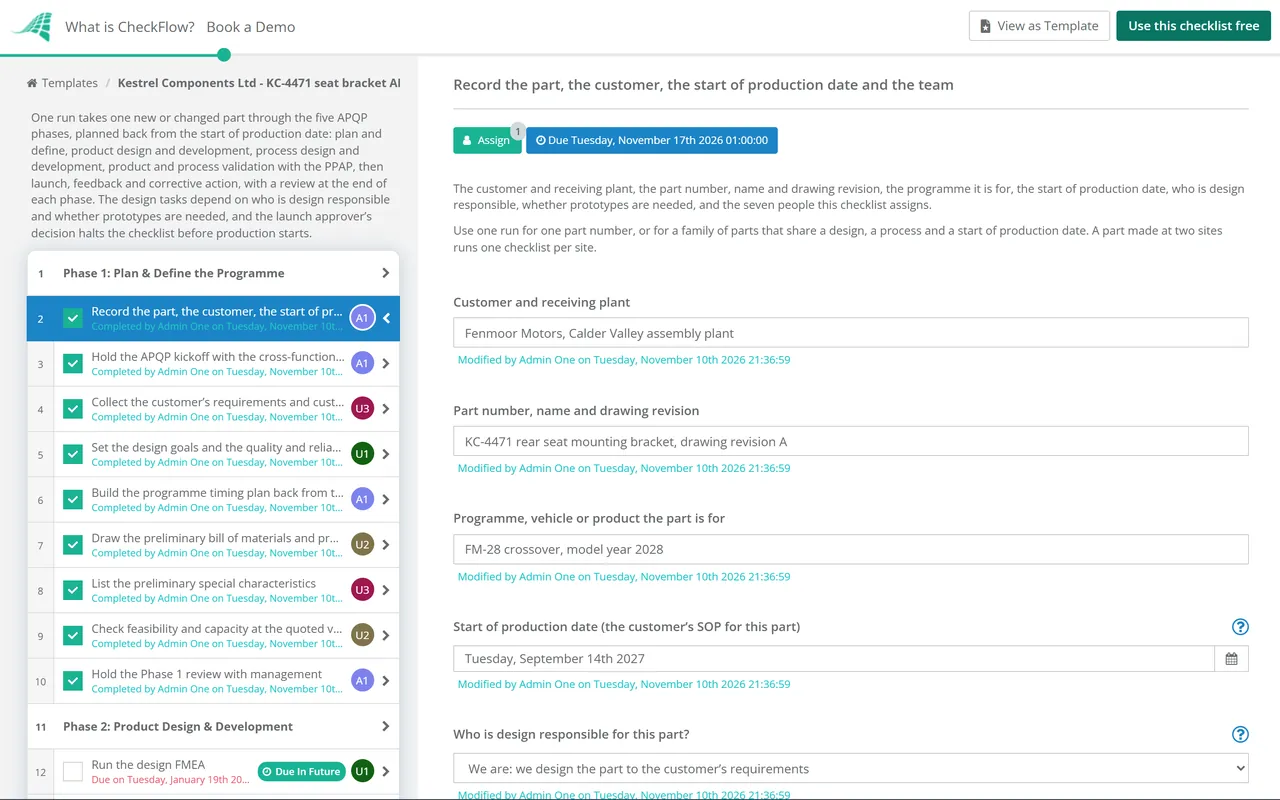
    Phase 1: Plan & Define the Programme

    9 tasks

    Owned by the APQP lead. Enter the start of production date first: every due date counts back from it in working days, and the tasks after launch count forward from it. This template allows about ten months before it; for a shorter programme the early tasks fall due before you start, so change their due dates on the checklist or do them first. Say who is design responsible and whether the customer needs prototypes; each answer adds the design tasks this part needs.

    • Record the part, the customer, the start of production date and the team — the customer and receiving plant, the part number, name and drawing revision, the programme it is for, the start of production date, who is design responsible, whether prototypes are needed, and the seven people this checklist assigns
    • Hold the APQP kickoff with the cross-functional team — who is on the team and what each person owns, the customer’s contacts, how the team will work with the customer and with sub-suppliers, and the dates of the phase reviews
    • Collect the customer’s requirements and customer-specific requirements — the nomination or purchase order, the drawings and specifications, volumes and quoted rate, the customer’s supplier manual and its customer-specific requirements for IATF 16949, and the dates the customer has set for prototypes, PPAP and launch
    • Set the design goals and the quality and reliability targets — the performance, durability, weight and cost goals the customer has set, and the quality and reliability targets the part must meet in the customer’s own terms
    • Build the programme timing plan back from the start of production — the customer’s milestones (prototypes, PPAP, start of production) and the team’s own: design freeze, tooling kickoff and delivery, the production run and the phase reviews
    • Draw the preliminary bill of materials and process flow — every purchased part and material and where it will come from, and the main process steps from receiving to shipping, as far as they are known now
    • List the preliminary special characteristics — the product and process characteristics the customer designates on its drawings and specifications, and the ones the team adds from experience with similar parts, each with the customer’s symbol
    • Check feasibility and capacity at the quoted volume — whether the part can be made to the requirements at the quoted rate and volume with the equipment, floor space and shifts available, and what new equipment or tooling is needed
    • Hold the Phase 1 review with management — the team shows what Phase 1 produced (the requirements, the targets, the timing plan, the preliminary bill of materials, process flow and special characteristics), the open risks and actions, and whether the people, tooling and money for the next phase are in place
  2. Phase 2

    Phase 2: Product Design & Development

    13 tasks

    Owned by the design engineer where you are design responsible, and by the quality engineer where you build to the customer’s design. The first task’s answers decide which design tasks show. Every run ends this phase with the team feasibility commitment and the Phase 2 review.

    • Run the design FMEA — the part’s functions, how each could fail, the effects and causes, the risk ranking in the method the customer requires, and the actions, with the special characteristics it identifies
    • Review the customer’s design for manufacturability — every drawing and specification checked for what you can make and measure: tolerances, materials, datums, special characteristics, and anything unclear or missing
    • Write the prototype control plan — the dimensional checks, material tests and performance tests the prototype parts get, and the record each check leaves
    • Agree the design changes with the customer in writing — each change the drawing review asked for, the customer’s answer, and the drawing revision that carries it
    • Hold the design reviews — the design checked against the requirements and targets at each stage, with the DFMEA actions, manufacturing and assembly feedback, and the test results so far
    • Specify the new equipment, tooling and facilities — the tools, fixtures, machines and floor space the part needs, with long-lead items ordered so they arrive before the process is proved
    • Build, check and ship the prototype parts — the parts built and checked to the prototype control plan, the results recorded and the parts shipped to the customer’s dates
    • Plan and run design verification — the tests that show the design meets its requirements, the samples, the acceptance criteria and the results, in a design verification plan and report
    • Specify the gauges and test equipment — the measuring equipment and checking aids each characteristic needs, special characteristics first, ordered in time for the measurement studies
    • Confirm the special characteristics — the preliminary list updated from the design FMEA or the customer’s drawings, agreed with the customer where it requires, and carried into the drawings and control plans
    • Release the drawings and specifications — the drawings, models, material and performance specifications released at a stated revision with the special characteristics marked, and sent for customer approval where the customer requires it
    • Sign the team feasibility commitment — the team confirms the part can be made, measured, packed and delivered in the required quantity, at the quoted cost and to the timing plan, or lists what must change
    • Hold the Phase 2 review with management — the team shows what Phase 2 produced (the design FMEA or drawing review, design verification, any prototypes, the special characteristics, the equipment and gauge plans and the feasibility commitment), the open risks and actions, and whether the people, tooling and money for the next phase are in place
  3. Phase 3

    Phase 3: Process Design & Development

    11 tasks

    Owned by the manufacturing engineer. The process is designed around the released design: the flow, the floor plan, the process FMEA, the pre-launch control plan, the instructions, the packaging and the plans for proving the gauges and the process. The tooling is delivered and proved before Phase 4.

    • Finalise the process flow chart — every step from receiving to shipping, including inspection, rework, storage and the handling of nonconforming parts
    • Agree the packaging with the customer — the containers, dunnage, quantities and labels the customer requires, checked to protect the part, and approved by the customer where it asks
    • Lay out the floor plan — where each operation, inspection point and gauge sits, how material flows, and where nonconforming parts are held
    • Run the process FMEA — each process step from the flow chart, how it could fail, the effects on the part and the customer, the causes, the controls and the actions
    • Write the pre-launch control plan — the extra dimensional checks, tests and inspections after prototypes and before production, with the controls for every special characteristic and the reaction to a failure
    • Write the work instructions and set-up sheets — an instruction for each operation from the PFMEA and control plan, with the settings, checks and what to do when a check fails
    • Plan the measurement systems analysis — the gauge studies for each gauge used on a special characteristic and the method and acceptance criteria the customer requires
    • Plan the preliminary process capability studies — which characteristics are studied, how many parts, how they are sampled and the capability the customer requires
    • Plan quality with the new sub-suppliers — each new sub-supplier’s parts approved through their own quality planning and PPAP, or your own approval, before those parts go into the production run
    • Install and prove the tooling and equipment — each tool and machine accepted at the maker and again after installation, with first parts checked before the production run
    • Hold the Phase 3 review with management — the team shows what Phase 3 produced (the process flow, floor plan, process FMEA, pre-launch control plan, instructions, packaging, the measurement and capability plans and the proved tooling), the open risks and actions, and whether the people, tooling and money for the next phase are in place
  4. Phase 4

    Phase 4: Product & Process Validation

    11 tasks

    Owned by the quality engineer with the production manager. The process is run as it will run in production and the results prove it: gauge studies, a significant production run, capability, validation tests, packaging and the PPAP. The launch approver then decides whether production starts, and nothing after that decision can be completed until it is made.

    • Train the operators and inspectors — everyone who will run, set or check the process trained on the work instructions and control plan before the production run, with the record kept
    • Complete the measurement systems analysis studies — each planned gauge study run on the production gauges, the results against the customer’s criteria, and any gauge fixed or replaced
    • Run the significant production run — the run made at the production site with production tooling, gauges, materials, operators and settings, at the production rate, in the quantity the customer requires
    • Complete the preliminary process capability studies — the planned studies run on parts from the production run, with the results against the customer’s targets and the actions for any characteristic that falls short
    • Run the production validation tests — the engineering tests repeated on parts from production tooling and the production process, to show they still meet the requirements
    • Check the packaging with parts from the run — parts from the run packed as specified and checked for damage, labels and quantities, through a trial shipment where the customer asks
    • Update the control plan for launch and production — the pre-launch plan’s extra checks carried into the launch period the customer requires, and the production control plan that follows it, matching the PFMEA
    • Submit the PPAP and record the customer’s disposition — the PPAP prepared and submitted at the level the customer requires, and the customer’s decision: approved, interim approval or rejected
    • Check launch readiness — the PPAP disposition, open actions from the phase reviews, capacity at the production rate, the launch control plan, stock of purchased parts, packaging and trained people, each confirmed or listed as open
    • Close the gaps that stopped the launch decision — each reason the launch approver gave for Not yet, the fix and the evidence, before the decision is made again
    • Launch approver decides whether production starts — the readiness check, the PPAP disposition and the open risks reviewed, and a decision: go, go with conditions, or not yet
  5. Phase 5

    Phase 5: Launch & Ramp-Up

    6 tasks

    Applies only when the launch decision is Go or Go with conditions. Owned by the production manager with quality. Any conditions from the launch decision are closed and the launch checks the customer requires are in place before the first part ships. Production starts on the start of production date, and the extra checks stay until their exit criteria are met and the customer agrees.

    • Close the conditions set at the launch decision — each condition the launch approver set, the action taken and the evidence, closed by the date agreed
    • Put the launch containment checks in place — the extra inspection the customer requires for the launch period set up before the first part ships: where it sits, what it checks, how results are recorded and the exit criteria
    • Start production and ship the first parts — production started on the agreed date with the production control plan in use, and the first shipment made with the labels and packaging approved
    • Monitor quality and delivery through ramp-up — parts made, scrap, internal and customer rejects, delivery against the schedule and any containment finds, reviewed each week
    • Confirm the process holds at the production rate — a run at the full rate over the period the customer sets, with capability rechecked on production data
    • Exit launch containment with the customer’s agreement — the exit criteria met, the evidence sent to the customer, and the extra checks removed only once the customer agrees
  6. Phase 6

    Phase 6: Feedback, Assessment & Corrective Action

    5 tasks

    Applies only when the launch decision is Go or Go with conditions. Owned by the APQP lead. What the launch taught goes back into the documents that run the process and into the next programme, and the programme is handed over to series production.

    • Log the customer’s feedback and complaints — returns, complaints, field reports and the customer’s scorecard for quality and delivery since launch, each with its cause and response, and any gap against the targets given an owner
    • Fix problems with corrective action — each problem from the launch investigated to its root cause, with a corrective action and a check that it worked
    • Update the PFMEA, control plan and work instructions — what the launch and the corrective actions taught carried into the living documents, so the production process runs from current ones
    • Record the lessons learned — what went well and what did not, phase by phase, written where the next programme’s team will find them
    • Hand over to series production and close the programme — the final review held, open actions given owners in the plant’s own systems, the records filed and the programme closed

What This Checklist Does in Each APQP Phase

This checklist follows the five APQP phases, with a review at the end of each. The table shows what it does in each phase and how the phase ends. It is this template’s own breakdown, not the AIAG manual’s list of outputs; your customer’s requirements decide what each phase must deliver.

APQP phase What this checklist does How the phase ends here Templates it links to
1. Plan and define the programmeCollects the customer’s requirements and customer-specific requirements, sets the design goals and targets, builds the timing plan, and drafts the bill of materials, process flow and special characteristics.Phase 1 review with management (does not stop the checklist)None
2. Product design and developmentRuns the design FMEA, design reviews, design verification and drawing release where you are design responsible, or a manufacturability review of the customer’s design; adds prototypes where needed; specifies tooling and gauges.Team feasibility commitment, then the Phase 2 reviewFMEA Checklist
3. Process design and developmentFinalises the process flow and floor plan, runs the process FMEA, writes the pre-launch control plan and work instructions, agrees packaging, plans gauge and capability studies, and proves the tooling.Phase 3 review with managementFMEA, FAT, SAT, Supplier Audit
4. Product and process validationTrains the team, completes the gauge studies, runs the significant production run, checks capability, validation tests and packaging, updates the control plan and records the PPAP disposition.The launch approver’s decision: Go, Go with conditions or Not yet. The checklist halts here.PPAP Submission, Calibration Management
5. Launch, feedback, assessment and corrective actionStarts production, runs the launch containment checks until the customer agrees to end them, then logs feedback, fixes problems with corrective action, updates the documents and records lessons learned.Exit from launch containment, then the final review and handover to series productionRoot Cause Analysis (8D), CAPA

Phase names. The names above are the ones public sources commonly give the five phases. AIAG’s third edition may word them differently, so use your customer’s own names where its requirements give them.

The standards. The APQP and Control Plan manuals are published by AIAG and IATF 16949:2016 by the International Automotive Task Force; all three are paid documents, and this checklist does not reproduce them. IATF 16949:2016 is the edition in force. The IATF’s July 2026 stakeholder communiqué plans a second edition for mid-2027, with launch management one of its five priorities, and says the dates are indicative (IATF communiqué SC-2026-005).

Where this comes from. Read on 10 November 2026: AIAG’s pages for the APQP third edition, the Control Plan first edition and their implementation dates; the IATF’s communiqué on the second edition and its customer-specific requirements page. What each customer requires is in its own customer-specific requirements.

Why Run APQP in CheckFlow?

1

No launch without a decision

The seven people who run the programme are chosen on the first task, and each task is assigned to the person who owns it. The launch decision is assigned to the launch approver alone, and nothing after that approval step can be completed until they decide. Not yet hides the launch and shows the task to close the gaps.

2

Only the design work this part needs

Design responsibility shows either the design FMEA, design reviews, verification and drawing release, or the review of the customer’s design. Prototypes add their control plan and build, and a new sub-supplier adds its quality planning. Every due date moves with the start of production date.

3

Every programme on one screen

Each part being launched is its own checklist, so the Reports Grid shows every programme, its next task and what is overdue, and the record of each review, study and decision stays with the task that produced it.

CheckFlow does not build FMEAs, run gauge studies or calculate capability. Do those in your FMEA and statistics software and attach the output to the task that asked for it. CheckFlow runs the programme around them: who does each piece of work, by when, with what evidence, and who decided the launch. CheckFlow’s manufacturing checklist software shows how plants run their other quality routines the same way.

Run the submission in Phase 4 with the PPAP Submission Checklist and both FMEAs with the FMEA Checklist. Accept new equipment with the Factory Acceptance Test (FAT) Checklist and Site Acceptance Test (SAT) Checklist, keep the gauges in calibration with the Calibration Management Checklist, and run the line’s day-to-day checks after launch with the Manufacturing Quality Control Checklist.

AI generator

Didn’t find what you need? Describe it.

Describe the process in a sentence and the AI checklist generator drafts the phases and tasks for you.

Frequently Asked Questions

What is APQP?

APQP stands for Advanced Product Quality Planning. It is a structured method for planning a new or changed part, used by automotive manufacturers and their suppliers and borrowed by other industries. A cross-functional team works through five phases, from the customer’s requirements to launch and feedback, with a review at the end of each, so that design and process risks are found and dealt with before production starts. AIAG publishes the manual.

What are the five phases of APQP?

As public sources commonly name them: plan and define the programme; product design and development; process design and development; product and process validation; and launch, feedback, assessment and corrective action. This checklist follows them in order and splits the fifth into two phases, the launch itself and the feedback after it. Check your customer’s requirements for the names and deliverables it uses.

What is the difference between APQP and PPAP?

APQP is the whole planning programme for a part, from the customer’s requirements to the launch and after. PPAP is the approval at the end of APQP’s validation phase: the supplier shows that its production process makes the part to every requirement, and the customer approves it. This checklist records the PPAP disposition; the PPAP Submission Checklist runs the submission itself.

Which edition of the APQP manual is current?

AIAG’s Advanced Product Quality Planning (APQP) manual, third edition, read on 10 November 2026. The control plan content moved out of it into a separate AIAG manual, Control Plan, first edition. AIAG says GM and Stellantis required implementation from 1 September 2024 and Ford from 31 December 2024. Other customers set their own dates in their customer-specific requirements.

What control plans does APQP use?

This checklist writes a prototype control plan for prototype parts where the customer needs them, a pre-launch control plan after prototypes and before production, and a production control plan, with the extra launch checks the customer requires carried between the last two. AIAG describes its Control Plan manual as adding a Safe Launch requirement to the control plan phases; your customer’s requirements say how to apply it.

What happens at an APQP gate review?

The team shows what the phase produced, the open risks and actions, and whether the resources for the next phase are in place, and management decides whether the programme moves on. This checklist holds a review at the end of Phases 1 to 3 that does not stop the checklist, and one launch decision at the end of Phase 4 that halts everything after it until the launch approver decides.

Who should be on an APQP team?

A cross-functional team from the start: a programme or APQP lead, design and manufacturing engineering, quality, purchasing or supplier quality, and production, with the customer and key sub-suppliers involved where they need to be. This checklist names seven roles on its first task, including the launch approver, and one person can hold several of them in a smaller plant.

Does IATF 16949 require APQP?

IATF 16949:2016 is the automotive quality management standard, and vehicle makers add their own customer-specific requirements. Ford’s (effective 15 June 2026) ask suppliers to submit its External Supplier APQP/PPAP Readiness Assessment as Ford specifies; GM’s (effective 30 October 2025) do not mention APQP. Read your customer’s requirements on the IATF Global Oversight site. The IATF plans a second edition of IATF 16949 for mid-2027, with launch management one of its stated priorities, and says the dates are indicative.

How long does APQP take?

No rule sets a length: the customer’s timing for prototypes, PPAP and start of production sets it. This template allows about ten months between the first task and the start of production, then about three months after launch for containment and feedback. Enter your start of production date and the due dates follow it. For a shorter programme the early tasks will already be due: change their due dates on the checklist to fit your timing plan.

Is CheckFlow free for this template?

14-day free trial, no card required. The Business plan is $10 per user per month after the trial. Full details at checkflow.io/pricing.

Plan Every Launch the Same Way

Free trial — no credit card required.

14-day free trial, no credit cardFull refund in your first 30 daysUS hosting, EU on request