Business Closure Checklist Template

Closing a company that can pay its debts? Agree the decision, tell staff and creditors in the right order, pay every debt, send the final tax returns, keep the records, and file the strike-off or dissolution only after a director signs off.

Last reviewed: November 2026

Printed from checkflow.io/templates/legal-contract-management/business-closure-checklist

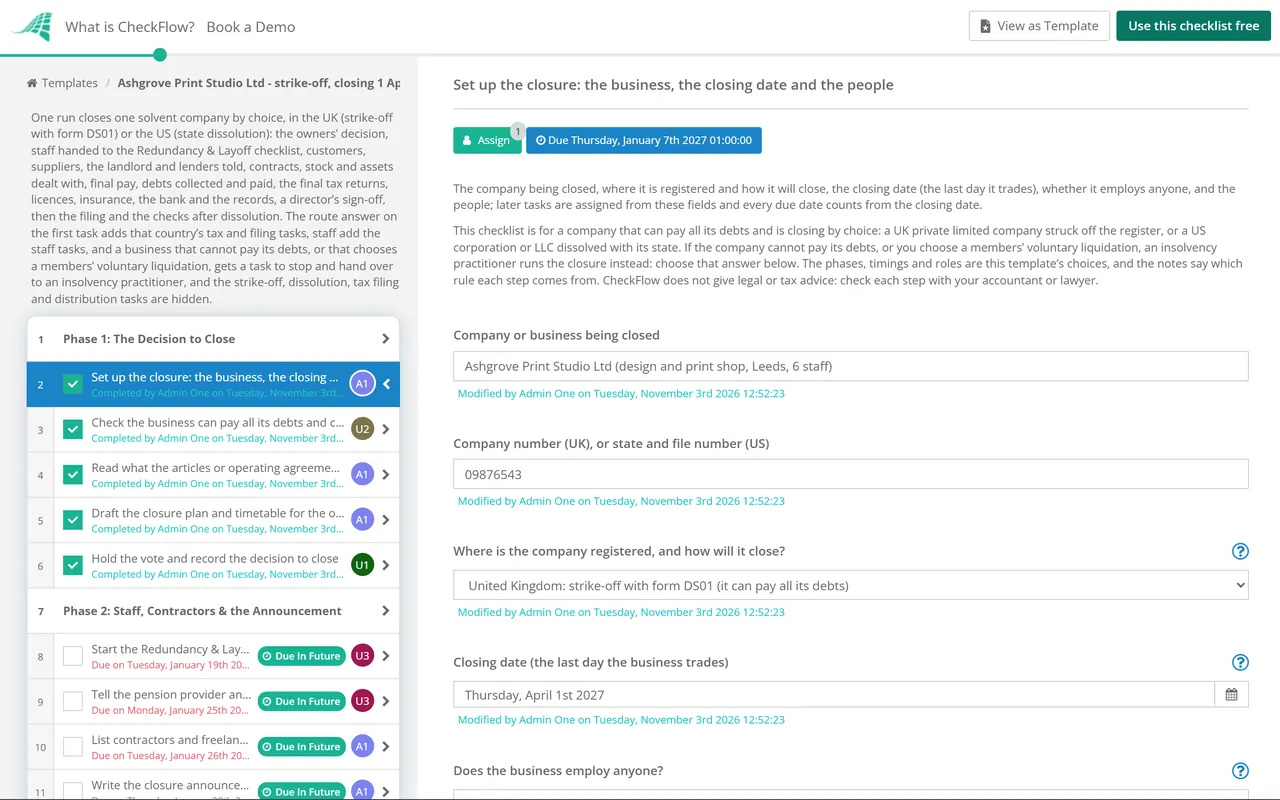
This free business closure checklist is for owners, directors and their accountants closing one company that can pay its debts, by choice: a UK private limited company struck off the Companies House register, or a US corporation or LLC dissolved with its state. One run covers one closure, planned around the closing date. It records the owners’ decision and the vote the articles or operating agreement need, checks the business is solvent, and hands staff consultation and notice to the Redundancy & Layoff checklist. Customers, suppliers, the landlord and lenders are told, contracts ended, stock sold and assets dealt with. After the last trading day come final pay, the payroll scheme, debts collected and paid, and the final tax returns, then licences, insurance, what is left for the owners, the bank accounts and the records. A director signs off before the strike-off or dissolution is filed, and the run ends with the checks after the company has gone. A business that cannot pay its debts, or that chooses a members’ voluntary liquidation, needs an insolvency practitioner or a bankruptcy lawyer instead.

Business Closure, Redundancy or Matter Closing?

This checklist closes a whole business: one solvent company, closed by choice. In the UK that is a private limited company struck off the Companies House register with form DS01; in the US, a corporation or LLC dissolved with its state. One run takes the closure from the owners’ decision to the checks after the company has gone: staff, customers, suppliers, the landlord and lenders, contracts, stock and assets, final pay, debts, the final tax returns, licences, insurance, the bank and the records, then a director’s sign-off before the filing. A company that cannot pay its debts, or that is wound up in a members’ voluntary liquidation, needs an insolvency practitioner or a bankruptcy lawyer instead, and is not covered here.

Staff consultation, notice and redundancy pay run in the Redundancy & Layoff Process Checklist, which this checklist starts rather than repeats. Ending one client relationship is the Client Offboarding Checklist, leaving one supplier the Vendor Offboarding Checklist, and finishing one project the Project Closeout Checklist. The Year-End Close Checklist closes the books at the end of a financial year, not the company.

This checklist

Closing the business

Covers: the owners’ decision, staff, customers, suppliers, the landlord and lenders, contracts, stock and assets, final pay, debts, the final tax returns, licences, insurance, the bank, the records, the sign-off and the strike-off or dissolution.

Planned around: the closing date, the last day the business trades.

Output: a company struck off or dissolved, with its debts paid, its returns filed and its records kept.

The staff

Redundancy and layoff

Covers: consultation, selection, notice, redundancy pay and, in the US, any WARN Act notice.

Planned around: its own timetable, started from Phase 2 here.

Output: staff consulted, given notice and paid what they are owed, in the Redundancy & Layoff Process Checklist.

A law firm’s file

Legal matter closing

Covers: a law firm closing one client matter: the final bill, money left in client account, the closing letter and how long the file is kept.

Planned around: the end of the matter.

Output: a closed matter, in the Legal Matter Closing Checklist.

What the Business Closure Checklist Covers

Nine phases take one closure from the owners’ decision to the checks after the company has gone. The first task records the closing date, which sets every due date, where the company is registered and whether it employs anyone. The first task also asks where the company is registered and how it will close: the UK strike-off adds the HMRC and Companies House tasks, each US answer names how the IRS taxes the business and adds the IRS and state tasks, and a corporation also gets the Form 966 task. Staff add the Redundancy & Layoff hand-off, the pension task and final pay. A business that cannot pay its debts, or that chooses a members’ voluntary liquidation, gets a task to stop and hand over, and the strike-off, dissolution, tax filing and distribution tasks are hidden. The final returns come before the sign-off, apart from the US final federal income tax return, which can only be filed once the company has dissolved. The director’s sign-off is the gate before the filing: Not approved keeps the checklist halted and adds a task to put right what stops it.

  1. Phase 1

    Phase 1: The Decision to Close

    7 tasks

    Owned by the closure lead, with the owners. Enter the closing date, the last day the business trades, on the first task: every due date counts before or after it in working days. Say where the company is registered and how it will close, and whether it employs anyone, and the tasks for that route and for staff appear. If the business may not be able to pay all its debts, or a members’ voluntary liquidation suits better, that answer adds a task to stop this run and hand over, and hides the strike-off, dissolution, tax filing and distribution tasks. The second task lists what the business owns and owes to confirm the route.

    • Set up the closure: the business, the closing date and the people — the company being closed, where it is registered and how it will close, the closing date (the last day it trades), whether it employs anyone, and the people; later tasks are assigned from these fields and every due date counts from the closing date
    • Check the business can pay all its debts and confirm the route — list what the business owns and what it owes, including tax, the lease to its end, staff pay and refunds owed to customers, then confirm the route chosen on the first task; if the list shows the business may not be able to pay all its debts, change that answer to ‘It may not be able to pay all its debts’
    • Stop this run and hand the closure to an insolvency practitioner or a lawyer — after a members’ voluntary liquidation or a possible insolvency only: appoint a licensed insolvency practitioner (UK) or take advice from a bankruptcy lawyer (US) before staff, customers or creditors are told, record who is advising, and archive this checklist or mark its remaining tasks not applicable as they advise; if the advice is that the business can pay its debts and be struck off or dissolved, change the answer on the first task. If this task appears later in the run, act on it now: its due date is the planned date at the start
    • Read what the articles or operating agreement need for the decision — the articles of association or the operating agreement, any shareholders’ or members’ agreement, and any agreement with investors or lenders: who must agree to close and how (a board resolution, an owners’ vote, a written resolution), and anyone who must consent or be consulted first
    • Draft the closure plan and timetable for the owners — the proposed closing date, what happens to staff, customers, contracts, stock and assets, the advisers (accountant, solicitor or attorney), the cost of closing, and who does what; the owners decide on this plan in the next task
    • Hold the vote and record the decision to close — the directors and owners agree the closure and the closing date in the way the articles or operating agreement require, with the decision minuted or signed; if they choose another closing date, change it on the first task
    • File Form 966 with the IRS within 30 days of the resolution — for a C or S corporation: Form 966, Corporate Dissolution or Liquidation, within 30 days after the resolution or plan to dissolve is adopted, and another within 30 days of any amendment or supplement to it
  2. Phase 2

    Phase 2: Staff, Contractors & the Announcement

    4 tasks

    Staff hear first. Their consultation, notice and redundancy pay run in the Redundancy & Layoff checklist, which this phase starts; it and the pension task appear when the business employs anyone. Contractors are given notice on their own terms, and the announcement is written once for everyone.

    • Start the Redundancy & Layoff checklist for staff consultation and notice — if the business employs anyone: start a run of the Redundancy & Layoff Process Checklist for the consultation, the notices, redundancy pay and any WARN Act notice, planned back from the closing date; this checklist does not repeat those steps
    • Tell the pension provider and plan the end of staff benefits — the workplace pension or retirement plan, health cover and any other benefits: the final contributions, what ends when, and what staff are told
    • List contractors and freelancers and end their engagements — every contractor, freelancer and agency worker, the notice their terms need, their last day and the final invoice
    • Write the closure announcement and decide who hears first — one message with the closing date, what happens to open orders, deposits and warranties, and who to contact; this template tells staff first, then customers, suppliers, the landlord and lenders in Phase 3, with a notice on the website and in email signatures
  3. Phase 3

    Phase 3: Customers, Suppliers, Landlord & Lenders

    4 tasks

    The people the business owes, and who owe it, are told in the order this template sets, each with what happens to what is owed. The lease comes first because its notice period can be the longest.

    • Give notice under the lease and agree how the premises are handed back — the lease’s break clause or end date, the notice it needs and how notice must be given, repairs or reinstatement at the end, the deposit, and the hand-back date; leases of equipment and vehicles the same way
    • Tell customers and settle open orders, deposits and warranties — how each open order will be finished or refunded, deposits, gift cards and credit returned, and what happens to warranties, support and any data you hold for them
    • Tell suppliers and agree the final orders and accounts — last orders, returns, the final account with each supplier and when it will be paid; direct debits and standing orders are cancelled only once the final bill is paid
    • Tell the bank, lenders and anyone who gave a guarantee — loans, overdrafts, credit cards, finance agreements and card terminals: the amount to repay, any cost of repaying early, any security over assets, and whether a director or owner gave a personal guarantee
  4. Phase 4

    Phase 4: Contracts, Stock & Assets

    4 tasks

    Every licence, contract, piece of stock and asset is listed and given an end. In the UK, stock goes before the closing date: selling it later would delay the strike-off.

    • List the licences, registrations and authorities to tell — every licence, permit and registration and any registered business or trade name, the body that issued it, and when to cancel it
    • List every contract and end each one on its terms — software and subscriptions, utilities, phone and internet, maintenance, marketing and any other contract: the notice each needs, the end date, any fee for ending early, and what is owed or returned
    • Sell, return or clear the stock before the closing date — sell what can be sold, return what suppliers will take back and record what is written off; in the UK a company cannot apply for strike-off if it has traded or sold stock in the last 3 months, so the stock goes before the closing date
    • List the business assets and decide what is sold, transferred or kept for the owners — equipment, vehicles, furniture, IT, intellectual property, domain names, money owed to the business and cash: its value, who buys it or takes it, and what passes to the owners once the debts are paid
  5. Phase 5

    Phase 5: Last Trading Day, Final Pay & Debts

    6 tasks

    The business stops trading on the closing date. Final pay, the UK PAYE scheme, collecting what is owed, recovering deposits and paying every creditor follow. A debt that cannot be paid in full means stopping for insolvency advice.

    • Stop trading on the closing date — the last sale, the website and listings updated, card terminals and payment links closed, phones and email answered with the closure message, and the premises secured
    • Pay final wages and give each employee their final pay documents — final wages or salary, holiday pay, notice pay and redundancy pay as the Redundancy & Layoff run sets out, and expenses owed
    • Close the PAYE scheme with HMRC — tell HMRC straight away that the company has stopped employing people: a final Full Payment Submission or Employer Payment Summary with ‘Final submission because scheme ceased’ selected and the date the scheme ceased, the expenses and benefits returns, and any tax and National Insurance still owed paid
    • Collect what customers and others owe the business — final invoices sent, each unpaid one chased, and a decision on any that will not be paid before the filing
    • Recover deposits, bonds, prepayments and refunds — the rent deposit, utility and supplier deposits, prepaid subscriptions, insurance refunds and any tax refund; in the UK, deal with HMRC refunds before applying for strike-off, because HMRC cannot process or issue refunds to a dissolved company
    • Pay every creditor and keep proof of each payment — suppliers, the landlord, lenders, contractors, tax and any other debt, each with the amount and the date paid; if a debt cannot be paid in full, stop and take insolvency advice (change the answer on the first task)
  6. Phase 6

    Phase 6: Final Tax Returns & Registrations

    7 tasks

    The final returns for the country the company is registered in. UK companies cancel VAT, send the final VAT Return, the final accounts and the Company Tax Return, and pay what is owed. US companies close the state tax accounts and file the final federal employment and contractor returns. All of it comes before the sign-off, because the law requires it whatever is decided about the filing. The one exception is the US final federal income tax return, which can only be filed once the company has dissolved, so it comes in Phase 9.

    • Cancel the VAT registration within 30 days of stopping trading — if the company is VAT registered: cancel online, or by post on form VAT7 where gov.uk says you must, and keep HMRC’s confirmation of the cancellation date
    • Close the state tax accounts and the sales tax permit — the sales tax permit and final sales tax return, state payroll withholding and unemployment insurance accounts, and any local business tax, for each state where the business is registered; ask each state’s tax agency what it needs before the dissolution filing
    • File the final federal employment tax returns and Forms W-2 — Form 941 (or 944) for the quarter of the final wages, with the box ticked to say the business has closed, the date final wages were paid, and a statement naming who keeps the payroll records and where; Form 940 for the year, marked final; and Forms W-2 to employees with Form W-3
    • Report payments to contractors on Form 1099-NEC — for contractors paid in the year the business closes: Form 1099-NEC to each one the reporting rules cover, with Form 1096 to send paper copies, or filed electronically where that is required
    • Send the final accounts and Company Tax Return to HMRC — the final statutory accounts and Company Tax Return, stating that they are the final trading accounts and that the company will soon be struck off, with any terminal loss relief claimed on the final return
    • Send the final VAT Return — for the period up to and including the cancellation date, by the due date HMRC gives, accounting for stock and other assets on hand where VAT was or could have been reclaimed on them and the VAT due on them is over £1,000
    • Pay the Corporation Tax and every other tax still owed — Corporation Tax, VAT, PAYE and any other liability paid, and any refund HMRC owes the company collected before the strike-off application
  7. Phase 7

    Phase 7: Licences, Insurance, Bank & Records

    6 tasks

    Licences, online accounts, insurance, what is left for the owners, the bank accounts and the records, all dealt with before the filing. Once a UK company is dissolved, anything it still owns passes to the Crown.

    • Cancel the licences, permits and registrations — each one on the list from Phase 4 cancelled once nothing more is done under it, with written confirmation kept, and any business or trade name the business no longer needs
    • Transfer or close domain names, online accounts and subscriptions — domain names transferred to an owner or left to lapse, social media and listings closed or handed over, and email kept running long enough to catch late post and payments; gov.uk’s strike-off guide says to transfer any domain names before applying for strike-off
    • End the insurance policies, keeping any cover still needed — each policy ended once the premises, stock, vehicles and equipment it covers are gone, after asking the broker or insurer whether any cover should run on after closing
    • Share what is left among the owners — once every debt is paid: the remaining cash and assets passed to the shareholders or members as the articles or operating agreement say, with the tax on it agreed with the accountant first
    • Close the business bank accounts — once the last payment in and out has cleared, with the final statements downloaded and kept with the records
    • Decide who keeps the records, where, and until when — accounts, tax returns, payroll, contracts, minutes and registers, kept by a named person after closing, with the keep-until date for each
  8. Phase 8

    Phase 8: Sign-Off Before Filing

    3 tasks

    The approver signs off before the strike-off or dissolution is filed. Nothing after the sign-off can be completed until it is approved. Not approved leaves the sign-off open and adds a task before it to put right what stops the filing. The duties the law sets whatever is decided, the final returns, staff pay and the records, are all in the phases before it. The one exception is the US final federal income tax return, which can only be filed once the company has dissolved, so it comes in Phase 9.

    • Check the company can now be struck off or dissolved — every task above complete or marked not applicable, the debts paid, the assets dealt with, the final returns sent (in the US, all but the final federal income tax return, which follows the dissolution) and the records kept, then the check for your country below, with a summary for the approver
    • Put right what stops the filing — after Not approved only: what the approver found (an unpaid debt, an asset not dealt with, a return not sent, or the 3 months not yet passed), what will be done and by when; the sign-off task below stays open, so the filing cannot be completed; when it is put right, the approver changes the decision to Approved and completes the sign-off; if the business turns out unable to pay its debts, stop and take insolvency advice (change the answer on the first task)
    • Approve filing the strike-off or dissolution — the director or owner reads the summary and decides whether the company can be struck off or dissolved now: Approved, or Not approved with the reasons, recorded by the approver alone
  9. Phase 9

    Phase 9: Filing & After Dissolution

    9 tasks

    The filing, the notices that follow it and the checks after the company has ended. UK: form DS01, the copies within 7 days, the Gazette notice and the dissolution. US: the state filing, its confirmation, the final federal income tax return and closing the IRS account.

    • Apply to strike off the company with form DS01 — online, or on the paper form only if you cannot apply online, signed by the majority of the directors (both, if there are 2), with the Companies House fee
    • File the dissolution with the state — the state’s dissolution document filed with the Secretary of State or business filing office in the state where the company was formed, and with every other state where it is registered, with the fee
    • Send a copy of the application to everyone who must have one, within 7 days — the members (usually the shareholders), every existing and likely creditor (banks, suppliers, landlords or tenants, guarantors, personal injury claimants, HMRC, the Department for Work and Pensions and former employees owed money), the employees, the managers or trustees of any employee pension fund, and any director who did not sign; keep proof of posting or delivery
    • Confirm the state has accepted the filing and complete any steps it lists — the state’s confirmation or certificate kept with the records, and any further step the state’s instructions name
    • Watch for the Gazette notice and answer any objection — Companies House publishes a notice of the proposed strike-off in the Gazette, and any interested party can object; an objection must reach Companies House at least 2 weeks before the date in the notice; if the company stops being eligible, for example it trades again or becomes insolvent, withdraw the application at once, online or on form DS02
    • File the final federal income tax return, marked final — the return for the year the company dissolves or winds up, filed after the dissolution, with the ‘final return’ box ticked, capital gains and losses on Schedule D, Form 4797 where business property was sold and Form 8594 if the business was sold; then pay the tax owed
    • Close the IRS business account and cancel the EIN — a letter to the IRS with the business’s legal name, EIN, address and the reason for closing, with a copy of the EIN notice if you kept it, sent once every return is filed and all tax is paid; the IRS cannot close the account before then
    • Confirm the company has been dissolved — the second Gazette notice and the company’s record at Companies House showing it dissolved, not less than 2 months after the first notice, saved with the records
    • Check nothing was left behind after the dissolution — post and email still arriving, payments or refunds sent to the old company, a forgotten asset or account, and websites or listings still showing the business; in the UK an asset found later belongs to the Crown, and the company would have to be restored to the register to recover it

UK and US Closure Steps, and Strike-Off or Liquidation

The main steps in the UK and the US

The first task’s country answer adds the tasks in that column. Neither column covers a company that cannot pay its debts.

Step United Kingdom (private limited company) United States (corporation or LLC)
Who decidesUsually the directors and shareholders. The strike-off application is made by the majority of the directors (both, if there are 2).As the company’s own documents and its state’s law require. The SBA says any partnership needs the co-owners to agree.
If it cannot pay its debtsCreditors’ interests come first. Take advice from an insolvency practitioner or solicitor; a strike-off is not an alternative to formal insolvency proceedings.Take advice from a bankruptcy lawyer.
Telling the tax authorityHMRC: close the PAYE scheme straight away and cancel VAT within 30 days of stopping trading.IRS: Form 966 within 30 days of a corporation’s resolution to dissolve, and the final employment tax returns.
Final income tax returnFinal statutory accounts and Company Tax Return to HMRC, stated to be the final trading accounts.The return for the year the company dissolves, with the ‘final return’ box ticked, filed after the dissolution.
The filingForm DS01 to Companies House, no sooner than 3 months after the company last traded.The state’s dissolution document, with every state where the company is registered.
Who must be told about itMembers, creditors, employees, pension fund managers or trustees and any director who did not sign, within 7 days.Whoever the state’s instructions name.
When the company endsStruck off not less than 2 months after the Gazette notice, and dissolved when a second notice is published.When the state accepts the filing, as its instructions say.
Anything left overA dissolved company’s assets and bank balance pass to the Crown.Distributed to the owners once creditors are paid, as the company’s documents and its state’s law say; what happens to property found after dissolution is also set by state law.
RecordsBusiness documents for 7 years after the strike-off (gov.uk); VAT records for 6 years.Employment tax records for at least 4 years; other records by the IRS’s periods of limitations.

Strike-off or members’ voluntary liquidation (UK)

Both close a solvent UK company. This checklist runs a strike-off; a members’ voluntary liquidation is run by the insolvency practitioner, and choosing it on the first task stops this run.

Strike-off (form DS01) Members’ voluntary liquidation
Who runs itThe directorsA licensed insolvency practitioner, appointed as liquidator, who takes control of the company
Who can use itA company that has not traded, changed its name or sold stock in the last 3 months and is not facing insolvency proceedingsA solvent company that can pay its debts, with interest at the official rate, within 12 months
What it needsForm DS01 signed by the majority of the directors, and a copy to everyone affected within 7 daysA declaration of solvency signed by the majority of the directors before a solicitor or notary, a general meeting within 5 weeks to pass the resolution to wind up, the resolution in the Gazette within 14 days and the declaration at Companies House within 15 days
Cost£13 online or £18 on paper, to Companies HouseThe insolvency practitioner’s fees
Money to the shareholdersIncome Tax on what they take, unless the debts are settled, the debts due are collected and the amount is £25,000 or less (HMRC)Capital Gains Tax or Income Tax may apply when a shareholder winds up a company (HMRC): ask your accountant

Where this comes from. UK: gov.uk’s Closing a limited company, Strike off your limited company, Liquidate your limited company, Stop being an employer and Cancel your VAT registration, HMRC’s Corporation Tax: selling or closing your company, and Companies House’s Striking off or dissolving a limited company (updated 4 December 2025). The fees are from Companies House’s fees guidance (updated 25 September 2026) and the DS01 page; the older strike-off guide still gives £18. The law is in the Companies Act 2006 (Part 31) and the Insolvency Act 1986. US: the IRS’s Closing a business (last reviewed 21 July 2026), How long should I keep records?, the Form 966 instructions, the instructions for Form 1120, Form 1120-S and Form 1065 (30 April 2026) and for Forms 1099-MISC and 1099-NEC (1 July 2026), the Department of Labor’s last paycheck page and the SBA’s Close or sell your business. Each state sets its own dissolution filing, and no state’s rule is given here. All read on 3 November 2026.

Why Run a Business Closure in CheckFlow?

1

No filing before a director signs off

The sign-off is assigned to the director or owner alone, and the checklist halts there: the strike-off or dissolution filing cannot be completed until it is approved. Not approved keeps the checklist halted and adds a task to put right what stops the filing. The final returns, staff pay and the records all come before it, so nothing the law requires waits on the decision. The one exception is the US final federal income tax return, which can only be filed once the company has dissolved, so it comes in Phase 9.

2

Only the steps for your country and your staff

A UK company gets the PAYE, VAT, Company Tax Return and Companies House tasks; a US company gets the IRS and state tasks, and a corporation the Form 966 task. Staff add the Redundancy & Layoff hand-off, the pension task and final pay. A business that cannot pay its debts, or that chooses a members’ voluntary liquidation, gets a task to stop and hand over, and the strike-off, dissolution, tax filing and distribution tasks are hidden.

3

Every step has an owner and a date

Name the closure lead, the director who approves, the accountant and the people contact on the first task, and every task is assigned from those fields. Due dates count before and after the closing date in working days, so moving it moves the whole plan. The contracts, creditors, assets and records tables stay on the tasks they came from, and the Reports Grid shows every closure in progress.

CheckFlow does not give legal or tax advice, file anything with Companies House, HMRC, the IRS or a state, or decide whether a business is solvent: those stay with your directors and advisers. CheckFlow makes sure every step is done in order, with an owner and a due date for each, a sign-off before the filing, and a record of who did what and when. See how a checklist runs.

Run the staff side with the Redundancy & Layoff Process Checklist, wipe and dispose of computers with the IT Asset Disposal (ITAD) Checklist, and decide what records to keep with the Data Retention & Disposal Review Checklist.

AI generator

Didn’t find what you need? Describe it.

Describe the process in a sentence and the AI checklist generator drafts the phases and tasks for you.

Frequently Asked Questions

What should a business closure checklist include?

For a company that can pay its debts: the owners’ decision and the vote its documents need, the closing date, staff consultation and notice, customers, suppliers, the landlord and lenders told, contracts ended, stock and assets sold or distributed, final pay, debts collected and paid, the final tax returns, licences, insurance and bank accounts closed, the records kept, a sign-off, then the strike-off or dissolution filing and the checks after it.

How do you close a limited company in the UK?

gov.uk says the way depends on whether the company can pay its bills. A solvent company can be struck off the register with form DS01, usually the cheapest way, or put into a members’ voluntary liquidation run by an insolvency practitioner. Before a strike-off the company must close down properly: tell HMRC, treat employees by the rules, deal with its assets and send its final accounts and Company Tax Return. An insolvent company needs advice first.

When can a company not be struck off?

Companies House says a company cannot apply if, in the last 3 months, it has traded or carried on business, changed its name, or sold property it held for sale in its normal trade, or if it is the subject of insolvency proceedings or a section 895 scheme. It must withdraw an application, online or on form DS02, if it stops being eligible. Applying when it is not eligible is an offence.

Who do you have to tell when you apply to strike off a company?

Within 7 days of applying, Companies House says a copy of the application must go to the members, every existing and likely creditor (banks, suppliers, landlords or tenants, guarantors, personal injury claimants, HMRC and the DWP among them), the employees, the managers or trustees of any employee pension fund, and any director who did not sign. Anyone who joins those groups before the company is dissolved must also be sent a copy within 7 days.

Should you use a strike-off or a members’ voluntary liquidation?

Both close a solvent UK company. A strike-off is run by the directors with form DS01. A members’ voluntary liquidation needs a licensed insolvency practitioner as liquidator and a declaration of solvency. HMRC says that on a strike-off, shareholders pay Income Tax on what they take unless the company’s debts are settled, the debts due to it are collected and the amount is £25,000 or less, so compare both with your accountant before you choose.

How do you dissolve a corporation or LLC in the US?

The SBA lists the steps: decide to close as the company’s documents require, file the dissolution documents with each state where it is registered, cancel registrations, permits, licences and business names, comply with employment law, handle the final federal and state returns, and keep records. Each state sets its own filing, so read your Secretary of State’s instructions. This template names no state’s rule and asks you to record what your state needs.

What final tax returns does a US business file when it closes?

The IRS’s Closing a business page says to file a final return for the year you close: Form 1120 or 1120-S for a corporation, Form 1065 for a partnership and Schedule C for a sole proprietor, with the ‘final return’ box ticked where the form has one. A corporation also files Form 966 within 30 days of its resolution to dissolve. Employers file final Forms 941 or 944 and 940 and give Forms W-2, and payments to contractors may need Form 1099-NEC.

How long should you keep records after closing a business?

In the UK, gov.uk’s strike-off guide says to keep business documents such as bank statements, invoices and receipts for 7 years after the company is struck off, with copies of any employers’ liability insurance policy; VAT records are kept for 6 years. In the US, the IRS says employment tax records are kept for at least 4 years, and other records by the period of limitations that applies to them. Name who keeps them.

Can a sole trader use this checklist?

Partly. It is written for a company, so a sole trader has no strike-off, dissolution or vote. In the UK, gov.uk says to tell HMRC you have stopped being self-employed, send a final Self Assessment tax return and cancel any VAT registration. In the US, the IRS lists Schedule C with your individual return for the year you close. Mark the company tasks not applicable and keep the rest: customers, suppliers, contracts, debts and records.

Is CheckFlow free for this template?

14-day free trial, no card required. The Business plan is $10 per user per month after the trial. Full details at checkflow.io/pricing.

Close the Business With Nothing Left Behind

Free trial — no credit card required.

14-day free trial, no credit cardFull refund in your first 30 daysUS hosting, EU on request