
The client gives notice
First move: acknowledge the notice in writing and confirm the end date the contract gives.
Watch for: successor requests, and pressure to hand everything over before notice is paid.
Ask: why they are leaving, and listen.
Last reviewed: October 2026
No Credit Card Required
Printed from checkflow.io/templates/professional-services/client-offboarding-checklist
Ending a service relationship is a project with a deadline: the end of the notice period. This free client offboarding checklist is for agencies, consultancies and accounting and bookkeeping firms, whether the client is leaving, the firm is stepping away or a fixed engagement has run its course. It covers notice, work in progress, the handover pack, handing back client-owned accounts, removing access both ways, the successor firm, data return, record retention and a checked final invoice. Three questions at the start show only the tasks this exit needs.
Cancelling a software subscription is mostly automatic: billing stops, an export runs and the account closes. A service firm has been working inside the client’s business. It holds logins to the client’s systems, may own accounts the client paid for, keeps working papers beside the client’s records, and usually has work half finished when notice arrives. None of that unwinds by itself.
How the relationship ends changes the tone and a few tasks, not the core. The client leaves with everything that belongs to them, nobody keeps access they no longer need, and the firm is paid for its work. The checklist asks who ended it in Phase 1 and adjusts.
First move: acknowledge the notice in writing and confirm the end date the contract gives.
Watch for: successor requests, and pressure to hand everything over before notice is paid.
Ask: why they are leaving, and listen.
First move: give notice exactly as the termination clause says, by the method it names.
Watch for: leaving the client exposed. Give time and information for someone else to take over.
Keep it: short, factual and polite.
First move: confirm in writing that the engagement has ended, so nobody assumes you are still watching.
Watch for: deadlines after the end date that the client now owns.
Ask: for a reference or case study while the result is fresh.
Accounting firms have extra duties when a client moves practice, such as answering the new adviser’s professional enquiry. Law firms face client money and file retention rules, which the Legal Matter Closing Checklist covers in detail.
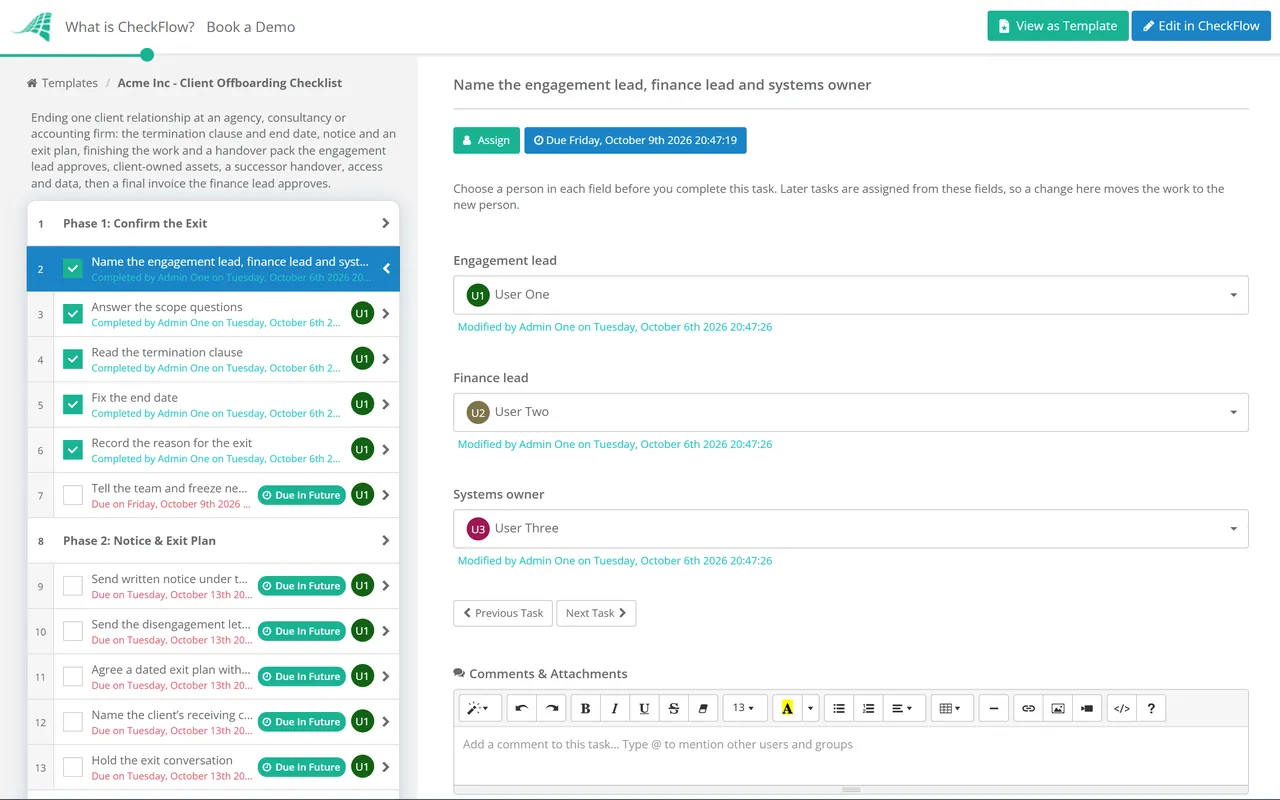
Seven phases run from the termination clause to the closed client record. The notice task appears only when the firm ends the relationship, the asset tasks only when the firm holds client-owned accounts or assets, and the successor tasks only when another firm takes over. The handover pack and final invoice each need named approval.
Owned by the engagement lead. Scope questions: who ended the relationship (Client / Firm / Fixed term ended), is another firm taking over (Yes/No), does the firm hold client-owned accounts or assets (Yes/No).
The first task is shown only when “Who ended the relationship?” is Firm.
The handover pack approval is assigned from the engagement lead field. The checklist halts until it is Approved.
These tasks are shown only when “Does the firm hold accounts or assets the client owns?” is Yes. Assigned to the systems owner.
Shown only when “Is another firm taking over the work?” is Yes. Owned by the engagement lead.
Assigned to the systems owner. Access goes on the end date, once the client has confirmed ownership of every account.
The final invoice approval is assigned from the finance lead field and halts the checklist until it is Approved.
Most offboarding arguments are about ownership: the client assumes everything is theirs, and the firm assumes its working files are its own. The table shows the usual position and how to hand each item back. It is a starting point, not legal advice. Your contract decides, so check the intellectual property and termination clauses first.
| Item | Usually belongs to | How to hand it back | Evidence to keep |
|---|---|---|---|
| Domains and hosting | The client, whoever registered them | Transfer the registration and hosting into the client’s own account, then move billing | Registrar confirmation and the new owner’s name |
| Ad, analytics and social accounts | The client, where the client paid for the activity | Make the client primary admin and payment holder, then remove the firm’s users | Screenshot of the admin list after the change |
| Code, design and source files | Depends on the IP clause; often the client once paid for | Repository or file transfer to the client’s account, with documentation | Transfer record and client confirmation |
| Original records and documents | The client | Return the originals, keep copies where you need them | Signed or emailed receipt |
| Final deliverables and reports | The client, once paid for | Include them in the handover pack | Approved handover pack |
| Working papers, drafts and internal notes | Usually the firm | Keep under your retention policy; share only if the contract or the law requires it | Retention period and destruction date |
| Firm templates, tools and methods | The firm, unless the contract licenses them | Remove the client’s access | Licence terms on file |
| Personal data processed for the client | The client, as controller | Return or delete as the data processing agreement says | Written confirmation of return or deletion |
Two rules sit behind the last rows. Under Article 28(3)(g) of the GDPR, mirrored in the UK GDPR, a processor must, at the controller’s choice, delete or return all personal data when the service ends and delete existing copies unless the law requires them to be kept. Firms in the UK anti-money laundering regulated sector, including accountants, bookkeepers and tax advisers, keep customer due diligence records for five years after the business relationship ends, under regulation 40 of the Money Laundering Regulations 2017. Check the current text of both.
Three dropdown answers decide what appears. A client moving to a rival agency gets the successor tasks, a firm-initiated exit gets the notice task, and a bookkeeping client with no accounts to transfer skips the asset register.
The handover pack waits for the engagement lead and the final invoice for the finance lead. Both approvals halt the checklist, so a half-finished pack or an unchecked write-off never reaches the client.
Receipts, admin screenshots and deletion confirmations sit on the task that produced them, and the audit trail shows who did each step and when. A read-only, white-label share link lets the client follow the exit plan.
CheckFlow is not your CRM, billing or practice management system. It runs the human process around them, so every exit follows the same steps. Most offboarding problems start at onboarding, when nobody recorded which accounts the firm set up and in whose name. CheckFlow’s client onboarding software captures that on day one, and the client onboarding checklist guide shows what to collect.
Consultancies can pair this template with the Consulting Client Onboarding Checklist, so the access granted at the start is the access removed at the end.

Accounting Firm Client Onboarding Checklist

Monthly Retainer Delivery Checklist

Marketing Agency Client Onboarding Checklist

Accounts Receivable & Collections Checklist

Employee Offboarding Checklist
Describe the process in a sentence and the AI checklist generator drafts the phases and tasks for you.
The termination clause and a fixed end date, a disengagement letter saying what the firm will and will not do from now on, and a decision on every piece of work in progress. Then a status report and the deadlines the client now owns, the return of client-owned accounts and records, access removed both ways, answers for any successor firm, data returned or deleted, retention set for your own records, and a checked final invoice.
Give the notice the contract requires, by the method it names, and keep working properly until the end date. Put the decision in a short, factual letter with a dated plan for what happens next. Give the client time and information for someone else to take over, hand back everything they own before removing your access, and never hold their accounts hostage over an invoice.
Only in narrow circumstances. ICAEW guidance says UK accountants can exercise only a particular lien, over the client’s own property that the unpaid work relates to. In the US, Circular 230 section 10.28 requires tax practitioners to return, on request, the records a client needs for federal tax obligations, and a fee dispute generally does not change that. AICPA members also cannot withhold client-provided records on a first request because fees are unpaid. Check your professional body’s current guidance first.
Nothing confidential without the client’s written authority. For UK accountants, section 320 of the ICAEW Code of Ethics covers changes in professional appointment: answer the new adviser’s professional enquiry promptly, say if there is nothing they need to know, and give the details if there is. Agencies have no equivalent rule, but a handover call protects the client and your reputation.
Personal data you processed for the client must be returned or deleted, at the client’s choice, under GDPR Article 28(3)(g); your data processing agreement usually sets the timescale. Your own business records follow your retention policy, and firms in the UK anti-money laundering regulated sector keep due diligence records for five years after the relationship ends.
The notice period sets the timetable, so plan to finish inside it. Most of the time goes on account transfers that need the client to act, such as accepting admin invitations and adding payment methods. Start the asset register the day notice arrives, not in the final week.
14-day free trial, no card required. The Business plan is $10 per user per month after the trial. Full details at checkflow.io/pricing.
14-day free trial, no credit cardFull refund in your first 30 daysUS hosting, EU on request