
The matter closes
When: the work is complete, or the retainer ends early.
What happens: deadlines and undertakings cleared, final bill, money returned.
Risk if skipped: money and obligations left with nobody watching.
Last reviewed: October 2026
No Credit Card Required
Printed from checkflow.io/templates/legal-contract-management/legal-matter-closing-checklist
Closing a file is the last piece of work on a matter and the easiest to leave half done. This free legal matter closing checklist is for law firms of any size and for in-house legal teams. It takes a matter from “the work is done” to an archived file with a destruction date: deadlines and undertakings cleared, a final bill, client money returned, a closing letter that ends the retainer, originals handed back, the conflicts record updated and retention set. Three questions at the start add the tasks for client money, for a retainer that ends early, and for England and Wales or US rules.
Firms often treat “closing the file” as one step. It is really three events, often years apart. Mixing them up is how a client ends up believing the firm is still acting, or how a file is shredded while a claim could still be brought.
The closing letter does most of the work. Malpractice insurers and bar guidance recommend a written disengagement or closing letter, because without one a client may reasonably think the relationship, and the firm’s duty to watch deadlines, continues. The letter also marks when the client becomes a former client for conflicts purposes.
When: the work is complete, or the retainer ends early.
What happens: deadlines and undertakings cleared, final bill, money returned.
Risk if skipped: money and obligations left with nobody watching.
When: the retainer ends and the client is told so in writing.
What happens: conflicts record updated; confidentiality continues indefinitely.
Risk if skipped: the client assumes you are still acting.
When: the retention period set at closing runs out.
What happens: a destruction review, then secure destruction recorded against the matter.
Risk if skipped: files kept forever, or destroyed while the firm still needs them.
This checklist covers the first two steps and diarises the third. It is the counterpart of the Legal Case Intake Process Checklist: what intake opens, closing should shut.
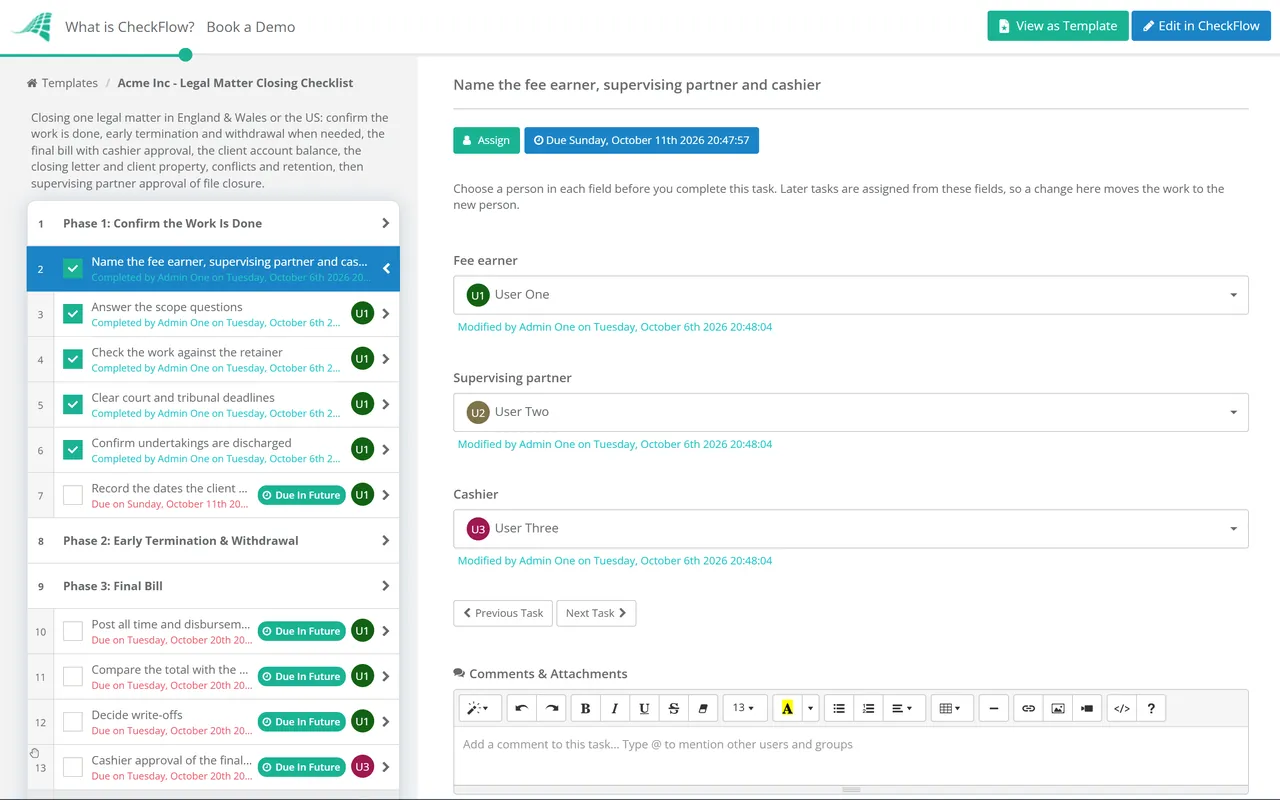
Seven phases run from checking the work is done to the supervising partner’s sign-off. Withdrawal tasks appear only when the retainer ends early, client account tasks only when the firm holds client money, and the records task matches the jurisdiction. The final bill and file closure each need named approval.
Owned by the fee earner. Scope questions: which rules apply (England & Wales / US), does the firm hold client money on this matter (Yes/No), is the matter ending before the work is complete (Yes/No).
These tasks are shown only when “Is the matter ending before the work is complete?” is Yes, whether the client terminated or the firm withdrew.
The approval is assigned from the cashier field and halts the checklist until Approved. No client money moves before it.
These tasks are shown only when “Does the firm hold client money on this matter?” is Yes. Assigned to the cashier.
Owned by the fee earner. The letter ends the retainer, so it goes before the file is archived.
The AML records task is shown only when the rules chosen are England & Wales; the trust records task only when they are US.
File closure is an approval assigned from the supervising partner field. The checklist halts until it is Approved.
The rules behind a file closing are spread across accounts rules, conduct codes, court rules and anti-money laundering law. US rules are set state by state, mostly adapted from the ABA Model Rules, so check your own state’s version. This is a starting point, not legal advice.
| Item | What to do | England & Wales | US (ABA Model Rules) |
|---|---|---|---|
| Client money | Bill, take costs, return the balance promptly | SRA Accounts Rules 2019: bill or written notice before taking costs (rule 4.3); return money promptly once there is no proper reason to hold it (rule 2.5) | Rule 1.15: promptly deliver funds the client is entitled to; state trust account rules apply |
| Untraceable balances | Record attempts to trace the client | Balances of £500 or less per matter can go to charity under SRA conditions; larger sums need SRA authorisation | Usually escheat to the state under unclaimed property law after a dormancy period that varies by state |
| Undertakings | Discharge or get a written release before closing | SRA Code paragraph 1.3: perform all undertakings within the agreed or a reasonable time | Check state rules and any written commitments given |
| Original documents | Return against a receipt, or record safe custody | Originals sent by the client generally belong to the client | Rule 1.16(d): surrender papers and property the client is entitled to |
| File contents | Separate client-owned from firm-owned documents | Law Society practice note: final versions and originals are usually the client’s; working papers usually the firm’s | Many states treat the file as the client’s, with copies kept by the firm |
| Conflicts record | Mark as former client, never delete | SRA Code 6.3 and 6.5: confidentiality continues, and adverse work for others is limited | Rule 1.9: duties to former clients |
| Proceedings | Come off the record if the retainer ends early | CPR 42.2 notice of change, or a CPR 42.3 order | Rule 1.16(c): follow the tribunal’s notice or permission rules |
| Records | Set retention and a destruction date | MLR 2017 regulation 40: customer due diligence records for five years after the relationship ends, where the work is in scope | Rule 1.15(a): trust account records for a period such as five years |
The cashier approves the final bill and client account position before money moves, and the supervising partner approves closure. Both approvals halt the checklist until given.
Three dropdowns decide what appears: client account tasks only where the firm holds money, withdrawal tasks only where the retainer ended early, and the right records task for the jurisdiction.
The closing letter, nil ledger and receipts for returned originals sit on the tasks that produced them, and the audit trail shows who did what and when, ready for a file review.
CheckFlow is not a case management, legal accounting or document management system. It runs the closing process around those tools, so every fee earner closes files the same way. CheckFlow for law firms shows how practices use it for intake, closing and the recurring compliance work in between.
Accountants, agencies and consultancies ending a client relationship can use the Client Offboarding Checklist, which adapts this process for firms without client account or court rules.

Legal Case Intake Process Checklist

Trial Preparation Checklist

Legal Hold Checklist

Client Trust Account Reconciliation Checklist

Legal Department Compliance Audit Checklist
Describe the process in a sentence and the AI checklist generator drafts the phases and tasks for you.
A check that the work is complete and no court deadline or undertaking is outstanding, the dates the client must act on after closing, a final bill, the return of client money, a closing letter that ends the retainer, returned originals, an updated conflicts record, a retention period with a destruction date, and a supervising partner’s sign-off. If the retainer ended early, add coming off the record and transferring the file.
That the matter is closed and the firm is no longer acting, from a stated date. What the firm will not do from now on, such as monitoring deadlines or updating its advice if the law changes. The dates the client must act on, like limitation or renewal dates. What happens to originals and any money held, and how long the file is kept before destruction. Keep it plain; it may be read again years later.
It goes back promptly to the client, or the third party it is held for. In England and Wales, rule 2.5 of the SRA Accounts Rules 2019 requires return as soon as there is no longer any proper reason to hold it; untraceable balances of £500 or less per matter can go to charity under SRA conditions, and larger sums need SRA authorisation. In the US, ABA Model Rule 1.15 requires prompt delivery, and unclaimed funds follow your state’s unclaimed property rules.
There is no single answer. In England and Wales many firms keep most files for at least six years, the main limitation period under the Limitation Act 1980, and longer for property purchases, wills and trusts; anti-money laundering records have their own five-year rule. In the US it depends on your state. Set periods by matter type and write the one that applies into the closing letter.
Usually both of you, in parts. The Law Society’s practice note for England and Wales says originals the client sent, final versions of documents and third-party correspondence generally belong to the client, while working papers, drafts, internal notes and accounting records generally belong to the firm. Engagement terms can change this. In the US it varies by state, and many treat the file as the client’s.
Because duties to former clients outlast the retainer. ABA Model Rule 1.9 stops a lawyer acting against a former client in the same or a substantially related matter without the former client’s informed consent, confirmed in writing. In England and Wales the SRA Code keeps former clients’ affairs confidential and restricts acting against a former client whose material confidential information the firm holds. Mark the client as former; never delete the record.
14-day free trial, no card required. The Business plan is $10 per user per month after the trial. Full details at checkflow.io/pricing.
14-day free trial, no credit cardFull refund in your first 30 daysUS hosting, EU on request