
Handled by the month-end close
- Transaction cut-off and posting
- Bank and balance sheet reconciliations
- Accruals, prepayments and depreciation
- Management accounts and review
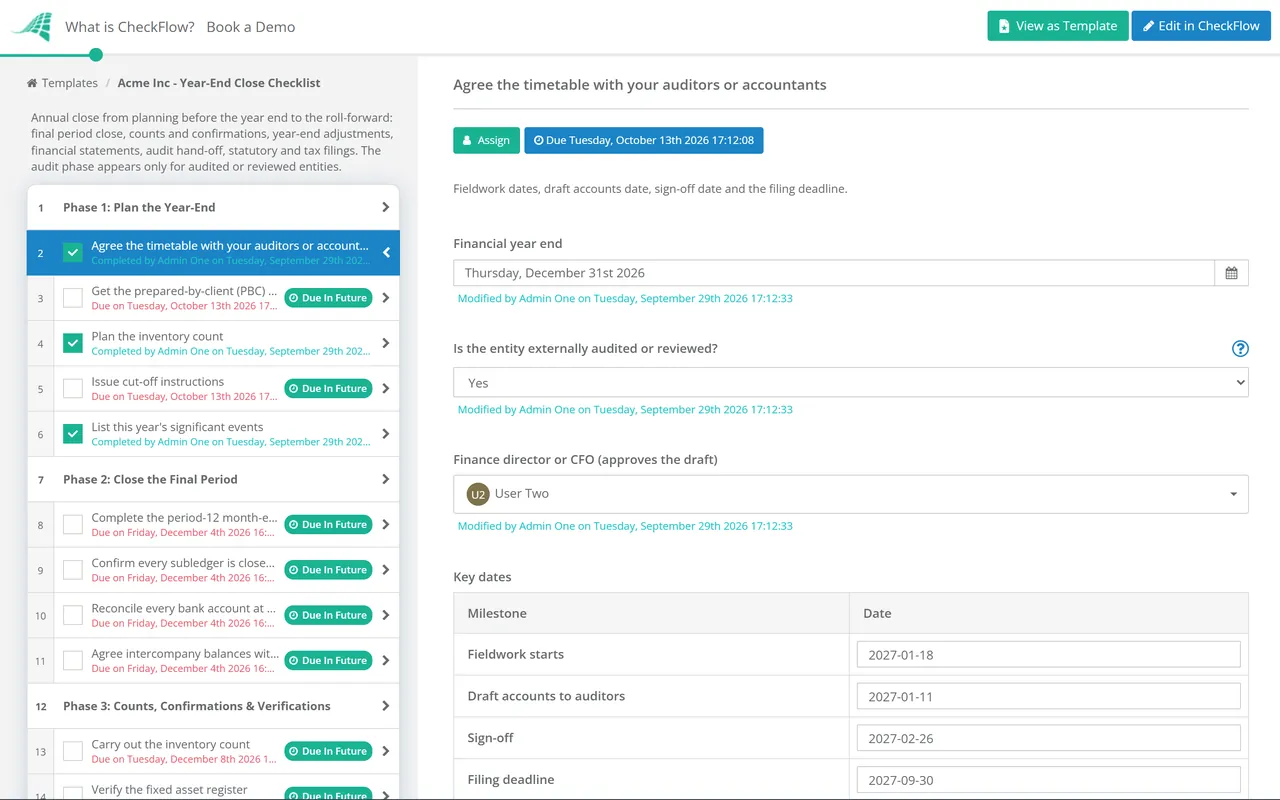
Most finance teams have their month-end close under control. The year-end is different because so much of it happens only once. The people who ran last year’s inventory count, agreed the audit timetable or prepared the tax provision may have left, and the knowledge often lives in one spreadsheet and a few old emails. This free year-end close checklist gives controllers, finance managers and small finance teams a structured annual process that builds on the month-end close rather than repeating it. It starts before the year ends with planning and cut-off instructions, closes period 12, then covers year-end counts and confirmations, year-end adjustments and estimates, the financial statements, the audit hand-off, statutory and tax filings, and the roll-forward into the new year. The audit phase appears only for entities that have an external audit or review.
A year-end close is not a separate process from the month-end close. It is the final month-end close with a layer of annual work on top. Treating it as one enormous checklist is how teams end up re-doing reconciliations they already had, while missing the items that only come round once a year. This template assumes you run the monthly close using the Month-End Close Checklist, and adds only what the year-end needs.
The annual items fall into four groups: work that must be planned before the year ends, such as counts and cut-off; estimates that need a fresh, documented judgement once a year; the financial statements and the audit; and the statutory and tax filings that follow. Each group has different owners and deadlines, and several involve people outside finance.
Seven phases run from planning before the year ends to the roll-forward into the new year. Phase 6 appears only when the entity has an external audit or review.
Start six to eight weeks before the year ends. Counts, cut-off and the audit timetable can’t be arranged after the event.
Shown only when the entity has an external audit or review. Unaudited entities go straight to filing.
Year-end deadlines are set by company law, securities regulation and tax law, and they are counted from your own year-end date. The table shows common examples for the US and the UK. Other countries set their own, and your entity type, size and any extensions can change them, so confirm every date with your advisers and add it to the template as a due date.
| Obligation | United States | United Kingdom |
|---|---|---|
| Publish or file annual accounts | SEC registrants file Form 10-K within 60, 75 or 90 days, depending on filer status; private companies generally have no public filing | Companies House: 9 months after the year end for a private company, 6 months for a public company |
| Corporate income tax return | Form 1120: 15th day of the 4th month after the year end; Forms 1120-S and 1065: 15th day of the 3rd month; extensions available (to file, not to pay) | CT600: 12 months after the end of the accounting period |
| Corporation tax payment | Estimated tax paid during the year; any balance due with the original return date | 9 months and 1 day after the period end for most companies; large companies pay in quarterly instalments |
| Employee and contractor year-end | Forms W-2 and 1099-NEC by 31 January, or the next business day (calendar year) | P60s to employees by 31 May; P11D and P11D(b) by 6 July (tax year) |
| External audit | Required for SEC registrants; otherwise driven by lenders, investors or regulators | Required unless the company qualifies for an exemption; for years beginning on or after 6 April 2025 a company is small if it meets two of: turnover up to £15m, balance sheet up to £7.5m, 50 employees |
Several of these are changing. The SEC proposed in May 2026 to simplify its filer categories, which would change the 10-K deadlines for some companies if adopted. C corporations with a 30 June year end followed a different Form 1120 due date for tax years beginning before 2026, and now follow the standard rule. The US reporting threshold for Form 1099-NEC rose from $600 to $2,000 for payments made after 2025. In the UK, Companies House will require all accounts to be filed through software from 1 April 2028, when abridged accounts are also abolished, and HMRC is phasing in mandatory payrolling of benefits in kind from April 2027, which replaces P11D reporting for the benefits it covers.
Accounting frameworks change too. UK and Irish entities reporting under FRS 102 apply amended revenue and lease requirements for periods beginning on or after 1 January 2026, which brings most leases onto the balance sheet as IFRS 16 and US GAAP’s ASC 842 already do. IFRS reporters should plan for IFRS 18, which replaces IAS 1 for periods beginning on or after 1 January 2027. List any change that affects this year in Phase 1, so the work starts before the close rather than during the audit.
The year-end runs once a year, so the knowledge is easily lost. A yearly schedule starts the checklist eight weeks before the year end with every owner, due date and instruction from last year, including the changes recorded in last year’s debrief.
Answer one question at the start and the audit hand-off phase is shown or hidden. Audited entities get the PBC tracking, representation letter and board approval steps; unaudited entities go straight from the financial statements to filing.
Count sheets, confirmations, workpapers and approvals are attached to the tasks they support, and every task records who completed it and when. The PBC list becomes a set of assigned tasks rather than a spreadsheet emailed back and forth.
The year-end starts with a normal close. Our month-end close guide covers the reconciliations, journals and controls that the period-12 close depends on, and the Month-End Close Checklist runs them every month.
Tax has its own annual cycle. The Tax Preparation Checklist covers the records, deductions and adviser hand-off behind the return, and the Fixed Asset Register Review Checklist covers the asset verification that Phase 3 depends on. UK companies then turn the closed year into statutory accounts, and the Annual Accounts & Statutory Filing Checklist takes them through approval, Companies House and the CT600.

Month-End Close Checklist

Tax Preparation Checklist
Fixed Asset Register Review Checklist

Annual Accounts & Statutory Filing Checklist (UK)

Quarter-End Close Checklist
Describe the process in a sentence and the AI checklist generator drafts the phases and tasks for you.
It is the list of tasks a finance team completes to close the financial year: the final month-end close, plus year-end counts and confirmations, annual adjustments and estimates, the financial statements, the audit, statutory and tax filings, and rolling the ledger into the new year. A checklist gives each task an owner and a deadline, and keeps the process consistent from one year to the next.
The month-end close produces management accounts every month. The year-end close adds everything that happens only once a year: the audit timetable and request list, inventory counts and third-party confirmations, a fresh review of provisions, impairment and tax, statutory financial statements, and the filings that follow. Run the month-end checklist for period 12, then this checklist for the annual layer on top.
Six to eight weeks before the year ends. Inventory counts, cut-off instructions and the audit timetable all have to be arranged in advance, and some can’t be fixed after the year-end date has passed. Starting early also gives you time to deal with this year’s significant transactions and any new accounting standards before the close begins.
PBC stands for “prepared by client”. It is the auditors’ list of schedules, reconciliations and documents they need from you, usually with a due date for each. Treating each PBC item as an assigned task with a due date is the easiest way to avoid the last-minute chase that delays most audits.
Typical year-end adjustments include accrual true-ups, bonus and holiday pay accruals, the bad debt provision, inventory write-downs, impairment of long-lived assets, lease accounting, provisions for legal claims or warranties, and current and deferred tax. Which ones apply, and how they are measured, depends on your business and your accounting framework.
No. This checklist closes the books and produces the financial statements the tax return is based on. The Tax Preparation Checklist covers preparing and filing the return itself, including income and deduction documentation and the hand-off to your tax adviser. Most businesses run both, one after the other.
14-day free trial, no card required. The Business plan is $10 per user per month after the trial. Full details at checkflow.io/pricing.
14-day free trial, no credit cardFull refund in your first 30 daysUS hosting, EU on request