Probation Review Checklist Template

Most probation problems are not about the final meeting. They start when nobody wrote down what good looks like, the check-ins stopped after week three, and the end date passed before anyone noticed.

Last reviewed: October 2026

This free probation review checklist runs one new employee’s probation period, from the terms in the contract to the outcome. HR checks the probation terms in the contract and the written statement, the line manager agrees objectives and the standards expected in the first week, and short check-ins are logged until a mid-point review. Concerns at the mid-point bring a support plan. A final review before the end date leads to the line manager’s recommendation: pass, extend once, or not pass. HR checks the record, the decision maker decides with reasons, and the employment is confirmed in writing or ended with notice, a letter and the return of equipment. Pick the country on the first task to see the UK or US notes. Once probation is passed, the Employee Performance Review Checklist takes over.

One Probation, From the Contract to the Decision

A probation period is a time at the start of employment to check that a new employee suits the job, and that the job suits them. There is no legal requirement to have one in the UK, and it can be any length, so what matters is that the terms are written down, the employee knows what good looks like, progress is reviewed honestly and the decision at the end follows from the record.

This checklist runs one employee’s probation, from the contract to the outcome. It sits beside onboarding: the Employee Onboarding Checklist gets a new starter set up and settled, and this checklist decides whether the employment is confirmed. Three other checklists cover nearby processes.

This checklist

One probation period

Covers: one new employee, from the probation terms and first-week objectives to check-ins, the mid-point and final reviews, an extension if needed, the decision, and confirming or ending the employment.

Where: the UK (England, Scotland and Wales) and the United States, or general.

Output: a decision with its reasons, made on a dated record the employee has seen.
Once a year

The Employee Performance Review Checklist

Covers: the yearly review cycle for established employees: self-assessment, evidence, calibration, the conversation and the development plan.

Use it: once probation is passed; the last tasks here hand over to it. Employee Performance Review Checklist.

After probation

The Performance Improvement Plan (PIP) Process Checklist

Covers: a formal plan for an established employee who is not meeting the standard: objectives, support, check-ins and an outcome.

Use it: for capability problems after probation. During probation, the mid-point support plan and an extension do the same job. Performance Improvement Plan (PIP) Process Checklist.

What the Probation Review Checklist Covers

Nine phases follow one employee from the terms in the contract to the outcome. The country on the first task shows the UK or US notes and tasks, or keeps the checklist general. Concerns at the mid-point add a support plan, a recommendation to extend adds Phase 6, a recommendation not to pass adds a check by HR, and the decision shows either the tasks to confirm the employment or the tasks to end it. The decision maker’s decision is the gate: nothing after it can be completed until it is recorded.

  1. Phase 1

    Phase 1: Before the First Day

    6 tasks

    Start this checklist when the offer is accepted. Enter the start date, the mid-point review date and the probation end date on the first task: Phases 1 and 2 count in business days from the start date, Phase 3 from the start date and back from the mid-point review date, Phase 4 from the mid-point review date and Phase 5 back from the end date.

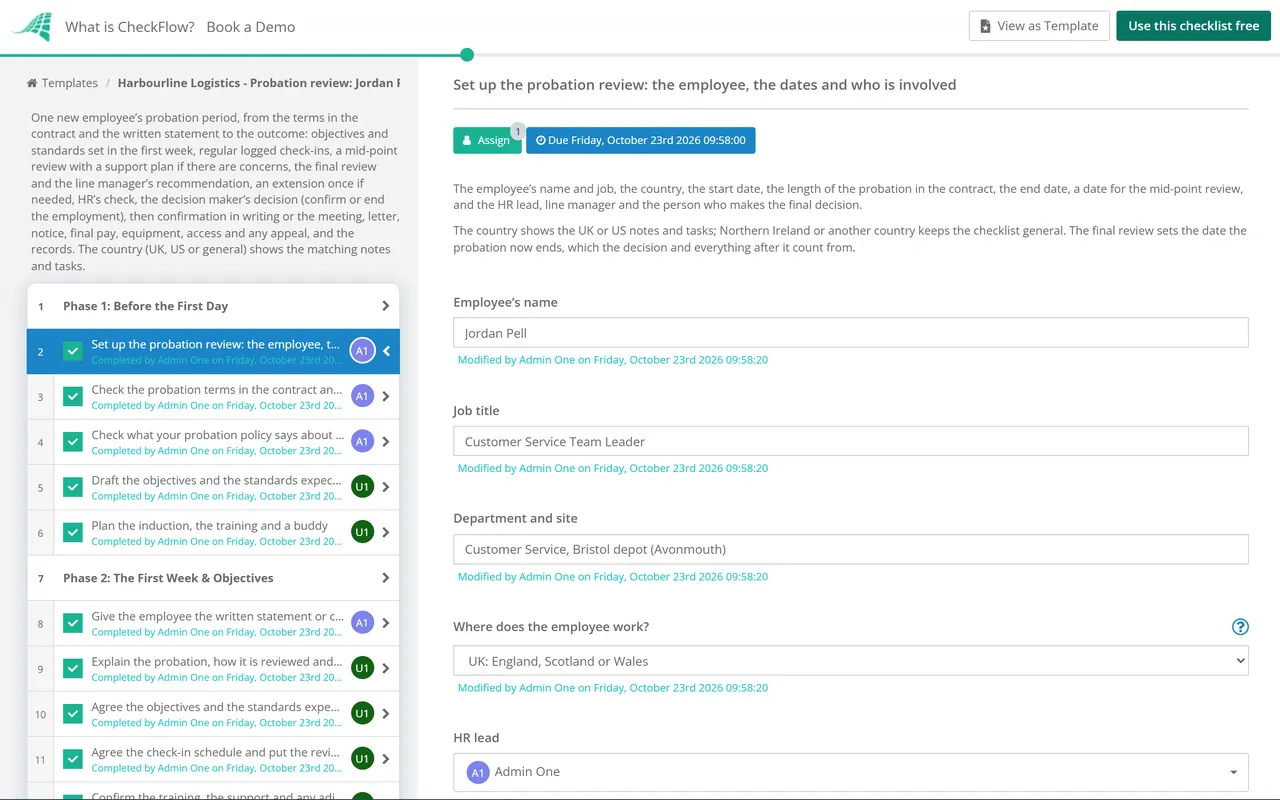
    • Set up the probation review: the employee, the dates and who is involved — the employee’s name and job, the country, the start date, the length of the probation in the contract, the end date, a date for the mid-point review, and the HR lead, line manager and the person who makes the final decision
    • Check the probation terms in the contract and the written statement — the length, the conditions to pass, the notice either side during probation, whether it can be extended and how, and what happens at the end, all in the documents the employee receives
    • Check what your probation policy says about reviews, extension and ending — how many reviews, who holds them, whether an extension is allowed and for how long, how a decision to end the employment is made and whether there is an appeal, so this run follows the same rules as everyone else’s
    • Draft the objectives and the standards expected — three to five objectives with a measure for each, the standards of attendance and conduct, and any training or qualification the job needs, written so the employee can tell at any point whether they are on track
    • Plan the induction, the training and a buddy — the first week’s timetable, the training that must be done during probation, and a colleague the employee can ask day-to-day questions; probation and induction run side by side but are not the same thing
    • US: check state law and your documents for limits on at-will employment — the state where the employee works, the offer letter, the handbook and any union contract, with advice taken if anything promises dismissal only for cause; in Montana, finishing probation brings protection against discharge without good cause
  2. Phase 2

    Phase 2: The First Week & Objectives

    6 tasks

    Make the probation clear in the first week: what it is for, how long it lasts, what good looks like and how progress will be reviewed. A clear start is what makes the final decision fair.

    • Give the employee the written statement or contract on the first day — the document that sets out the probation’s length and conditions, with a copy of the probation policy if there is one
    • Explain the probation, how it is reviewed and the possible outcomes — its length, the review dates, who decides, and that the outcome can be to confirm the employment, extend the probation once or end the employment
    • Agree the objectives and the standards expected, in writing — the objectives drafted before the start, discussed and adjusted with the employee, each with a measure and a date, and a copy given to them
    • Agree the check-in schedule and put the review dates in the diary — a short check-in every two to four weeks, the mid-point review and the final review, booked now so they are not missed
    • Confirm the training, the support and any adjustments needed — training booked with dates, the buddy introduced, and any adjustment the employee has asked for in place or in progress
    • Record the objectives and review dates in the HR system — the agreed objectives, the review dates and the probation end date on the employee’s record, so a change of manager does not lose them
  3. Phase 3

    Phase 3: Regular Check-ins

    5 tasks

    Short, regular conversations between the formal reviews. Acas suggests informal check-ins throughout probation, so the outcome is never a surprise. Phase 3 counts from the start date and back from the mid-point review date.

    • Hold the first check-in at the end of week two — how the employee is settling in, what is going well, anything unclear about the job or the objectives, and whether the training is happening
    • Hold a check-in at least monthly and log each one — the date, progress against each objective, the support given since the last check-in, anything the employee raised and the next steps, written the same day
    • Give feedback as it happens, with examples — specific praise and specific concerns at the time, with dated examples, rather than saved up for a review
    • Check the promised training and support have happened — every course, briefing and piece of equipment promised in the first week, delivered or rescheduled, so a gap in support is not later held against the employee
    • Raise any concern about performance, attendance or conduct early — told to the employee as soon as it arises, with examples and what good looks like, and noted in the check-in log
  4. Phase 4

    Phase 4: The Mid-Point Review

    7 tasks

    A formal one-to-one review about halfway through, counted from the mid-point review date on the first task. If there are concerns, four tasks add a support plan, a check on other causes, a written note of what must improve and a follow-up review.

    • Prepare for the review and share the information with the employee — the objectives, the check-in log, feedback from colleagues or customers and any performance data, shared before the meeting so the employee can prepare
    • Hold the mid-point review meeting — a two-way conversation in private: progress against each objective, the employee’s view, their wellbeing and how they are settling in, what support they need, and an honest view of whether they are on track
    • Record the review and share the record with the employee — what was discussed, what was agreed and whether the employee is on track, shared with them after the meeting
    • Concerns: agree a support plan with dated actions — what must improve, the training, coaching or change in workload that will help, who does what by when, and how progress will be measured
    • Concerns: check whether health, disability or something outside work is a factor — a private conversation about anything affecting the employee’s work; a health condition or disability may call for reasonable adjustments before any decision, and an occupational health referral if the employee agrees
    • Concerns: tell the employee in writing what must improve and what could happen — the gap with examples, the standard expected, the support offered, the date of the next review, and that the probation could be extended or the employment ended if things do not improve
    • Concerns: hold a follow-up review on the support plan — progress against the plan, whether the support was given, and whether the concerns are resolved, recorded and shared with the employee
  5. Phase 5

    Phase 5: The Final Review

    7 tasks

    The final review takes place before the probation end date on the first task, which this phase counts back from. The line manager recommends one of three outcomes and sets the date the probation now ends: the original end date, or a new one if the probation is extended.

    • Hold the remaining check-ins and log them — the same short check-ins after the mid-point review, with the same record of progress, support and next steps
    • UK: check when the employee gains protection from unfair dismissal — today the qualifying period is two years’ continuous employment; for a dismissal whose effective date of termination falls on or after 1 January 2027 it is six months, and Acas says ending probation before that point does not remove the legal risk
    • Gather the evidence: objectives, check-in notes, feedback and attendance — the objectives and how each was measured, every check-in and review record, any support plan, feedback from colleagues or customers, attendance and training completed
    • Invite the employee to the final review in writing and share the evidence — the date, the purpose and the evidence to be discussed; if the meeting could end in dismissal, say so and tell the employee they may bring a companion
    • Hold the final review meeting — the evidence against each objective, the employee’s own view and anything they want considered, a discussion of the possible outcomes, and notes taken
    • Record the line manager’s recommendation and the date the probation now ends — pass, extend the probation once, or not pass, with the reasons; enter the original end date, or the new end date if you extend
    • Not passing: HR checks the evidence, the process and the reasons — that objectives were set and reviewed, concerns were raised early with support offered, other causes were checked, the employee was heard, and the reasons are about the job and consistent with how others have been treated
  6. Phase 6

    Phase 6: Extending the Probation (Only If Extended)

    5 tasks

    This phase applies only when the recommendation is to extend. Extend once, with reasons, new objectives and a new end date, confirmed before the original end date. The first three tasks count in business days from the day the recommendation is recorded, the last two back from the date the probation now ends.

    • Extension: confirm it in writing before the original end date — the reasons, the length of the extension, the new end date, the review points and the possible outcomes; Acas says failing to confirm an extension before the original period ends could be a breach of contract
    • Extension: set new objectives, the support and the review points — what must improve and how it will be measured, the extra training or support, the check-in dates and the date of the second final review, agreed with the employee
    • Extension: update the written statement within one month — the changed probation end date confirmed in writing and the HR record updated
    • Extension: hold the check-ins and log them — progress against the new objectives, the support given and the next steps at each check-in, shared with the employee
    • Extension: hold the second final review meeting — the evidence against the new objectives, the employee’s view, and the manager’s recommendation to confirm or end the employment; invite the employee in writing first, as for the first final review
  7. Phase 7

    Phase 7: The Probation Decision

    2 tasks

    HR checks the record, then the decision maker decides: confirm the employment or end it. The decision is the gate: nothing in Phases 8 and 9 can be completed until it is recorded. Both tasks count back from the date the probation now ends.

    • HR checks the record before the decision — the objectives, every review record and the recommendation, that the process followed the policy, that the decision would be consistent with others, and that nothing points to a discriminatory or automatically unfair reason
    • Decision maker records the probation decision — confirm the employment or end it, with the date and the reasons; nothing after this task can be completed until it is done
  8. Phase 8

    Phase 8: Confirm or End the Employment

    8 tasks

    The decision shows one set of tasks: three to confirm the employment, or five to end it. They count from the date the probation now ends.

    • Confirmed: tell the employee and confirm in writing that they have passed — the news given in person first, then a letter or email confirming the employment, with specific feedback on what went well
    • Confirmed: start any change that applies after probation — any longer notice period, benefit or pay step that the contract links to passing probation, set up in payroll and the HR system
    • Confirmed: hand over to regular one-to-ones and the annual review — objectives for the months ahead, the one-to-one rhythm and the date of the first annual performance review
    • Ending: tell the employee the decision at a meeting and give the reasons — a private meeting with HR present, the decision and the reasons explained clearly, the notice and the last day, and how to appeal if your policy allows it
    • Ending: confirm the dismissal in writing with the reasons, the notice and any appeal — the reasons, the notice period or pay in lieu, the last day of employment, the final pay, and who to write to and by when if your policy gives a right of appeal
    • Ending: work out the notice and the final pay — the notice in the contract or the legal minimum, whichever is longer, whether it is worked or paid in lieu, and final pay including any holiday owed
    • Ending: arrange the return of equipment and remove access on the last day — laptop, phone, keys and badge returned, and system and building access removed at the end of the last day; run the Employee Offboarding Checklist alongside
    • Ending: arrange any appeal under your policy — heard by someone senior who was not involved in the decision, the outcome confirmed in writing; mark not applicable if there is no appeal
  9. Phase 9

    Phase 9: Records & Close-Out

    3 tasks

    Whatever the outcome, keep the record and learn from it. These tasks count from the date the probation now ends.

    • Update the HR system and payroll with the outcome — the probation status, the date it ended, any change to notice, pay or benefits, or the leaving date
    • File the probation records and give the employee a copy of the final record — the objectives, check-in log, reviews, letters and decision on the personnel file, kept and later deleted in line with your retention policy and the UK GDPR or local privacy law
    • Note anything to change in recruitment, induction or the probation policy — what helped or hindered this employee, and whether a pattern of failed probations points to a problem with how the role is recruited or introduced

Probation Rules and Review Timing at a Glance

Probation in the UK and the US at a glance

The points that shape a probation review, with the source for each. The country on the first task shows the matching notes in the checklist.

Point UK: England, Scotland and Wales United States
Is a probation period required?No, and it can be any length (Acas guidance)Set by the employer; in Montana it is 12 months if the employer sets none (Montana Code 39-2-910)
Where the terms goThe written statement must include any probation, its conditions and its length, given on or before the first day (Employment Rights Act 1996, ss.1(2) and 1(4)(ga))The offer letter, handbook or contract; check none of them promises dismissal only for cause
Extending itConfirm before the original period ends (Acas) and confirm the change in writing within one month (s.4)Montana: before it ends, and no more than 18 months in all (39-2-910(2)); elsewhere, your policy
Unfair or wrongful dismissalTwo years’ service today (s.108); six months where the effective date of termination is on or after 1 January 2027 (Employment Rights Act 2025, s.25; SI 2026/559)Most employment is at will; in Montana, discharge without good cause after probation is wrongful (39-2-904)
Protection from day oneDiscrimination (Equality Act 2010, s.39) and automatically unfair reasons such as pregnancy, family leave and whistleblowing (gov.uk)Federal anti-discrimination law covers discharge decisions (EEOC)
Notice from the employerAt least one week once employed for one month, while service is under two years (s.86), or the contract’s longer noticeDepends on the state, the offer letter and any union contract
Written reasonsOn request after two years’ service (s.92), six months from 1 January 2027; Acas advises written reasons in every caseDepends on the state and your policy

How the reviews fit together

The checklist turns three dates on the first task into due dates, then counts the decision and the outcome from the date the probation now ends, which the final review sets.

Stage What happens Counted from Where in the checklist
Before the first dayTerms checked, objectives drafted, induction plannedStart date, counted backPhase 1
First weekWritten statement, the probation explained, objectives agreedStart datePhase 2
Every two to four weeksShort check-ins, each one loggedStart date and mid-point datePhases 3 and 5
HalfwayFormal mid-point review; a support plan if there are concernsMid-point review datePhase 4
About a week before the endFinal review and the line manager’s recommendationProbation end date, counted backPhase 5
If extendedExtension confirmed in writing, new objectives, a second final reviewThe recommendation and the new end datePhase 6
By the end dateHR check, then the decisionDate the probation now endsPhase 7
After the decisionConfirm or end the employment, records and lessonsDate the probation now endsPhases 8 and 9

Sources. The Employment Rights Act 1996 (sections 1, 4, 86, 92 and 108), section 25 of the Employment Rights Act 2025 and its commencement regulations (SI 2026/559), gov.uk’s Dismissing staff guide, Acas guidance on probation periods, Montana Code 39-2-910 and the EEOC’s prohibited employment practices. Acas guidance is not law. Northern Ireland has its own employment law, US states vary, and this table is not legal advice.

Why Run Probation Reviews in CheckFlow?

1

Reviews that happen on time

Enter the start date, the mid-point review date and the end date, and every task gets a due date in business days: the first-week tasks, the check-ins, the mid-point review and the final review a week before the end. The decision and the outcome count from the date the probation now ends. Overdue alerts go to the people assigned, so a probation does not run past its end date unreviewed.

2

The right steps for each case

One answer on the first task shows the UK notes and tasks, such as the day-one written statement and the new six-month unfair dismissal period, or the US ones on at-will employment and Montana. Concerns at the mid-point add a support plan, an extension adds its own phase, and the decision shows only the tasks for confirming or ending the employment.

3

A decision on the record

The decision maker’s decision is a gate: the letter, the notice and the records cannot be ticked off until it is made with its reasons, after HR has checked the record. The Reports Grid lists every probation with its answers, so HR can see which are due and which were extended, and Analytics shows completion rates and overdue work. See how approval steps work.

CheckFlow does not decide whether someone passes probation or whether a dismissal is fair. The line manager, HR and the decision maker decide, with your policy and, where needed, legal advice. CheckFlow makes sure each review happens on time, every task has an owner and the decision rests on a dated record. HR checklist software shows how onboarding, probation and reviews run from templates across a team.

Start a new employee with the Employee Onboarding Checklist, and hold the check-ins with the One-on-One Meeting Checklist. Once probation is passed, the Employee Performance Review Checklist takes over. If the employment ends, run the Employee Offboarding Checklist for the last day. When health or disability is affecting work, use the Reasonable Accommodation Request Checklist, and for misconduct during probation, the Disciplinary Procedure Checklist. A new manager inheriting a team can find probation end dates with the New Manager Onboarding Checklist.

AI generator

Didn’t find what you need? Describe it.

Describe the process in a sentence and the AI checklist generator drafts the phases and tasks for you.

Frequently Asked Questions

What should a probation review checklist include?

Every step of one employee’s probation: checking the terms in the contract and the written statement, setting objectives and the standards expected in the first week, regular check-ins with a written log, a mid-point review, a support plan if there are concerns, the final review and a recommendation, HR’s check, the decision and its reasons, and then either confirming the employment in writing or ending it with notice, a letter and the return of equipment. This template adds the extension steps, and the UK or US notes, when they apply.

How long should a probation period be?

In the UK there is no legal requirement to have a probation period, and it can be any length. Acas guidance says it should be tailored to the job: a technical or specialist role may need longer for training and assessment. Whatever the length, it must be in the written statement of employment particulars, with its conditions. In the US the length is set by the employer; Montana sets 12 months if the employer does not set one.

Can you extend a probation period?

Yes, if the contract or policy allows it. Acas says an employer should extend when performance is not yet satisfactory but likely to improve with more support, and must confirm the extension before the original period ends, as failing to do so could be a breach of contract. In the UK the change to the written statement must be confirmed in writing within one month. This template allows one extension, with reasons, new objectives, a new end date and a second final review.

Does the Employment Rights Act 2025 change probation periods?

Not directly. Acas says the Act does not affect probation periods: there is still no legal requirement to have one. What changes is unfair dismissal. Section 25 of the Act cuts the qualifying period from two years to six months, in force from 1 January 2027, for dismissals whose effective date of termination falls on or after that date. Acas notes that ending a probation before six months does not avoid legal risk, so a fair process matters either way.

Can you dismiss someone during their probation?

Yes, but Acas calls dismissal during probation a last resort, after support and perhaps an extension, and advises a fair procedure with the reasons given in writing. In the UK, discrimination law and the automatically unfair reasons apply from the first day, and the correct notice must be given. In most of the US employment is at will, so probation does not by itself change what is needed, though state law, the offer letter and any union contract can; Montana requires good cause once probation is over.

What notice do you give if an employee does not pass probation?

In the UK, the notice in the contract or the statutory minimum, whichever is longer. Under section 86 of the Employment Rights Act 1996, an employee who has worked for one month or more is entitled to at least one week’s notice while their service is under two years. Notice can be paid in lieu. In the US, notice and final pay depend on the state, the offer letter and any union contract.

Can the employee bring someone to a probation review?

Acas says employees have a right to request to be accompanied, by a colleague or a trade union representative, to meetings that could result in dismissal. The right might not apply to every probation review, but an employer can offer it, and must make reasonable adjustments for a disabled employee, which might include a companion. This template tells the employee in the final review invitation if the meeting could end in dismissal.

How is a probation review different from a PIP?

A probation review runs for every new employee, whether things are going well or not, and ends with a decision to confirm, extend or end the employment. A performance improvement plan is for an established employee who is not meeting the standard. During probation, the mid-point support plan and an extension do the job a PIP would do later. After probation, use the Performance Improvement Plan (PIP) Process Checklist.

Is CheckFlow free for this template?

14-day free trial, no card required. The Business plan is $10 per user per month after the trial. Full details at checkflow.io/pricing.

Review Every Probation Before It Ends

Free trial — no credit card required.

14-day free trial, no credit cardFull refund in your first 30 daysUS hosting, EU on request