71% of companies have no formal offboarding process. 83% of former employees keep system access after leaving. Both are preventable.
Employee departures are treated as an afterthought in most organisations — a farewell lunch, a handshake, and a frantic last-minute attempt to collect the laptop. The cost of that approach is measured in data breach exposure ($4.45 million average, IBM 2023), lost institutional knowledge that existed only in the departing employee’s head, and a former employee relationship that could have been an asset — a future client, a future referral, a future rehire — but was left with a poor last impression instead. A structured offboarding process does not just prevent these failures. It actively converts a departure into an organisational asset: documented knowledge, secure systems, and a departing employee who leaves as an ambassador rather than a liability. This free employee offboarding checklist gives HR teams, managers, and growing businesses a structured framework for every departure — voluntary, involuntary, or contract completion.
The Three Ways Offboarding Fails — and What a Structured Process Prevents
Poor offboarding produces three categories of harm — security risk, knowledge loss, and relationship damage. Each is preventable with a structured checklist that ensures the right actions happen at the right time for every departure.
Failure Mode 1
The Security Gap
What happens: Former employees retain active access to email, cloud storage, development environments, CRM systems, and financial platforms. 83% of organisations have experienced this. Only 44% revoke all access within 24 hours of a departure.
The cost: The IBM 2023 Cost of a Data Breach Report puts the average breach cost at $4.45 million. Organisations with automated offboarding reduce security incidents by 34%.
What prevents it: A structured IT access revocation phase completed on or before the final day — not weeks later when someone notices the account is still active.
Failure Mode 2
The Knowledge Gap
What happens: 42% of institutional knowledge exists only in individual employees’ heads — undocumented processes, client relationships, system workarounds, and project context. Only 37% of organisations ensure adequate knowledge transfer during offboarding.
The cost: Projects stall. Clients disengage. The replacement hire spends months reconstructing what existed before. The $500,000 annual cost of inconsistent offboarding estimated by 41.6% of HR leaders (SHRM, 2025) is largely the cost of this gap.
What prevents it: A structured knowledge transfer and handover phase — started from the moment notice is received, not on the last day.
Failure Mode 3
The Relationship Gap
What happens: The departure is handled perfunctorily — no real exit interview, no meaningful farewell, no alumni connection maintained. The former employee leaves neutral or negative.
The cost: Former employees are future references for talent. They are future clients. And — with boomerang employees representing 35% of new hires in early 2025 (Gallup), the highest rate on record — they may be your next hire. A poor departure experience closes all of these doors.
What prevents it: A structured exit interview, a genuine farewell, and an alumni relations protocol that treats the departure as the beginning of a long-term professional relationship, not the end of one.
What the Employee Offboarding Checklist Covers
This checklist covers eight phases of the employee offboarding process — from the moment departure is confirmed through to post-departure compliance and alumni relations. Notes indicate where the process differs for voluntary, involuntary, and contract completion departures.
The offboarding process starts the moment departure is confirmed — not the week before the last day. Every day of the notice period is a day available for knowledge transfer and an orderly handover. Use all of it.
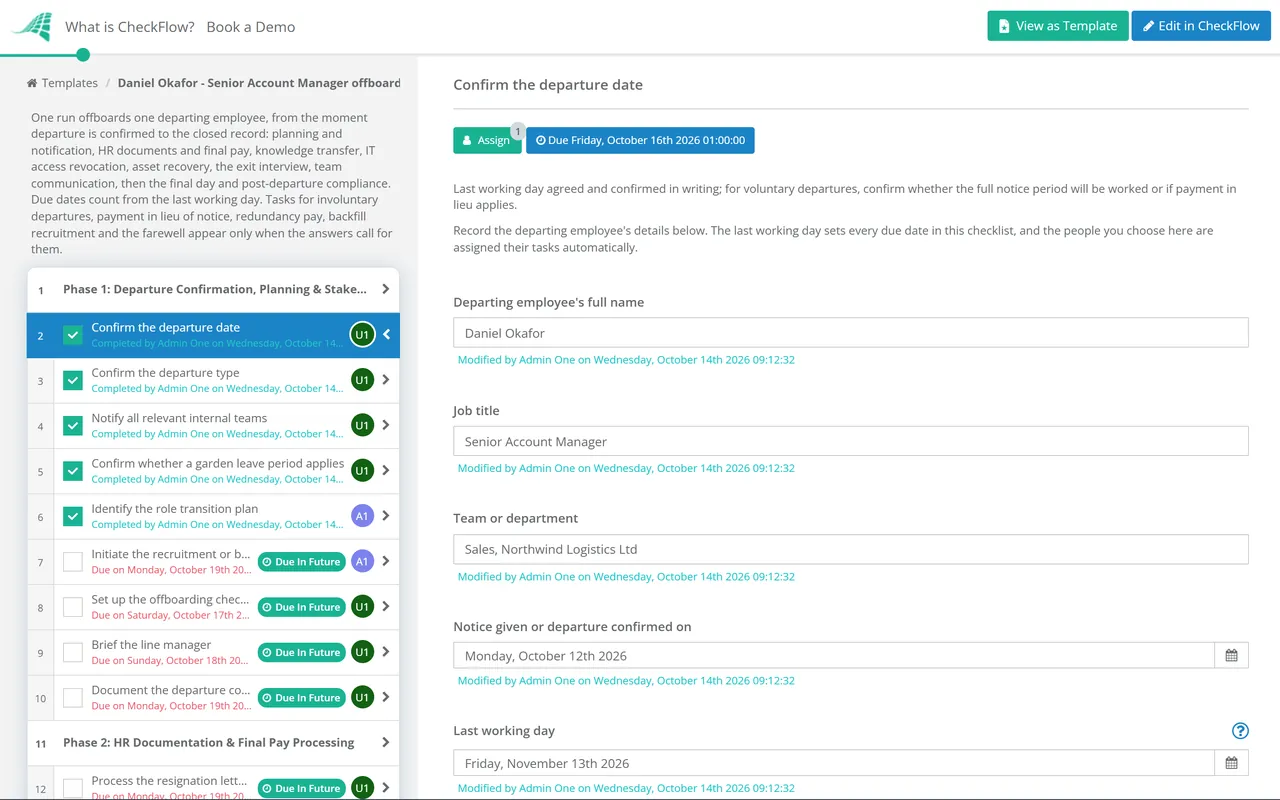
Confirm the departure date — last working day agreed and confirmed in writing; for voluntary departures, confirm whether the full notice period will be worked or if payment in lieu applies
Confirm the departure type — voluntary resignation, retirement, redundancy, dismissal, or contract completion; confirm the applicable legal requirements and documentation for each type
Notify all relevant internal teams — HR, IT, finance, the line manager, and any other teams with dependencies on the departing employee; initiate their offboarding actions
Confirm whether a garden leave period applies — for senior roles or where the employee has access to sensitive information; garden leave conditions and obligations should be confirmed at the outset
For involuntary departures — confirm legal counsel has been consulted before the departure conversation; ensure the process meets all statutory and regulatory requirements; consider whether immediate access revocation is required
Identify the role transition plan — who covers the departing employee’s responsibilities during the notice period and after their departure? Is the role being backfilled or redistributed?
Initiate the recruitment or backfill process — where the role is being replaced; confirm timeline and overlap where feasible
Set up the offboarding checklist in CheckFlow — assign tasks to HR, IT, the manager, and finance; confirm all task owners are notified
Brief the line manager — confirm the manager’s responsibilities in the offboarding process; knowledge transfer, exit interview, farewell, and team communication
Document the departure confirmation — written record of the departure date, type, and notice terms; retained in the personnel file
Phase 2
Phase 2: HR Documentation & Final Pay Processing
Process the resignation letter or termination documentation — confirm the appropriate written documentation is received or issued; file in the personnel record
Issue a termination letter or departure confirmation — confirming the agreed departure date, notice terms, and any conditions; signed and filed by both parties
Calculate final pay — salary to last working day, accrued but untaken annual leave, any outstanding bonuses or commissions, and any statutory entitlements; confirm calculation is accurate before the final payrun
Process payment in lieu of notice (PILON) if applicable — confirm the tax treatment and payment timing
Confirm redundancy pay calculation where applicable — statutory minimum and any contractual redundancy entitlement; confirm tax treatment
Review benefits termination — health insurance, pension contributions, company car, share schemes, and any other benefits; confirm termination dates and any required notifications to benefit providers
Issue COBRA notification (US) or equivalent — confirm timing and method meet statutory requirements
Review and remind of confidentiality and non-compete obligations — confirm any post-employment restrictions in the contract are communicated clearly at departure; do not assume the employee has retained this information
Confirm expense claims — all outstanding expense claims submitted and approved; confirm any company credit card balance or company loans are settled
Issue P45 (UK) or equivalent tax documentation — on or promptly after the last working day; confirm timing meets statutory requirements
Phase 3
Phase 3: Knowledge Transfer & Structured Handover
Knowledge transfer started on the last day is knowledge transfer that does not happen. This phase should begin within 48 hours of departure being confirmed — not in the final week of the notice period.
Identify the knowledge transfer scope — what processes, relationships, projects, systems knowledge, and institutional context does the departing employee hold that must be documented or transferred?
Identify the knowledge transfer recipients — who needs to receive each piece of knowledge? The replacement hire, the line manager, a colleague, or a documented procedure?
Document key processes and procedures — any recurring tasks, processes, or workflows the departing employee owns that are not yet documented; create written documentation during the notice period
Document key client, partner, and stakeholder relationships — client names, relationship history, key contacts, preferences, and any outstanding commitments or sensitivities
Brief the successor or covering colleague — structured handover meetings; the departing employee walks the successor through key responsibilities while still in post
Introduce the successor to key external contacts — clients, suppliers, and partners who need to know who their new contact will be; a joint introduction is more effective than a cold handover
Transfer ownership of key documents and files — confirm all work files, project documents, and institutional materials are stored in shared systems and not solely in personal drives or local storage
Review and transfer any active projects — project status, next actions, key contacts, deadlines, and any known risks transferred to the successor
Update CRM records and shared systems — contacts reassigned, account ownership transferred, and any system records updated to reflect the change in ownership
Confirm handover is complete — the line manager confirms they are satisfied the key knowledge and responsibilities have been adequately transferred
Phase 4
Phase 4: IT Access Revocation & System Management
IT access revocation is a security imperative — not an administrative formality. Access should be revoked on or before the final working day. For involuntary departures, immediate revocation on notification should be standard procedure.
Initiate IT offboarding — notify IT of the departure date and type; trigger the IT offboarding checklist; confirm the revocation schedule
Revoke email account access — on the last working day; set up an out-of-office or auto-forward to the relevant colleague for the appropriate period
Revoke all application and system access — CRM, HR system, financial software, project management tools, cloud storage, and any other business applications
Revoke remote access — VPN, remote desktop, and any other remote access credentials revoked on or before the final day
Revoke physical and building access — key cards, PIN codes, and any biometric access deactivated
Transfer or archive email and digital files — the departing employee’s email archive and digital files transferred to the relevant colleague or archived according to the data retention policy
Confirm no shared or personal accounts are used — business accounts that were shared with other employees should have passwords changed; personal accounts used for business purposes should be reviewed
Manage any social media or external accounts — company social media accounts, LinkedIn admin access, or any external platforms where the departing employee had administrative access
For detailed IT offboarding steps — see CheckFlow’s dedicated IT Offboarding Checklist for a complete technical process covering every access and device step
Confirm IT offboarding is complete — IT team confirms all access has been revoked and the departing employee has no remaining active access
Phase 5
Phase 5: Asset Recovery & Return
Identify all company assets held by the departing employee — laptop, mobile phone, tablet, access cards, company car, uniforms, tools, specialist equipment, and any other company property
Arrange return of all assets — confirm collection or return method; for remote employees, arrange a secure return shipping process
Inspect returned assets — confirm condition and identify any damage beyond normal wear and tear
Manage any deductions for unreturned or damaged assets — confirm the contractual and legal basis for any deductions; confirm the employee has been notified and agreed in writing
Recover any company documents or intellectual property — physical documents, printed materials, and any company property held at the employee’s home address
Cancel company credit cards or procurement accounts — confirm the employee’s company card is cancelled and final statements reconciled
Settle any outstanding loan or salary advance — company loans or salary advances repaid or deducted from final pay in accordance with the written agreement
Return personal property — confirm any personal items left at the workplace are returned to the departing employee
Confirm asset recovery is complete — all company property accounted for; any outstanding items documented with a recovery plan
Update the asset register — all returned assets logged; any lost or damaged assets recorded and relevant insurance notified where applicable
Phase 6
Phase 6: Exit Interview & Departure Feedback
Schedule the exit interview — ideally conducted by HR or a senior leader who is not the departing employee’s direct manager; at least three to five working days before the last day
Confirm the exit interview format — in-person, video, or written survey; a live conversation produces more nuanced feedback than a form alone
Conduct the exit interview — covering reasons for leaving, what the employee valued, what could be improved, management quality, culture feedback, and any specific observations they are willing to share
Listen without defensiveness — the value of an exit interview depends entirely on the interviewer’s ability to receive candid feedback constructively; confirm responses will be used to improve the organisation
Document the exit interview findings — a written summary retained in the HR record; anonymised feedback shared with relevant leadership where appropriate
Offer to serve as a reference — confirm the organisation’s reference policy; if appropriate, offer the departing employee a named reference contact
Invite to the alumni network — where an alumni programme exists; or at minimum connect on LinkedIn and maintain contact
Analyse exit interview data over time — individual exit interviews are interesting; patterns across multiple departures are actionable; confirm aggregate analysis is conducted periodically
For involuntary departures — the exit interview may not be appropriate; consider a post-departure survey or call as an alternative once legal matters are resolved
Use exit feedback to improve onboarding — the best source of insight for improving the new hire experience is feedback from people who have lived it
Phase 7
Phase 7: Team Communication & Transition Management
Plan team communications — who tells the team, when, what is said, and what is not said; for voluntary departures, agree the message with the departing employee before communicating
Communicate the departure to the team before rumours do — colleagues notice when someone is clearing their desk or absent from meetings; a clear, timely communication is better than speculation
Communicate to external stakeholders — clients, suppliers, and partners who work directly with the departing employee; introduce their replacement proactively
Manage workload redistribution — confirm how the departing employee’s responsibilities are distributed during the gap period; communicate clearly to the team to prevent uncertainty
For involuntary departures — the communication should be carefully prepared in advance with HR and legal guidance; delivered respectfully and with minimal operational disruption; security and access implications addressed before the communication
Plan the farewell — for voluntary departures; a genuine, team-led farewell reflects organisational culture and leaves a lasting impression; even a modest farewell matters more than its absence
Confirm the team’s morale is monitored — departures — particularly valued ones — affect team morale and confidence; confirm the manager is aware and engaged with the team
Address any team concerns about workload, role security, or direction — departures raise questions; address them proactively
Update org charts, team pages, and internal directories — remove or update references to the departing employee on the last working day
Confirm the business continuity plan for the gap period is in place — all key responsibilities have a named cover and clients or partners have been notified of their new contact
Phase 8
Phase 8: Final Day, Post-Departure Compliance & Alumni Relations
Conduct a final day check-in — the line manager or HR confirms all offboarding tasks are complete before the employee leaves
Confirm all assets have been returned — on or before the final day; do not let the employee leave with company property outstanding
Confirm all access has been revoked — IT confirms revocation is complete; do not rely on scheduled revocations alone
Issue a written confirmation of departure — confirming the last working day, final pay details, and any post-employment obligations; retained by both parties
Maintain the personnel file for the required retention period — employment records must be retained for the statutory period (typically six years in the UK, varies by state in the US); confirm GDPR or FERPA-equivalent data protection obligations are met
Monitor for any post-departure access attempts — IT should confirm no login attempts using former credentials in the weeks following departure
Maintain the alumni relationship — connect on LinkedIn; add to alumni communications where the former employee consents; maintain a professional relationship for referrals, future business, and potential rehire
Record the departure type and reason — in the HR system; aggregate data over time informs retention strategy and identifies flight risk patterns
Conduct a post-departure review of the offboarding process — what worked, what was missed, and what should be improved for the next departure
Close the offboarding record — all tasks completed, all documentation filed, and the checklist archived as a complete record of how the departure was managed
This checklist is available as a free, runnable template in CheckFlow — with tasks assigned across HR, IT, the manager, and finance, critical access revocation tasks enforced before the final day, and a complete documented record for every departure.
The checklist above applies to all departures — but the emphasis, timing, and legal requirements differ significantly by departure type.
Departure Type
Voluntary Departure
Resignation or retirement
Timing: Typically 2–4 weeks notice; full notice period available for knowledge transfer.
Key emphasis: Knowledge transfer and handover; maintaining the relationship; a genuine farewell; exit interview for honest feedback.
Legal notes: Confirm notice period obligations; garden leave conditions where applicable; post-employment restrictions reminder.
Access revocation: On the last working day; coordinated but not immediate.
Departure Type
Involuntary Departure
Redundancy, dismissal, or performance-related exit
Timing: May be immediate or with payment in lieu of notice.
Key emphasis: Legal compliance; immediate access revocation where required; careful team communication; documentation of the process.
Legal notes: Consult legal counsel before the departure conversation; confirm statutory rights (redundancy pay, consultation obligations, right of appeal); manage the process with respect and dignity regardless of the reason.
Access revocation: Immediate or same-day for dismissals; confirm with legal and HR.
Departure Type
Contract Completion
Fixed-term, contractor, or project-based
Timing: End date is known in advance — use the known timeline to prepare.
Key emphasis: Asset recovery; access revocation; IP and confidentiality reminder; project handover.
Legal notes: Confirm IR35 (UK), worker classification (US), or equivalent obligations; confirm contract terms are met; no automatic employment rights but statutory notice may apply.
Access revocation: On the contract end date; plan in advance using the known timeline.
CheckFlow’s offboarding checklist can be configured with different task sets for each departure type — ensuring the right process runs for the right situation automatically.
Why Run Employee Offboarding in CheckFlow?
1
Nothing is missed in the rush of a departure
Departures are often emotionally charged, time-pressured, and operationally disruptive — exactly the conditions under which critical steps get skipped. Access is not revoked. Assets are not collected. The knowledge transfer never happens. CheckFlow runs the same structured checklist for every departure — assigning IT access revocation, knowledge transfer, asset recovery, and exit interview tasks to named owners with due dates, regardless of how disruptive or unexpected the departure is.
2
A complete legal and compliance record
Employment disputes — from constructive dismissal claims to data protection complaints about former employees’ lingering access — require evidence of how the departure was managed. Every completed task in CheckFlow is timestamped and attributed to a named person. The complete offboarding record is archived immediately and accessible in minutes, not reconstructed from email history months later.
3
Convert every departure into an alumni asset
Boomerang employees — former staff who return — represented 35% of new hires in early 2025. Former employees are also your most credible references for new talent and your most trusted endorsers to potential customers. The quality of their departure experience determines their relationship with your organisation going forward. CheckFlow ensures the farewell, exit interview, and alumni follow-up tasks are never skipped — because they always look optional until they matter.
The IT access revocation workstream in employee offboarding has its own dedicated checklist covering every technical step — account deactivation, access revocation across all systems, device recovery, and credential management. CheckFlow’s IT Offboarding Checklist is the technical companion to this HR-led process. See the IT Offboarding Checklist →
Offboarding and onboarding are the bookends of the employee lifecycle — and both run in CheckFlow with the same structured, multi-stakeholder process. The same discipline that gives new hires a consistent start gives departing employees a consistent close. See the Employee Onboarding Checklist →
What is employee offboarding and what does it cover?
+
Employee offboarding is the structured process of managing an employee’s departure from the moment it is confirmed to the final archiving of their employment record. It covers eight areas: departure confirmation, planning, and stakeholder notification; HR documentation and final pay processing; knowledge transfer and structured handover; IT access revocation and system management; asset recovery; exit interview and departure feedback; team communication and transition management; and final day logistics, post-departure compliance, and alumni relations. A structured offboarding process protects the organisation from security risk (lingering system access), operational risk (undocumented knowledge leaving with the employee), and relationship risk (a poor departure experience closing the door on future value from the former employee).
Why is employee offboarding important?
+
Employee offboarding matters for three reasons. First, security: 83% of former employees have continued accessing accounts after leaving, and lingering access is one of the most preventable contributors to data breaches costing an average $4.45 million. Organisations with structured offboarding reduce security incidents by 34%. Second, knowledge retention: 42% of institutional knowledge exists only in individual employees’ heads, and only 37% of organisations ensure adequate knowledge transfer during offboarding. Senior employee departures can set teams and projects back significantly when knowledge transfer is not structured. Third, future value: with 35% of new hires in early 2025 being boomerang employees, and former employees serving as talent references and potential clients, the quality of the departure experience has direct commercial implications.
What is the difference between offboarding a voluntary resignation and an involuntary termination?
+
Voluntary resignations and involuntary terminations follow the same checklist structure but differ significantly in emphasis and timing. For voluntary departures, the full notice period is available for knowledge transfer and handover, and the relationship focus — exit interview, farewell, and alumni connection — is a priority. For involuntary departures (redundancy or dismissal), legal counsel should be consulted before the departure conversation, the statutory rights process must be followed rigorously, access revocation may be immediate rather than end-of-notice, and communications to the team require more careful management. The documentation and legal compliance requirements are more demanding for involuntary departures, and the exit interview may be replaced by a post-departure survey once any legal matters are resolved.
How quickly should system access be revoked when an employee leaves?
+
For voluntary departures where the full notice period is worked, access should be revoked on or immediately after the final working day. Only 44% of organisations currently revoke all access within 24 hours of departure — the remainder leave a significant security window. For involuntary departures, immediate revocation at the point of notification is standard practice for any departure where data or system security is a concern. Access revocation should cover email, cloud storage, CRM, financial systems, VPN, remote desktop, physical access credentials, and any social media or external platform accounts held in the company’s name. For a detailed IT access revocation checklist, see CheckFlow’s IT Offboarding Checklist.
What is a boomerang employee and why does offboarding affect it?
+
A boomerang employee is a former employee who returns to work for the same organisation. Gallup reported that 35% of new hires in early 2025 were boomerang employees — the highest rate on record, driven partly by labour market dynamics and partly by organisations actively maintaining alumni networks. Boomerang employees typically onboard faster, perform at a higher level earlier, and have lower recruitment costs than external hires — because they already understand the culture, systems, and relationships. The extent to which a former employee considers returning depends almost entirely on how they were treated when they left. A poor offboarding experience closes that door permanently. A structured, respectful offboarding — with a genuine exit interview, a proper farewell, and ongoing alumni connection — keeps it open.
Is CheckFlow free to use for this template?
+
You can start a free 14-day trial with no credit card required, giving you full access to all features including this template. The Business plan is $10 per user per month after the trial. Full details at checkflow.io/pricing.
Manage Every Departure Securely, Compliantly, and Well
Free trial — no credit card required.
Do you like cookies? 🍪 We use cookies to ensure you get the best experience on our website. Learn more