Employee Performance Review Checklist Template

A structured performance review process — from preparation through to documented follow-through — that produces fair assessments, genuine development, and a legally defensible record.

A performance review that is not prepared for is a performance review that is not useful. A manager who walks into a review meeting having reviewed nothing but the job description is a manager who will deliver feedback based on recency bias and impression rather than evidence — and an employee who receives that feedback will not trust it, act on it, or feel treated fairly. The research on performance management is consistent: the quality of the preparation determines the quality of the conversation, and the quality of the follow-through determines whether the conversation produces any actual change. 54% of HR professionals anticipate the rise of continuous feedback as a complement to formal reviews — but the formal review, done well, remains the structured moment where performance is assessed against expectations, development is planned, and the record is documented. A structured performance review checklist ensures every manager runs a review that is substantive, fair, evidenced, and followed through — consistently, for every employee, regardless of how experienced the manager is or how busy the cycle is. This free checklist gives HR teams and line managers a structured framework for the full review cycle.

Use This Template Free See Live Example
No Credit Card Required

The Three Ways Performance Reviews Most Commonly Fail

Insufficient preparation

Most review failures begin before the meeting room. A manager who has not reviewed the employee’s objectives, gathered any evidence of performance, or spoken to key stakeholders cannot deliver specific, accurate feedback. The result is vague generalities that the employee either agrees with politely or disputes — and neither outcome produces useful development.

Prevention: A structured preparation checklist requiring evidence gathering before the review meeting is scheduled.

No follow-through

The development goals agreed at the review are not revisited until the next annual review. The training that was committed to was never booked. The performance concern that was discussed is not checked in on until it becomes a formal disciplinary matter months later. The review happens; the improvement does not.

Prevention: Structured follow-through tasks with named owners and due dates that are created during the review and tracked as a process.

Inconsistent standards across managers

One manager rates everyone highly to avoid difficult conversations. Another applies rigorous standards and produces lower ratings for an equivalent team. Without calibration, performance ratings across the organisation are incomparable — making them unreliable for promotion decisions, succession planning, and fair pay.

Prevention: A defined calibration process where managers’ ratings are reviewed and aligned before they are communicated to employees.

What the Employee Performance Review Checklist Covers

This checklist covers six phases of the performance review cycle — from cycle launch through to documented follow-through. Run it as a shared process between HR, managers, and employees.

Phase 1

Phase 1: Review Cycle Setup & Communication

A performance review cycle should be launched at least four weeks before the review period ends — not the week before. Managers need time to gather evidence; employees need time to complete self-assessments.

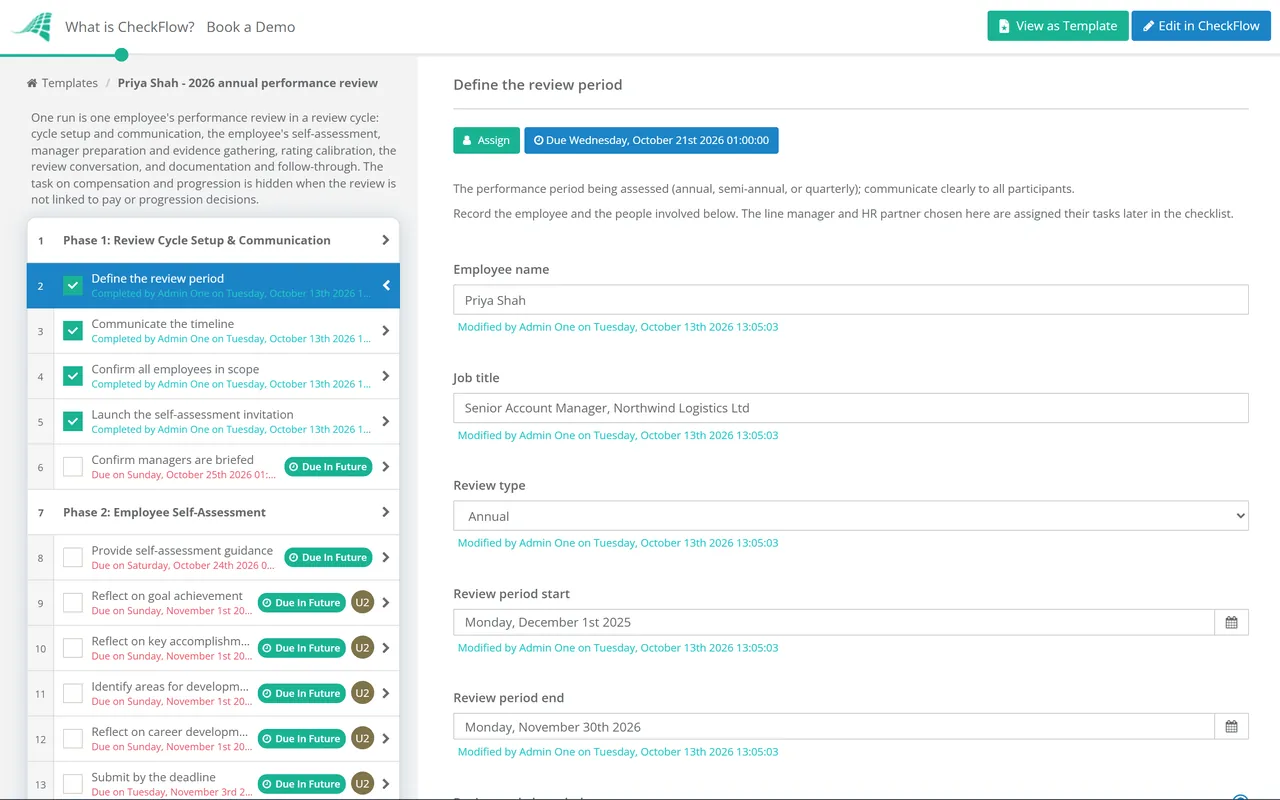
  • Define the review period — the performance period being assessed (annual, semi-annual, or quarterly); communicate clearly to all participants
  • Communicate the timeline — launch date, self-assessment deadline, manager review deadline, calibration date, and communication date; all in advance with adequate time
  • Confirm all employees in scope — eligibility criteria (minimum time in role, new starters not yet in scope, employees on leave) confirmed and communicated
  • Launch the self-assessment invitation — employees invited to complete their self-assessment with clear guidance and deadline
  • Confirm managers are briefed — on the process, timeline, rating scale, calibration process, and their responsibilities; manager guide distributed
Phase 2

Phase 2: Employee Self-Assessment

  • Provide self-assessment guidance — clear instructions on what the self-assessment should cover; examples of evidence-based reflection
  • Reflect on goal achievement — progress against each objective set at the last review; specific examples and evidence, not just ratings
  • Reflect on key accomplishments — what the employee is most proud of in the review period
  • Identify areas for development — honest reflection on where performance could be stronger; not a performance verdict, a development input
  • Reflect on career development goals — what the employee wants to develop, learn, or progress towards in the next period
  • Submit by the deadline — confirm the self-assessment is complete and submitted; manager review begins after self-assessment receipt
Phase 3

Phase 3: Manager Preparation & Evidence Gathering

Manager preparation is where review quality is determined. A manager who has gathered specific evidence of performance against objectives — including feedback from stakeholders — will deliver a more accurate, fair, and useful review than one who relies solely on their own memory.

  • Review the employee’s objectives and expectations — set at the last review or during onboarding; confirm what was expected
  • Gather performance evidence — specific examples of work delivered during the review period; outcomes achieved or missed; quality of work produced
  • Review any ongoing feedback or check-in notes — from regular one-to-ones during the year; the annual review should not contain surprises
  • Gather input from key stakeholders — colleagues, internal clients, or cross-functional partners who work closely with the employee; particularly for 360-degree feedback processes
  • Read the employee’s self-assessment — before completing the manager assessment; note areas of agreement and divergence
  • Complete the manager assessment — rating each objective and competency with specific evidence; draft written comments
  • Plan the review conversation — the key messages; how to raise any performance concerns; development goals to discuss
  • Submit manager assessment by the deadline
Phase 4

Phase 4: Rating Calibration

  • Confirm calibration group — who participates in calibration for this team or department; typically managers plus HR and the department head
  • Review ratings across the team — confirm the distribution is reasonable; flag any outliers for discussion
  • Discuss any cross-team inconsistencies — where equivalent performance is being rated very differently by different managers
  • Confirm ratings are based on evidence — managers should be able to support each rating with specific examples; subjective impressions are challenged
  • Document calibration outcomes — any rating changes agreed in calibration recorded; rationale documented
  • Confirm protected characteristic bias check — distribution of ratings across gender, ethnicity, age, and other protected characteristics reviewed for potential bias patterns
Phase 5

Phase 5: The Review Conversation

The review meeting should feel like a conversation, not a verdict delivery. The manager should spend more time listening than talking — particularly on the employee’s self-assessment and development aspirations.

  • Schedule the review meeting — private, uninterrupted; adequate time (typically 60–90 minutes); not back-to-back with other meetings
  • Open by affirming the purpose — this is a development conversation, not an administrative exercise; set a collaborative tone
  • Review goals and performance together — ask the employee to share their perspective first before the manager presents theirs
  • Discuss areas of strength — specific examples; genuine recognition of what the employee has done well and its impact
  • Discuss areas for development — specific, evidence-based, focused on behaviours and outcomes rather than personality; framed as growth opportunities
  • Communicate the overall rating — with context and rationale; allow the employee to respond
  • Discuss the connection to compensation and progression — where applicable; be clear about the link between performance and rewards decisions
  • Agree development goals — two or three specific, measurable development goals for the next period; not imposed but collaboratively agreed
  • Close by confirming next steps — what happens after this conversation; when the next check-in is
Phase 6

Phase 6: Documentation & Follow-Through

  • Complete the final review form — final ratings, written comments, and agreed development goals documented formally
  • Obtain employee signature or acknowledgement — the employee acknowledges the review has taken place; they may or may not agree with all ratings but acknowledgement is required
  • File in the HR system — completed review form retained in the employee’s personnel file; accessible for future reference
  • Schedule the development follow-through — training booked, coaching arranged, stretch assignments confirmed; development goals have a plan, not just a statement
  • Set performance objectives for the next period — SMART objectives agreed and documented; the next review cycle has a clear baseline
  • Schedule the first check-in after the review — within 30 days; to confirm development is on track and address any outstanding questions from the review
  • Track development goal progress — via regular one-to-ones; confirmed at the mid-cycle point if a formal mid-year review exists

This checklist is available as a free, runnable template in CheckFlow — with tasks assigned to managers and employees, calibration tracked, and follow-through actions automatically created after each review conversation.

Use This Template Free

A Framework for a Productive Review Conversation

The review meeting should be a structured dialogue, not an unstructured discussion or a one-way rating delivery. This framework gives managers a clear agenda that allocates time intentionally.

Opening — 5 minutes

Purpose, agenda, and tone-setting

Confirm this is a two-way conversation. Agree the agenda and how long you have. Reduce anxiety by affirming the purpose: this is a development conversation, not a judgment.

Employee shares first — 15 minutes

Self-assessment highlights

Manager asks the employee to share their self-assessment highlights before presenting the manager’s view. This signals genuine interest in the employee’s perspective and significantly reduces defensiveness when the manager’s assessment follows.

Performance discussion — 20 minutes

Goals review and evidence discussion

Work through each objective together. Discuss where perspectives align and where they differ. Be specific — evidence-based discussion is more credible and more useful than general impressions.

Development discussion — 15 minutes

Development goals and aspirations

What development does the employee want? What does the manager see as the priority? Agree on 2–3 specific, measurable development goals for the next period — collaboratively agreed, not imposed.

Rating and compensation — 5 minutes

Formal rating and rewards link

Communicate the formal rating with rationale. Be honest and clear. Discuss the link to compensation and progression decisions where applicable. Allow the employee to respond.

Next steps and close — 5 minutes

Confirming what happens next

Confirm what happens after this conversation. When is the next check-in? What should the employee do if they have further questions? Close with a positive, forward-looking statement.

Why Use CheckFlow for Performance Reviews?

1

A consistent review process for every manager and every employee

Review quality should not depend on the manager’s experience or enthusiasm. CheckFlow runs the same structured review cycle for every employee — the same preparation steps, the same calibration phase, the same documentation requirements — ensuring every employee receives an equivalent quality of review regardless of which manager is conducting it.
2

Follow-through tracked and visible

Development goals agreed at a review that are never revisited are not development goals — they are aspirations written in a form. CheckFlow’s follow-through phase assigns development goal tracking as ongoing tasks with deadlines, sends reminders to the manager, and makes the status of every agreed goal visible. The review conversation leads to documented action, not a filed form.

3

A legally defensible record for every employee

Performance reviews are the primary evidence in employment disputes — disciplinary actions, redundancy selections, and performance-related dismissals all depend on documented evidence of how performance was managed. Every review in CheckFlow is timestamped, signed, and archived — with the full history of ratings, comments, and development goals retained for every employee.

The development goals agreed at a performance review deserve their own structured process. CheckFlow’s Employee Development Checklist covers the full development planning cycle — from goals through to 70-20-10 learning pathway and quarterly review. See the Employee Development Checklist →

Performance reviews are recurring — annually, semi-annually, or quarterly. CheckFlow’s recurring checklist feature launches the full review cycle automatically at the defined cadence, with all tasks pre-assigned and pre-dated. Learn more about recurring checklists →

Frequently Asked Questions

What should a performance review checklist cover?

+

A comprehensive performance review checklist covers six phases: cycle setup and communication (defining the review period, communicating the timeline, and launching the self-assessment); employee self-assessment (goal reflection, accomplishment documentation, and development aspiration); manager preparation and evidence gathering (reviewing objectives, collecting examples, gathering stakeholder input, and completing the draft assessment); calibration (reviewing ratings across teams for consistency and evidence-basis); the review conversation (structured dialogue covering performance, development, and next steps); and documentation and follow-through (formalising the review, filing the record, booking development activities, and setting the next cycle’s objectives). The most commonly missed phase is follow-through — the development goals that are agreed but never actioned.

How should managers prepare for a performance review?

+

Manager preparation should begin at least one week before the review meeting and should cover four areas. First, review the employee’s objectives from the previous cycle — what was expected and against what standard. Second, gather specific evidence of performance during the review period — concrete examples of work delivered, outcomes achieved, and any areas of concern that were noted in one-to-ones. Third, read the employee’s self-assessment before completing the manager’s assessment — identify areas of agreement and divergence. Fourth, plan the conversation — particularly how to raise any performance concerns constructively, and what development conversation is needed. A manager who has not done this preparation will deliver feedback based on recency bias and general impression rather than evidence.

What is rating calibration and why does it matter?

+

Rating calibration is the process of reviewing and aligning performance ratings across multiple managers before they are communicated to employees. Without calibration, rating standards vary significantly by manager — one applies generous ratings to avoid conflict; another applies exacting standards. Employees with equivalent performance levels receive different ratings depending on which manager evaluates them, making ratings unreliable for promotion decisions, pay decisions, and succession planning. Calibration sessions — typically involving the managers in a department, the department head, and HR — review the distribution of ratings and challenge any ratings that cannot be supported by specific evidence. They also flag potential bias patterns across protected characteristics.

What documentation should be retained from performance reviews?

+

Performance review documentation that should be retained includes: the completed review form with ratings, written comments, and development goals; the employee’s self-assessment; any calibration notes where the rating was discussed and adjusted; the employee’s signed or electronic acknowledgement of the review; and records of any follow-up actions (development goals booked, next-cycle objectives agreed). This documentation should be retained in the employee’s personnel file for the duration of employment and typically for a defined period following departure — UK employment tribunal claims must normally be brought within three months, so retention for at least 12 months post-departure is advisable. In employment disputes, this documentation is the primary evidence of how performance was managed.

Is CheckFlow free to use for this template?

+

You can start a free 14-day trial with no credit card required, giving you full access to all features including this template. The Business plan is $10 per user per month after the trial. Full details at checkflow.io/pricing.

Run Reviews That Actually Develop People — Not Just File Their Forms

Free trial — no credit card required.