Employee Termination Checklist Template

Dismissing an employee? Check the reason and the process, review the contract and the law for the UK or the US, work out notice and final pay, get the decision on the record, and hold a respectful termination meeting before offboarding starts.

Last reviewed: November 2026

Printed from checkflow.io/templates/human-resources/employee-termination-checklist

This free employee termination checklist is for HR teams and managers in the UK and the US who have to end someone’s employment for conduct, capability, a legal bar or some other substantial reason. One run covers one dismissal, planned back from the date of the termination meeting. It records the reason and the evidence, checks the process that reason needs and that the employee’s side was heard, compares the case with similar ones and screens for protected reasons and periods. It checks your policy and the contract, adds the unfair dismissal check for Great Britain (with the Employment Rights Act 2025 changes from 1 January 2027), the at-will check for the US or a local law check elsewhere, and gets an employment law review. It works out the notice, the leaving date, the final pay and its deadline, and the benefits that end. The dismissing manager then decides. After an approval it writes the letter with the appeal route, plans the meeting, briefs the witness and agrees with IT which access ends during the meeting. After the meeting it confirms the letter, books the final pay for its deadline, adds the US COBRA notice or the written reasons in Great Britain, and starts the Employee Offboarding checklist.

One Dismissal, From the Reason to the Hand-Off

This checklist covers one involuntary termination: an employer ending someone’s employment for conduct, capability, a legal bar or some other substantial reason. One run starts when dismissal is a possible outcome and ends when the employee has left the meeting and offboarding has started. It checks the reason and the process behind it, reviews the policy, the contract and the law for the country, works out notice and final pay, and puts the decision with one named manager before anyone tells the employee.

The investigation and the hearing for a conduct case run in the Disciplinary Procedure Checklist, and an improvement plan in the Performance Improvement Plan (PIP) Process Checklist. A redundancy, with its pools, consultation, WARN and OWBPA rules, is the Redundancy & Layoff Process Checklist. Once the meeting is over, the Employee Offboarding Checklist runs the leaving process: handover, property, tax forms and records.

This checklist

Ending one person’s employment

Covers: the reason and the process followed, the protected screen, policy, contract and legal review, notice and final pay, the dismissing manager’s decision, the letter, the termination meeting and access removal.

Planned around: the date of the termination meeting.

Output: a decision on the record, a letter, a meeting held with a witness, and offboarding started.

Before it

The disciplinary procedure

Covers: one conduct case from intake to the investigation, the hearing letter, the hearing, the outcome and the appeal.

Planned around: the hearing.

Output: a decided case, in the Disciplinary Procedure Checklist.

After it

Employee offboarding

Covers: the leaving process for any departure: handover, IT and assets, final pay processing, the exit interview and records.

Planned around: the last working day.

Output: a clean exit, in the Employee Offboarding Checklist.

What the Employee Termination Checklist Covers

Eight phases take one dismissal from the reason to the hand-off. The first task records the date of the termination meeting, which sets every due date, and two answers that add notes and tasks: the country where the employee works (Great Britain, Northern Ireland, the US or another country) and the reason dismissal is being considered. How the notice is handled and whether a settlement agreement is offered each add a task; when the notice is worked, a task to plan the rest of the notice and the last working day replaces the two leaving-day tasks. The dismissing manager’s decision is the gate: nothing after it can be completed until it is recorded, and a decision not to dismiss adds the task that follows.

  1. Phase 1

    Phase 1: Set Up the Termination

    3 tasks

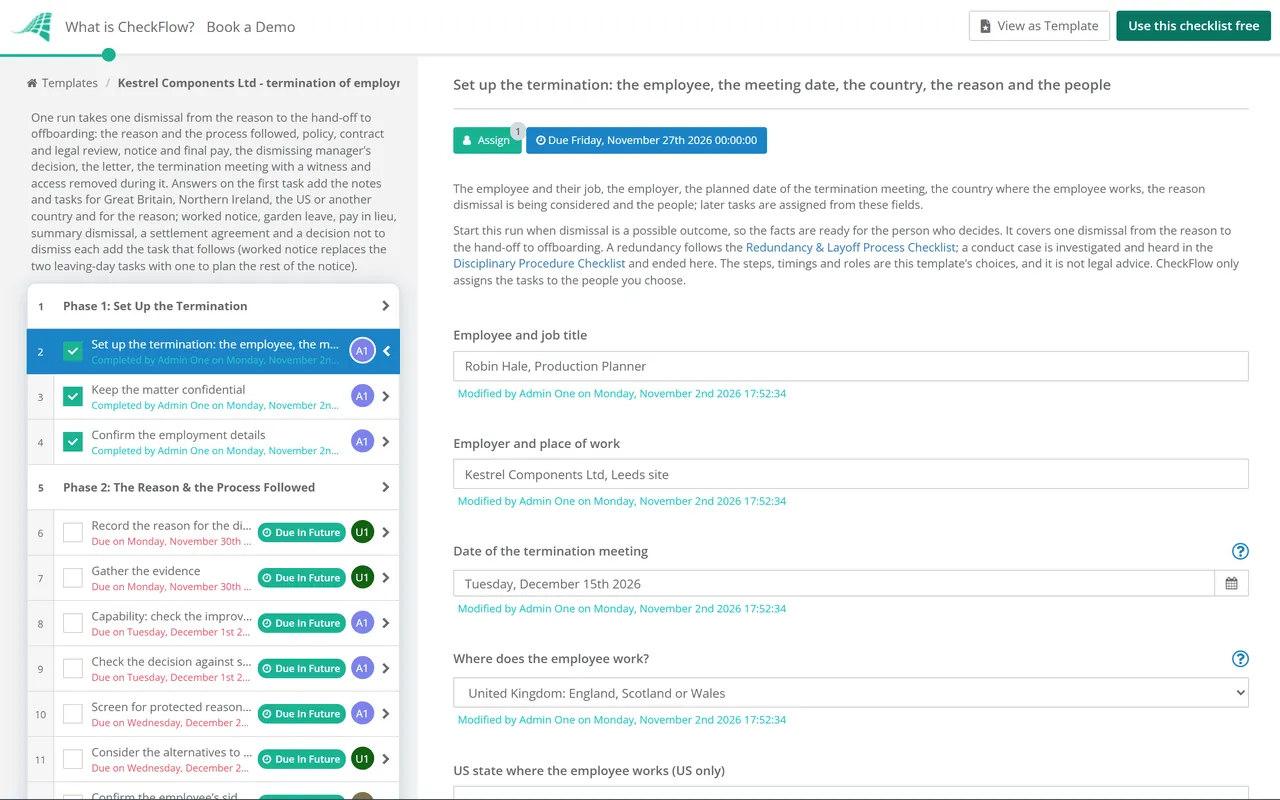
    Owned by the HR lead. Enter the date of the termination meeting on the first task: every due date counts back from it in working days, and the tasks after the meeting count forward. Say where the employee works and why dismissal is being considered, and the notes and tasks for that country and that reason appear. Starting this run decides nothing: the dismissing manager decides in Phase 5.

    • Set up the termination: the employee, the meeting date, the country, the reason and the people — the employee and their job, the employer, the planned date of the termination meeting, the country where the employee works, the reason dismissal is being considered and the people; later tasks are assigned from these fields
    • Keep the matter confidential — who knows now (the line manager, the dismissing manager and HR), who else is told and when (payroll, IT, the witness and any adviser), and where the documents are kept, so nobody else hears before the employee does
    • Confirm the employment details — the contract and its date, the job title, continuous service from the start date, hours, pay and benefits, any changes since, and whether a collective agreement or a recognised union covers the role
  2. Phase 2

    Phase 2: The Reason & the Process Followed

    11 tasks

    Write down the reason in plain words and gather the evidence behind it. The reason chosen on the first task adds one task for the process that reason needs. Then check the decision against similar cases, screen for protected reasons and periods, consider alternatives, and confirm the employee’s side has been heard before anyone decides.

    • Record the reason for the dismissal — the reason in plain words, the facts it rests on and the dates, written so that the letter and any later question can rely on it
    • Gather the evidence — the records behind the reason: warnings and their dates, improvement plan notes, attendance or absence records, an investigation report, hearing notes and any statements
    • Conduct: check the disciplinary steps were completed — the investigation, the written notice of the case with the evidence, the hearing and any warnings still current, as run in the Disciplinary Procedure Checklist; for gross misconduct too, the Acas Code says a fair disciplinary process should always be followed before dismissing
    • Capability: check the improvement process was completed — the standards set, the support and training given, the time allowed to improve, the reviews and any warnings, as run in the improvement plan; gov.uk says an employer should warn that work is not satisfactory and give a chance to improve before taking action
    • Ill health: check the medical evidence and the adjustments considered — the medical evidence (gov.uk says a GP report needs the employee’s permission, and they can see it before you do), any occupational health assessment, whether the employee is disabled under the Equality Act 2010 and the reasonable adjustments considered; gov.uk calls dismissal a last resort here
    • Legal bar: confirm the restriction and the alternatives — what stops the employee doing the job lawfully (gov.uk’s example is a driver who loses their licence), whether it is permanent or temporary, and whether another role or a short break is possible
    • Other substantial reason: record why it justifies dismissal — the reason, why it is substantial and the steps taken; gov.uk’s example is temporary cover that was made clear at the start; Acas says that from March 2027 (planned) dismissing someone and rehiring them on worse terms (fire and rehire) becomes automatically unfair in most cases, so take advice before any dismissal linked to a contract change
    • Check the decision against similar cases — how similar cases were handled before and whether this one is treated the same way; gov.uk says an employer must be consistent, and the EEOC says two employees who commit a similar offence may not be disciplined differently because of a protected characteristic
    • Screen for protected reasons and periods — pregnancy, maternity or other family leave, a recent complaint, grievance or whistleblowing report, a health condition or disability, a union or representative role, and any protected characteristic; in Great Britain some of these make a dismissal automatically unfair, and in the US the EEOC says retaliation for a discrimination complaint is illegal
    • Consider the alternatives to dismissal — another role, a final warning, more support or time, adjustments or a change of hours, and why each was or was not suitable
    • Confirm the employee’s side has been heard — the date of the hearing or final review, who heard it, whether the employee was accompanied, what the employee said and how it was considered; in Great Britain the Acas Code says the employee should be told the case in writing, be heard at a meeting and be allowed to be accompanied, and the decision follows the meeting
  3. Phase 3

    Phase 3: Policy, Contract & Legal Review

    7 tasks

    Check your own policy was followed and read the contract terms that apply at the end. The country chosen on the first task shows its own check: unfair dismissal and service in Great Britain, the local law in Northern Ireland or another country, at-will employment and its limits in the US. Then an employment lawyer or adviser reviews the whole file before the decision.

    • Check your own policy was followed — each step your disciplinary, capability or absence policy sets out, done as written, and any step missed with the reason; gov.uk says a tribunal considers whether the employer followed the relevant procedures
    • Read the contract terms that apply at the end — the notice clause, any pay in lieu or garden leave clause, bonus, commission and share scheme rules on leaving, restrictive covenants and confidentiality, the return of property, and any collective agreement
    • UK (Great Britain): check service against the unfair dismissal rules — the employee’s continuous service on the effective date of termination (the day the notice ends, or the day employment ends without notice); the qualifying period is two years today, and six months where the effective date of termination falls on or after 1 January 2027, even if notice was given before then; use the expected effective date from the meeting date and the notice: Phase 4 confirms it, and if it moves across 1 January 2027 or the six-month or two-year mark, check this task again
    • Northern Ireland: check the law that applies there — Northern Ireland has its own employment law, so the Great Britain notes in this template do not apply; gov.uk says its qualifying period for unfair dismissal is still usually one year and that employers follow the Labour Relations Agency’s Code of Practice
    • US: check at-will employment and its limits — the Department of Labor says a termination that is not discriminatory or retaliatory is subject only to any private contract or labor contract; check for an employment contract, offer letter or handbook promise, a collective bargaining agreement and the state’s law (in Montana, a discharge after the probationary period without good cause is wrongful)
    • Another country: check the local law — what the country’s law requires for the reason, the process, notice, final pay and the documents to give, and any authority or employee body that must be told or consulted, confirmed by a local employment lawyer
    • Get an employment law review of the file — an employment lawyer or adviser reads the reason, the evidence, the process and the employee’s response, the protected screen, the contract terms and the service or local law check, and says what to change before the decision
  4. Phase 4

    Phase 4: Notice, Final Pay & Benefits

    7 tasks

    Work out the notice, the leaving date and the final pay before the decision, so the dismissing manager sees the whole cost and the letter can state it. How the notice is handled adds its own task, and so does a settlement or severance agreement. Payroll records the final pay deadline: in the US it depends on the state.

    • Work out the notice period and the leaving date — the contractual notice, any legal minimum, which is longer, how the notice period will be handled and the effective date of termination
    • Garden leave: set the terms — that the contract allows it, what the employee may and may not do, who they may contact, pay and benefits during it, holiday, and when devices and passes are returned
    • Pay in lieu: check the contract and the payment — the contract’s pay in lieu clause, or the employee’s agreement where there is none, what the payment includes and its tax treatment, checked with payroll
    • Summary dismissal: confirm the grounds — the finding of gross misconduct and the fair process before it; gov.uk says a summary dismissal may still be ruled procedurally unfair, and that a fair procedure must be followed as for any other disciplinary matter
    • Work out the final pay and its deadline — salary to the leaving date, notice pay or pay in lieu, holiday not taken, bonus or commission due under the contract, expenses, any deductions the contract allows, and the date the final pay is due
    • List the benefits that end, and when — health and life cover, pension, a company car, share or equity awards and any other benefit, with the date each ends and who tells the provider
    • Prepare the settlement or severance agreement — the payment, what the employee gives up, the reference, the deadline to accept and who explains it; in Great Britain a settlement agreement only stops statutory claims if it meets the conditions in section 203(3) of the Employment Rights Act 1996, including advice from a relevant independent adviser who is named in it
  5. Phase 5

    Phase 5: The Decision to Dismiss

    3 tasks

    The HR lead puts the file together, and the dismissing manager decides. Nothing after the decision can be completed until it is recorded. A decision not to dismiss adds the task that follows it.

    • Put the decision pack together — one summary for the dismissing manager: the reason, the process and the employee’s response, the protected screen, the legal advice, the notice and leaving date, the final pay and any agreement
    • Decide whether to dismiss — the dismissing manager reads the pack and records the decision and the reasons for it; nothing after this task can be completed until it is done
    • Not approved: record the outcome and close the run — the outcome instead of dismissal (for example a warning or more support under the procedure that led here), told to the employee through that procedure; then mark the rest of this checklist not applicable; if the decision was recorded wrongly, un-complete the decision, change it and complete it again
  6. Phase 6

    Phase 6: The Letter & the Meeting Plan

    4 tasks

    Write the letter the employee receives at the meeting, plan the meeting itself, agree with IT exactly which access ends and when, and brief the witness. Keep the circle small until the meeting.

    • Write the dismissal letter — the decision and the reasons, the effective date of termination, the notice and how it is handled, the final pay and when it is paid, benefits, the return of property, and the right of appeal with the deadline and who to write to
    • Plan the termination meeting — the time and a private room or video call, who attends (the dismissing manager and the witness), what will be said, how the employee leaves, and whether a companion may come; in Great Britain the statutory right to be accompanied covers disciplinary hearings and appeals, and your procedure may allow one at this meeting too
    • Agree the access removal plan with IT — every account, system, building pass and device to remove, who removes each one and the time: during the meeting, with no warning to the employee before it, unless the employee is working their notice, when access is removed on the last working day and this plan passes to Employee Offboarding
    • Brief the witness — their role (to observe and take notes, not to join the discussion), confidentiality, the timings and where the notes are kept
  7. Phase 7

    Phase 7: The Termination Meeting

    5 tasks

    Tell the employee the decision clearly and with respect, give them the letter and explain what happens next. The witness takes the notes, and IT removes access while the meeting is under way. When the employee works their notice, a task to plan the rest of the notice and the last working day replaces the two leaving-day tasks.

    • Hold the termination meeting — the decision said clearly and briefly, the letter handed over, the notice, final pay, benefits and appeal explained, the employee’s questions answered and their reaction listened to, without reopening the decision
    • Take the meeting notes — who attended, the times, what was said on both sides, any questions left open and what the employee was given
    • Remove access during the meeting — the accounts, systems and passes in the plan removed at the agreed time, and anything that could not be removed yet listed with a time
    • Help the employee leave with dignity — their personal belongings, how they get home, who they can contact with questions, any support you offer (such as an employee assistance programme) and what colleagues will be told
    • Worked notice: plan the rest of the notice and the last working day — where the employee works their notice: the work they do until the effective date of termination, who they report to, any limits on systems, clients or sites, and the last working day, when access is removed and Employee Offboarding takes over the leaving day
  8. Phase 8

    Phase 8: After the Meeting & Hand-Off

    6 tasks

    Make sure the letter has arrived, tell the people who need to know, and book the final pay for its deadline. The country chosen on the first task adds the US COBRA notice or the Great Britain written reasons. The last task starts Employee Offboarding, which runs the rest of the leaving process.

    • Confirm the employee has the letter — if it was not handed over at the meeting, sent the same day by email and by post or another tracked method, with the date it was sent
    • Tell colleagues and contacts who need to know — the team, and clients or suppliers the employee dealt with, told in the agreed words, with no reasons given and nothing said about the employee beyond the fact they are leaving and when
    • Confirm the final pay is booked for its deadline — the final pay worked out in Phase 4 booked with payroll for the deadline recorded there (or paid at the meeting where a US state requires payment at the time of dismissal); Employee Offboarding records the payment
    • US: tell the plan administrator about the COBRA qualifying event — where COBRA applies, the employer must notify the plan within 30 days of the termination, and the plan then sends the election notice within 14 days of being notified; this template does it the day after the meeting
    • UK (Great Britain): give written reasons if asked — an employee with two years’ service on the effective date of termination can ask for a written statement of the reasons, which is due within 14 days of the request; where the effective date of termination is on or after 1 January 2027, six months’ service is enough
    • Start the Employee Offboarding checklist — an Employee Offboarding checklist started for the employee with the leaving date, the notice terms, the final pay date and the access already removed, so it can finish the handover, the return of property, tax forms, benefits and records; the appeal deadline and the appeal manager passed on with it; mark the offboarding checklist’s termination letter, final pay, pay in lieu and COBRA tasks done, with a link to this run, so nothing is done twice

UK and US Termination Rules, and What Changes in 2027

Termination rules in Great Britain and the US at a glance

The country chosen on the first task shows the notes and tasks for each row. ERA is the Employment Rights Act.

Topic Great Britain (England, Scotland, Wales) United States
Protection against dismissalUnfair dismissal: the employer needs a fair reason and a reasonable process. The qualifying period is two years today, and six months where the effective date of termination is on or after 1 January 2027 (ERA 1996 s.108; ERA 2025 s.25). Automatically unfair reasons need none.At will: the Department of Labor says a termination that is not discriminatory or retaliatory is subject only to any private or labor contract. State law can add limits; in Montana, discharge without good cause after probation is wrongful (MCA 39-2-904).
The processThe Acas Code of Practice on disciplinary and grievance procedures. A tribunal can adjust an award by up to 25 per cent for an unreasonable failure to follow it.Your own policy and any contract or labor agreement. The EEOC says similar offences may not be disciplined differently because of a protected characteristic.
NoticeThe longer of the contract and the statutory minimum: one week after one month’s service, then one week per full year from two years, up to 12 weeks (ERA 1996 s.86).What the contract, handbook or labor agreement says. WARN notices for larger layoffs are on the Redundancy & Layoff page.
Written reasonsOn request, within 14 days, after two years’ service; six months where the effective date of termination is on or after 1 January 2027. Without asking, whatever the service, when dismissed while pregnant or when maternity or adoption leave ends because of the dismissal (ERA 1996 s.92).Check whether your state requires a separation notice.
Final paySalary to the leaving date, notice pay or pay in lieu and holiday not taken. Tax and National Insurance depend on what the payment includes (gov.uk).Federal law does not require the final paycheck immediately, but some states may (DOL). Read the state’s own rule.
Health coverCheck the terms of any private medical cover.COBRA, generally for employers with at least 20 employees: notify the plan within 30 days; the plan sends the election notice within 14 days (DOL EBSA).
Time to bring a claimSix months for an unfair dismissal claim where the relevant date is on or after 1 October 2026; three months before that (ERA 2025 s.152 and Sch. 12; SI 2026/954).Depends on the law the claim is brought under.

What the Employment Rights Act 2025 changes for dismissals in Great Britain, and when

The first change is already in force; the January 2027 changes reach any dismissal whose notice runs into January. Acas lists the later dates as planned.

When What changes Source
1 October 2026 (in force)Employment tribunal time limits rose from three months to six, including for unfair dismissal. Cases whose relevant date is before 1 October 2026 keep the old limit.ERA 2025 s.152 and Sch. 12; SI 2026/954, regs 3 and 4
1 January 2027The qualifying period for unfair dismissal falls from two years to six months.ERA 2025 s.25(2); SI 2026/559, reg. 3
1 January 2027The cap on the compensatory award for unfair dismissal is removed.ERA 2025 s.25(3); SI 2026/559, reg. 3
1 January 2027An employee can ask for written reasons for dismissal after six months’ service instead of two years.ERA 2025 Sch. 3 para. 1(2); SI 2026/559, reg. 3
Who the January changes coverEvery dismissal whose effective date of termination falls on or after 1 January 2027, even if notice was given before then. Not one whose effective date of termination falls before it.SI 2026/559, reg. 4
Planned for March 2027 (Acas)Dismissing someone and rehiring them on worse terms (fire and rehire) becomes automatically unfair in most cases.Acas, Employment Rights Act 2025 page; ERA 2025 s.28
Planned for October 2027 (Acas)Stronger protection against dismissal for pregnant workers and those returning from maternity leave, through regulations under a power already in force (none made yet).Acas, Employment Rights Act 2025 page; ERA 2025 s.26

Northern Ireland has its own employment law, and the Great Britain rows are not Northern Ireland’s law: gov.uk says its qualifying period for unfair dismissal is still usually one year, and employers follow the Labour Relations Agency’s Code of Practice. Start with nidirect and take local advice. For other countries, the template adds a task to check the local law.

Where this comes from. Read on 2 November 2026: the Employment Rights Act 1996 sections 86, 92, 97, 108 and 203; the Employment Rights Act 2025 section 25, Schedule 3 and section 152, with the commencement regulations SI 2026/559 and SI 2026/954; the Acas Code of Practice and Acas’s Employment Rights Act 2025 page (last updated 30 October 2026); gov.uk’s Dismissing staff and Dismissal: your rights; the Department of Labor’s Termination and Last Paycheck pages; EBSA’s employer’s guide to COBRA; the EEOC; and Montana Code Annotated 39-2-904. No US state’s final pay deadline is listed here: read it on the state’s own site. The law changes often in 2026 and 2027, so check the sources again before you rely on them. This is not legal advice.

Why Run Terminations in CheckFlow?

1

A decision before anyone is told

The decision is assigned to the dismissing manager alone, and the checklist halts there: the letter, the meeting, access removal and the hand-off cannot be completed until a decision is recorded, with its reasons. Before it, the file shows the reason, the process, the employee’s response, the protected screen, the legal advice and the cost. A decision not to dismiss adds the task to record the other outcome. See how approvals that halt a checklist work.

2

The right notes for the country and the reason

England, Scotland or Wales shows the unfair dismissal check, the notice and letter notes and the written reasons task, with the 2027 changes. The US shows the at-will check, the state final pay note and the COBRA task. Northern Ireland and other countries get a task to check their own law. The reason adds its own check, and worked notice, garden leave, pay in lieu, summary dismissal or a settlement agreement each add theirs.

3

Every step has an owner and a date

Name HR, the line manager, the dismissing manager, payroll, IT and the witness on the first task, and every task is assigned from those fields. Due dates count from the meeting date, so moving the meeting moves the plan. The evidence, final pay and access tables stay on the run, and the Reports Grid lists every run with its answers, while Analytics shows where tasks are waiting.

CheckFlow does not give legal advice, calculate pay or remove anyone’s access for you: those stay with your advisers, payroll and IT systems. It makes sure every dismissal gets the same checks in the same order, with an owner and a due date for each, a decision on the record before anyone is told, and a record of who did what and when. See how a checklist runs.

Hear a conduct case with the Disciplinary Procedure Checklist, run an improvement plan with the Performance Improvement Plan (PIP) Process Checklist and end a probation with the Probation Review Checklist. Make redundancies with the Redundancy & Layoff Process Checklist, then run the leaving process with the Employee Offboarding Checklist and close IT access with the IT Offboarding Checklist. The post HR Offboarding Checklist covers the HR side of any departure.

AI generator

Didn’t find what you need? Describe it.

Describe the process in a sentence and the AI checklist generator drafts the phases and tasks for you.

Frequently Asked Questions

What should an employee termination checklist include?

The reason in writing and the evidence for it, a check that the right process was followed and the employee was heard, a screen for protected reasons, the policy and contract terms, a legal review, the notice, leaving date and final pay, a decision by a manager with authority, the letter with the appeal route, a planned meeting with a witness, access removed during it, and a hand-off to offboarding.

How much notice do you have to give when dismissing an employee in the UK?

In Great Britain the employer must give at least the statutory minimum: one week after one month’s service, then one week for each full year of service from two years, up to 12 weeks after 12 years (Employment Rights Act 1996, section 86). If the contract gives more, the longer period applies. Either side can waive notice or accept pay in lieu. Summary dismissal for gross misconduct still needs a fair process first.

How does the Employment Rights Act 2025 change unfair dismissal?

In Great Britain, from 1 January 2027 the qualifying period for unfair dismissal falls from two years to six months, the cap on the compensatory award is removed, and written reasons can be asked for after six months. The changes cover any dismissal whose effective date of termination falls on or after 1 January 2027, even if notice was given before. Tribunal time limits already rose to six months on 1 October 2026.

When is final pay due after a termination in the US?

It depends on the state. The Department of Labor says federal law does not require employers to give former employees their final paycheck immediately, but some states may require immediate payment. This template asks payroll to read the deadline on the state’s own site and record it before the decision, and to have the payment ready for the meeting where the state requires payment at the time of dismissal.

Do you have to give written reasons for a dismissal in the UK?

In Great Britain an employee with two years’ service can ask for a written statement of the reasons, and the employer must give it within 14 days of the request. Where the effective date of termination is on or after 1 January 2027, six months’ service is enough. An employee dismissed while pregnant, or whose maternity or adoption leave ends because of the dismissal, gets the statement without asking. The Acas Code also says to give the reasons when telling the employee.

Who should be in the room for a termination meeting?

This template puts two people there: the dismissing manager, who tells the employee the decision and answers questions, and a witness, for example someone from HR, who observes and takes the notes. In Great Britain the statutory right to be accompanied covers disciplinary hearings and appeals; your own procedure may also let the employee bring a companion to this meeting. Keep the meeting short, private and respectful, and give the letter there.

What should a termination letter include?

The decision and the reasons for it, the effective date of termination, the notice period and how it is handled (worked, garden leave or pay in lieu), the final pay and when it will be paid, what happens to benefits, what property to return, and the right of appeal with the deadline and who to write to. In Great Britain the Acas Code lists the reasons, the end date, the notice and the right of appeal.

Does a dismissed employee in the US keep their health cover?

Where COBRA applies (generally private-sector group health plans of employers with 20 or more employees), losing coverage because employment ended for any reason other than gross misconduct lets the employee and their family choose to continue it. The employer notifies the plan within 30 days, and the plan sends the election notice within 14 days. This template adds that task for US employees.

Is CheckFlow free for this template?

14-day free trial, no card required. The Business plan is $10 per user per month after the trial. Full details at checkflow.io/pricing.

Run Every Dismissal the Same Careful Way

Free trial — no credit card required.

14-day free trial, no credit cardFull refund in your first 30 daysUS hosting, EU on request