
Reasonable Accommodation Request Checklist Template

Most accommodation requests do not go wrong on the law. They go wrong when a remark to a supervisor is never passed on, the doctor’s letter lands in the personnel file, or nobody writes down why an option was turned down.

Last reviewed: October 2026

This free reasonable accommodation request checklist runs one request from one employee or job applicant, from the day it is made to the review after the change starts. It follows the interactive process for reasonable accommodation under Title I of the Americans with Disabilities Act (ADA) and, for Great Britain, the duty to make reasonable adjustments in the Equality Act 2010; pick the law on the first task and the checklist shows the matching notes and tasks. HR records the request and keeps medical information confidential, the manager sets out the job and its essential functions, documentation is asked for only when it is needed, and the options are discussed with the person and assessed for effectiveness, cost and disruption. A decision maker decides with reasons, the person is told in writing, and the change is put in place and reviewed. When the accommodation is time off in the US, the Leave of Absence (FMLA) Checklist may run alongside it.

One Request, From the First Conversation to the Review

In the United States, Title I of the Americans with Disabilities Act requires a covered employer to make reasonable accommodation for a qualified applicant or employee with a disability unless it would cause undue hardship. In Great Britain, the Equality Act 2010 requires every employer to take the steps it is reasonable to have to take to avoid a substantial disadvantage to a disabled applicant or employee. The words differ, but the work is the same: hear the request, understand the job, talk to the person, find something that works and decide with reasons.

This checklist runs one request for one person. It is not a health and safety check: the DSE Workstation Assessment Checklist assesses every display screen user’s workstation, and this checklist can call for that assessment when a workstation is part of the request. Two other checklists cover the steps around it.

This checklist

One accommodation request

Covers: one employee’s or applicant’s request, from the first conversation to the review: confidentiality, essential functions, documentation, the interactive discussion, options, undue hardship, the decision and the change itself.

Where: the United States (ADA) and Great Britain (Equality Act 2010).

Output: a change that works, a decision with its reasons and a confidential record.

Time off

The Leave of Absence (FMLA) Checklist

Covers: a US FMLA leave case: eligibility, the WH-381 and WH-382 notices, certification, health coverage and job restoration.

Where: the United States, federal law.

Use it: when the accommodation is time off and the FMLA may also apply. Both can run at once. Leave of Absence (FMLA) Checklist.

After an absence

The Return-to-Work Checklist

Covers: the return after sickness, injury or leave: fit notes or fitness for duty, a phased return and follow-up reviews.

Where: the United States and the United Kingdom.

Use it: for the return itself; run a request here when the person needs a lasting change to the job. Return-to-Work Checklist.

What the Reasonable Accommodation Request Checklist Covers

Eight phases follow one request from the first conversation to the review. The jurisdiction on the first task shows the notes and tasks for the ADA in the United States or the Equality Act 2010 in Great Britain, or keeps the checklist general. An applicant, a schedule change, equipment or a workstation, time off, a request for documentation, documentation that is still insufficient, a cost or disruption concern, an alternative or a refusal, a withdrawn request and an accommodation that needs changing each add their own tasks. The decision maker’s decision is the gate: nothing after it can be completed until it is recorded.

  1. Phase 1

    Phase 1: Receive & Record the Request

    7 tasks

    A request does not need special words or a form. Treat any statement that links a change at work to a health condition as a request, whoever passes it on, and start this checklist the day it reaches you. Enter the date of the request first: every due date in Phases 1 to 6 counts in business days from it.

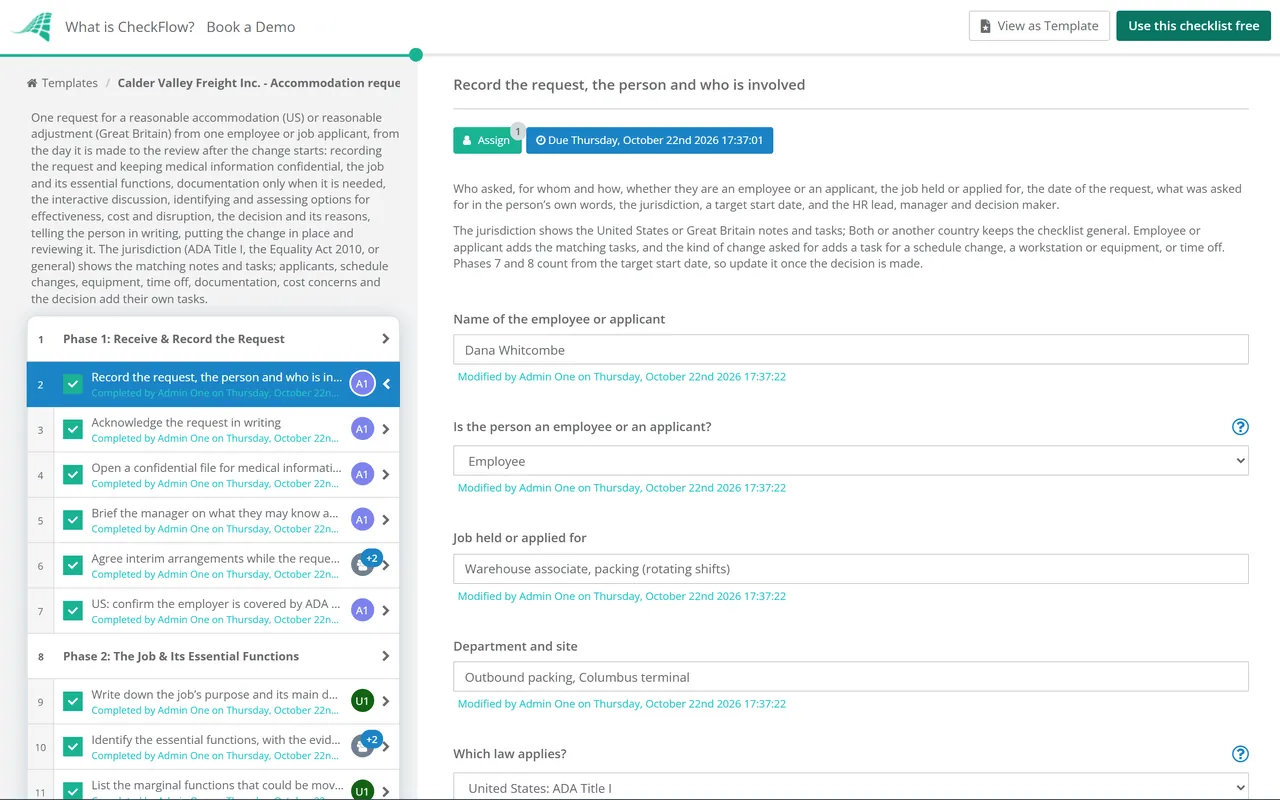
    • Record the request, the person and who is involved — who asked, for whom and how, whether they are an employee or an applicant, the job held or applied for, the date of the request, what was asked for in the person’s own words, the jurisdiction, a target start date, and the HR lead, manager and decision maker
    • Acknowledge the request in writing — a short reply that confirms what was asked for, who will handle it and what happens next; you may ask the person to fill in a form or put the request in writing, but you cannot ignore a request made in conversation
    • Open a confidential file for medical information — any medical information kept on separate forms in a separate, access-controlled file, never in the personnel file, and shared only with the people who need it
    • Brief the manager on what they may know and say — the manager learns the work restrictions and the accommodation, not the diagnosis, passes any request they hear straight to HR, and never tells co-workers that the person is getting an accommodation
    • Agree interim arrangements while the request is considered — anything that can be done straight away so the person can keep working, or take part in the application, while the request is assessed, recorded with the date it started
    • Applicant: adjust the application process and keep it moving — the interview, test or other step changed so the applicant can take part, judged separately from anything the job itself may need, and no decision to drop the applicant because they might need an accommodation later
    • US: confirm the employer is covered by ADA Title I — 15 or more employees for each working day in 20 or more calendar weeks in the current or the preceding calendar year; a state or local law that gives equal or greater protection still applies alongside the ADA
  2. Phase 2

    Phase 2: The Job & Its Essential Functions

    4 tasks

    Before weighing any option, be clear what the job is for. The essential functions are its fundamental duties: an accommodation must let the person do them, and you never have to remove one. The Equality Act does not use the term, but the same analysis shows where a disadvantage falls.

    • Write down the job’s purpose and its main duties — from the job description, how the work is actually done and by whom, and the time each duty takes
    • Identify the essential functions, with the evidence for each — the duties the job exists to do, duties few others could take on and highly specialised duties, judged on written job descriptions prepared before the job was advertised, the time spent, the consequences of not doing them, any collective agreement and the experience of people in the job
    • List the marginal functions that could be moved or swapped — the occasional or minor duties that could go to a colleague in exchange for others; restructuring a job can move marginal functions, but you never have to move an essential one
    • Note when, where and with what the work is done — the shift pattern, start and finish times, breaks, workstation, equipment and site, and which of them could change without affecting other people’s work
  3. Phase 3

    Phase 3: Disability & Documentation

    6 tasks

    Ask for medical information only when the disability or the need for the change is not obvious, and then only for what you need. Information already on file that answers the question is enough. Asking for documentation adds two tasks, and documentation that is still insufficient after the person has had a chance to add to it adds a referral.

    • Decide whether you need any documentation — none when the disability and the need are obvious or the person has already given you enough; otherwise a request limited to the condition that needs the change, its functional limitations and why the change is needed
    • Ask for only the documentation you need — a letter saying what information you need and why, from an appropriate health or rehabilitation professional, with the person’s signed consent if you want to send that professional specific questions; never the complete medical records
    • Review the documentation and explain anything missing — whether it shows the disability and why the change is needed; if not, explain what is missing and give the person a fair chance to provide it before going further
    • Refer to occupational health or a professional you choose, at your cost — an assessment limited to the disability and the functional limitations that need the change, paid for by you, with the person told what the referral is for and who will see the report
    • US: check the person is covered by the ADA definition of disability — an impairment that substantially limits a major life activity, or a record of one, read broadly and without counting the effect of medication or other mitigating measures (ordinary glasses aside); someone covered only because they are regarded as disabled is not owed an accommodation
    • UK: check whether the person may be disabled under the Equality Act — a physical or mental impairment with a substantial and long-term adverse effect on normal day-to-day activities, long-term meaning it has lasted, or is likely to last, at least 12 months or the rest of the person’s life; treatment is ignored when judging the effect (glasses and contact lenses aside), and cancer, HIV infection and multiple sclerosis are always disabilities
  4. Phase 4

    Phase 4: The Interactive Discussion

    3 tasks

    Meet the person, talk about the barrier and what might remove it, and write down what was said. The EEOC calls this the interactive process; in Great Britain the same conversation shows which steps would be reasonable. The person does not have to name the exact change, but does need to describe the problem.

    • Arrange the meeting and any support the person needs to take part — a date, a private room or a video call, who will attend, and any adjustment for the meeting itself, such as an interpreter or the questions sent in advance
    • Discuss the barrier, the limitations and the person’s own ideas — which duties are hard, when and why, the precise job-related limitations, what has helped before and what the person suggests, asking only what you need to understand the limitation
    • Send the person a written summary of the discussion — what was agreed, what is still open, the information either side will provide and when you expect to decide, with a chance to correct the summary
  5. Phase 5

    Phase 5: Identify & Assess the Options

    10 tasks

    List every option that could work, check each against the job, and look at cost and disruption only for the ones that would be effective. The kinds of change asked for on the first task add a task for a schedule change, a workstation or equipment, and time off, and a cost or disruption concern adds an individual assessment.

    • List the possible accommodations, starting with the person’s suggestions — changes to hours or shifts, equipment, the workstation or premises, duties, rules and policies, training, communication support or time off, each written as a concrete step
    • Schedule change: check the effect on cover and on other people’s work — who covers the hours or shift, whether a duty must be done at a particular time, and whether the change would stop other people doing their jobs; working together out of habit is not a reason to refuse, a real effect on operations may be
    • Equipment or workstation: assess what is needed and get quotes — an assessment of the workstation, equipment or route the person uses, quotes and delivery times for anything to buy, and whether your lease lets you change the premises
    • Time off: agree how the leave is taken and check other leave rights — accrued paid leave first and then unpaid leave if more is needed, a fixed-period absence policy adjusted rather than applied automatically, regular updates if there is no fixed return date, and whether FMLA leave in the US or your own sick leave scheme also applies
    • Check that each option removes the barrier — whether each option lets the person do the essential functions, take part in the application or have the same benefits as colleagues; it does not have to be the best option available, but it must work
    • Employees only: look at vacant roles if nothing works in the current job — a move to another role is the last option, looked at only when no change in the current job would work or every one would cause undue hardship, unless you and the employee both prefer a move
    • Check the cost and disruption of each effective option — the net cost after any outside funding, and the effect on the site and on colleagues’ work; the person’s salary or grade plays no part, and nor do co-workers’ feelings
    • Make an individual assessment of cost and disruption, with evidence — a written assessment of the specific option against your actual resources and operations, not a general conclusion, and a check that another effective option would not cause the same problem
    • US: check outside funding, tax credits and deductions — a state vocational rehabilitation agency or other source that would pay some or all of the cost, and any federal, state or local tax credits or deductions; only the net cost counts, and if outside money would pay the whole cost, cost cannot be an undue hardship
    • UK: tell the person about Access to Work — a government grant the person applies for, which can pay for support such as specialist equipment, a support worker or travel to work, but not for the reasonable adjustments you must make; it may ask to speak to you or assess the workplace, and Northern Ireland has its own scheme
  6. Phase 6

    Phase 6: The Decision

    6 tasks

    The decision maker decides once the options are assessed. Where more than one option works, the person’s preference should carry weight, but you may choose the one that is cheaper or easier to provide. The decision is the gate: nothing in Phases 7 and 8 can be completed until it is made. An alternative, a refusal or a withdrawn request each add a task.

    • Record the person’s preferred option and why — which effective option the person prefers and any they would rather not have; you cannot make anyone accept an accommodation they do not want
    • Prepare the recommendation for the decision maker — the request, the job analysis, the options assessed, any cost or disruption evidence, the person’s preference and the recommended accommodation with its start date and review date
    • Decision maker decides on the request — granted as asked, granted with an alternative that works, partly granted, not granted, or withdrawn by the person, with the reasons recorded here; nothing after this task can be completed until it is done
    • Alternative or part granted: explain why it works — how the chosen option removes the barrier, why the option asked for was not chosen, and that the person can come back if it does not work
    • Not granted: give the reasons in writing and what else was considered — the specific reasons, the evidence of cost or disruption or why no option would work, the alternatives considered, and how to raise a concern or a grievance
    • Withdrawn or declined: confirm in writing and close the request — the person’s decision recorded in their words, confirmation that they can ask again at any time, and the rest of this checklist marked not applicable
  7. Phase 7

    Phase 7: Put It in Place & Confirm in Writing

    5 tasks

    Tell the person the decision in writing, then make the change by the target start date on the first task. Ordering and set-up count back from that date, so update it if the decision moved it.

    • Tell the person the decision in writing — what will change, from when, who to contact if it does not work, the review date, and that their medical information stays confidential
    • Order equipment and arrange any changes to the workplace — purchase orders, delivery dates and installation, any change the landlord must approve, and the person kept informed of any delay
    • Update rotas, duties, policies and time records — the new hours or shift pattern on the rota and in time recording, duties moved, and any exception to a policy written down so it is applied consistently
    • Train the person and brief anyone who needs to know — training on new equipment or ways of working, and colleagues who cover or work differently told what changes, without being told why
    • Confirm the accommodation is in place on the start date — the person, the manager and HR agree it is working as planned, and any problem is fixed straight away
  8. Phase 8

    Phase 8: Review & Records

    5 tasks

    The duty is ongoing. Review the accommodation with the person, change it if it is not working, and keep the records. The review counts six weeks of business days from the target start date.

    • Review whether the accommodation is working — the person’s view, the manager’s view and any change in the condition, the job or the workplace
    • Needs changing: reopen the discussion — a new meeting on what is not working, the options assessed again and a new decision recorded, as a new run of this checklist if the change is substantial
    • File the records and keep medical information separate — the request, the summary of the discussion, the options assessed, the decision letter and the review on file, with medical information only in the confidential file
    • US: keep the request records for at least one year — requests for reasonable accommodation and other employment records kept for one year from the date of the record or the personnel action, whichever is later, and every relevant record kept until any charge of discrimination is finally resolved
    • Close the request and note anything to change in your policy — what went well, what took too long, and any change needed to the accommodation policy, the employee handbook or manager training

ADA Accommodation and UK Reasonable Adjustments at a Glance

The two laws side by side

The same request under the ADA and under the Equality Act 2010, with the provision each point comes from. The jurisdiction on the first task shows the matching notes in the checklist.

Point United States: ADA Title I Great Britain: Equality Act 2010
The dutyReasonable accommodation for a qualified applicant or employee with a disability, unless it would cause undue hardship (29 CFR 1630.9)Reasonable adjustments: the steps it is reasonable to have to take to avoid a substantial disadvantage (ss.20, 21, 39(5) and Schedule 8)
Which employers15 or more employees in each of 20 or more calendar weeks this year or last (29 CFR 1630.2(e))Every employer, whatever its size (s.39(5)); Northern Ireland has its own law
Who is protectedAn impairment that substantially limits a major life activity, or a record of one; not someone only regarded as disabled (1630.2(g), 1630.9(e))A physical or mental impairment with a substantial and long-term effect on day-to-day activities (s.6, Schedule 1); cancer, HIV and MS always count
When it startsWhen the person, or someone for them, says they need a change at work for a medical reason, in any words (EEOC guidance)When you know, or could reasonably be expected to know, of the disability and the disadvantage (Schedule 8, para 20)
Finding the answerAn informal, interactive process with the person (1630.2(o)(3) and the appendix to 1630.9)The Act sets the test of what is reasonable; talking to the person is how you find the steps
The limitUndue hardship: significant difficulty or expense, judged on the factors in 1630.2(p)Whether it is reasonable for you to have to take the step (s.20)
Who paysThe employer, net of outside funding and tax credits; the person may choose to pay the part that would be an undue hardshipThe employer; the disabled person cannot be asked to pay (s.20(7)); Access to Work may fund extra support
Medical informationSeparate confidential medical file; supervisors told only restrictions and accommodations (1630.14)Special category data under the UK GDPR
ApplicantsNo disability questions before an offer, only about the ability to do the job (1630.13, 1630.14(a))No health questions before an offer, except for set purposes such as adjustments for an interview (s.60)
RecordsKeep requests for one year, or until any charge is resolved (29 CFR 1602.14)As long as your data protection retention policy allows

The interactive process, step by step

The appendix to the EEOC’s regulations describes four steps once an accommodation is requested. The checklist follows them and adds a review, because the duty is ongoing.

Step What it involves Where in the checklist
1. Analyse the jobThe job’s purpose and its essential functionsPhase 2
2. Consult the personThe precise job-related limitations and how they could be overcomePhases 3 and 4
3. Identify and assess optionsPossible accommodations, worked out with the person, and how effective each would bePhase 5
4. Choose and put it in placeThe person’s preference considered, then the option that is most appropriate for both sides, put in placePhases 6 and 7
ReviewWhether it still works as the condition, the job or the workplace changesPhase 8

Sources. The ADA regulations, 29 CFR Part 1630 and their appendix, the EEOC’s enforcement guidance on reasonable accommodation and undue hardship, 29 CFR 1602.14 on records, the Equality Act 2010 and gov.uk’s Access to Work guide. State laws and other countries’ laws may add rights, and this table is not legal advice.

Why Run Accommodation Requests in CheckFlow?

1

No request left with a supervisor

Enter the date of the request and every step to the decision gets a due date counted in business days, so a request made in passing is acknowledged, discussed and decided on time. Open requests show on the Reports Grid, and overdue alerts go to the people assigned.

2

One checklist for the US and Great Britain

One answer on the first task shows the ADA notes and tasks, such as coverage, the definition of disability and outside funding, or the Equality Act ones, such as the long-term test and Access to Work. A schedule change, new equipment or time off adds the task that checks it, and an applicant gets the application process adjusted.

3

A decision with its reasons

The decision maker’s decision is a gate: the letter, the change and the review cannot be ticked off until it is recorded with its reasons. A refusal adds a task to explain it in writing, and the activity log shows who did what and when. See how approval steps work.

CheckFlow does not decide whether someone is disabled, which accommodation is reasonable or whether a cost is an undue hardship. HR and the decision maker decide, with the law and, where needed, legal or occupational health advice. CheckFlow makes sure each step happens on time, that every task has an owner and that the request leaves a complete record. HR checklist software shows how requests, leave and reviews run from templates across a team.

When the accommodation is time off in the US, run the Leave of Absence (FMLA) Checklist alongside it. Plan a return after a long absence with the Return-to-Work Checklist, assess a display screen workstation with the DSE Workstation Assessment Checklist, handle a complaint about a refusal with the Grievance Procedure Checklist, and put your accommodation policy in the handbook with the Employee Handbook Update & Rollout Checklist.

AI generator

Didn’t find what you need? Describe it.

Describe the process in a sentence and the AI checklist generator drafts the phases and tasks for you.

Frequently Asked Questions

What should a reasonable accommodation checklist include?

Every step of one request: recording it the day it is made, keeping medical information in a separate confidential file, setting out the job and its essential functions, asking for documentation only when it is needed, the interactive discussion with the person, listing and assessing options for effectiveness, cost and disruption, the decision with its reasons, a written reply, putting the change in place and reviewing it. This template adds the steps for applicants, schedule changes, equipment, time off and refusals when they apply.

Does an employee have to say “reasonable accommodation”?

No. The EEOC says a request can be made in plain English and need not mention the ADA or the words “reasonable accommodation”: the person only has to say they need a change at work for a reason related to a medical condition. A family member, friend or health professional can ask for them, and the request does not have to be in writing. In Great Britain the duty applies once you know, or could reasonably be expected to know, about the disability and the disadvantage.

What is the interactive process under the ADA?

An informal discussion between the employer and the person to find an accommodation that works. The appendix to the EEOC’s regulations describes four steps: analyse the job and its essential functions, consult the person about the precise limitations, identify possible accommodations with them and assess how effective each would be, then consider their preference and put the most appropriate one in place. When the answer is obvious, the steps can be very short.

Can an employer ask for medical documentation?

Under the ADA, yes, when the disability or the need for the accommodation is not obvious, but only the documentation needed to show the disability and why the change is needed, usually not the complete medical records. If it is insufficient, the employer should explain what is missing and allow the person to provide it; after that it may ask for an assessment by a professional it chooses and pays for. Any medical information is kept confidential and apart from the personnel file.

What counts as undue hardship?

Significant difficulty or expense for the employer, judged on the net cost of the accommodation after any outside funding or tax credits, the resources of the site and of the whole organisation, the type of operation and the impact on the site, including on other employees’ ability to do their jobs. It needs an individual assessment with evidence, not a general conclusion, and co-workers’ fears or morale do not count. If one option is an undue hardship, the employer must still provide another that works.

Who pays for a reasonable adjustment in the UK?

The employer. Section 20(7) of the Equality Act 2010 says an employer cannot ask the disabled person to pay any of the cost of complying with the duty. Separately, the person can apply to Access to Work, a government grant for support such as specialist equipment, a support worker or travel to work. It does not pay for the reasonable adjustments an employer must make, and Northern Ireland has its own scheme.

Do job applicants have a right to accommodations too?

Yes. Both laws cover applicants as well as employees, so an interview, test or other step in the hiring process must be adjusted where needed, and judged separately from anything the job itself may need. Both also limit questions about health or disability before a job offer. A move to a vacant role is not an option for an applicant under the ADA.

How quickly must an employer respond?

Neither law sets a number of days. The EEOC says an employer should respond expeditiously, move the interactive process along as quickly as possible and act promptly to provide the accommodation, and that unnecessary delay can itself break the ADA. This template counts every step to the decision from the date of the request, about four weeks in all, and you can shorten the due dates in the template.

Is CheckFlow free for this template?

14-day free trial, no card required. The Business plan is $10 per user per month after the trial. Full details at checkflow.io/pricing.

Answer Every Accommodation Request on Time

Free trial — no credit card required.

14-day free trial, no credit cardFull refund in your first 30 daysUS hosting, EU on request